









































































































































Quick Overview:
Startups need speed, flexibility, and focus, and the DevOps-as-a-Service model delivers all three. From faster deployments to reduced overhead, it’s the smarter way to build and scale. This blog examines how DaaS enables startups to remain lean, launch faster, and compete with tech giants without incurring significant costs.
Understanding DevOps as a Service (DaaS). Let’s start with the basics.
What is DevOps as a Service (DaaS)?
Simply put, it’s a way for startups to reap all the benefits of DevOps without having to build everything from scratch. You can hire dedicated developers team that helps you create, test, and launch your software quickly and reliably.
Think of it like this: instead of setting up your kitchen, buying all the gear, and learning to cook, you get a ready-made meal from a top chef. It saves time, effort, and money.
With DevOps implementation services, you get:
- Automated tools for testing and launching
- Cloud platforms (like Amazon Web Services) that scale with you
- Ongoing support from DevOps experts
- Faster updates with fewer bugs
Nope! That’s the beauty of it. DevOps development services handle complex tasks, so you can focus on building your product efficiently.
Why Startups Should Consider DaaS
Startups are all about speed and flexibility. You’re trying to do a lot with limited time and money. DaaS helps with both.
Here’s why it makes sense:
- Faster Time to Market
You don’t have to set up tools or processes yourself. That means you can launch your app or website faster. And in the startup world, speed matters. That’s one of the main reasons why startups should consider DaaS and why DevOps is important. - Lower Upfront Costs
Hiring a whole DevOps team is expensive. With the DevOps platform as a service, you pay for only what you need. That’s ideal when your budget is tight. - Focus on What Matters
Your team can focus on building features, interacting with users, and enhancing your product. The DevOps team handles the technical aspects in the background. - Easy to Scale
As your users grow, your systems must also succeed. DevOps as a Service makes it easy to scale without downtime or stress.
Real-world Scenario: Why do we need DevOps?
You launch your product, and it goes viral (yay!). Suddenly, 10,000 people are signing up in a day. If your systems aren’t ready, everything crashes. However, with DaaS, your platform can scale up quickly and remain stable.

Evaluating the Need for DaaS in Your Startup
Not every startup may need DaaS right away. So, how is it right for you?
Ask yourself these questions:
- Is your tech team spending more time fixing issues than building features?
- Do you struggle with slow or broken releases?
- Are bugs and crashes hurting your user experience?
- Are you unsure how to scale your platform safely?
If you said “yes” to any of those, DevOps as a Service could be a great move.
Signs you’re ready for DaaS:
- You’re launching soon and need reliable infrastructure.
- You don’t have in-house DevOps experience.
- You want to grow fast but stay stable.
- You’re tired of late-night server crashes or missed deadlines.
Absolutely! DaaS doesn’t replace your team. It supports them and takes pressure off so they can do what they do best.
Implementing DaaS: A Step-by-Step Guide
Ready to try DevOps as a Service? Here’s a simple guide to get started:
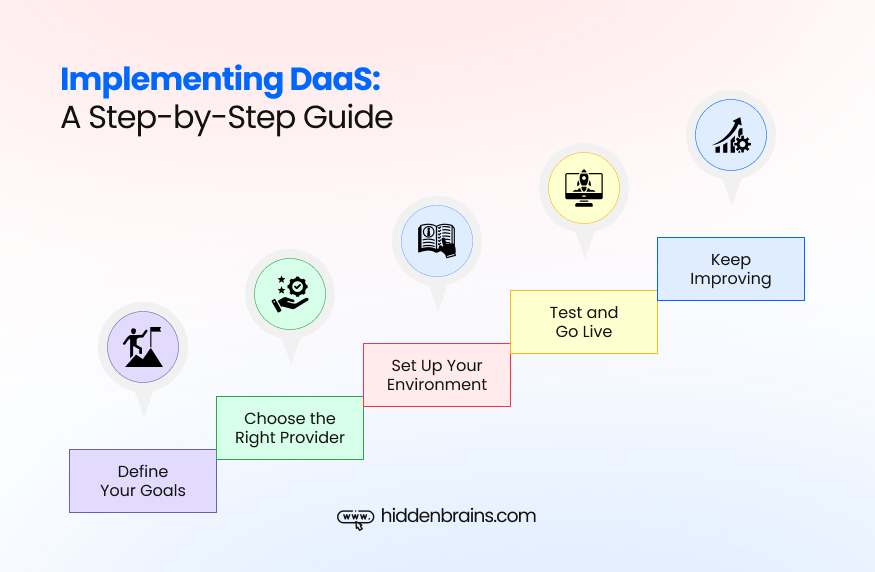
Step 1: Define Your Goals
What would you like DaaS to assist with? Faster releases? Fewer bugs? Easier scaling? Be clear about your goals so you can measure results.
Step 2: Choose the Right Provider
Not all DaaS providers are the same. Look for ones that:
- Understand startup needs
- Offer flexible pricing
- Have strong reviews and case studies
- Support the tools you already use (like GitHub, AWS, etc.)
Step 3: Set Up Your Environment
The enterprise software development company will assist you in setting up everything. It includes:
- Code pipelines (automated testing and deployment)
- Monitoring tools
- Security checks
- Cloud infrastructure (usually through Amazon Web Services or similar)
Step 4: Test and Go Live
Before launch, you’ll run some test deployments. Once everything looks good, you’re ready to go live.
Step 5: Keep Improving
DevOps as a Service isn’t a one-time thing. It’s an ongoing service. Continue to review your performance and work with your provider to make improvements.
Quick Tip: Start small. You don’t need to move everything to DaaS on day one. Begin with your staging or testing environment, then grow from there.
Common Challenges and How to Overcome Them
Like anything new, switching to DaaS has a learning curve. But don’t worry, it’s all manageable.
Challenge 1: Team Resistance
Startup companies may have developers who feel unsure about bringing in outside help.
Solution: Involve them early. Show how DaaS makes their lives easier, with less stress and fewer midnight emergencies.
Challenge 2: Security Concerns
Worried about sharing code and data with outsiders? That’s normal.
Solution: Select a provider with robust security protocols. Inquire about encryption, access controls, and auditing procedures.
Challenge 3: Misaligned Expectations
Sometimes, startups expect instant results. However, like any other solution, DaaS requires some setup time.
Solution: Set clear goals and timelines from the start. Regular check-ins help everyone stay aligned.
Challenge 4: Choosing the Wrong Provider
The wrong fit can cause delays and frustration. Startups must be cautious when selecting a DevOps development services provider.
Solution: Do your research. Ask for referrals. Have a trial period.
You can. A good DevOps as a Service setup should make it easy to switch. Ensure that your data and processes are well-documented.
Best Practices for Maximizing DaaS Benefits
Once you’re up and running with DaaS, you want to maximize its benefits. Here’s how:
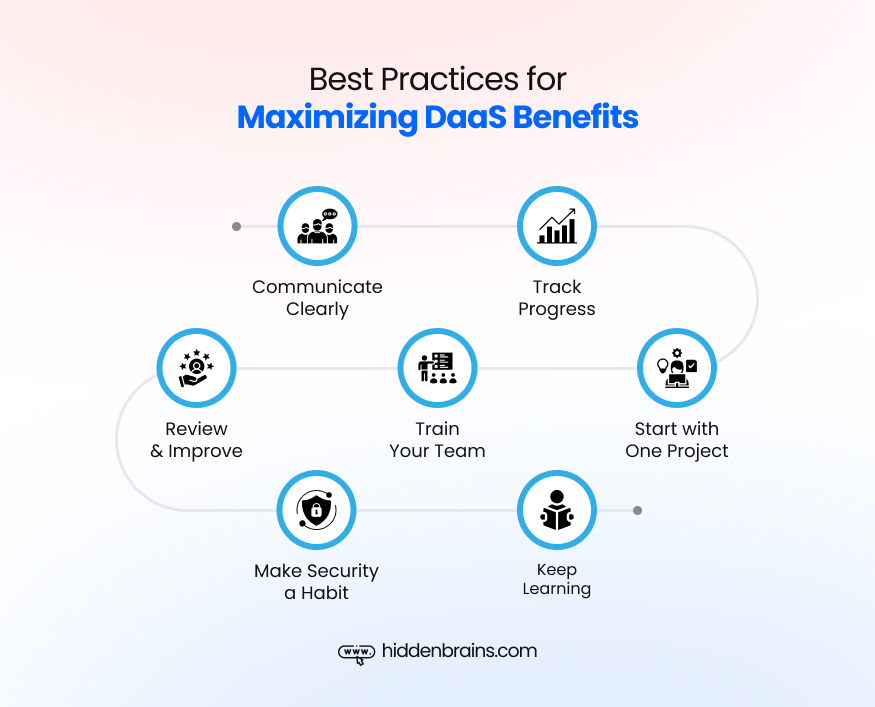
Maintain open communication lines between your team and the DevOps development services provider. Successful DevOps depends heavily on clear and regular communication. Make sure your in-house team and your DaaS provider are always aligned.
- Hold weekly check-ins to review progress and blockers.
- Use shared tools like Slack, Microsoft Teams, or Jira for daily collaboration.
- Encourage transparent updates even when things go wrong. It builds trust.
2. Track Progress
Use simple metrics to track success. For example:
- How often do you release updates?
- How many bugs make it to production?
- How long does it take to fix issues?
DevOps is never “done.” Review performance every month or quarter. What’s working? What needs to improve? Schedule monthly or quarterly reviews to:
- Assess what’s working well (tools, workflows, team performance)
- Identify bottlenecks or recurring issues
- Plan for improvements or tool upgrades
4. Train Your Team
Ensure your development team understands the tools and processes. That way, everyone can collaborate smoothly. Even with a DaaS partner, your internal dev team needs to be in the loop.
- Provide basic training on the DevOps tools being used (CI/CD pipelines, monitoring dashboards, etc.)
- Encourage developers, QA, and operations staff to work closely together.
- Assign internal champions who can work closely with the DaaS provider to ensure seamless integration.
5. Start with One Project
Instead of moving your whole product, start DaaS with one service or feature. Learn from that, then expand. Instead of shifting everything to DaaS at once, begin with one application, feature, or microservice.
- Learn how the process works
- Gather feedback
- Identify challenges early
- Once confident, you can roll out DaaS across more projects with fewer risks.
6. Keep Learning
Stay updated on new tools, practices, and trends. Whether you’re developing custom software or enterprise software, the tech industry moves quickly. DevOps tools and practices evolve rapidly. Staying up-to-date is the key to staying competitive.
- Follow thought leaders and DevOps blogs.
- Attend online meetups, webinars, or conferences.
- Encourage your team to explore new tools, trends, or integrations. Helpful reminder:
DaaS is a tool. It works best when you treat it as a partnership, not just a service. Stay involved, ask questions, and build a long-term relationship with your provider.
Use strong passwords, enable two-factor authentication, and regularly review access rights. Your DaaS provider should help with this. Security should be built into your DevOps process, not added as an afterthought.
- Use strong passwords and enforce two-factor authentication (2FA).
- Regularly review user access and permissions.
- Ask your DaaS provider how they handle compliance, data protection, and vulnerability scanning.

What Emerging DaaS Trends Should Startups Watch in 2026?
As DevOps-as-a-Service continues to reshape IT operations, startups must stay ahead of emerging trends to remain competitive and cost-efficient. Here are the key DaaS trends to watch in 2026:

- AI-powered Device Management
DaaS providers are integrating AI for predictive maintenance, usage analytics, and automated updates, reducing downtime and enhancing productivity. - Flexible Subscription Models
Expect to see hyper-customized DaaS plans with per-user pricing, allowing startups to scale device needs up or down as teams grow or shrink. - Security-first Solutions
Zero Trust architecture and endpoint threat detection are becoming DaaS essentials ideal for remote-first or hybrid teams. - Multi-platform Support
Startups need flexibility. DaaS providers are expanding their support for Windows, macOS, Linux, and mobile ecosystems under a single unified service. - Edge Computing Integration
With the rise of IoT and edge devices, DaaS will extend beyond laptops to encompass smart sensors, wearables, and connected tools. - Enhanced Personalization
DaaS providers are offering personalized device environments with pre-configured apps, user preferences, and role-based access improving onboarding and productivity from day one.
Frequently Asked Questions
How does DevOps as a Service help startups accelerate their market entry?
Getting your product to market quickly is everything when you’re just starting out. DevOps as a Service (DaaS) helps you launch faster by:
Automating tasks that would take hours or days
Making your software updates quicker and smoother
Cutting down delays caused by bugs or server issues
Letting your team focus on building, not fixing
It’s like having a ready-to-go setup that saves time and energy.
Why is access to expert DevOps talent crucial for startup growth?
You don’t need to hire a big team. You need the right team. When you use DevOps development services, you get:
Access to experts who know what works
Help with smart tools and practices from day one
Fewer trial-and-error moments that slow you down
Guidance to scale smoothly as your users grow
These pros help you avoid costly mistakes and move forward with confidence.
In what ways does DaaS improve scalability for rapidly changing startups?
Startups grow fast. Your tech needs to keep up. With DaaS, it’s easier to grow without breaking things. Here’s how:
You can add new features without redoing everything
Your systems adjust as your traffic increases
You get smart monitoring to catch issues early
You can use tools like Amazon Web Services that scale easily
It’s like building on solid ground, ready to grow with you.
How can outsourcing DevOps reduce costs and increase ROI for startups?
Hiring and training a whole tech team can be costly.
Outsourcing DevOps cuts that cost and gives you more in return:
No need to spend on full-time DevOps staff
Pay only for what you need when you need it
Launch faster = make money sooner
Fewer breakdowns = happier customers
Better results. Lower costs. That’s smart ROI.
What makes DevOps as a Service the smartest move compared to in-house solutions?
Doing everything in-house sounds great until it drains your time and budget. DaaS makes more sense for startups because:
It’s flexible, fast, and ready to go
You get proven systems without building from scratch
Support is always there when you need it
You can focus on your product, not backend headaches
DevOps as a Service is like having an expert partner who keeps things running while you grow.
Why is DevOps as a Service a good solution for your fast-growing startup?
Growth is exciting and overwhelming. DaaS helps you handle it all without the stress:
Your tech setup grows with your business
You don’t fall behind on updates or security
You stay ahead of bugs, crashes, and slowdowns
You spend more time building and less time fixing
It’s like giving your startup power, speed, and support.
What are the key benefits of using DevOps development services for startups?
Startups need to move fast and stay lean. DevOps development services help you do both:
Faster releases, fewer bugs
More reliable software performance
Easy scaling as your app gets more users
Expert advice without the high cost
DevOps gives you the edge, whether you’re involved in enterprise software development or creating a small app.
Why are more startups turning to DevOps as a Service provider?
Simple: It works.
More startups are turning to DevOps as a Service provider because it’s a faster, more innovative, and more affordable way to grow. Building an in-house DevOps team takes time, money, and experience, things that most small businesses can’t afford to spare early on. Outsourcing DevOps provides startups with instant access to expert assistance, proven tools, and reliable systems that ensure everything runs smoothly.
It removes the guesswork from software development and deployment. Your product reaches the market quicker, updates occur faster, and there are fewer bugs to fix. Whether focused on custom software development or building enterprise software, DevOps as a Service helps you move faster, scale easily, and stay focused on what matters: growing your business. More startups now choose DaaS because:
It’s faster and cheaper than building an in-house team
You get top-level tools and talent from day one
It helps with custom software development that’s reliable and scalable
Your app gets updates quicker and with fewer issues
You avoid burnout and keep your team focused on what matters
Outsourcing DevOps is like having a whole tech team without the full cost.



Conclusion
Every second counts and every resource matters. That’s where DevOps as a Service comes in. It takes away the headaches of managing complex infrastructure, speeds up your releases, and keeps your team focused on what really matters: building and growing your product. Instead of juggling endless tools and firefighting downtime, you get agility, scalability, and peace of mind from day one. For startups chasing big dreams on tight timelines, this isn’t just a smart choice; it’s the smartest move. Ready to scale faster and smarter? DevOps as a Service might just be your game-changer.
