














































































Summary
Software development trends in the USA for 2026 are centered on AI-first engineering, cloud-native architecture, modular modernization, and security-driven development. Enterprises are moving away from rigid, off-the-shelf systems toward scalable, custom-built platforms that enable compliance, integration, and long-term agility. CTOs must prioritize DevSecOps, platform engineering, offshore accountability models, and governed AI adoption. Organizations that treat 2026 as a transformation year, not just an upgrade cycle, will gain a competitive advantage through faster innovation, stronger security, and measurable ROI.
The software development trends in the USA for 2026 are no longer driven by “innovation for the sake of innovation.” They are driven by business pressure. Faster product releases. Smarter automation. Tighter compliance. Lower cloud costs. And the need to build resilient systems that can scale without breaking.
In 2026, software leaders in the U.S. will prioritize technologies that reduce engineering friction, modernize architectures, and deliver measurable ROI. AI agents, secure development pipelines, modular cloud systems, and distributed teams will define how products are built.
This blog breaks down the top trends in software development for 2026 with a clear business lens so CTOs and engineering leaders can build roadmaps that actually work.
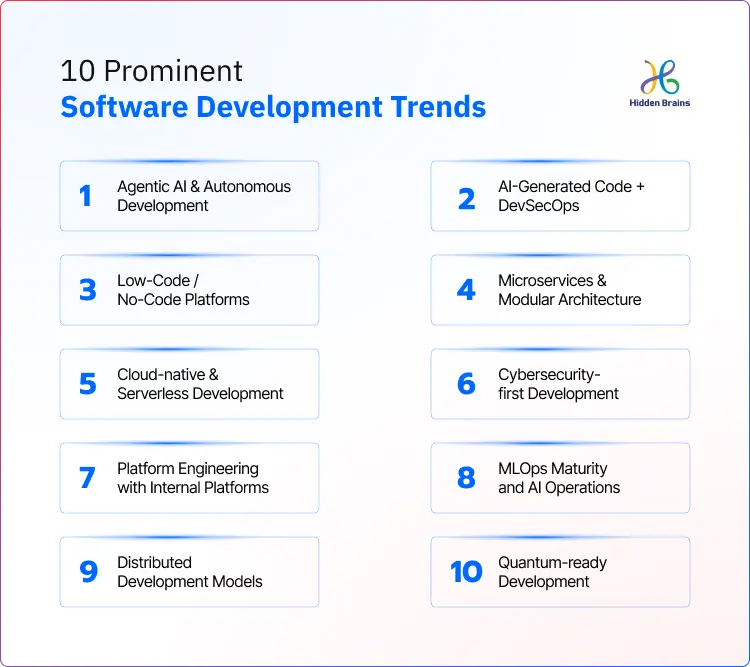
Top 10 Emerging Software Development Trends in 2026
Many online resources still treat trends as “new tools.” That’s outdated thinking. The emerging software development trends in 2026 are actually about changing how engineering teams operate.
In the U.S., product teams are shifting from:
- Feature-driven development → Outcome-driven delivery
- Manual testing → Automated QA pipelines
- Traditional DevOps → AI-powered DevSecOps
- Single-location teams → Distributed and offshore engineering pods
For U.S. businesses building enterprise platforms at scale, localized execution matters. If your roadmap involves compliance-heavy development, regulated systems, or large modernization initiatives, partnering with software development company in California can help align engineering delivery with U.S. market expectations.
Turn Your Software Stack into a Growth Engine
Talk to Our Experts
1. Agentic AI & Autonomous Development
Agentic AI refers to AI systems that can take goals, break them into tasks, and execute actions autonomously. It includes coding agents that can write modules, generate tests, debug errors, and even manage workflows.
Why is it growing in 2026
Companies are moving beyond simple chat-based AI. Throughout 2025, businesses spent billions on AI agent development services, with departmental AI (including software development agents) growing rapidly.
How it impacts software development
Development shifts from “developer writes everything” to “developer supervises and validates AI execution.”
AI agents will support:
- Sprint planning
- Code scaffolding
- Test automation
- Documentation generation
- Ticket resolution
Business benefits:
- Faster delivery cycles
- Reduced dependency on niche talent
- Improved developer productivity
- Scalable engineering output
Use Case – AutoBank Feature Factory:
A major US bank deploys coordinated agentic AI agents to build and deploy complete mobile banking features autonomously (planning → code → test → deploy), slashing cycle time from weeks to days with compliance guardrails.
The uncomfortable reality is this: most enterprises fail when they try to use generic AI tools for high-stakes environments. With tailored AI software development services, organizations can build compliant agentic AI systems that match internal workflows, security policies, and regulatory requirements.
2. AI-generated Code + DevSecOps
AI-generated Code + DevSecOps is the combination of AI-assisted coding with security embedded into the software delivery pipeline. AI can generate code rapidly, but DevSecOps ensures it is verified, scanned, and compliant before deployment. As AI-assisted development expands, many enterprises are also choosing to hire Cursor AI developers to accelerate coding workflows while maintaining structured security oversight.
Why is it growing in 2026
In 2025, AI coding tools have become part of many U.S. developers’ daily workflows. Yet trust continues to be a concern, as teams remain cautious about AI hallucinations, insecure logic, and hidden vulnerabilities. As a result, DevSecOps is no longer optional, it is essential for building secure and reliable software.
How it impacts software development:
- Automated vulnerability scanning
- Secure coding standards
- AI-driven testing pipelines
- Policy-based approvals for AI-generated code
Business benefits:
- Faster delivery without compromising security
- Fewer post-release fixes
- Reduced compliance risk
- Better code consistency across teams
Real use case – MediChat Clinical Communication Platform
A healthcare organization implements Medichat, a secure clinical communication platform powered by AI coding assistants, to streamline care coordination, enable encrypted messaging between care teams, and maintain compliance with healthcare data regulations, improving workflow efficiency and reducing communication gaps during patient care updates.
3. Low-Code / No-Code Platforms
Low-Code / No-Code Platforms enable teams to build applications through drag-and-drop components, visual workflows, and reusable modules with minimal coding.
Why is it growing in 2026
The North American low-code market was valued at $12.68 billion in 2025, and adoption continues to accelerate because enterprises want rapid digital delivery without hiring aggressively.
How it impacts software development
- APIs and integrations
- Governance and security
- Scalable backend architecture
- Performance optimization
Business benefits:
- Faster prototyping
- Reduced time-to-market
- Lower cost for internal applications
- Stronger business agility
Real example – WhoSellZit Marketplace Engine
A growing digital marketplace platform enables sellers and buyers to manage listings, pricing, and transactions through a scalable ecommerce infrastructure, allowing rapid feature updates and smooth onboarding of new vendors to support expanding online marketplace operations.
4. Microservices & Modular Architecture
Microservices & modular architecture refers to breaking software into smaller, independent services that can be deployed and scaled separately. Modular architecture also promotes reusable building blocks across multiple applications.
Why is it growing in 2026
U.S. enterprises want flexibility. Legacy monoliths create bottlenecks and slow innovation. Microservices allow companies to modernize systems without full rewrites.
How it impacts software development
- Service-based architecture
- Event-driven systems
- API-first ecosystems
- Independent deployment pipelines
Business benefits:
- Faster feature rollout
- Better scalability
- Lower downtime risk
- Smoother third-party integrations
Real example – Scosche Digital Storefront
A global consumer electronics brand modernizes its online storefront with a scalable ecommerce platform, enabling seamless product discovery, optimized checkout experiences, and reliable performance during high-traffic promotional events.
5. Cloud-native & Serverless Development
Cloud-native & serverless development focuses on building applications specifically designed for cloud environments, using containers, managed services, and serverless functions to reduce infrastructure burden.
Why is it growing in 2026
U.S. enterprises are adopting cloud-native systems because they scale faster and reduce operational overhead. Serverless is also attractive because it allows companies to pay only for what they use.
How it impacts software development
- Serverless functions
- Containerized microservices
- Managed databases
- Cloud observability and monitoring tools
Business benefits:
- Lower infrastructure management effort
- Auto-scaling for unpredictable workloads
- Reduced hosting costs
- Faster deployment cycles
Real example – MRS Holdings Digital Platform
A global oil and gas enterprise modernizes operations with cloud-enabled digital systems, enabling real-time asset visibility, automated workflows, and scalable data integration across distributed energy operations.
If your enterprise is stuck with slow, outdated platforms that cannot scale, the right solution is to adopt modern web app development services to build cloud-native systems optimized for speed, security, and performance.
6. Cybersecurity-first Development
Cybersecurity-first development means security is embedded from the first sprint through threat modeling, secure coding standards, automated testing, and continuous monitoring.
Why is it growing in 2026
In 2025, the average cost of a data breach for U.S. companies reached $10.22 million. That single number is forcing cybersecurity to become a development priority, not a post-launch patch.
How it impacts software development
- Zero-trust frameworks
- Automated vulnerability scans
- Security compliance checks in CI/CD
- Stronger identity and access controls
Business benefits:
- Fewer breaches
- Better compliance readiness
- Reduced financial risk
- Stronger customer trust
Real example – Enterprise Secure Collaboration Platform
Enterprise security platforms embed cybersecurity controls into every development phase (threat modeling), automated vulnerability scans, zero-trust access from deployment), protecting sensitive collaboration environments used by government and financial organizations.
7. Platform Engineering with Internal Developer Platforms
Platform Engineering with Internal Developer Platforms (IDPs) refers to building internal systems that standardize infrastructure access, deployment templates, monitoring tools, and developer workflows.
Why is it growing in 2026
Tool sprawl is killing productivity. Enterprises want faster onboarding, consistent environments, and fewer DevOps bottlenecks.
How it impacts software development
- Provision environments
- Deploy services
- Monitor applications
- Access reusable templates
Business benefits:
- Faster onboarding
- Reduced DevOps ticket dependency
- Higher developer satisfaction
- Standardized delivery pipelines
Real example – DevHub Self-Service Portal
A Fortune 500 U.S. tech giant launches an internal developer platform (IDP) with standardized templates, AI scaffolding, and self-serve environments, dropping new-service onboarding from weeks to hours and boosting satisfaction scores.
8. MLOps Maturity and AI Operations
MLOps Maturity and AI Operations refer to the frameworks that manage AI models in production: training, monitoring, drift detection, retraining, and rollback.
Why is it growing in 2026
As AI becomes embedded in operations, unreliable models can damage business decisions. This is why businesses are adopting MLOps services to strengthen governance, compliance, and performance consistency across AI-driven systems.
How it impacts software development
- Version-controlled pipelines
- Audit trails
- Automated monitoring
- Regulated deployment processes
Business benefits:
- Stable AI performance over time
- Reduced operational failures
- Improved regulatory readiness
- Scalable enterprise AI adoption
Real example – DiagOps Continuous Models
A U.S. healthcare analytics company matures MLOps with agentic automation for model training, drift detection, retraining, and rollback, ensuring regulatory-compliant predictive tools evolve with fresh patient data.
9. Offshore Distributed Development Models
Offshore & distributed models are evolving into structured “delivery pods” with clear ownership, strong async workflows, and DevSecOps alignment.
Why is it growing in 2026
Remote work is normal now. In 2025, 45% of U.S. developers were working remotely. That acceptance makes distributed execution more scalable than ever.
How it impacts software development
- Async communication frameworks
- Offshore governance models
- Shared documentation and automation
- Time-zone overlap for critical workflows
Business benefits:
- Higher development velocity
- Scalable engineering capacity
- Reduced delivery costs
- Improved release consistency
Real example – GlobalSync 24/7 Velocity
A California-based U.S. SaaS company operates with hybrid distributed teams across nearshore and offshore locations, leveraging async collaboration tools, clearly defined autonomy, and AI-supported workflows to maintain steady momentum and seamless execution across time zones.
10. Quantum-ready Development
About the trend
Quantum-Ready Development means designing software architectures that can integrate quantum computing capabilities when they become commercially accessible.
Why is it growing in 2026
The U.S. is investing heavily in advanced computing and AI infrastructure. Even though quantum computing is still emerging, early preparation will help R&D-heavy companies move faster later.
How it impacts software development
- Quantum simulation environments
- Hybrid quantum-classical workflows
- Future-ready system integration layers
Business benefits:
- Future-proof R&D investments
- Readiness for computational breakthroughs
- Competitive advantage in high-innovation sectors
Real example – MolSim Quantum Pipeline
A U.S. pharma/biotech firm builds hybrid quantum-classical workflows (simulators + libraries like IBM/Azure Quantum) for molecular drug simulations, future-proofing R&D to plug in real quantum hardware and accelerate discovery timelines.
How AI Is Reshaping Software Development in 2026
AI is no longer a separate “innovation project.” It’s becoming part of the development workflow itself.
In 2025, private AI investment in the U.S. reached $159 billion, showing how aggressively American enterprises are funding AI-first operations. More importantly, 88% of U.S. organizations reported using AI in at least one business function.
This momentum is strongly reflected in software development growth projections, trends 2026, where AI-led engineering, automation, and intelligent development platforms are becoming core drivers of enterprise innovation. The biggest shift is clear: AI is becoming proactive, not reactive.
What CTOs Should Do Next
To stay ahead of the software development trends in 2026 in the U.S., CTOs should focus on structured execution instead of chasing innovation mindlessly. The market is moving fast. But speed without governance will only create technical debt, compliance gaps, and expensive rework. Here’s what matters most in 2026.
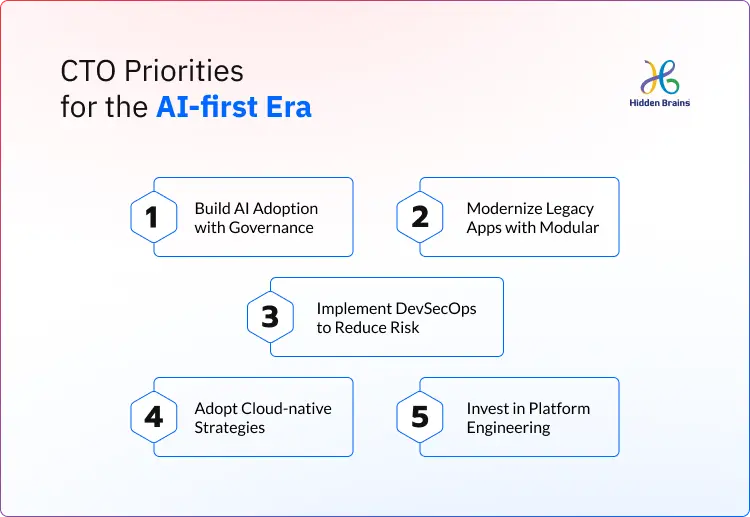
Build AI Adoption with Governance, Not Experimentation
Agentic AI and AI-generated code can deliver massive acceleration. But without guardrails, they can also introduce hallucinated logic, security vulnerabilities, and compliance issues. CTOs should implement AI governance frameworks early, covering model validation, access control, audit trails, and secure deployment pipelines. As organizations adopt the latest trends in custom software development, governance-driven AI implementation will become a leadership priority rather than just a technical initiative. As trends in AI software development for 2026 continue to evolve, governance will become a leadership responsibility, not just a technical upgrade.
Modernize Legacy Apps Using Modular Architecture
Modernization in 2026 is no longer about rewriting everything. It’s about breaking down legacy monoliths into scalable modules that can evolve independently. Microservices, API-first development, and reusable components allow enterprises to innovate faster without disrupting critical business operations. This approach directly supports the latest trends in custom software development, where agility, modular architecture, and integration readiness matter more than simply adding new features.
Implement DevSecOps to Reduce Breach Risk
Cybersecurity-first development is no longer optional for modern engineering teams. CTOs must integrate security directly into the software development lifecycle (SDLC) through DevSecOps practices. It includes automated vulnerability scanning, continuous security testing, threat modelling, and secure code validation, especially when AI-generated code is part of the workflow. By embedding security into CI/CD pipelines and adopting zero-trust principles, organizations can significantly reduce breach risk while maintaining development speed.
Adopt Cloud-native Strategies with Cost Optimization
Cloud-native and serverless development can accelerate releases, but cloud costs can spiral without architecture discipline. CTOs should prioritize event-driven systems, serverless functions, and performance monitoring, while also implementing FinOps practices to keep infrastructure spend predictable. In 2026, the cloud strategy must support both scalability and cost control, aligning strongly with the future of the software development industry growth projections and trends 2026.
Invest in Platform Engineering to Improve Developer Velocity
Platform engineering is becoming a must-have for large organizations. Internal Developer Platforms (IDPs) reduce friction, improve onboarding, and standardize deployment pipelines across teams. CTOs should treat developer experience as a business enabler. It is one of the most impactful emerging software development trends for 2026 because it drives long-term engineering efficiency.
Build offshore Delivery Models with Accountability Frameworks
Distributed teams are no longer a workaround; they are a strategic advantage. CTOs should structure offshore teams into ownership-based pods with clear sprint responsibilities, measurable KPIs, strong async rituals, and shared DevSecOps pipelines. This is the foundation of offshore dev trends 2026, and it reflects the most practical answer to what the latest trends in offshore software development are.
Strengthen Mobile Strategy as a Core Enterprise Priority
In the U.S., customers expect seamless mobile experiences across banking, healthcare, retail, and logistics. CTOs should ensure mobile apps are not treated as “front-end add-ons,” but as critical product channels integrated with secure backend ecosystems. If mobile execution is slowing down due to legacy systems or poor scalability, the solution is investing in reliable mobile app development services that support performance, security, and cloud-native integration.

Modernize, Scale & Secure Your Software for 2026 Growth
Connect NowHow Hidden Brains Can Help You
Hidden Brains brings 22+ years of software engineering expertise, with 6000+ accomplished projects delivered across industries and a strong global footprint spanning 100+ countries worldwide. We help U.S. enterprises modernize legacy systems, implement AI-powered workflows, build scalable cloud-native platforms, and create future-ready architectures aligned with the software development industry growth trends 2026.
If your organization is planning modernization, automation, or enterprise digital transformation initiatives for 2026, our software development services can help you build custom solutions that deliver measurable ROI without compromising on compliance, scalability, or long-term maintainability.
Frequently Asked Questions
How can CTOs measure ROI from AI-driven software development in 2026?
CTOs should measure ROI through faster release cycles, fewer production issues, and reduced engineering workload. Tracking developer productivity and lower maintenance costs is also key.
Which industries in the USA will adopt software development trends fastest in 2026?
Banking, healthcare, retail, logistics, and manufacturing will lead adoption. These sectors need automation, security, and scalable platforms to stay competitive.
How can enterprises avoid vendor lock-in while adopting cloud-native platforms?
Enterprises should use modular architecture, API-first design, and container-based deployment. This keeps systems portable across cloud providers.
What new skills will software development teams need in 2026?
Teams will need cloud-native development skills, DevSecOps expertise, and AI governance knowledge. Platform engineering and MLOps will also become high-demand areas.
How will compliance impact software development in the USA in 2026?
Compliance will push teams to embed security, audit logs, and automated policy checks into development pipelines. This will reduce legal risk and improve release confidence.
What is the safest way to modernize legacy software without downtime?
A phased approach works best. CTOs should modernize module by module using microservices, while keeping core systems stable during migration.
What are the latest trends in offshore software development?
The latest trends in offshore software development include AI-assisted coding, distributed engineering teams, cloud-native development, and DevSecOps integration. Companies are increasingly partnering with offshore teams for specialized skills, faster product development, and scalable engineering capacity while maintaining strong collaboration through modern development platforms.


Conclusion
The software development trends for 2026 in the U.S. are clear: AI-driven engineering, cloud-native execution, modular architecture, security-first development, and distributed delivery models will define the next generation of enterprise software. But the winners won’t be the companies that follow trends. They’ll be the companies that operationalize them with the right strategy, governance, and execution discipline.
