


















































































































































Quick Summary
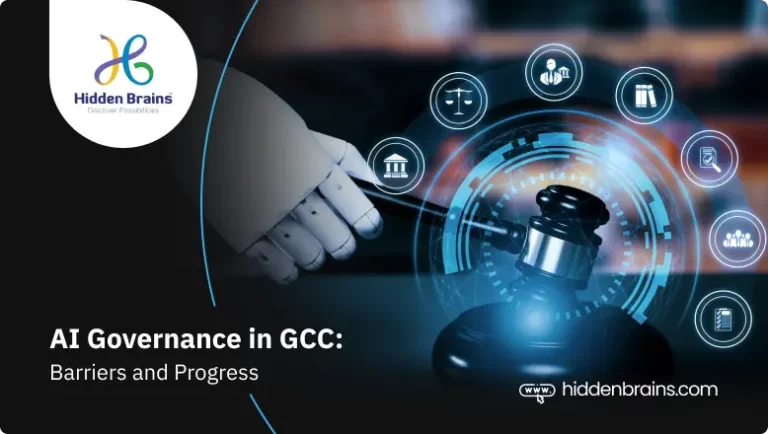
AI Governance in GCC: A Bold Leap Forward Amid Hurdles
In the GCC nations, enterprise and SME leaders face barriers while pursuing artificial intelligence governance, yet real progress and collaborative efforts are emerging. This blog explores responsible AI governance fundamentals, local initiatives, and how to move toward practical AI integration services with confidence.
Artificial intelligence governance matters now, especially across the GCC nations. Enterprises and SMEs adopting AI must clearly understand AI governance in GCC and embed responsible AI practices to ensure their investments remain sustainable, secure, and trustworthy.
In this blog, we’ll:
- Explore what artificial intelligence governance means in the GCC nations.
- Examine how companies are implementing it and the barriers they face.
- Highlight progress and collaborative initiatives underway.
- Offer practical guidance for organisations looking for enterprise AI governance, AI strategy and consulting, AI integration services, and custom AI development services.
- Explain how a leading AI development company can support your journey.
What Is AI Governance, and How Is AI Governance in GCC Being Implemented?
AI governance refers to the framework of policies, roles, practices, and mechanisms that steer the development, deployment, monitoring, and continuous improvement of AI systems. It ensures that AI is trustworthy, accountable, transparent, fair, and aligned with both business and societal values. In other words, it is about managing risks and maximising value when turning AI into a business reality.
In the GCC nations, there is growing momentum around artificial intelligence governance. National strategies and regulation frameworks are being put in place, though many gaps remain.
For example:
- Some Gulf Cooperation Council states have launched national AI strategies that embed ethical principles and soft regulation rather than strictly binding laws.
- Across the region, private-public partnerships and digital transformation initiatives are helping build infrastructure and data capabilities and raise awareness of responsible AI.
So, while many GCC countries are active, the pace and depth of implementation vary widely. For enterprises and SMEs, this means evolution with both opportunities and responsibilities.

Your AI journey starts with the right governance strategy.
Connect NowHow are Enterprises in GCC Adopting Responsible AI Governance Frameworks?
GCC organisations are increasingly recognising that responsible AI governance is not optional. They are implementing frameworks to ensure fairness, transparency, bias mitigation, data privacy, and human oversight. These efforts often draw on international standards while being tailored to local contexts.
For example, many large organisations in Saudi Arabia now require risk assessments for AI models, maintain model inventories, provide audit trails, and embed human-in-loop oversight. They also seek responsible AI solutions that support algorithmic fairness and accountability.
The takeaway for GCC-based enterprises: you will benefit from looking beyond your geography, understanding how peer organisations adopt responsible practices, and adapting elements to your local setting.
What Are the Key Challenges in Establishing Enterprise AI Governance in the GCC Nations?
When implementing enterprise AI governance in the GCC, companies face several common barriers:
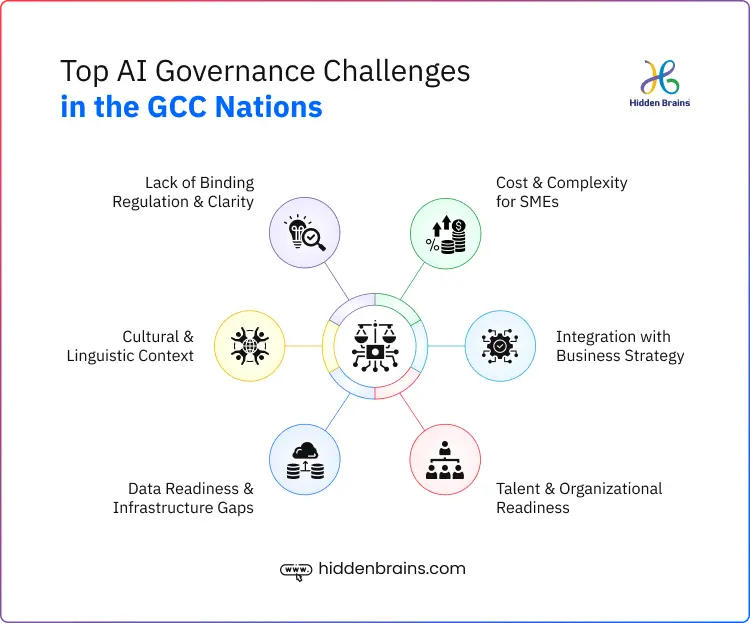
Data Readiness and Infrastructure Gaps
While the GCC is at the global forefront of AI ambition with regional CEOs prioritizing generative AI to gain a competitive edge, a significant gap remains in execution readiness. Despite heavy investment in “Giga-projects” and sovereign cloud foundations, many organizations still grapple with legacy data silos. Without localized data residency compliance, high-speed data pipelines, and unified governance frameworks, these nations risk a “pilot trap” where AI initiatives look promising in isolation but fail to scale across the enterprise.
Talent and Organisational Readiness
Many organisations identify talent shortages and cultural resistance as major obstacles. For example, 41% of tech leaders cite resistance to change from top management, and 49% cite resistance from employees. Embedding responsible AI practices requires not just technology but people who understand AI risk, ethics, compliance, and business alignment.
Lack of Binding Regulation and Clarity
Many GCC countries have strategies and ethical guidelines, but fewer have enforceable laws that mandate responsible AI governance. This “soft regulation” approach can leave companies uncertain about compliance, trust, and accountability. Enterprises may struggle to map which standards to adopt and how to implement them.
Cultural and Linguistic Context
AI models and governance frameworks need to account for local languages, dialects, and societal norms. Only 0.6% of large language model content is in Arabic. Without adaptation, responsible AI initiatives may fail to resonate locally or risk unintended bias.
Integration with Business Strategy
Too often, AI initiatives focus on technology first and governance second. But for effective enterprise AI governance, governance must be embedded from strategy through to operations. Without alignment, efforts can become isolated pilots rather than scalable programmes.
Cost and Complexity for SMEs
For small and medium enterprises, investing in full-scale governance frameworks, audits, and oversight may appear out of reach. Yet neglecting governance exposes them to regulatory, reputational, and operational costs.
Understanding these challenges is the first step toward designing a realistic roadmap for responsible AI, tailored to your business and region.
How Can Organisations in the UAE Ensure Responsible AI Practices and Compliance?
If your organisation is based in the United Arab Emirates (UAE) or operates there, and you want to ensure responsible AI practices and compliance, here are practical steps:
- Start With a Governance Framework Aligned with Business Goals: Define what responsible AI means for your organisation: fairness, transparency, privacy, and human oversight. Map this to your AI initiatives.
- Create an AI Inventory and Risk Register: Know what AI systems you have (or plan to deploy), what data they use, what decisions they make, and what risks they pose. This is part of enterprise AI governance.
- Ensure Human-in-loop and Auditability: For critical systems, ensure human oversight, decision logging, and audit trails. This supports accountability and trust.
- Embed Local Context and Language: Ensure your AI models and governance reflect the UAE’s context (language, culture, regulations). This strengthens relevance and reduces unintended biases.
- Train Stakeholders and Build a Culture of Responsible AI: From leadership to users, everyone must understand their role in responsible AI. Governance is as much about people as it is about technology.
- Partner for Compliance and Monitoring: With evolving regulations in the UAE, adopting best practices and aligning with regional initiatives is key.
By doing these, you build a foundation for responsible AI, not as a one-off compliance task, but as an ongoing discipline.
Make responsible AI a reality for your UAE enterprise!
Contact Us
What are the Fundamentals of Responsible AI for Enterprises?
For enterprises, the fundamentals of responsible AI include:
- Transparency: Ability to explain how AI decisions are made, and where appropriate, provide explanations to affected users.
- Fairness and bias mitigation: Ensuring AI systems treat individuals fairly across demographics, and actively monitor for bias.
- Accountability: Clear ownership of AI systems, with roles for governance, risk, and compliance, and oversight.
- Privacy and security: Ensuring data is managed securely and in compliance with relevant laws.
- Human oversight and control: AI should augment human decision-making, not replace accountability.
- Sustainability and inclusivity: Ensuring responsible AI solutions deliver value equitably and align with broader societal goals (e.g., SDGs).
- Continuous monitoring and improvement: AI governance is not a set-and-forget model; it evolves, risks shift, and governance must keep pace.
These fundamentals should guide your enterprise’s approach to custom AI development services, AI strategy and consulting, and AI support and maintenance, ensuring long-term, responsible operations.
In the Kingdom of Saudi Arabia (KSA), AI governance is closely aligned with the national strategy for economic diversification and digital transformation. National AI programmes emphasize ethical AI principles, strong data governance frameworks, and active public-private collaboration.
How are GCC Nations Approaching Artificial Intelligence Governance?
1. Education: Upskilling & Ethical EdTech
In the GCC, education PPPs are moving beyond infrastructure to “infrastructure for the mind,” focusing on ethical AI deployment.
- UAE: ADQ & Gates Foundation Partnership (2025)
- The Initiative: A landmark partnership to accelerate responsible AI and EdTech adoption. ADQ (UAE sovereign investor) and the Bill & Melinda Gates Foundation are deploying USD 40 million to scale proven AI solutions.
- Responsible Practice: The program specifically focuses on “ethical use” of AI to support teachers and foundational learning, ensuring technology serves human pedagogical needs rather than replacing them.
- Source: Gates Foundation – ADQ AI-for-Education Partnership
- Bahrain: Tamkeen AI Upskilling (2025)
- The Initiative: Bahrain’s Labour Fund (Tamkeen) launched a massive package to train 50,000 citizens in AI by 2030 through partnerships with private technology providers.
- Impact: Aims to create a workforce capable of managing AI governance and data trust, aligning with the WEF’s requirement for “human capital” to unlock economic value.
- Source: World Economic Forum – AI for Sustainable Development in Bahrain
2. Health: Predictive Diagnostics & Unified Governance
GCC health sectors are using AI-driven PPPs to streamline regulation and improve patient outcomes through “privacy-by-design.”
- UAE: National Unified Digital Healthcare Platform (2026)
- The Initiative: The Ministry of Health and Prevention (MoHAP) is launching an AI-powered platform to consolidate licensing for over 200,000 healthcare professionals.
- Responsible Practice: It integrates “Zero Government Bureaucracy” goals with high data-security standards to ensure practitioner data is handled transparently across federal and local authorities (DHA, DoH).
- Source: UAE MoHAP AI Office | SPAG FINN Partners Report
- Abu Dhabi: Global AI Healthcare Academy
- The Initiative: A collaboration between the Department of Health – Abu Dhabi and MBZUAI (university) that has trained over 3,750 professionals in AI for cardiology and radiology.
- Governance: The partnership emphasizes “responsible and impactful innovation,” ensuring clinical staff understand the ethics of AI-assisted diagnosis.
- Source: Abu Dhabi Department of Health
3. Agriculture: Precision Farming & Resource Scarcity
Agriculture in the GCC is a matter of national security (Food Security), where AI PPPs focus on extreme resource efficiency.
- Saudi Arabia: MEWA & KAUST Precision Agriculture
- The Initiative: The Ministry of Environment, Water, and Agriculture (MEWA) partners with academic and private entities (like KAUST and startups) to deploy AI-driven sensors in date palm plantations.
- Impact: These systems have demonstrated a 40% reduction in water use in regions like Al-Qassim.
- Responsible Practice: The “Qatrah” program under Vision 2030 uses AI to automate irrigation valves based on real-time soil data, ensuring sustainable water management in one of the world’s most water-stressed regions.
- Source: ResearchGate – AI in Agriculture KSA
- Qatar: MOCI PPP Electronic Platform (2025)
- The Initiative: Launched in August 2025, this platform showcases PPP projects in food security and agriculture specifically tied to the Third National Development Strategy (2024–2030).
- Governance: Regulated by Law No. 12 of 2020, it enforces strict transparency and accountability for private partners handling national food data.
- Source: International Trade Administration – Qatar PPP Programs
What Responsible AI Solutions are Driving Innovation in GCC Enterprises?
In GCC, responsible AI solutions are not just theoretical; they’re driving real innovation. Examples include:
- AI-driven analytics in energy and utilities that reduce downtime and waste while being overseen by governance frameworks.
- Arabic-language large language models (LLMs) that reflect local context and aim to ensure inclusivity and reduced bias.
For enterprise leaders and SMEs, these illustrate that “responsible” does not mean “slow” or “less competitive,” quite the opposite: it means sustainable, trusted AI that becomes a business advantage.
How Do Government Regulations in the GCC Influence AI Governance Models?
Government regulation plays a big role in shaping AI governance. In the Gulf nations:
- Many national strategies emphasise ethical principles, privacy, data protection, and human rights. These form the backbone of governance frameworks.
- The presence or absence of enforceable laws determines how much enterprises must invest in governance upfront. “Soft regulation” (guidelines rather than mandates) is common in some GCC markets.
- Regulatory clarity helps enterprises adopt responsible AI governance faster and with more confidence. When governments signal clear expectations, companies can better align enterprise AI governance, risk management, and investment in AI initiatives.
Therefore, enterprises operating in or targeting GCC should monitor regulatory developments, embed governance early, and anticipate how compliance, transparency, and ethical oversight will become differentiators.
What Best Practices Define Responsible AI Governance?
Having explored the barriers, progress, and regulatory environment, here are the best practices organisations should adopt:
- Governance by design: Build your governance framework early, before or along with AI integration, not as an afterthought.
- Align governance with business strategy: Ensure governance supports outcomes like growth, efficiency, margin improvement, and risk control.
- Create leadership commitment: Board and senior management must champion governance, not just the technology teams.
- Maintain human-in-loop oversight: Critical AI decisions should have human oversight and review.
- Monitor, audit and update: Continuously monitor models, audit decisions, track performance, and refine.
- Ensure transparency and explainability: Use tools and practices to explain AI decisions, especially in regulated or high-risk contexts.
- Embed cultural and local relevance: Ensure governance and AI solutions reflect local language, norms, regulations, and contexts.
- Train your workforce and build culture: Everyone from data scientists to business users must understand responsible AI practices.
- Leverage partnerships and collaborations: Work with external experts, regulators, and cross-industry groups to keep abreast of trends and standards.
- Prioritise scalable governance: As your AI footprint grows, governance must scale too; don’t lock into one-off controls.
These best practices will enable enterprises and SMEs to adopt AI in a way that is both bold and responsible.
How Can Companies Build a Culture of Responsible AI Aligned with Governance Principles?
Building a culture is often the hardest part, but also the most valuable. Here are the steps to embed culture:
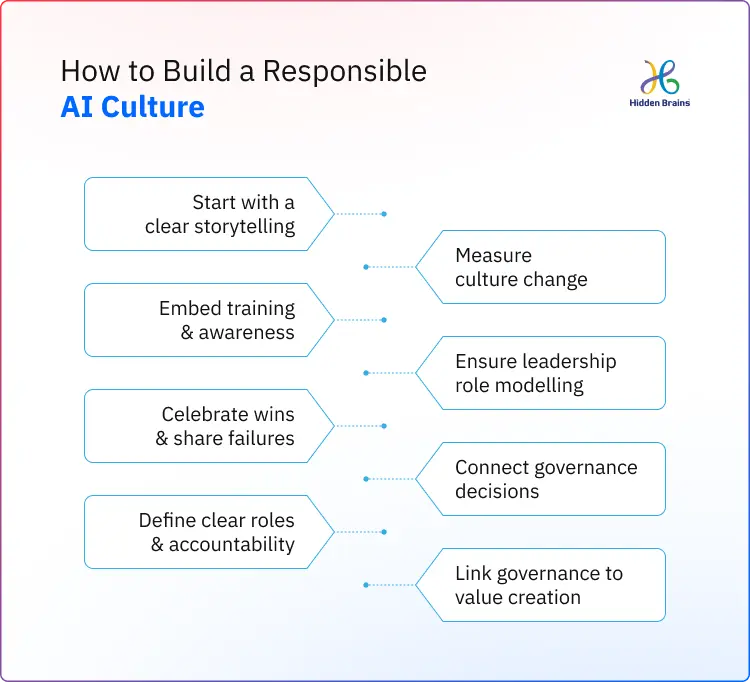
- Start with storytelling: Communicate why responsible AI, governance, and ethics matter in your organisation. Use real-life examples of both success and risk.
- Define clear roles and accountability: Who owns AI governance? Define roles such as AI ethics officer, data governance lead, and AI risk manager.
- Embed training and awareness: Run training sessions for all levels of staff, even those who don’t directly work with AI. They should understand the scope and impact.
- Connect governance to everyday decisions: Make sure policies are simple, usable, and embedded in workflows, not hidden away in documents.
- Celebrate wins and share failures: When governance helps catch an issue early, talk about it openly as a sign of maturity.
- Measure culture change: Use surveys, audits, and metrics to gauge how well responsible AI practices are becoming part of the organisation.
- Ensure leadership role modelling: Senior management should visibly align with governance and responsible AI, not just delegate it.
- Link governance to value creation: Show how responsible AI enables better customer trust, opens new markets, controls risk, and improves margins.
When culture aligns with governance principles, AI initiatives can scale confidently, sustainably, and ethically.
How can Hidden Brains Help
As a leading AI software development company in UAE, Hidden Brains provides end-to-end support and partnership for organisations across GCC seeking to adopt AI responsibly and effectively.
We have previously optimized government workflows with MS Word automation. With experience in managing digital transformation for government, domain expertise, and over 22 years of industry knowledge, we have several ways to help.
Here’s how we help:
- AI strategy and consulting: We work with your leadership to define a clear AI roadmap aligned with business goals, governance frameworks, and risk appetite.
- Custom AI development services: Whether you need predictive models, decision-automation systems, or natural language solutions tailored to Arabic and regional context, we build them with governance embedded.
- AI integration services: From legacy systems to cloud platforms, we integrate AI into your operations with solid governance, data pipelines, and change management.
- AI support and maintenance: Governance is ongoing. We provide monitoring, performance tracking, governance reviews, and continuous improvement to ensure your AI investment remains trustworthy and valuable.
- Responsible AI solutions: We ensure your AI systems include transparency, fairness, human oversight, audit trails, bias monitoring, and compliance with regional norms.
If you are an enterprise, SME, or top-level organisation in the GCC countries looking to integrate AI into your business, you don’t just need technology. You need a partner who understands artificial intelligence governance, responsible AI, and how to transform strategy into results. Hidden Brains is here to help you navigate the future of AI governance with confidence, speed, and trust.
Let’s build a responsible, high-impact AI journey together.
Frequently Asked Questions
Let’s address key questions that help enterprises understand responsible AI governance and its practical applications.
What is AI governance, and how are GCC nations implementing it?
AI governance is the framework for ethical, safe AI use covering fairness, privacy, and accountability. GCC countries like the UAE implement testing via federal councils and sandboxes. Saudi Arabia uses SDAIA guidelines for national strategies. It’s proactive: Rules evolve with tech, ensuring innovation thrives.
What are the key challenges in establishing enterprise AI governance in the GCC nations?
Top hurdles: skills gaps, uneven infrastructure, and complex data privacy. Enterprises struggle with biased data and compliance costs. Solution? Start with basic frameworks like ISO 42001 to build steadily.
How can organizations in the UAE ensure responsible AI practices and compliance?
UAE orgs follow federal ethics principles, transparency, and no bias. Use sandboxes for testing, conduct regular audits, and train on PDPL. Partner with experts for seamless integration.
What responsible AI solutions are driving innovation in GCC enterprises?
Tools like PwC’s audits and Google’s Gold Standards enable ethical scaling. In the UAE/Saudi Arabia, they power cybersecurity and predictive analytics, unlocking $320B economic value by 2030.
How do government regulations in the GCC influence AI governance models?
Tools like PwC’s audits and Google’s Gold Standards enable ethical scaling. In the UAE/Saudi Arabia, they power cybersecurity and predictive analytics, unlocking $320B economic value by 2030.
How do government regulations in the GCC influence AI governance models?
Regs like the UAE’s multi-tier councils and Qatar’s bank guidelines set ethics baselines. They push agile models and sandboxes over bans, balancing innovation with safety across GCC.


Conclusion
The GCC nations are at a pivotal moment in the evolution of artificial intelligence governance. From growing national strategies to enterprise adoption of responsible AI, the opportunities are vast, and so are the risks for those who move without governance. Enterprises and SMEs seeking to integrate AI must place AI governance, responsible AI practices, and enterprise AI governance at the heart of their strategy. They can start doing so by hiring a leading software development company in Saudi Arabia. By doing so, they not only manage risk, they unlock value, build trust, and future-proof their operations.