


























































































































































Summary
In 2026, UAE enterprise AI is shifting from experimental chatbots to autonomous agents and sovereign systems. Success is no longer measured by simple uptime, but by how effectively AI integrates into the local ecosystem. Key metrics now prioritize Goal Completion Rates (GCR) for autonomous tasks, Arabic Nuance Accuracy for cultural alignment, and strict Data Residency Sovereignty to meet UAE PDPL standards. By focusing on “Agentic” performance and measurable ROI—like cognitive load reduction and error avoidance, businesses can move beyond hype toward industrial-scale AI that drives genuine competitive advantage in the Gulf region.
The metrics you choose today will define your competitive position tomorrow. But here’s what most enterprises get wrong: they adopt someone else’s targets, measure what others measure, and wonder why their AI transformation feels like following a script written that’s not complete.
Dubai’s journey to becoming the world’s most AI-ready city isn’t about copying benchmarks; it’s about defining your own version of excellence aligned with UAE Vision 2031. Your metrics should reflect your ambitions, your market realities, and your unique path to global leadership.
This isn’t a prescriptive framework with rigid targets. It’s a strategic thinking guide to help you identify which AI software development metrics actually matter for your enterprise, how to measure them in ways that drive decisions, and how to build the infrastructure to support your vision.
Rethinking AI Metrics: From Best Practices to Best Fit
Before diving into specific KPIs, ask yourself these fundamental questions:
What does success actually look like for your organisation?
Not in generic terms like “digital transformation” but in concrete business outcomes. Is it entering new markets? Reducing operational costs by a specific amount? Delivering personalised experiences that competitors can’t match?
What constraints are you operating under?
Regulatory requirements in your sector, existing technology debt, talent availability, and budget realities. Your metrics must acknowledge these constraints, not ignore them.
Where are you starting from?
A logistics company with real-time tracking infrastructure has different priorities than a traditional manufacturer just beginning digitisation. Your baseline determines your trajectory.
The UAE’s national AI strategy provides direction, 45% GDP contribution by 2031, ethical AI governance, and sovereign data control, but how you contribute to that vision is yours to define.
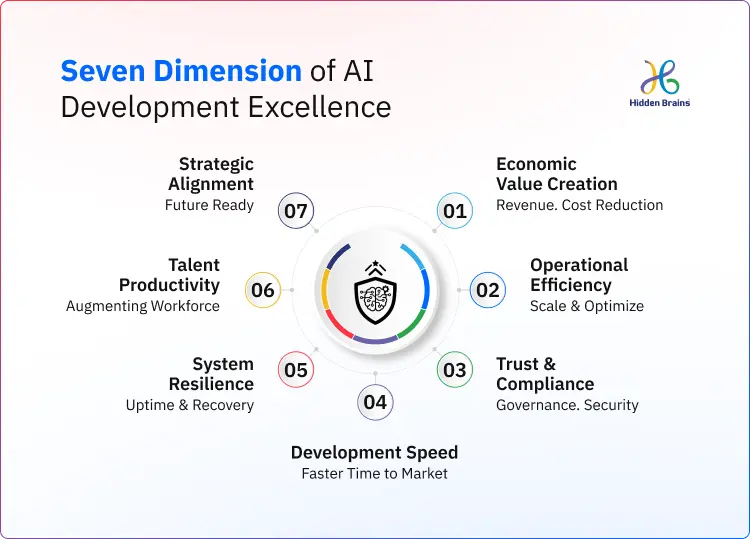
The Seven Dimensions of AI Development Excellence
Selecting the right partner is a strategic decision, not simply a technology choice. The right partner goes beyond cost and technical expertise, they shape your ability to innovate, scale, manage risk, and translate AI investments into measurable business outcomes. Rather than applying a generic checklist, we explore seven critical dimensions that help enterprises evaluate partner capabilities, define what excellence means in their context, and make informed decisions aligned with their long-term AI strategy.
Dimension 1: Economic Value Creation
The Question: How directly can you connect AI investments to revenue growth or cost reduction?
Some enterprises track AI-attributed revenue—sales generated through recommendation engines, dynamic pricing, or predictive lead scoring. Others measure cost avoided through automation, optimised resource allocation, or reduced error rates.
Your Decision: What economic metric would make your board sit up and take notice? That’s your north star. Whether it’s 10% revenue growth or 40% cost reduction, the number matters less than the connection between AI initiatives and business outcomes.
Consider a Dubai retail enterprise: they might measure AI’s contribution through average basket value increases, inventory holding cost reductions, and personalisation-driven repeat purchase rates. A healthcare provider might track diagnostic accuracy improvements, patient throughput, and administrative cost savings.
Critical Consideration: Can your current systems even measure this? If not, that’s your first infrastructure priority. Partner with a custom software development company in the UAE that can instrument your applications for proper attribution from day one.
Dimension 2: Operational Efficiency at Scale
The Question: As your AI usage grows 10x, do your costs grow 10x or 2x?
This is where cost per inference, compute efficiency, and infrastructure optimisation matter. But the “right” number depends entirely on your use case. A high-frequency trading algorithm needs sub-millisecond responses regardless of cost. A content recommendation system can tolerate slightly longer processing if it halves infrastructure spend.
Your Decision: Map your AI use cases by business criticality and cost sensitivity. Optimise aggressively where volume is high and margins are thin. Invest in performance where customer experience or regulatory compliance demands it.
A logistics company running route optimisation millions of times daily might target aggressive cost reduction. A financial services firm running fraud detection on every transaction might prioritise speed and accuracy over cost.
Critical Consideration: Efficiency isn’t just about cloud bills, it’s about team velocity. Can your developers iterate quickly? Can models retrain automatically? Can you scale without hiring proportionally? These operational efficiencies compound over time.
Dimension 3: Trust, Safety & Regulatory Alignment
The Question: What would it cost if your AI made a consequential error or violated compliance requirements?
For UAE enterprises, this dimension isn’t optional. Digital Dubai regulations, sector-specific compliance requirements, and the national commitment to ethical AI create clear boundaries. But within those boundaries, you choose how conservative or innovative to be.
Your Decision: Categorise your AI use cases by risk level. Customer service chatbots have a different error tolerance than medical diagnostic tools. Marketing personalisation has different compliance needs than credit decisioning.
For high-risk applications in healthcare, finance, or government services, you might target near-zero hallucination rates with extensive human oversight. For lower-risk applications, you might accept higher error rates in exchange for faster deployment and learning.
Critical Consideration: Sovereign data compliance isn’t negotiable for sensitive information, but you define “sensitive” within your context. A custom software development services provider with deep UAE expertise can help you architect compliant solutions without over-engineering.
Onground Experts Ready to Drive Your Business into the AI Era.
Call us
Dimension 4: Development Velocity & Innovation Speed
The Question: How quickly can you move from idea to production, and does that speed match your market’s pace of change?
Some industries demand monthly feature releases. Others operate on quarterly planning cycles. Neither is inherently superior; they reflect different competitive dynamics.
Your Decision: Benchmark yourself against competitors, not generic industry standards. If your closest rival ships weekly and you ship quarterly, that’s a strategic vulnerability. If everyone in your sector moves slowly, matching their pace might be sufficient.
Leading enterprises measure lead time for features (idea to production), deployment frequency, and the percentage of time spent on innovation versus maintenance. But what constitutes “fast enough” depends on your market position and strategy.
Critical Consideration: Speed without quality is recklessness. Your metrics should balance velocity with stability. A software development company in the UAE with mature DevOps practices can help you achieve both.
Dimension 5: Talent Productivity & AI Augmentation
The Question: Are your developers, data scientists, and analysts becoming more productive or just busier?
The UAE’s goal of training 10,000 AI professionals by 2031 creates opportunity but also competition for talent. Maximising the productivity of your existing team through AI-assisted development, automated testing, and intelligent tooling becomes critical.
Your Decision: Measure what matters to your team’s output. This might be AI code acceptance rates, time saved on repetitive tasks, or the ratio of time spent on strategic work versus maintenance.
Some enterprises track developer satisfaction and retention as leading indicators of productivity. Others choose to hire dedicated developers or resources for a productive team and faster results.
Critical Consideration: AI tools are enablers, not replacements. If your code acceptance rates are low, it might indicate poor tooling, insufficient training, or mismatched use cases. Investigate before optimising the wrong thing.
Dimension 6: System Resilience & Business Continuity
The Question: When (not if) something fails, how quickly can you recover, and what’s the business impact?
For enterprises where AI powers core operations, dynamic pricing, inventory management, supply chain control tower, customer service, fraud detection, and downtime directly hits revenue and reputation. For others, AI augments human decision-making, and brief outages are inconvenient but not catastrophic.
Your Decision: Map your AI systems by business criticality. Tier 1 systems might require aggressive recovery targets (minutes), extensive redundancy, and 24/7 monitoring. Tier 3 systems might tolerate hours of downtime with manual failback.
Measure Mean Time to Recovery (MTTR), but also Mean Time Between Failures (MTBF), and the business impact of outages. A system that fails weekly but recovers in seconds might be more acceptable than one that fails quarterly but stays down for hours.
Critical Consideration: Resilience isn’t just technical, it’s operational. Do your teams have runbooks? Are alerts actionable? Is escalation clear? This is where you need operational maturity, intent driven technical depth rather than just surface-level adaptation. If you are not sure whether your AI is working in your favour or not, get an AI strategy and consultation session.

Dimension 7: Strategic Alignment & Future Readiness
The Question: Are your AI investments building capabilities that compound or solve isolated problems?
This is the hardest dimension to measure, but potentially the most important. Every AI initiative should either deliver immediate business value or build capabilities (data infrastructure, ML platforms, team skills, organisational processes) that enable future initiatives.
Your Decision: Track your innovation pipeline, how many AI experiments are running, how many graduate to production, and what percentage of new initiatives leverage existing capabilities versus requiring ground-up builds.
Leading enterprises measure the reusability of their AI components, the time to launch subsequent AI projects (which should decrease as platforms mature), and alignment between the digital strategy roadmap and corporate objectives.
Critical Consideration: This dimension requires long-term thinking in quarterly results environments. Executive sponsorship and clear governance make the difference between building sustainable AI capabilities and accumulating one-off projects.
Defining Your Metrics: A Workshop Approach
Rather than accepting generic targets, invest time in defining metrics that matter for your context:
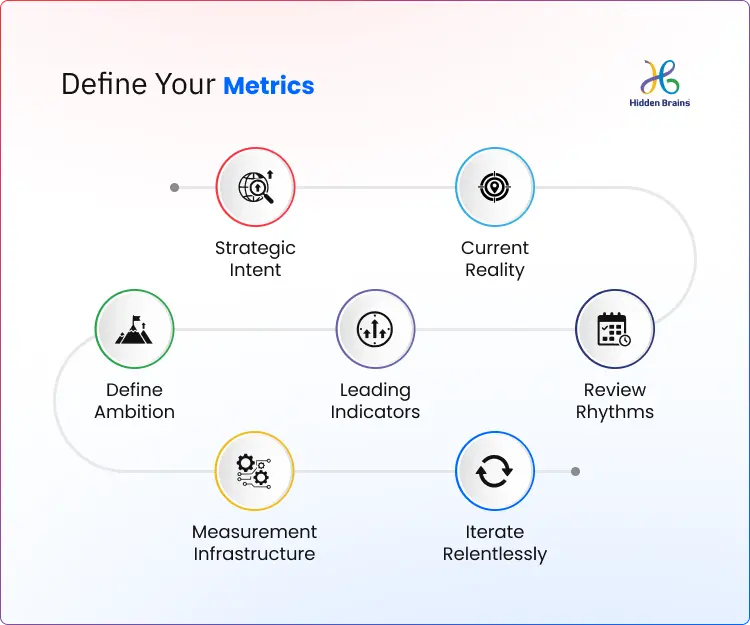
Step 1: Clarify Your Strategic Intent. Are you pursuing market share growth, margin expansion, new market entry, or operational transformation? Your metrics should ladder directly to these goals.
Step 2: Map Your Current Reality. Where are you today across these seven dimensions? Be honest. Gaps aren’t failures, they’re opportunities. Once you have measured the reality and know the new economy of business, you have a way to find whats next.
Step 3: Define Your Ambition. Where do you need to be in 12, 24, 36 months to achieve your strategic intent? This becomes your target state.
Step 4: Identify Leading Indicators. What metrics predict future success? These become your focus areas.
Step 5: Build Measurement Infrastructure. Can you actually track these metrics today? If not, that’s your first AI infrastructure project. For businesses investing in Enterprise AI Development Services in the UAE, having the right data and measurement systems in place is essential to proving ROI. Work with a software development company in the UAE that understands both the technical and business requirements.
Step 6: Establish Review Rhythms Weekly team reviews, monthly executive updates, quarterly board reporting. Metrics only drive improvement if they’re actually reviewed and acted upon.
Step 7: Iterate Relentlessly Your metrics should evolve as your capabilities mature and your market changes. What you measure in Year 1 might be table stakes in Year 3.
Real-world Application: Three Different Visions of Success
Consider three Dubai enterprises, all investing in AI, all measuring differently:
Enterprise A: Aggressive Market Expansion A fintech startup targeting regional dominance measures AI-driven customer acquisition costs, activation rates for AI-powered features, and viral growth coefficients. Their development team ships multiple times daily, accepts higher error rates for faster learning, and prioritises speed over optimisation.
Their vision: be first to market with transformative AI experiences.
Enterprise B: Operational Excellence An established logistics provider measures route optimisation savings, delivery time predictability, and customer satisfaction scores. They deploy weekly, maintain rigorous testing protocols, and optimise cost per transaction aggressively.
Their vision: defend market position through superior operational efficiency.
Enterprise C: Strategic Transformation A healthcare provider measures diagnostic accuracy improvements, clinician time saved, and patient outcome correlations. They deploy monthly, maintain extensive compliance documentation, and prioritise explainability over raw performance.
Their vision: become the regional standard for AI-augmented healthcare.
None of these approaches is “correct”, each aligns perfectly with the organisation’s strategic intent, market position, and risk tolerance. Your vision determines your metrics, not the other way around.
Building the Infrastructure to Support Your Vision
Measurement requires infrastructure. Outstanding metrics built on inadequate systems create frustration, not insight.
Data Infrastructure: You need clean, accessible, real-time data pipelines. If you’re measuring AI-attributed revenue but your transaction systems don’t track AI interactions, you’re guessing.
Development Platforms: Modern DevOps, MLOps, and observability platforms enable the metrics that matter, deployment frequency, MTTR, and model performance tracking.
Governance Frameworks: Especially in regulated sectors, your metrics must be auditable, explainable, and compliant with Digital Dubai standards.
Talent & Process: Metrics don’t interpret themselves. Your team needs alignment, proper insights, and skills to get analytics. You need teams skilled in data analysis, comfortable with experimentation, and empowered to act on insights.
This is where strategic partnerships accelerate progress. A custom software development company in the UAE with proven AI, DevOps, and compliance expertise can compress years of trial-and-error into months of focused execution.
Aligning Your Vision with the UAE’s National Priorities
While your metrics are yours to define, alignment with UAE Vision 2031 creates strategic advantages, access to government initiatives, ecosystem partnerships, talent pools, and potential funding.
Economic Diversification: How do your AI initiatives contribute to non-oil GDP growth or create high-value jobs?
Sustainability: Can you demonstrate environmental benefits through optimisation, efficiency, or enablement of green technologies?
Global Competitiveness: Are you building capabilities that position UAE enterprises as regional or global leaders?
Ethical AI Leadership: Do your governance practices and transparency standards exemplify responsible AI development?
Your metrics can reflect these alignments without being constrained by them. An enterprise reducing logistics emissions through AI optimisation contributes to sustainability goals while pursuing cost efficiency.
A healthcare AI platform that maintains 100% data sovereignty while delivering world-class accuracy demonstrates both compliance and excellence.
Your Next Steps: From Reading to Action
This Week: Reflection & Assessment
- Gather your leadership team and discuss: what does AI success look like for us specifically?
- Map your current AI initiatives against the seven dimensions
- Identify which 3-4 dimensions matter most for your strategic intent
- Acknowledge honestly where you lack measurement capability today
This Month: Definition & Planning
- Define your specific metrics within priority dimensions
- Set your own targets based on your baseline, ambition, and constraints
- Audit your measurement infrastructure. What can you track today, and what requires investment?
- Engage a software development company UAE for infrastructure assessment of gaps or make your foundation strong
This Quarter: Implementation & Learning
- Build or enhance measurement capabilities for your priority metrics
- Establish review rhythms and accountability
- Run your first AI initiative with comprehensive metrics tracking
- Learn, iterate, and refine based on what you discover
Ongoing: Evolution & Optimisation
- Review metrics quarterly, are they still driving the right behaviours?
- Benchmark progress against your targets and competitive landscape
- Expand measurement to additional dimensions as capabilities mature
- Share learnings across your organisation to build AI fluency
The Metrics That Matter Are the Ones You Define
Dubai’s vision for AI leadership creates context, not constraints. UAE Vision 2031 provides direction, not dictation. National initiatives like Stargate UAE, Dubai AI Week 2026, and the UAE National AI Strategy create an ecosystem of opportunity.
But your path within that ecosystem is yours to chart. The metrics you choose signal your priorities, shape your team’s focus, and ultimately determine whether your AI transformation creates sustainable competitive advantage or just generates activity.
What Hidden Brains Can Do For You?
Hidden Brains is a software development company in the UAE with on-ground experts and tech experts who work on every phase. Instead of a prescribed solution, we help you diagnose with 2 hours FREE consultation, we help you strategize, consult, and build what matters for you. Your vision. Your metrics and we as your transformational partner.
We help you grow, track, and meet the KPIs of your business.
Frequently Asked Questions
How can you help me align with Dubai’s 2031 Vision?
To align with Dubai’s Vision 2031, the key is to integrate AI in ways that drive economic diversification and improve public sector services. By focusing on smart cities, AI in government operations, and creating AI-driven economic growth, we can contribute directly to Vision 2031. We would tailor AI strategies that not only optimize business processes but also prioritize sustainability and innovation in line with the vision’s long-term goals.
What are the core KPI categories for AI software development?
Core KPIs in AI development revolve around measuring business impact, like cost savings, ROI, and revenue growth, while also focusing on model performance (accuracy, speed, efficiency). Operational aspects like scalability, deployment frequency, and user engagement also matter. And, of course, ethical considerations are crucial, measuring fairness, bias, and transparency in AI models.
How do we measure the impacts of AI projects?
The impact of AI projects can be measured by their direct business outcomes, whether AI solutions increase revenue, reduce costs, or enhance operational efficiency. We also track adoption rates, user engagement, and system performance. Additionally, understanding AI’s alignment with regulatory requirements and its ethical integrity is crucial in measuring its true impact.
What measures do you take to protect personal data during AI model training and processing?
Protecting personal data during AI training involves anonymizing the data and encrypting it both at rest and in transit. We implement data minimization to ensure only relevant data is used and integrate secure techniques like federated learning, where data never leaves its original location. Additionally, ensuring full compliance with laws like GDPR and the UAE’s PDPL is a top priority.
What are the critical considerations for UAE businesses when measuring trust, safety, and regulatory alignment for AI systems?
For UAE businesses, trust and safety hinge on ethical AI design. It’s about creating transparent, explainable systems that ensure bias-free outcomes. Also, adherence to local regulations like UAE PDPL is crucial for data sovereignty and ensuring AI aligns with Dubai’s strict AI governance frameworks. Regular audits and compliance checks ensure that AI systems meet regulatory standards while protecting data privacy.



Conclusion
The UAE’s vision for 2031 demands more than just “off-the-shelf” AI; it requires a strategic framework built on trust, autonomy, and localization. Adopting these 20 advanced KPIs ensures your enterprise isn’t just running models, but mastering a digital workforce that respects regional values and regulatory boundaries. As we navigate 2026, the winners will be those who bridge the gap between technical potential and sovereign execution. Don’t just deploy AI, measure its ability to act, adapt, and comply. Partner with us to turn these sophisticated metrics into your enterprise’s new standard for excellence.