


















































![Sales & Distribution [Oil & Gas]](https://www.hiddenbrains.com/blog/wp-content/themes/blankslate/assets/images/sales_and_distribution-icon.74d08193.svg "Sales & Distribution [Oil & Gas]")

![Fluid Terminal Management [Oil & Gas]](https://www.hiddenbrains.com/blog/wp-content/themes/blankslate/assets/images/fluid_terminal_management-icon.4b3a27a4.svg "Fluid Terminal Management [Oil & Gas]")


![Sales & Distribution [Oil & Gas]](https://www.hiddenbrains.com/blog/wp-content/themes/blankslate/assets/images/sales_and_distribution-icon.74d08193.svg?1.0.0 "Sales & Distribution [Oil & Gas]")
![Fluid Terminal Management [Oil & Gas]](https://www.hiddenbrains.com/blog/wp-content/themes/blankslate/assets/images/fluid_terminal_management-icon.4b3a27a4.svg?1.0.0 "Fluid Terminal Management [Oil & Gas]")






























































Overview
Custom CRM development is evolving fast in 2026, and costs are shifting just as quickly. This blog breaks down what businesses truly spend, from small MVP builds to enterprise-grade systems with AI, automation, and multilingual support. You’ll learn the real cost drivers, hidden expenses, regional variations across APAC, and smart ways to reduce your budget without cutting quality. If you’re planning a CRM in 2026, this guide shows exactly what to expect and how to plan wisely.
Custom CRM development cost is becoming a major focus for businesses in 2026. And the USA is leading this shift. With a fast-growing digital economy and a massive consumer base, North American businesses are investing heavily in smarter, scalable CRM systems. The region now accounts for nearly 37% of global CRM spending, making it one of the most competitive markets for custom software solutions. So you may be wondering what the custom CRM development cost in 2026 will look like.
Costs are changing fast, and new technologies like AI, automation, and predictive analytics—often implemented by a Custom AI Development Company are becoming standard. Compliance requirements and integration needs are also rising. Many US companies, from startups to large enterprises, want CRMs tailored to local workflows, languages, and customer behaviors.
This blog breaks down what you can expect to spend on CRM software development costs in 2026. Clear ranges. Real factors. No vague estimates. Just practical insights you can use to plan your CRM budget confidently and pick your custom CRM implementation solutions partner.
Average Cost of Custom CRM Development in 2026
Understanding the custom CRM development cost in 2026 is easier when you break it down by business size and complexity. Costs vary. But these ranges reflect the latest trends in the U.S. market. Small businesses, mid-sized firms, and large enterprises invest differently. These numbers show what U.S. companies typically spend today.
| CRM Type | Cost Range | Timeline | Key Features | 2026 Add-Ons |
|---|---|---|---|---|
| Basic / MVP CRM | $30,000–$50,000 | 2–4 months | Core CRM, simple dashboards, 1–2 integrations | Basic automation (+$5k–$10k) |
| Mid-Sized CRM | $75,000–$150,000 | 4–6 months | Workflows, analytics, multi-device, 3–5 integrations | AI modules (+$20k–$40k) |
| Enterprise CRM | $150,000–$300,000+ | 6–12 months | Advanced automation, AI insights, 5+ integrations | Gen-AI chatbots (+$30k–$80k) |
Small Business CRM Cost Range
Small businesses usually start with a simple CRM. Something clean. Something that manages contacts, deals, and basic pipelines without heavy automation. The following table can help you understand the custom CRM development budget guide in a nutshell:
- Typical Cost: $30,000–$50,000
- Timeline: 2–4 months
The CRM software development costs cover contact management, simple dashboards, and up to 1–2 basic integrations.
2026 Add-Ons:
- Basic automation: +$5,000–$10,000
- Light reporting upgrades
This is perfect for SME’s in the USA, looking for a practical MVP.
Mid-sized CRM Cost Range
Mid-market companies need more: automated workflows, advanced analytics, multi-device support, robust reporting, and seamless integrations with ERP, HRM, and marketing tools.
- Typical Cost: $75,000–$150,000
- Timeline: 4–6 months
This level usually includes 3–5 third-party integrations and custom dashboards.
2026 Add-Ons:
- AI personalization modules: +$20,000–$40,000
- Composable modules: +10% cost bump
Regional note:
- UK equivalents run £18,000–£24,000.
Enterprise CRM Cost Range
Enterprise CRMs go far beyond standard workflows. These systems scale globally, support heavy automation, and integrate advanced AI.
- Typical Cost: $150,000–$300,000
- Timeline: 6–12 months
This category serves large U.S. enterprises in BFSI, telecom, healthcare, logistics, and manufacturing.
Features here include forecasting, sentiment analysis, multi-region support, and 5+ integrations.
2026 Add-Ons:
- Generative AI chatbots: +$30,000–$80,000
- Compliance upgrades (GDPR, HIPAA, PDPA): +15%
What’s Included in These Numbers?
Every CRM development pricing tier typically includes:
- UX/UI Design
Simple for SMBs. Deeply customized for enterprises. - Frontend Development
Dashboards, forms, modules, mobile-friendly screens. - Integrations
From payment systems to ERPs and cloud apps. - QA & Testing
Performance, usability, security, and automation tests. - Deployment
Cloud hosting setup, CI/CD pipelines, DevOps support. - Backend Development
APIs, logic, workflows, and database setup.
Key Factors Influencing Custom CRM Development Cost
CRM development pricing depends heavily on what you build and how complex your needs are. In the U.S., factors like advanced AI features, industry-specific workflows, strict compliance requirements, and deep integrations shape the final cost.
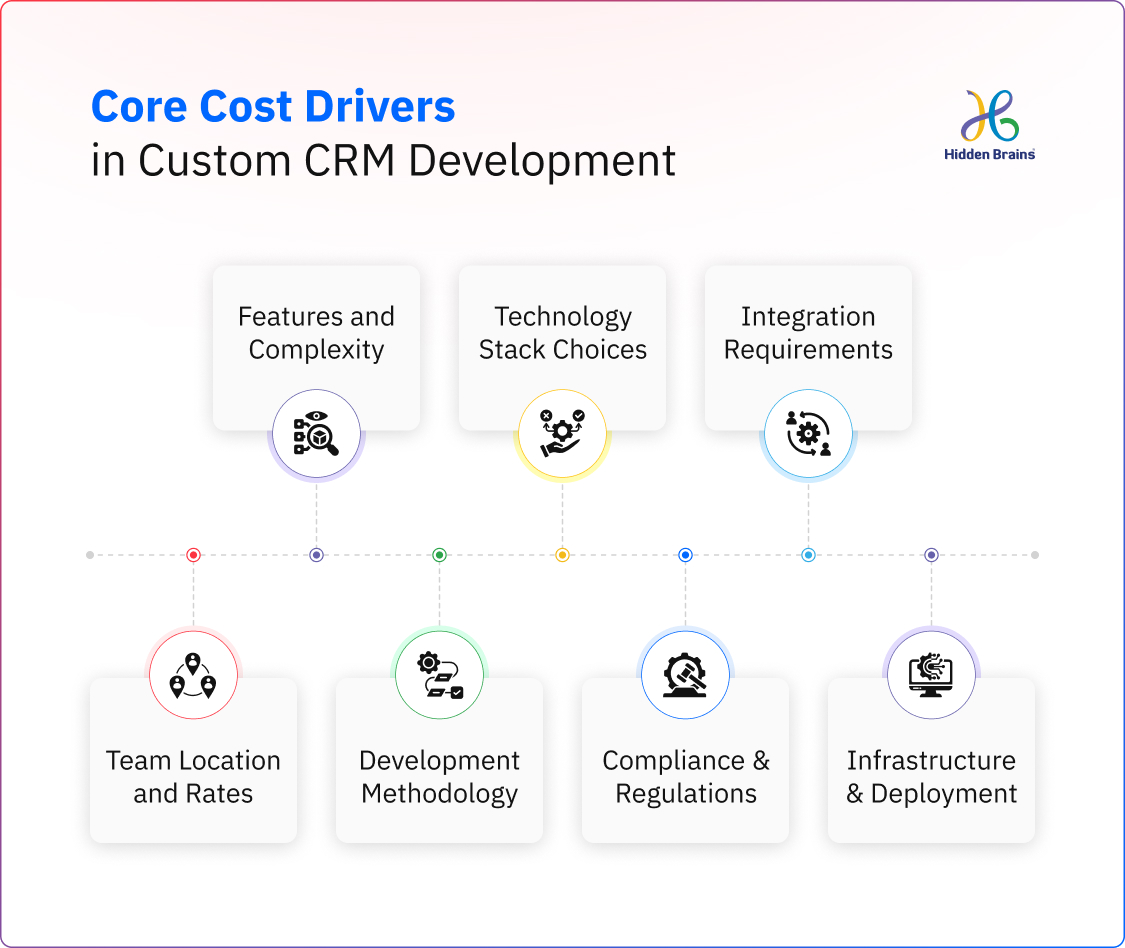
Mobile-first experiences, cloud adoption, and security standards also influence budgets. Here’s a simple breakdown of what drives CRM pricing in the U.S. market.
Features and Overall Complexity
The more your CRM does, the higher the cost. Basic features like contact management are affordable. But once you add automation, AI insights, smart workflows, and analytics dashboards, the cost goes up quickly.
In the United States, the challenge is mobile-first usage. Smartphone penetration already stands at 91% and is projected to remain stable near 97% by 2026. It means businesses across sectors often need mobile-first CRM design, which adds 15–20% to development due to cross-platform optimization and responsive features.
Multilingual support also increases complexity. CRMs often need Spanish, French, Mandarin, and English versions to serve diverse U.S. demographics.
More languages = more UI/UX variations, translation integrations, and higher cost, typically adding 10–15% for localization efforts.
Technology Stack Choices
Your tech stack determines performance, security, and scalability.
- Frontend: React, Vue, or Angular.
- Mobile: React Native or Flutter.
- AI/ML: Python, TensorFlow, or cloud-native AI services.
- Backend: Node.js, Python, or .NET.
React Native and Flutter are popular in the USA due to booming mobile commerce. Choosing these stacks usually adds $10,000–$20,000 to the budget. In AI-heavy markets like the US, enterprise CRMs rely on Python + TensorFlow for predictive analytics. The push for AI integration services makes it mandatory for many sectors, especially BFSI. So, costs rise accordingly.
The requirement for hybrid deployments also matters. In the US, CCPA requires local controls. Cloud adoption also influences the CRM software development cost. States like California and New York already maintain 94% cloud adoption, thanks to hyperscaler investments.
Integration Requirements
Integrations can be simple or extremely complex. Basic CRMs connect with payment gateways, Gmail, or WhatsApp Business. Enterprise CRMs integrate with ERP Software, billing, HRM, e-commerce systems, and marketing automation tools.
In the United States, compliance-driven and industry-specific integrations make things significantly pricier:
- HIPAA compliance for healthcare (PHI handling, audit logs, encryption)
- CCPA / CPRA data-privacy controls and consumer opt-out flows (especially in California)
- PCI-DSS Level 1 for payment-heavy retail and fintech.
These regulated integrations can raise costs by 15–25%. Additionally, U.S. retailers and CPG companies frequently require product traceability integrations (e.g., GS1 standards, FDA compliance modules, or ESG/sustainability reporting), which demand custom data pipelines and increase development time and budget accordingly.
Team Location and Hourly Rates
Where your software development team sits matters a lot in determining the custom CRM development costs in 2026.
- Asia-Pacific (India, Vietnam, Philippines):
Most cost-effective. Offshore savings of 20–50%. - Middle East (UAE, Saudi Arabia):
Higher costs due to compliance-heavy custom CRM builds. - North America:
Highest hourly rates worldwide. - Europe:
Moderate, but still more expensive than APAC.
In countries with multilingual or RTL interface requirements (e.g., Arabic), UI/UX costs increase by 20–30%.
Development Methodology (Agile vs. Waterfall vs. Hybrid)
Agile is the most common approach in 2026. It’s flexible and ideal for evolving requirements.
Waterfall is used for government or highly regulated projects.
Hybrid models are popular in the United States, especially for healthcare (HIPAA), financial services (FINRA/SEC), and large enterprises subject to CCPA/CPRA or state-level privacy laws—due to strict data-privacy regulations, audit requirements, and staged compliance checks.
Hybrid = More planning + More documentation. And that means slightly higher costs.
Compliance and Data Regulations
Compliance has become a major cost driver in APAC and the Middle East.
- California: CCPA/CPRA compliance adds $5,000–$10,000 for privacy assessments and opt-out mechanisms.
- Healthcare sector: HIPAA mandates secure handling of PHI and regular audits, adding approximately $50,000–$150,000+ in implementation and ongoing compliance costs.
- Financial Sector: PCI DSS mandates strict protection of cardholder data, resulting in higher infrastructure and certification costs—often accounting for 15–25% of the total project budget.
- Federal/Government Projects: FedRAMP policies enforce cloud security and localization → elevated audit and deployment expenses.
If your CRM stores sensitive financial or health data, expect additional security certifications.
Infrastructure and Deployment Model
APAC markets lean toward cloud-first architectures. But certain sectors like banking, government, and healthcare prefer hybrid or on-prem setups due to local data laws.
Hybrid deployments in the UAE and Saudi Arabia add 10–15% to server and DevOps costs. High-traffic CRMs may also require CDNs, load balancers, and microservices, further increasing cost.
CRM Feature-based Cost Breakdown
CRM development pricing rises or falls based on the features you choose. Basic modules like contact and lead management are affordable. They usually include pipelines, activity logs, and simple dashboards. These features stay in the $8,000–$20,000 range and work well for early-stage teams.
Advanced Features Change the Game: AI recommendations, workflow automation, analytics, and forecasting add serious value, but also increase cost. Regions differ, too. North America pays more due to higher talent rates, while APAC gets the same AI capabilities at 20–40% lower cost, making the region attractive for AI-driven CRM builds.
Custom UI/UX Adds Another Layer: Mobile-first designs, multilingual layouts, and branded dashboards can push budgets 10–25% higher, especially in APAC’s mobile-heavy markets.
Third-party Integrations are Often the Biggest Hidden Factor
ERP, HRM, billing, and marketing APIs can cost $3,000–$80,000 each, depending on complexity, documentation quality, and compliance requirements.
Let’s understand the custom CRM cost breakdown by features with the help of a table:
| Feature Category | Cost Range (2026) | Complexity Driver |
|---|---|---|
| Core (Contacts, Tasks) | $8K–$15K | Basic CRUD operations |
| Lead Management | $5K–$20K | Pipeline customization |
| Automation | $8K–$25K | Rule-based triggers |
| Analytics | $5K–$40K | Predictive capabilities |
| AI/ML | $15K–$150K | Custom models |
| Mobile/Industry Modules | $10K–$80K | Native apps, sector-specific |
| Integrations | $3K–$80K per API | API depth |
Cost Comparison: In-house vs Outsourced vs Freelancers
Custom CRM costs in 2026 vary by team model.
In-house teams are the costliest. Salaries, benefits, and overhead push totals to $100,000–$300,000+ yearly. You get full control. But hiring is slow. Fixed costs stay high.
Outsourced agencies sit in the middle at $30,000–$150,000. They offer strong processes and diverse skills. Delivery is predictable. But communication layers exist.
Freelancers are the cheapest at $10,000–$50,000. But the risk is high. Quality varies. Accountability is uncertain. Continuity depends on one person.
Let’s understand this with the help of a table:
| Model | Cost Range (Mid-tier) |
Hourly Rate | Timeline (Months) | Key Pros/Cons |
|---|---|---|---|---|
| In-House | $100K–$300K+ (yearly) | $50–$150 (salaries + benefits) | 6–12 | Pros: Full control. Cons: High fixed costs, slow hiring. |
| Outsourced Agency | $30K–$150K | $25–$150 | 4–8 | Pros: Expertise, established processes. Cons: Communication layers. |
| Freelancers | $10K–$50K | $50–$200 (variable) | 3–6 | Pros: Low cost, flexible. Cons: Quality & accountability risks. |
Do You Want to Avoid Overpaying for Your Cutting-edge CRM?
Let’s Talk
Hidden Costs to Consider in 2026
Not every CRM expense shows up in the initial estimate. Many costs surface later. And if you don’t plan for them, they can slow you down. Here are the hidden cost areas every business should factor in.
Cloud Hosting & Infrastructure
- Your CRM needs a stable home.
- Cloud platforms offer speed, uptime, and global reach.
- But advanced setups cost more. Especially for high-traffic apps.
- Multi-region backups and disaster recovery also add layers.
- Expect growing cloud bills as your user base expands.
Security & Compliance
- Regulations are getting stricter across the Middle East.
- You’ll need checks, audits, and upgraded controls.
- Compliance frameworks demand ongoing updates.
- More data = more protection needed.
- Healthcare, finance, and government sectors carry extra obligations.
Maintenance & Support
- Your CRM will need continuous care.
- Bug fixes, updates, and performance tuning never stop.
- New device types and OS versions add more work.
- Support teams need to respond fast to user issues.
- Continuous monitoring prevents downtime.
Scaling & Future Enhancements
- As your business grows, your CRM must grow with you.
- More users, more data, and more traffic require adjustments.
- New features will become necessary over time.
- Integrations evolve and must be updated.
- Scaling is not a one-time effort; it’s ongoing.
How to Reduce CRM Development Costs in 2026?
Cutting custom CRM development costs doesn’t mean lowering quality. It simply means making smarter choices. Small decisions, feature scope, partner selection, and development style can save months of time and thousands in budget.
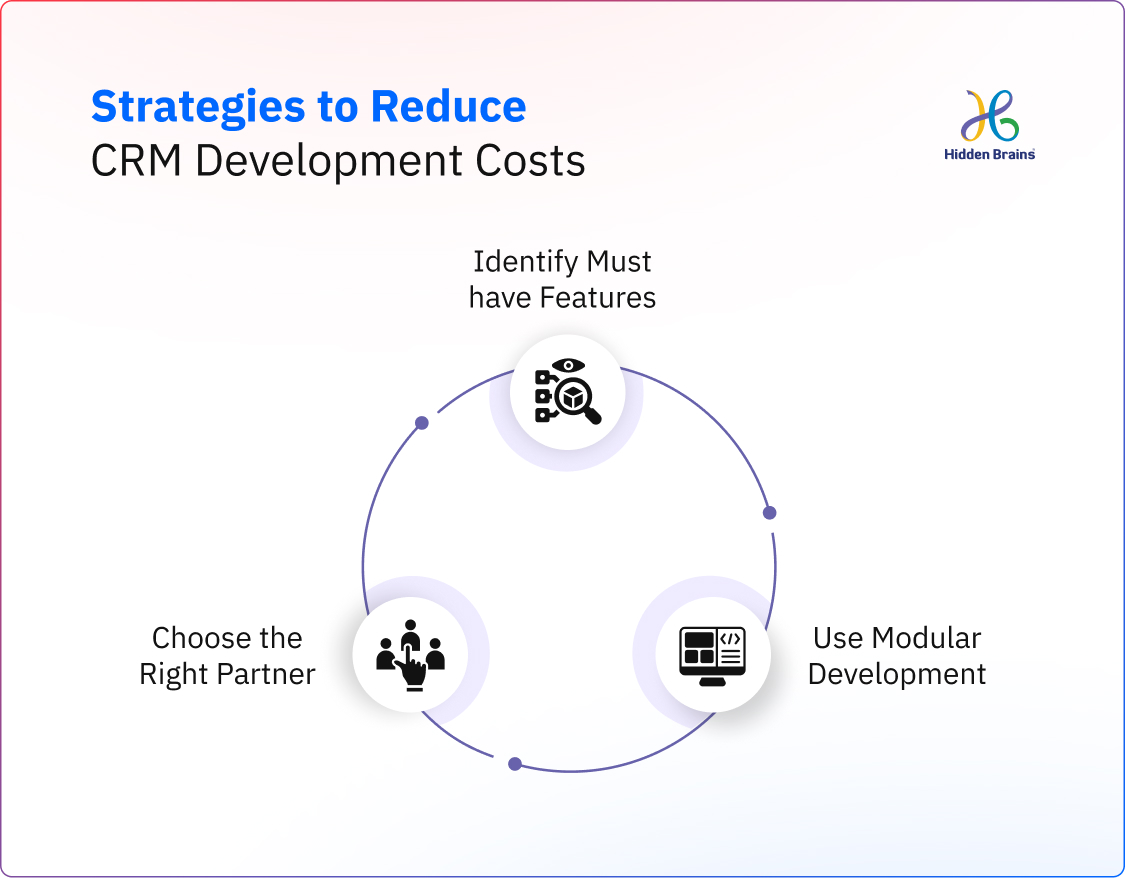
The following custom CRM development budget guide will give you a few practical insights.
Prioritize the Must-have Features
Start with essentials. Pick only the features your team cannot operate without. Skip the extras for now. This keeps the build lean. It shortens timelines and reduces rework. Add more features later based on real user feedback.
Use Modular Development or Pre-built Components
Go modular to save money. Break the CRM into reusable sections. Use pre-built elements where possible. This reduces coding effort. It improves consistency. It speeds up updates and future enhancements.
Choose the Right Partner (Experience, Portfolio, Region)
Select a reliable custom software development services partner with deep experience. Review their past work. Ensure they understand your industry. Region matters too. Some markets offer better rates without compromising quality. Good communication and clear processes reduce hidden costs.
Custom CRM Cost Examples (Real Scenarios)
Understanding real-world CRM builds can help you benchmark your own investment. Here are practical examples from different industries and scales:
Delta Airlines – Enterprise-grade Custom CRM App
Delta built a fully custom CRM mobile app for its 90,000+ employees, giving flight attendants real-time passenger data, service history, and on-board issue resolution tools. The app also includes video-chat support with ground agents.
Estimated cost range: $1M–$3M+ for enterprise-level CRM mobility.
Oneworld Accuracy – Mid-sized Professional Services CRM
This UK accounting firm with 150 staff deployed SuiteCRM with heavy customizations to centralize client records, automate compliance workflows, and track billable hours across EU branches.
Estimated cost range: $120K–$300K, depending on module depth.
Digital LMS Platform – CRM-integrated User Growth Engine
A fast-scaling LMS integrated a custom CRM layer to improve learner engagement, automate admin workflows, and personalize communication, driving 20% annual growth in users and 35% revenue increase.
Why Choose Hidden Brains
Hidden Brains brings 22+ years of global experience and has delivered 6,000+ custom software solutions worldwide. Our CRM implementation services cover everything from consulting and customization to support. With deep domain expertise and scalable delivery models, we help businesses build powerful, tailored CRM systems.
Looking for the Best Way to Build Your CRM with Expert Guidance?
Let’s Talk
Frequently Asked Questions
Custom CRM development can feel complex. These quick answers make it easier to plan, budget, and move forward confidently.
How much does custom CRM development cost in 2026?
Costs vary by size and features. Most projects fall between basic builds and enterprise-grade systems, and can range from $30,000 to $3,00,000. Regional choices also influence pricing.
How long does it take to build a custom CRM?
A custom CRM with core, essential features typically requires 2 to 4 months to develop. More complex, enterprise-grade CRM solutions—incorporating advanced functionality, third-party integrations, and extensive testing—generally take 6 months to a year to complete.
Is custom CRM better than off-the-shelf tools?
Yes, if you need control, flexibility, and scalability. Off-the-shelf works for simple needs.
Can AI features increase CRM costs?
Yes. AI adds complexity. It also adds value with better automation and insights.
Why do CRM costs vary across regions?
Talent rates, mobile-first needs, compliance rules, and tech stacks differ by region. This changes the overall cost and timelines.



Conclusion
Building a custom CRM in 2026 is an investment in long-term efficiency and smarter customer relationships. Costs vary, but clarity helps you plan better. Start small. Scale fast. Choose the right team. Hopefully, this blog helped you find clarity about the custom CRM development cost in 2026. With the right strategy, your CRM can grow with your business and deliver real, measurable impact.