






























































































































Quick Summary
- AI agents are moving into everyday business software — Companies are embedding agents into ERP, CRM, procurement, and operational platforms to automate real workflows, not just answer questions.
- The focus is shifting from building AI to making it work in the real world— Security, compliance, integration, and measurable business impact now define successful AI deployments.
- Europe’s enterprise AI adoption is accelerating— While many companies are exploring AI, scalable agent deployments are still an opportunity for early movers.
- Compliance needs to be built in from the start— EU AI Act requirements are influencing how organizations design, govern, and monitor AI agents.
- The real value comes from execution, not conversation— The strongest AI agents connect with existing systems and take controlled actions instead of simply providing information.
- Production-ready agents need strong foundations — Reliable deployments require secure permissions, audit trails, human oversight, evaluation, and continuous monitoring.
- Successful AI projects start with a clear business outcome— The best-performing initiatives begin with one workflow, one owner, and one measurable goal.
- Choosing the right AI partner is critical— Enterprises need a partner with AI expertise, software engineering experience, and a strong understanding of security and compliance to move from pilots to production.
European enterprises are embedding AI agents into the systems where work already happens: ERP, CRM, ticketing, procurement, and learning platforms. According to Gartner, agentic AI will be embedded in 33% of enterprise applications by 2028, up from less than 1% in 2024. The challenge is no longer building AI agents; it is deploying them securely, compliantly, and in ways that deliver measurable business value.
As the EU AI Act’s compliance obligations take effect, governance, not model capability, is becoming the primary determinant of which AI agent initiatives reach production.
This guide explores what embedded AI agents change, the adoption patterns emerging across Europe, and what to look for in an AI agent development partner.
| Section | Details / Information |
|---|---|
| Guide Focus | Explore how European businesses are embedding AI agents into enterprise software, the architecture patterns behind successful deployments, and what it takes to move from AI experiments to production-ready systems in 2026. |
| Time to Read | 15–20 minutes |
| Target Audience | CIOs, CTOs, enterprise leaders, product executives, innovation teams, and organizations evaluating AI agent development strategies in Europe. |
| TL;DR | AI agents are moving from standalone assistants into core business systems. The key challenge is no longer model capability, but building secure, integrated, and measurable AI solutions that deliver business value. |
| Main Takeaways | Learn how AI agents differ from traditional chatbots, where European adoption stands, the key patterns shaping enterprise AI agent development, production requirements, and how to choose the right AI development partner. |
| Business Impact | Understand how AI agents can automate workflows, reduce manual effort, improve decision-making, and increase operational efficiency across enterprise functions. |
| Key Challenges Covered | Explore the major challenges enterprises face when deploying AI agents, including system integration, data readiness, security, governance, scalability, and operational management. |
| Recommended For | European organizations planning AI agent initiatives, upgrading enterprise software with AI capabilities, or selecting an AI agent development company for production deployments. |
| Expected Outcome | Helps business leaders understand how to evaluate, build, and scale AI agents that align with business goals and enterprise requirements. |
What is an AI Agent Embedded Into Software?
An AI agent is a system that plans multi-step work, calls tools, and takes actions inside your existing software.
| Traditional Chatbot | Embedded AI Agent |
|---|---|
| Answers procurement questions | Executes procurement workflows |
| Reads information provided to it | Connects directly with ERP, CRM, and business systems |
| Suggests mismatched purchase orders | Compares PO, invoice, and goods receipt data |
| Requires a human to take action | Routes approvals or completes permitted actions |
| Limited audit trail | Actions logged with identity and traceability |
Key takeaway:
The value shift is moving from information retrieval to governed business execution.
As opposed to a chatbot, which answers questions in a separate window and leaves the work to you.
Where European AI adoption actually stands
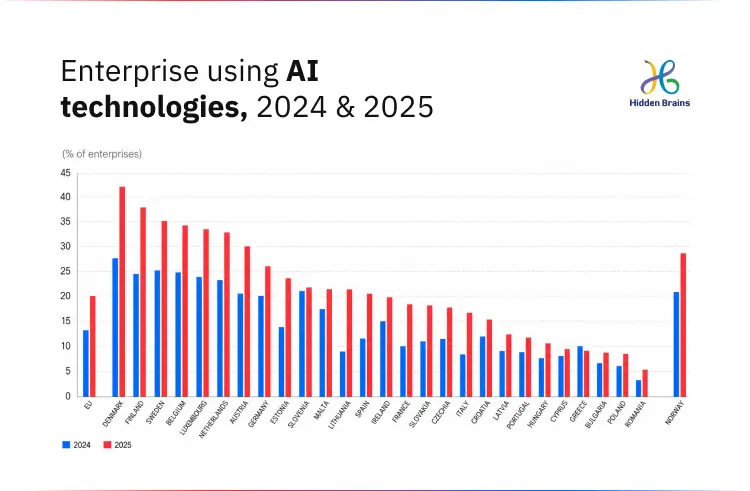
Twenty percent of EU enterprises used AI technologies in 2025, up from 13.5% in 2024, one of the sharpest single-year increases Eurostat has recorded. Among large enterprises, adoption reaches 55%.
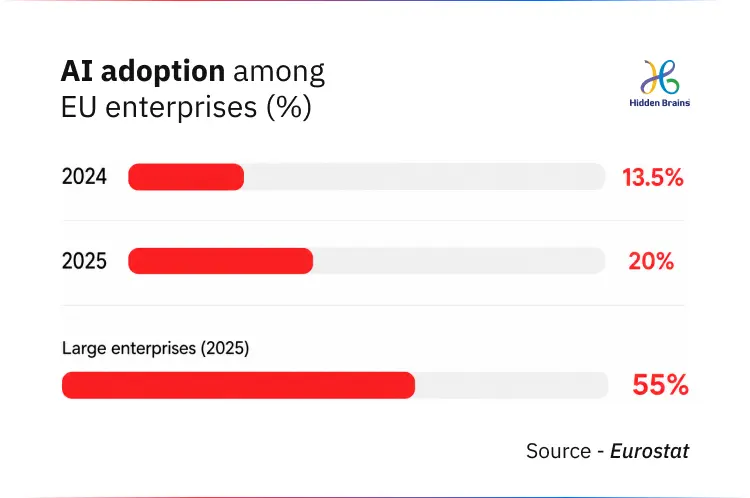
The headline number hides a wide spread. Adoption ranges from 5.2% to 42.0% depending on the member state, which means “the European market” is not one market and a partner claiming pan-European coverage should be able to say which one you are in.
Source : europa.eu
- Two things follow. First, the Nordic and Benelux markets are roughly a generation ahead of Central and Eastern Europe on adoption, so the same agent proposal lands very differently in Copenhagen and Bucharest.
- Second, most of that 20% is not agentic. Eurostat’s most-used AI technology in 2025 was text analysis, at 11.8% of enterprises. Agents that take actions across systems remain a small subset, which is precisely why the ones that work are still a competitive advantage rather than table stakes.
Create an Actionable AI Roadmap Built For Your Business Goals.
Get AI Consulting
What Difference Does an AI Agent Embedded Into Software Make?
An embedded agent changes throughput and consistency in the workflows it touches, because it removes the handoffs between systems where work currently waits for a human to re-key it.
The Business Impact of Embedded AI Agents: Capabilities and Limitations
Faster end-to-end execution
The agent removes the copy-paste step between systems. Where an invoice currently waits in an inbox for someone to open the ERP, find the PO, and re-key the match, the agent reads from one system and writes to the other directly. The time saved is not the seconds of typing; it is the hours or days the item spent queued.
This compounds where a process crosses three or four systems. Each crossing is a queue, and each queue has a person on the other side of it.
Greater accuracy and consistency
The agent applies the same business rule to every record, and logs which rule it applied. That second half matters more than the first.
Humans apply judgment inconsistently under volume, not through carelessness, but because attention degrades across a long queue. An agent does not degrade. More importantly, when it does get something wrong, the log tells you exactly which rule fired and on what input, so you fix the rule once rather than retraining a team.
Real-time intelligence at the point of decision
The agent monitors continuously and acts when a condition is met, rather than surfacing the issue in a report that someone reads on Monday.
This is the difference between reporting that explains what happened and monitoring that allows intervention. A stock variance flagged three days later is a write-off. The same variance flagged at the moment of receipt is a phone call to the supplier.
Scale without replatforming
Agents integrate through APIs into what you already run, which means the entry cost is one workflow rather than one system migration. You can start with invoice matching and extend to goods receipt without touching the ERP core.
Higher workforce productivity
Rules-based work moves to the agent; judgment work stays with the team. The realistic outcome in most deployments is not headcount reduction but capacity reallocation — the same people handling exceptions and customers instead of transcription.
What an Embedded Agent Does Not Fix
An embedded AI agent can improve existing workflows, but it cannot solve fundamental process, data, or ownership issues. Successful deployments require strong operational foundations before automation begins.
- It does not fix broken processes — Automating an unnecessary approval step only creates a faster version of the same inefficient process.
- It does not fix poor data quality — An agent working with incorrect inventory data will make confident decisions based on wrong information, faster and at a larger scale than a human.
- It does not fix unclear ownership — If no one owns the process outcome today, no one will own the agent’s output either. This lack of accountability is often a bigger risk than the technology itself.

Want to understand the right architecture for your AI agent software?
Get a 2 Hour Free ConsultationHow European Businesses are Building AI Agents Into Their Software
Five patterns account for most serious agent work in Europe in 2026:
- Compliance-first architecture — AI Act risk classification and auditability designed in before the build begins, not reviewed afterwards.
- Deep integration into core business systems — The agent reaches the ERP, CRM and ticketing directly, which makes integration the hard part rather than modelling.
- Compliance-native hybrid infrastructure — EU-domiciled inference and log storage for regulated workloads, commercial APIs for everything else.
- Composition over construction — Teams build on agent frameworks, platforms and model providers, reserving custom engineering for integration and guardrails.
- Measurable outcomes in value-bounded domains — One workflow, one owner, one number, with governance and skills funded as part of the build.
Each is covered below.
Pattern 1: Compliance-first architecture
European teams now classify the use case against the EU AI Act before choosing architecture, because the classification determines the architecture, not the other way round.
| Date | Applicable Rules / Milestone | Key Obligations and Notes |
|---|---|---|
| 2 August 2025 | GPAI obligations and AI governance rules apply (Articles 51–55) | Governance, coordination and cooperation measures; reporting and information-sharing requirements under Articles 51–55. |
| 2 August 2026 | Main AI Act rules begin applying, including Article 50 transparency obligations and enforcement mechanisms | Broad application of the AI Act; transparency obligations under Article 50 (labelling, user information, synthetic content traceability), plus Member State enforcement and market surveillance start. |
| 2 Dec 2026 | Transition deadline for certain Article 50(2) synthetic content obligations; additional prohibited AI practices apply | Deadline for compliance with Article 50(2) requirements for synthetic content; prohibition of newly listed harmful AI practices comes into force. |
| 2 August 2027 | Member States must have at least one operational AI regulatory sandbox | National sandboxes established to support testing and innovation under regulatory oversight. |
| 2 Dec 2027 | High-risk obligations apply to standalone Annex III AI systems | Full high-risk compliance requirements (risk management, conformity assessment, documentation, post-market monitoring) apply to standalone systems listed in Annex III. |
| 2 August 2028 | High-risk obligations apply to AI systems embedded in regulated products under Annex I | High-risk requirements extended to AI components embedded within regulated products (medical devices, automotive, etc.) under Annex I. |
The headline most people heard was “the EU delayed the AI Act.” That is only partially true, and operationally misleading. The timeline for some high-risk AI obligations has shifted, but core compliance requirements continue to take effect.
Transparency obligations under Article 50 apply from 2 August 2026, while certain high-risk AI system obligations have been deferred to later deadlines. For organizations building AI agents, this does not remove the need for preparation. It changes where teams should focus.
For an agent build, the timeline translates into concrete requirements:
Disclosure at the interface
Under Article 50, users interacting with an AI agent need to understand that they are interacting with an AI system. This is a product design decision, embedded in user flows, interface patterns, and communication design, not a compliance banner added at launch.
Decision and tool-call logging
Every action an agent takes against a system of record needs to be attributable, traceable, and reconstructable. Retrofitting structured logging, audit trails, and identity controls after deployment is significantly more complex.
Human oversight paths
Sensitive workflows require defined escalation routes, approval checkpoints, and human intervention mechanisms. Confidence thresholds and oversight models need to be designed into the agent architecture from the beginning.
Substantial-modification tracking
AI systems already placed on the market may benefit from transitional provisions until significant changes are introduced. Organizations need clear records of what changed, when it changed, and whether those changes trigger new compliance obligations.
The revised timeline is not a reason to pause. Classification, data governance, evaluation frameworks, and operational controls remain the longest-lead activities in AI Act readiness. The additional time creates an opportunity to build these foundations properly, not postpone them.
Pattern 2: Deep integration into core business systems
The real value of AI agent development services comes from connecting agents with the systems where business already happens: ERP, CRM, ticketing, procurement, and operational platforms
Most enterprise systems were not designed for autonomous AI access. The biggest challenges are not model capabilities, but enabling secure, controlled, and reliable interactions between AI agents and existing software.
The key considerations are:
System connectivity
The agent must access the right data and actions through well-defined APIs and integration layers. Reading information is common; enabling controlled actions requires deeper engineering.
Identity and permissions
AI agents need their own identity with clearly defined access boundaries. They should only perform actions they are authorized to take, with every activity traceable to the agent and user context.
Controlled actions and approvals
Not every workflow should be fully automated. Enterprises need clear rules around which actions the agent can execute independently and where human approval is required.
Reliable enterprise integration
Agents need consistent ways to interact with multiple systems without creating fragile point-to-point integrations. Standards such as Model Context Protocol (MCP) are helping enterprises build more scalable tool access layers.
Pattern 3: Compliance-native hybrid infrastructure
European deployments increasingly split the stack: EU-domiciled inference and log storage for regulated workloads, commercial APIs for everything else.
Three questions decide the split, and a partner who cannot answer them contractually is not ready for regulated European deployment:
- Where does the agent’s reasoning computation physically occur?
- Where are its logs and audit trails stored, and for how long?
- Which third-party model provider processes what data, under which agreement?
| Model | Control & Auditability | Run Cost at Volume | Time to First Deployment |
|---|---|---|---|
| EU-domiciled self-hosted | Highest — full control of weights, logs, residency | Higher fixed cost, lower marginal cost | Slowest |
| Hybrid | Regulated workloads isolated; general workloads on API | Balanced | Moderate |
| Commercial API only | Depends on provider terms and regional endpoints | Low fixed, high marginal at volume | Fastest |
The economics matter more than they used to. A pilot handling a few hundred calls a day costs almost nothing on a commercial API. The same agent at production volume generates orders of magnitude more inference, and the point where self-hosting becomes cheaper arrives faster than most business cases assume. Model that curve before you commit, not after.
Pattern 4: Composing on Platforms Rather Than Building From Zero
Most European teams are no longer writing orchestration from scratch. They compose on agent frameworks and platforms, and reserve custom engineering for integration, guardrails, and evaluation, the parts specific to their business.
| Approach | Control | Time to Production | Lock-in Risk | AI Act Documentation Burden |
|---|---|---|---|---|
| Build from scratch | Highest | Slowest | Lowest | Carried entirely by you |
| Compose on a platform | High where it matters | Moderate | Moderate | Shared, but you remain the deployer |
| Buy a packaged agent | Lowest | Fastest | Highest | Depends heavily on vendor documentation |
One practical reality: AI agent technology is still evolving. Frameworks change, vendors consolidate, and switching between platforms is not always easy. Keep your business logic separate from the underlying agent framework, and plan for some components to change over time.
Buying an AI agent solution does not remove your responsibilities. Under the EU AI Act, the organization using the system typically remains responsible for deployment practices, including human oversight, monitoring, and ensuring the system is used correctly.
Pattern 5: Measurable Outcomes in Value-bounded Domains
The agent deployments that reach production start narrow: one workflow, one accountable owner, one number that proves it worked.
Research across 2025 and 2026 is consistent that the dominant causes of agent pilot failure are organisational rather than technical: unclear success criteria, insufficient tool and data access, and missing evaluation coverage. Model quality is rarely the binding constraint.
A note on the widely cited “88% of AI agents fail to reach production” claim: this figure is frequently repeated in vendor content and industry discussions, but it does not trace back to a publicly available primary research source.
The reality is more nuanced: many AI agent pilots do struggle to move into production, but the reasons are typically not model limitations. They are usually linked to integration challenges, unclear business ownership, governance gaps, data readiness, and operational complexity.
What the ones that work have in common:
- A quantified success criterion agreed before build. “Reduce invoice matching cycle time from two days to four hours,” not “improve efficiency.”
- A named owner with authority across IT, operations, and compliance. Someone who can unblock a data access issue without convening a steering committee.
- An evaluation harness. Because agent output is non-deterministic, conventional test cases do not work.
- You need a graded set of representative inputs with expected behaviours, run continuously, the equivalent of a regression suite for a system that does not give identical answers twice.
- Budget for governance and skills. The operating cost of an agent includes the people who monitor it. Funding the build without funding the run is the most reliable way to produce an expensive orphan.
Where European Businesses are Deploying AI Agents: Use Cases
Agents are landing first in workflows that are high-volume, rule-governed, and expensive to staff, and where an error is recoverable.
| Function | What the Agent Does |
|---|---|
| Procurement | Matches invoices to POs and goods receipts, flags variances above tolerance, routes exceptions. |
| Order-to-cash | Validates orders, chases missing data, updates status across ERP and CRM. |
| Customer service | Resolves routine tickets end-to-end, escalates on low confidence with full context attached. |
| Document review | Extracts and compares terms across contracts and regulated archives. |
| Internal knowledge | Answers policy and process questions against controlled internal sources. |
| Recruitment | Screens and structures candidate information, with humans retaining all hiring decisions. |
A European deployment in practice
Hidden Brains built a generative AI layer into a learning management platform for a European EdTech client, not as a separate assistant, but embedded in the product: an AI tutor answering student questions in context, automated feedback and assessment, content summarisation, adaptive learning paths, and predictive analytics identifying at-risk students for early intervention.
Two aspects of that build are directly relevant to any European agent project:
Compliance was designed in, not added.
GDPR compliance, encryption, and access controls were part of the architecture from the requirements phase rather than a pre-launch review.
The intelligence went where the work was.
The AI tutor lives inside the learning journey, not in a separate window students have to remember to open.
The client reported an 88% growth in course completion rates and a 60% increase in user engagement following deployment. (See the full case study.)
What Production-Grade AI Agents Need Inside Enterprise Software
A production AI agent is not a smarter chatbot. It is an operational software capability that can reason, execute workflows, interact with enterprise systems, and operate within defined controls.
The gap between a successful demo and a production deployment is determined by eight capabilities:
1. Multi-step reasoning and workflow execution
Enterprise AI agents must translate business goals into a sequence of actions, not just answer questions. For example, invoice reconciliation requires validation across multiple systems, business rules, and approval paths. Production AI software needs adaptive workflows that handle exceptions, not fixed scripts.
2. Persistent workflows and recovery
Enterprise processes rarely complete in a single interaction. AI agents need to maintain state, resume interrupted tasks, and prevent duplicate actions across long-running workflows. Reliable orchestration and workflow management are critical for production AI deployments.
3. Context and memory management
AI agents need the right context at the right time, not unlimited memory. Effective systems determine what information to retain, retrieve, summarize, or discard. This directly impacts accuracy, cost, and user experience.
4. Enterprise system integration
The value of AI agents comes from their ability to operate within existing business applications. Production deployments require secure connections across ERP, CRM, document systems, and operational platforms. Integration architecture, not model selection, often becomes the primary scaling challenge.
5. Security and role-based access
Enterprise AI agents require controlled identities and permission boundaries.
They must operate with least-privilege access and respect existing authorization models. Security cannot be added after deployment; it must be designed into the AI software architecture.
6. Auditability and explainability
Every agent action must be traceable, reviewable, and understandable.
Organizations need visibility into decisions, tool usage, data access, and workflow execution. Auditability is a foundation for enterprise trust and regulatory readiness.
7. Human oversight and approval controls
Automation does not remove the need for human judgment in critical workflows.
Sensitive actions require defined approval points, escalation paths, and accountability.
The strongest AI agent implementations combine autonomy with appropriate human control.
8. Multi-agent orchestration
Complex enterprise processes often require multiple specialized AI agent development that work together. A coordinated approach can improve scalability, but introduces new challenges around reliability and governance. Successful deployments require clear roles, evaluation methods, and operational controls.
What to Get Right Before You Build
The capabilities above describe the system. This checklist covers the inputs, and most agent projects fail here rather than on engineering.
| Factor | What Good Looks Like | Warning Sign |
|---|---|---|
| AI Act classification | Your use case mapped against Annex III with specific reasoning, documented before architecture. | “We’ll assess compliance at the end” |
| Data readiness | The data the agent reads is current, owned, and known to be accurate. | Nobody can say who owns the source table. |
| Tool and API access | Required actions exposed as scoped, permissioned endpoints. | The agent needs a shared admin account to function. |
| Agent identity | Its own identity with least-privilege permissions and full attribution. | Actions logged as a generic service user. |
| Evaluation coverage | Graded test set of representative inputs, run continuously. | “It seemed to work in the demo” |
| Human oversight | Defined confidence thresholds, escalation routing, named recipients. | Escalation goes to an unmonitored queue. |
| Audit logging | Every tool call and decision reconstructable after the fact. | Logs capture outputs but not inputs or reasoning steps. |
| Data residency | Contractually specified processing and storage locations. | “It’s in the EU” with no contractual basis. |
| Run-cost model | Inference cost projected at production volume, not pilot volume. | Business case built on pilot-scale API spend. |
| Named owner | One person accountable across IT, operations, and compliance | Ownership distributed across a committee. |
The AI Software Development Process for Agentic Systems
Building an agent follows a recognisable software development process, with one structural difference: evaluation replaces test cases, because the output is non-deterministic.
- Use-case scoping: Define the workflow, success metrics, and AI Act classification before development begins.
- Data and tool access audit: Map required systems, permissions, and integration requirements.
- Agent design and guardrails: Establish action limits, approvals, escalation paths, and logging controls.
- Evaluation harness: Create measurable tests to validate agent performance before deployment.
- Staged rollout: Start with human-in-the-loop workflows before expanding autonomy.
- Observability and monitoring: Continuously track performance, changes, and production behaviour.
How Our AI Agent Software Development Company in Europe Helps
We help enterprises design, develop, and deploy production-ready AI agents that integrate with existing business systems and workflows. With deep enterprise software expertise, we focus on building secure, scalable, and business-driven AI solutions.
- AI agent strategy and development: Identify high-value use cases and build custom AI agents aligned with business goals.
- Enterprise integration: Connect AI agents with ERP, CRM, BI, and operational systems through secure architectures.
- Secure AI engineering: Build agents with GDPR, governance, access controls, and auditability in mind.
- MCP and tool-access development: Enable secure agent interaction with enterprise systems using controlled permissions.
- Production deployment and optimization: Move AI agents from prototypes to reliable enterprise software solutions.
Frequently Asked Questions
How do we control and audit AI agent decisions in production?
AI agent costs depend on usage, model selection, infrastructure, integrations, and monitoring needs. Enterprises should estimate AI agent development and operational costs based on production scale, not pilot usage.
How do we control and audit AI agent decisions in production?
Production AI agents require audit logs, role-based access, human oversight, and governance controls to ensure every action is traceable, explainable, and compliant.
Can we change model providers later without rebuilding?
Yes. A flexible AI agent architecture separates business logic, integrations, and workflows from the underlying AI models, reducing vendor lock-in.
How long before we see measurable ROI?
ROI depends on workflow complexity, integration readiness, and business goals. Focused AI agent solutions with clear success metrics typically deliver value faster.
How do enterprises manage AI agents after deployment?
Successful enterprise AI agent deployment requires continuous monitoring, performance evaluation, workflow updates, security reviews, and ongoing optimization.

Conclusion
European AI agent development in 2026 is defined less by model capability and more by the ability to deploy, govern, and scale agents in production.
The leading enterprises are following five principles: classify compliance requirements before architecture, integrate agents into systems of record, design for governance and security, build scalable orchestration, and focus each agent on a measurable business outcome.
Two factors should shape every AI agent strategy today: EU enterprise AI adoption increased from 13.5% to 20% in one year, and the EU AI Act timeline is moving forward despite changes to high-risk obligations. Article 50 transparency requirements still apply from 2 August 2026.
The deferral is time to prepare, not time to wait. The organizations that move fastest will be those that establish the right foundations early.
Ready to move beyond AI agent experiments? Build production-ready AI software with our AI agent development experts.