





































































































































Summary
- Understand the UAE and Saudi AI regulatory landscape before development.
- Classify AI use cases according to data, impact, autonomy, and risk.
- Map AI data flows across models, APIs, vector databases, vendors, and logs.
- Build privacy and data governance into the architecture.
- Apply Zero Trust and guardrails to autonomous AI agents.
- Use an Enterprise AI Gateway to centrally enforce AI access and security policies.
- Evaluate foundation-model providers and third-party AI risks.
- Govern fine-tuning, model updates, maintenance, and production changes.
- Establish continuous testing, monitoring, auditability, and human oversight.
- Treat AI compliance as an engineering capability—not a final-stage checklist.
What happens when your AI does exactly what you asked—but exactly what your policy prohibits?
For enterprises in the UAE and Saudi Arabia, that gap can become a regulatory, financial, and reputational risk.
As AI systems gain access to enterprise data, APIs, and business workflows, compliance can no longer sit at the end of the development process, especially when UAE requirements such as the Federal Personal Data Protection Law (PDPL), and Saudi requirements such as the Saudi Personal Data Protection Law (PDPL), its Implementing Regulations, and SDAIA’s AI Ethics Principles can directly shape how AI systems are designed and deployed.
It needs to be designed into the system, from data governance and security to access controls, human oversight, and auditability.
That is the role of an experienced AI Software Development company in the UAE: turning compliance requirements into controls that are built into the product, rather than added after it.
The goal isn’t to limit what AI can do. It’s to architect what AI is allowed to do.
So, how do you put this into practice? The following steps show how enterprises can embed compliance into the AI development lifecycle, from architecture to deployment and beyond.
Establish the Regulatory Perimeter Before You Build
AI compliance does not begin with the model. It begins with AI development services that are architected around the regulatory obligations applicable to the application.
The same AI capability can carry very different compliance implications depending on where it is deployed, which sector it serves, what data it processes, and the decisions or actions it enables.
For organizations operating across the UAE and Saudi Arabia, four dimensions should be assessed at the outset:
- Jurisdiction: UAE mainland, DIFC, ADGM, or Saudi Arabia
- Sector: Financial services, healthcare, telecommunications, government, or other regulated industries
- Data: Personal, sensitive, financial, health, employee, or government data
- AI function: Whether the system generates content, provides recommendations, makes decisions, or takes autonomous action
This distinction is important because regulatory exposure is driven not simply by the use of AI, but by the combination of data, purpose, impact, and degree of autonomy.
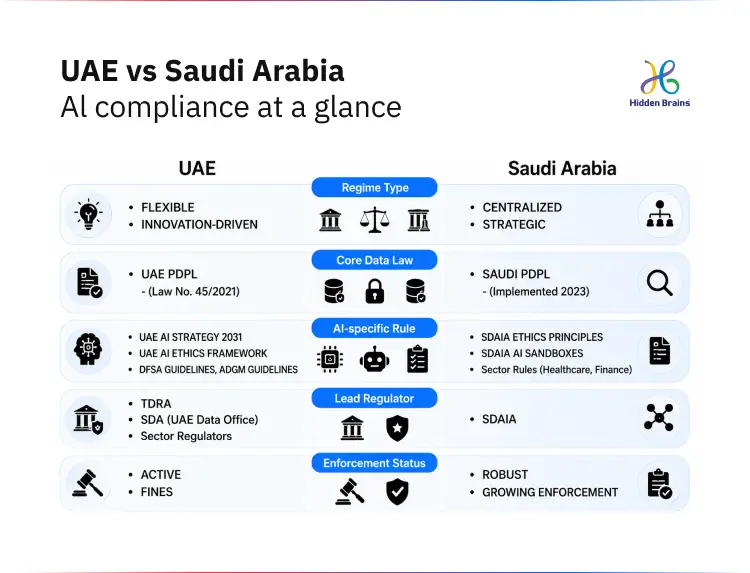
In the UAE, organizations may need to assess the federal data-protection framework alongside requirements applicable within specific jurisdictions such as DIFC and ADGM, as well as sector-specific obligations. DIFC is particularly relevant for AI deployments because its data-protection framework includes provisions addressing personal data processed through autonomous and semi-autonomous systems.
Saudi Arabia presents a similarly layered environment. The Saudi Personal Data Protection Law and its implementing framework establish requirements for personal-data processing, while SDAIA’s AI Ethics Principles and AI governance frameworks introduce additional considerations around privacy, security, transparency, human oversight, and risk management.
The practical implication is straightforward:
Do not begin with “Which model should we use?” Begin with “What are we permitted to let this AI system do?”
Enterprise AI success goes beyond the demo. It requires a clear path from AI capability to measurable business outcomes and ROI, while ensuring the application remains secure, compliant, and governable.
Classify the AI Use Case Before You Build
Not every AI application carries the same level of risk. It’s not a boxed solution that applies to all.
A tool that summarizes internal documents is fundamentally different from an AI system that evaluates a loan application, recommends a medical treatment, or executes a financial transaction.
Yet organizations often classify AI based on the technology—the model, platform, or architecture, rather than the impact of the use case.
A more effective approach is to assess four dimensions:
- Data: What information does the system process?
- Impact: Who could be affected if the system is wrong?
- Decision authority: Does the AI generate, recommend, decide, or act?
- Reversibility: Can its decision or action be easily reversed?
This creates a practical risk spectrum:
| Risk level | Typical use cases |
|---|---|
| Low | Internal summarization, enterprise search, drafting |
| Moderate | Customer support, personalization, document classification |
| High | Lending, insurance, recruitment, healthcare recommendations |
| Very high | Autonomous payments, deletion, production changes, critical systems |
The key distinction is often autonomy. Consider two systems that use the same underlying model:
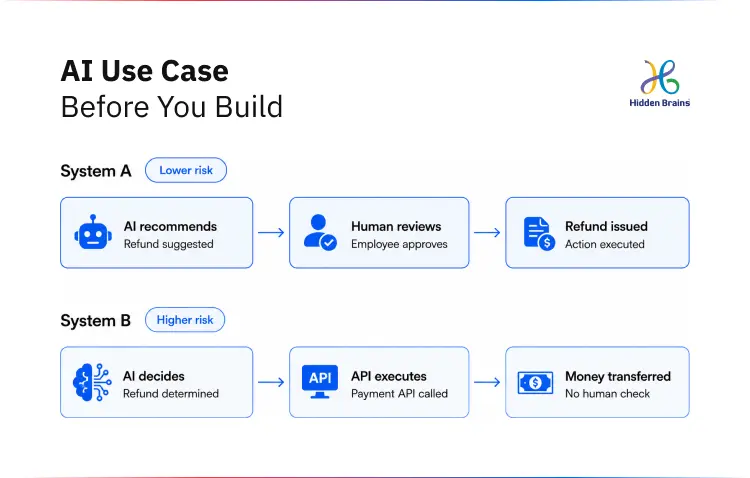
The model has not changed, but the risk has.
As AI moves from generating information to making decisions and taking actions, the required level of oversight, access control, testing, and auditability should increase accordingly. This is where AI optimization can improve efficiency.
In regulated financial systems, risk classification is critical. In a five-year engagement with Credit Pulse, a Saudi national credit bureau under SAMA supervision, we rebuilt a machine-learning credit-scoring platform with compliance, data security, real-time risk monitoring, dispute resolution, and auditability embedded into the architecture. The microservices-based platform supported a 62% revenue increase and 94% user satisfaction, based on client-reported outcomes.
Risk classification should precede architecture and development, ensuring the application’s autonomy is proportionate to its potential impact.
Turn AI compliance requirements into production-ready architecture.
Talk to our Experts
Map the AI Application’s Data Flow End to End
Once the use case has been classified, the next question is deceptively simple:
Where does the data actually go?
For traditional applications, organizations are accustomed to mapping databases, APIs, and user access. AI introduces additional layers that can create new data flows and new compliance exposure.
A single AI interaction may move information through:
- User
- Application
- AI Gateway
- AI Orchestrator
- RAG / Vector Database
- Model Provider
- Tools / APIs
- Human Review
- Business Systems
- Logs & Monitoring
Each layer can introduce a different privacy, security, or regulatory consideration.
The data flow should account for more than the production database
Personal or sensitive information may also appear in:
- Prompts and conversation history
- Uploaded documents
- Vector embeddings
- Model inputs and outputs
- Debug and application logs
- Evaluation datasets
- Monitoring and analytics platforms
- Backups and caches
- External APIs
- Vendor and subprocessor systems
This creates an important architectural question:
If sensitive data leaves the primary application, do you still know where it is, who can access it, and how long it remains there?
From Data Mapping to Architecture
Mapping the flow is only the first step. The right data engineering services can turn these requirements into enforceable controls across the AI data lifecycle.
AI pipelines should control how data is ingested, classified, transformed, stored, accessed, and deleted, particularly when external model providers or cross-border transfers are involved.
This can translate into controls such as PII redaction, data minimization, tenant isolation, access controls, retention policies, and data-loss prevention.
The objective isn’t just to know where the model runs. It’s to know where your data goes—and control it.
You cannot govern a data flow you cannot trace.
Build Privacy by Design into the AI Architecture
Knowing where data flows is not enough. The next step is to build privacy controls into the architecture itself.
AI applications should follow the principle of collecting and exposing only the data necessary for a specific task. Sensitive information should not automatically flow into every prompt, model, database, or API the system can access.
This can be achieved through architectural controls such as PII detection and redaction, data minimization, pseudonymization, tenant isolation, granular access controls, and configurable retention and deletion.
For example, a customer-service agent may need to verify a customer’s identity without requiring the underlying system to expose their complete financial or personal profile to the model.
The same principle applies to AI vendors. Organizations should establish whether providers retain prompts and outputs, use customer data for training, where inference takes place, and how data is deleted.
Privacy therefore becomes more than a policy requirement. It becomes an engineering constraint that shapes what the AI can access, process, retain, and expose.
The safest AI architecture is not the one that protects all data after access. It is the one that limits unnecessary access in the first place.
This is where privacy-by-design becomes particularly important for organizations deploying AI across the UAE and Saudi Arabia: privacy should be enforced by the architecture, not left to the user’s judgment or the model’s behavior.
Engineer Guardrails for AI Agents
A conventional AI application primarily generates. AI agent development takes this further, enabling systems to retrieve information, make decisions, and take action by calling APIs, updating records, sending communications, or initiating transactions.
For organizations deploying AI in the UAE and Saudi Arabia, this makes the agent’s permissions and accountability part of the compliance architecture, not simply a security consideration.
Apply Zero Trust to Agentic AI
AI agents should not receive unrestricted access by default. A Zero Trust approach means every agent, user, tool, and request must be verified and authorized before access is granted.
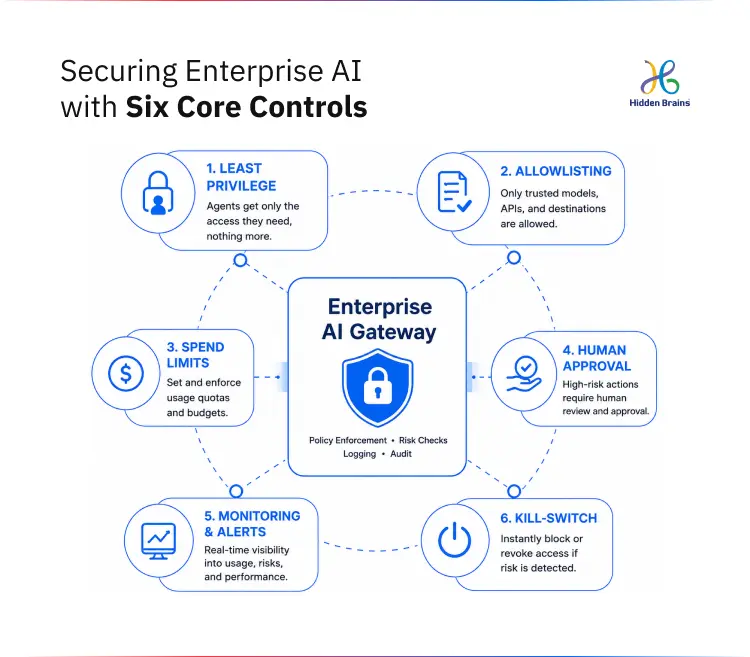
Key controls include:
- Least-privilege access
- API and tool allowlisting
- Transaction and spending limits
- Human approval for high-impact actions
- Continuous monitoring and audit logs
- Rollback and kill-switch mechanisms
An Enterprise AI Gateway can provide a centralized control layer between agents, models, enterprise data, and tools, enforcing identity, access, data, API, and audit policies consistently.
This becomes particularly important where AI systems process personal or sensitive data or perform actions that could materially affect customers, employees, or business operations.
The goal is controlled autonomy: allowing AI to operate at machine speed while keeping high-impact actions within clearly defined boundaries.
An AI agent should earn autonomy through evidence, not receive it by default.
Build Security and Human Oversight into the System
AI security cannot stop at securing the model. The application, data, tools, APIs, and people around it also need protection.
For AI deployments in the UAE and Saudi Arabia, security and oversight should be designed into the system from the beginning. This is where an established engineering process matters. Hidden Brains’ ISO/IEC 27001-certified security practices and CMMI Level 3 delivery process mean these controls are built and verified inside the development lifecycle, not bolted on after deployment.
Secure the AI Application
AI-specific threats can include:
- Prompt and indirect prompt injection
- Sensitive-data leakage
- Retrieval or knowledge-base poisoning
- Excessive agent permissions
- Insecure tool and API calls
- Cross-tenant data exposure
- Unauthorized model or prompt changes
Controls such as input/output validation, DLP, network restrictions, short-lived credentials, tool isolation, and continuous monitoring can reduce these risks.
Make Human Oversight Meaningful
Human-in-the-loop should not become a checkbox. For high-impact actions, the reviewer should have:
- Context
- Evidence
- Authority to intervene
- Ability to override
The system should also make it clear when AI is being used, what role it plays, and when a decision or action requires human review. This is particularly important for AI applications affecting financial decisions, healthcare, employment, customer rights, or other high-impact outcomes.
The objective is not to place a human behind every AI decision. It is to ensure that the right decisions have the right level of human control.
Human oversight is effective only when humans have the authority and the information to intervene.
Treat the AI Supply Chain as Part of Your Risk Perimeter
Building a compliant AI application does not end with the systems an enterprise owns.
Modern AI architectures often depend on foundation-model providers, cloud infrastructure, vector databases, APIs, monitoring platforms, and other subprocessors. Each dependency can introduce its own data, security, and regulatory considerations.
For organizations operating in the UAE and Saudi Arabia, vendor selection therefore needs to go beyond model accuracy, latency, and cost.
The critical question is:
Can you govern the data and risk introduced by every provider your AI depends on?
This requires visibility into where data is processed, how long it is retained, whether it is used for training, where subprocessors operate, and how the provider handles deletion, incidents, and changes to its services.
These requirements should be reflected in the architecture, contracts, access policies, and ongoing monitoring of the AI application.
The objective is not to eliminate third-party providers. It is to ensure that external dependencies do not become blind spots in your AI governance framework.
Compliance Is a Continuous Operating Model
AI governance does not end when the application goes live.
Model updates, fine-tuning, new training data, prompt changes, RAG updates, new tools, and changing user behavior can all alter how an AI system performs, and the risks it creates.
For enterprises in the UAE and Saudi Arabia, maintenance therefore needs to be treated as part of the governance model.
Before a significant change reaches production, teams should assess:
- What changed?
- Could it affect the system’s risk classification?
- Does it introduce new data or vendors?
- Do existing guardrails still work?
- Does it require new testing or human approval?
Fine-tuning deserves particular attention. Introducing new datasets can affect privacy, bias, model behavior, and data provenance. Similarly, changing a model provider or adding a new agent tool can introduce an entirely new data flow or permission boundary.
This is why mature AI environments use versioning, controlled releases, regression testing, monitoring, and rollback mechanisms across models, prompts, datasets, and policies.
Every significant AI change can change its risk profile—validate, monitor, and govern it before deployment.
The goal is not to slow down iteration. It is to ensure that AI can evolve without silently moving beyond the controls that made it safe to deploy.
Make AI Compliance an Engineering Capability
AI governance is most effective when it is treated as an engineering capability rather than a compliance exercise.
For enterprises, this means moving from policies that describe what AI should do to architectures that determine what it can do. Regulatory requirements need to translate into concrete controls across the AI lifecycle: use-case assessment, data architecture, model selection, access permissions, agent behavior, security testing, deployment, and ongoing monitoring.
This shift matters because AI systems are not static. Models are updated, data sources evolve, new tools are connected, and autonomous capabilities expand. A control that is effective today may not be sufficient tomorrow.
Organizations therefore need an operating model that brings together business, legal, risk, security, data, and engineering teams around a common AI governance framework—with clear ownership for decisions and measurable controls.
For companies operating in the UAE and Saudi Arabia, the opportunity is to build compliance into the foundation of AI adoption rather than treating it as a constraint on innovation.
That is where AI Software Development Services in the UAE can play a strategic role: translating regulatory and business requirements into scalable architecture, enforceable controls, and production-ready AI systems.
The result is not simply compliant AI.
It is AI that an enterprise can trust, scale, and measure against the outcomes it was built to deliver.

Build a Governed, Enterprise-Grade AI in UAE
Meet Our On-Ground TeamBuild AI That Can Be Trusted at Scale
The question for enterprises is no longer whether AI can be deployed. It is whether it can be deployed with enough control to scale.
In the UAE and Saudi Arabia, that requires more than selecting the right model or meeting regulatory requirements on paper. It requires an architecture that connects data governance, security, privacy, agent controls, human oversight, vendor management, and continuous monitoring.
The most effective approach is to build these capabilities into the AI lifecycle from the beginning, not retrofit them when the system is already in production. For enterprises, this creates a more sustainable path to AI adoption: faster innovation, clearer accountability, lower risk, and greater confidence in scaling AI across the business.
The objective is ultimately simple: build AI that is not only intelligent, but governable, secure, purpose-fit, valuable, and ready for enterprise scale.
For organizations looking to build that foundation, AI Software Development Services in the UAE can provide the engineering expertise needed to translate governance requirements into production-ready AI architecture.
Frequently Asked Questions
Should we build compliant AI in-house or work with a development partner?
It depends on whether you already have engineering, security, and data-governance capability that understands UAE and Saudi obligations. In-house fits when AI is core IP and you have that bench. A partner is usually faster and lower-risk when the compliance surface (PDPL, DIFC Regulation 10, SDAIA) is unfamiliar or the system is high-risk, because the controls have to be right the first time.
What needs to be in place before we start building?
Clarity on three things: which jurisdictions and sectors apply, what data the system will touch, and how much autonomy it will have. Most compliance failures trace back to skipping this, not to the model. A short use-case classification and data-flow mapping exercise up front saves far more time than it costs.
How long does it take to build a compliant AI application in the UAE or Saudi Arabia?
It scales with the risk tier, not the model. A low-risk internal tool can ship in weeks; a high-risk regulated system (lending, insurance, healthcare) takes longer because risk assessment, security testing, human-oversight design, and auditability are part of the build, not add-ons. Governance and data readiness usually drive the timeline more than the AI itself.
Can we integrate compliance and governance into an AI system that’s already live?
Yes, but it costs more and constrains more than designing it in. Retrofitting means re-mapping data flows, adding access controls and audit logging, and sometimes re-architecting where sensitive data was allowed to spread. Worth doing, but classifying risk and designing privacy and oversight in before the first line of code is always cheaper.
If our AI makes a wrong or non-compliant decision, who is accountable, us or the vendor?
The organization deploying the system generally carries the regulatory accountability, not the technology vendor. Under DIFC Regulation 10, the Deployer is treated as the controller. A partner can build and evidence the controls, but responsibility for the outcome stays with you, which is why oversight and auditability must be architected in and why contracts should spell out data handling, retention, and incident duties.
How do we choose an AI partner that genuinely understands UAE and Saudi governance?
Look past model accuracy and delivery speed and ask how they handle governance: how they classify risk, map data flows, enforce least-privilege access for agents, and evidence compliance. A credible partner discusses controls and auditability as readily as capability, and has delivered in regulated, high-risk sectors such as financial services, not just built demos.

Conclusion
In the UAE and Saudi Arabia, the question is no longer whether AI works, but whether it can be trusted to operate within clear limits as it scales. Meeting PDPL, DIFC Regulation 10, and SDAIA’s principles matters, but compliance on paper was never the goal. Governance is: risk classified before architecture, data flows mapped, privacy and access designed in, agents held to least-privilege, and human oversight with real authority.
Done this way, governance stops being a brake and becomes the foundation for scaling AI with confidence. That is where an experienced AI Software Development company in the UAE earns its place, turning governance requirements into architecture and controls an enterprise can trust.