



















































































































Summary
The EU AI Act timeline has changed, but businesses still need to prepare. This guide breaks down what Austrian enterprises need to know about AI compliance, risk levels, contracts, documentation, and governance before building or upgrading software with AI features. It explains what has already taken effect, what is coming next, and how teams can build compliance into their software from day one.
| Section | Details |
|---|---|
| Guide Focus | AI integration patterns, architecture decisions, data handling, stability practices, and practical implementation guidance. |
| Target Audience | CTOs, Engineering Leads, Product Managers, and teams responsible for software modernization. |
| TL;DR | The EU AI Act deadline has been extended, but its compliance requirements remain unchanged. Austrian enterprises should use this time to embed AI governance, documentation, and oversight into software projects. Preparing now is simpler and more cost-effective than retrofitting for compliance later. |
| Main Takeaways | Understand integration options, avoid common architecture mistakes, and build AI features that scale. |
| Recommended For | Teams exploring AI adoption within existing enterprise applications. |
| Reading Time | 15 minutes |
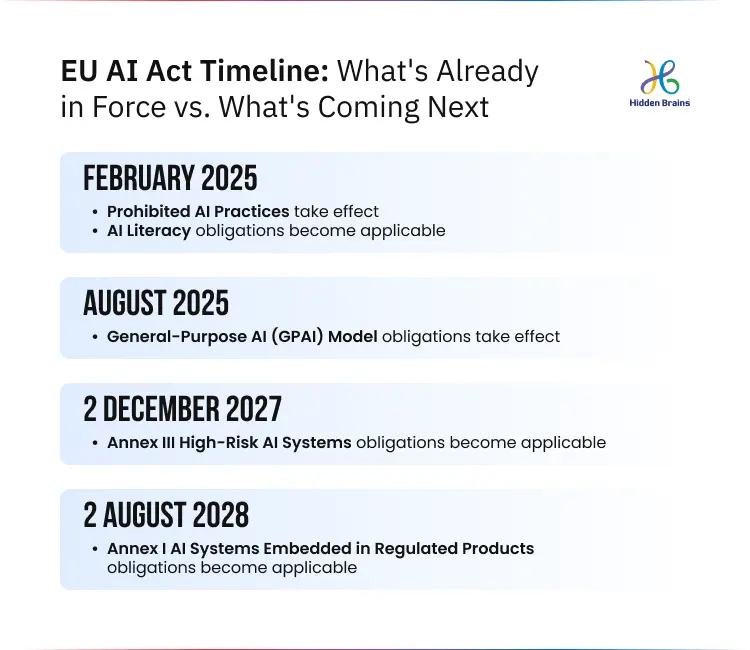
If your team is still planning around an August 2026 compliance deadline, that date has moved. Under the Digital Omnibus deal adopted on 7 May 2026, the European Commission pushed enforcement of high-risk AI obligations under Annex III to 2 December 2027, with Annex I systems (AI embedded in regulated products) now due 2 August 2028. The obligations themselves have not softened. Only the schedule has changed.
For an enterprise commissioning custom software in Austria, that gap between now and enforcement is a genuine planning window, not a reason to slow down. Several guides still ranking for this topic quote the original August 2026 date, and vendors, internal stakeholders, and even legal teams are sometimes still working to a deadline that no longer applies. Getting this wrong in either direction carries a cost.
Assuming the delay means the Act can wait creates the same exposure as ignoring it, because the underlying obligations are unchanged and Austria’s oversight structure is already taking shape.
What Actually Stayed the Same
The Act’s core structure survived the Omnibus revision untouched. It still classifies AI systems into four risk tiers: unacceptable (banned), high-risk, limited-risk (transparency obligations), and minimal-risk (largely unregulated). It still assigns different duties depending on whether an organization is a provider, meaning it builds or commissions an AI system placed on the market, or a deployer, meaning it uses one within its own operations.
Technical documentation, risk management systems, human oversight design, and event logging are all still coming. They arrive on a later schedule, with added simplifications for SMEs and small mid-cap companies.
It is also worth being precise about what was never delayed. Prohibited AI practices and the Article 4 AI literacy obligation have applied since February 2025, and rules for general-purpose AI models have applied since August 2025. Part of the Act is already live and enforceable today, independent of what happens with Annex III. The AI literacy requirement is easy to miss because it does not sound technical.
It obliges any organization developing or deploying AI systems to ensure that the staff involved have a sufficient level of AI competence and understanding, a point that Austria has begun to reinforce through national digital skills programs. A newly shipped AI feature with no accompanying training or documentation for the staff who operate it is already out of step with a rule that has been active for well over a year.
The practical takeaway for enterprises building bespoke software is straightforward. Documentation, logging, human oversight, and staff literacy are far cheaper to build in during development than to retrofit after go-live. A compliance-aware custom enterprise software development company treats this as an architecture decision made at the start of a project, not an audit item added at the end.

Build Compliance In, Not On
Talk to Our TeamWhich Enterprise Software Features are Considered High Risk?
Risk classification depends on how a system is used, not which vendor built it or which model sits underneath it. A recruiting module, a credit scoring feature, and a customer support chatbot can be built on the same underlying AI platform and still land in entirely different risk tiers, because the function each performs is what the Act evaluates.
| Risk Tier | Common Enterprise Software Use Case | What Changes in the Build |
|---|---|---|
| Unacceptable (banned) | Social scoring, manipulative behavioral targeting | Not permitted. Remove from scope entirely. |
| High-risk (Annex III) | Employment or recruiting screening, credit or insurance scoring, access to essential services, biometric identification | Technical documentation (Annex IV), risk management system, human oversight design, event logging, and conformity assessment before deployment |
| Limited-risk | Customer-facing chatbots, AI-generated content tools | Disclosure that users are interacting with AI, labeling of AI-generated content |
| Minimal-risk | Internal productivity tools, spam filters, and non-decisioning automation | No specific AI Act obligations, though GDPR and general data governance still apply |
A single enterprise software estate often spans all four tiers at once. That is why an AI system inventory, mapping every model, feature, and data dependency across an organization’s applications, is the practical starting point before any build decision gets made.
Who Enforces This in Austria, and Who to Actually Talk to
Austria has not passed a standalone national AI law. The EU AI Act applies directly, and national implementation is still forming. The KI-Servicestelle, established within the Rundfunk und Telekom Regulierungs-GmbH (RTR), is currently the main point of contact for Austrian organizations navigating the Act, though it functions as an advisory and coordination body rather than an enforcement authority today.
An eleven-member expert body, the KI-Beirat, advises the federal government and RTR on technical, ethical, and policy questions. The stated plan is a two-step approach: the Servicestelle is expected to transition into a dedicated national AI authority with market surveillance and enforcement powers once the high-risk provisions become applicable.
In the meantime, Austria’s data protection authority, the Datenschutzbehörde (DSB), remains active on the GDPR side of AI systems, particularly automated decision-making and profiling.
Any enterprise software project touching personal data should assume DSB-level scrutiny applies now, regardless of when AI Act enforcement formally activates. Much of that discipline overlaps with the practices covered in our GDPR compliance strategies for enterprise software, since AI Act and GDPR obligations converge wherever personal data feeds a model.
Discuss Your GDPR and AI Act Roadmap With Our Experts
Get 2 Hour Consultation
Provider vs. Deployer: Why It Matters for Your Next Software Contract
Most Austrian enterprises commissioning custom software are deployers. They use AI systems within their own operations rather than placing them on the market under their own name. That distinction blurs quickly in practice. A company that commissions a bespoke recruiting tool and appears as its operator may carry deployer obligations even though a development partner built the underlying system.
An organization that customizes or substantially modifies a general-purpose AI model for a specific high-risk use case can become a provider under the Act, with a fuller documentation burden attached.
This is a contracting question as much as a technical one. Enterprise software agreements should state, in writing, who owns risk classification, who maintains technical documentation, and who is responsible for post-market monitoring once a system goes live.
What to Put in Your Next Software RFP or Vendor Contract
Before commissioning or renewing an enterprise software build with AI components, a compliance-aware RFP should require vendors to address the following areas:
- AI feature inventory: Will the vendor document every AI-enabled feature, its purpose, data sources, and EU AI Act risk classification as part of the delivery process?
- Governance and human oversight: Does the proposed architecture include clear points for human review, override, escalation, or intervention for high-risk decisions, rather than adding audit logs after deployment?
- Technical documentation ownership: Who is responsible for maintaining Annex IV-style technical documentation after go-live, and how long will those records be retained?
- Data provenance and bias controls: Can the vendor provide evidence of where training or fine-tuning data originated, how data quality was assessed, and what measures were used to identify and mitigate bias?
- Role allocation and liability: Does the contract clearly define who carries provider versus deployer obligations if responsibilities change during implementation, customization, or ongoing operation?
Including these requirements early helps organisations avoid discovering compliance gaps after the software is already deployed.
“Most vendors don’t raise these questions. That’s where enterprises can end up exposed—and where the right development partner earns trust by asking the right questions first.
This is where enterprises choose Hidden Brains.
Not just for development, but for the engineering expertise, governance, and accountability needed to build with confidence.”
None of this is abstract. Each question maps to something a development team should already be able to produce: an architecture diagram showing where human review sits in a decision flow, a data lineage document, a versioned model changelog. A vendor unable to answer these concretely at the proposal stage is worth weighing as carefully as price or timeline.
A Practical Starting Sequence
Enterprises without a dedicated AI governance function sometimes assume readiness requires specialized compliance staff before any project can begin. A more workable approach is to sequence readiness into the software delivery process itself through a structured self-assessment or internal audit.
This helps teams identify AI-enabled features, evaluate risk levels, build oversight controls, and maintain documentation as part of normal development workflows.
1. Do you know where AI exists in your software estate?
Create an inventory of every AI-enabled feature, what it does, what data feeds it, and who is affected by its outputs.
2. Has every AI feature been classified by risk level?
Map each feature against the four EU AI Act risk tiers and validate borderline cases, such as recruiting, credit, biometric, and safety-related systems, against Annex III. Misclassification can create unnecessary compliance work or leave gaps.
3. Is human oversight designed into the product?
For high-impact AI features, build review, override, and escalation paths into the UI and workflow during design, not after user testing.
4. Is compliance documentation part of delivery?
Treat technical documentation, testing evidence, and governance records as development outputs created during engineering and QA, rather than documents rebuilt months after launch.
5. Does your change process trigger AI reviews?
A new model version, data source, or feature expansion should automatically trigger a risk reassessment instead of waiting for an annual review.
None of this requires an enterprise to have AI governance maturity before starting a project. It requires a development partner who builds these checkpoints into delivery by default.
Does the Delay Mean You Can Wait?
No, and this is where the Omnibus delay is most often misread. The obligations themselves are not shrinking; only the runway is longer. Software built without documentation, logging, or oversight will still need retrofitting later, and retrofitting audit trails into a live system is materially harder than designing for them upfront.
There is also a closer deadline that gets far less attention: the EU Product Liability Directive, which extends strict liability to software and AI, requires Member States to transpose it into national law by 9 December 2026, nearly a year before the Annex III deadline. For any enterprise building or deploying software that could cause harm through an AI-driven decision, that liability shift is arguably the nearer-term risk.
Treating the current window as a head start, rather than a reason to deprioritize the work, is the difference between running a compliance program and running a compliance scramble.
Frequently Asked Questions
Has the EU AI Act deadline changed in 2026?
Yes. Under the Digital Omnibus deal adopted on 7 May 2026, enforcement of high-risk Annex III obligations was postponed from 2 August 2026 to 2 December 2027. Annex I high-risk systems now apply from 2 August 2028. The substantive obligations were not reduced.
What is the Digital Omnibus AI Act delay?
It is a European Commission package proposing targeted simplifications to the AI Act, including SME documentation relief, expanded regulatory sandbox access, and a delayed timeline for high-risk system enforcement, without changing the Act’s core risk-based structure.
Is my company’s AI system high-risk under the EU AI Act?
Classification depends on how the system is used, not on which vendor or model powers it. Systems used in employment, credit or insurance decisions, access to essential services, biometric identification, or critical infrastructure are the most likely to fall into the high-risk Annex III category.
What does the EU AI Act mean for software developers?
For teams building enterprise software, it means risk classification, documentation, human oversight design, and event logging need to be part of the development lifecycle rather than an afterthought added before audit. Contracts should also clarify who owns compliance responsibilities as roles shift between provider and deployer.
Which authority enforces the AI Act in Austria?
Austria has not yet designated a dedicated enforcement authority. The KI-Servicestelle at RTR currently provides guidance and coordination, with plans to transition into a full enforcement body once high-risk provisions become applicable. The Datenschutzbehörde continues to enforce GDPR obligations on AI systems involving personal data in the meantime.
Do small and mid-sized companies get AI Act exemptions?
Not full exemptions, but simplified obligations, including reduced technical documentation requirements and prioritized access to regulatory sandboxes, are extended to SMEs and small mid-cap companies under the Omnibus revisions.
What happens if enterprise software isn’t AI Act compliant?
Penalties are tiered by violation type, up to 35 million euros or 7% of global turnover for prohibited practices, with lower but still substantial caps for other high-risk violations. Beyond fines, non-compliance can trigger mandatory recalls, deployment suspension, and reputational damage.



Conclusion
Compliance is not a checklist added to a finished system. It is a set of architecture and process decisions made during discovery, data design, and testing. For Austrian enterprises building or modernizing software with AI components, that means classifying risk before writing a line of code, designing human oversight into the interface rather than the incident report, and keeping documentation current as a byproduct of delivery rather than a retrospective exercise.
Hidden Brains’ enterprise software development services in Austria are built around this discipline, informed by the same rigor applied to GDPR-sensitive builds and backed by ISO/IEC 27001:2022 and ISO 9001:2015-certified delivery processes.