












Summary
- Build modular, Arabic-capable, auditable, human-governed AI agents.
- Map controls to PDPL, NCA ECC-2:2024, and SDAIA principles.
- Govern memory, logs, and vector stores as personal-data assets.
- Increase autonomy gradually, with approvals and kill switches.
- Start with one workflow, then reuse the foundation to scale.
A production-ready enterprise AI agent architecture in Saudi Arabia is modular, Arabic-capable, permission-aware, auditable, and human-governed. It lets an agent act on enterprise systems while the organization keeps control of its data, decisions, security, and accountability.
That sounds simple until the first pilot meets a review board. The agent answers HR questions perfectly in the demo. Then the data protection officer asks where the vector index is hosted, the CISO asks which service account can write to the ERP, and nobody can show who approved the last action it took. The project stalls.
This pattern is common. Gartner predicts that over 40% of agentic AI projects will be canceled by the end of 2027, citing rising costs, unclear business value, and inadequate risk controls. In the Kingdom, the risk-control part has a specific shape: the Personal Data Protection Law (PDPL), the National Cybersecurity Authority’s Essential Cybersecurity Controls (NCA ECC), and the AI ethics framework from the Saudi Data and Artificial Intelligence Authority (SDAIA).
This guide sets out the seven layers of an enterprise agent architecture, maps each one to the Saudi framework that governs it, and walks through a six-step path from pilot to production.
What Does “Production-ready” Mean for an Enterprise AI Agent?
An AI agent is production-ready when it can prove, with evidence, that it does a bounded job well, stays inside its permissions, and hands control to a person when it should. Working in a demo is not the same thing.
The difference starts with what the system can do. A generative AI chatbot primarily responds to questions. An AI agent goes further: it can plan steps, make decisions, and take actions such as creating a purchase request, updating a CRM record, or routing a case.
Once AI can act within business systems and change records, the requirements for security, permissions, governance, and human oversight become significantly higher. This distinction is explored further in our comparison of generative AI vs. agentic AI.
Before release, a production-ready agent can demonstrate all of the following:
- Named owners for the business outcome, technical operation, and AI risk. SDAIA’s ethics framework calls the risk role a Responsible AI Officer. In a mid-sized organization, one person may hold two of these roles.
- A bounded use case with measurable outcomes, such as reduced handling time, faster quote turnaround, better first-contact resolution, or less compliance-review effort.
- Permission-aware access to enterprise data and systems, so the agent sees and does only what the requesting user is allowed to.
- Guardrails, audit trails, and human escalation for consequential decisions.
- Arabic and English performance thresholds tested before release, including Gulf dialect and mixed-language queries.
- Monitoring of quality, drift (including silent updates from the model provider), security events, cost per completed task, latency, adoption, and business KPIs.
- A documented rollback, kill-switch, incident-response, and model-change process.
- Evidence of PDPL compliance, plus NCA- and SDAIA-aligned controls where they apply.
If any item is missing, the agent is still a pilot. That is not a failure; it simply tells you which work remains.
What Are the Layers of a Production-ready AI Agent Architecture?
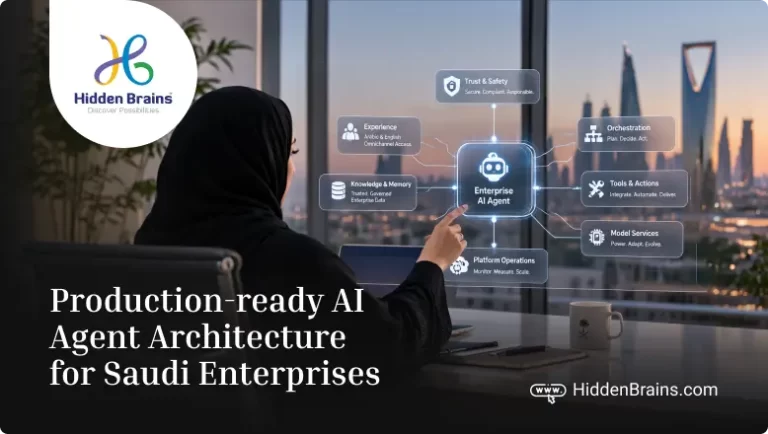
A production-ready AI agent architecture has seven layers: experience, orchestration, knowledge and memory, tools and actions, model services, trust and safety, and platform operations. Each layer has a job, and each needs a control that makes it safe to run on real data.
| Layer | What it must do | Production control |
|---|---|---|
| Experience | Arabic/English chat, voice, portal, mobile, or embedded workflow entry point | Arabic-first UX, clear AI disclosure, accessibility, user authentication, handoff to a human |
| Orchestration | Plans tasks, routes requests, manages state, retries failures, enforces policy | Approval gates for high-impact actions, step-level decision traces, a kill switch per agent |
| Knowledge and memory | Retrieves approved content through governed RAG; holds session and long-term memory | Data classification, permission-aware retrieval, retention rules, source citations, residency for vector indexes and memory stores |
| Tools and actions | Calls ERP, CRM, HR, banking, field-service, or government-integration APIs | Least-privilege service identities, sandboxing, idempotent writes, audit logs |
| Model services | Selects and routes among LLMs, embedding models, and domain models | Approved hosting location, Arabic evaluation sets, vendor risk review, model version pinning |
| Trust and safety | Detects prompt injection, personal-data leakage, ungrounded answers, policy violations | Input and output guardrails, groundedness checks, red-teaming, incident response |
| Platform operations | Tracks cost, latency, quality, adoption, failures, security events | Cost ceilings per agent, monitoring and alerting, prompt and model versioning, evaluation regression tests |
What the Table Doesn’t Show
- Agent memory is personal data. Vector indexes, conversation memory, and trace logs fall under PDPL just like the source systems, so they need the same classification, retention, and access rules. (Our guide to RAG vs LLMs covers retrieval design.)
- Every write must be safe to retry. Each tool runs under its own least-privilege identity, often through the Model Context Protocol (MCP), and idempotent writes stop a retry from creating two purchase orders.
- Arabic quality is measured, not assumed. Test on your own dialect and mixed-language set rather than a vendor benchmark. In-Kingdom compute options are also expanding, as we covered in our analysis of the US-Saudi AI infrastructure deal.
- Every new AI agent should cost less to operate, not more. Track cost per completed task and rerun evaluations whenever prompts or models change. Enterprise AI agent development services help build the operational foundation to scale efficiently.
Single-agent or Multi-agent LLM Architecture: Which Does an Enterprise Need?
Most enterprises should start with a single agent and split it only when a part of the work needs different permissions, a different model, or independent failure handling. A multi-agent LLM architecture adds coordination cost, more places to trace, and more service identities to secure.
| Question | Single agent fits when | Multi-agent fits when |
|---|---|---|
| How varied are the tasks? | One workflow with a few tools | Several distinct skills, such as research, drafting, and approval |
| Do steps need different permissions? | One permission scope covers the job | A step touches finance or personal data that others must not reach |
| Does work change hands? | One agent can finish the job | Work passes between specialist roles, as cases do between departments |
| What happens when a step fails? | Restarting the whole task is acceptable | One part must fail without stopping the rest |
| What is the audit burden? | One trace per task is enough | Each agent’s decisions must be reviewable on their own |
Permission separation is the strongest reason to split in a Saudi context. If one step reads HR records and another posts to a public channel, two agents with two narrow identities are easier to defend in a PDPL or NCA review than one agent that holds both rights.
How Do PDPL, NCA ECC, and SDAIA Guidance Shape the Architecture?
Saudi Arabia has no AI-specific law yet, so agents are governed by existing frameworks: PDPL for personal data, NCA controls for cybersecurity, and SDAIA guidance for AI ethics and adoption. None of them mention “agents” by name, which is why the architecture has to translate them into design decisions.
| Layer | Governing framework | Evidence an auditor will ask for |
|---|---|---|
| Knowledge and memory | PDPL: purpose limitation, minimization, retention, cross-border transfer | A data inventory that includes vector stores, memory, and logs; the legal basis for any transfer |
| Model services | PDPL transfer rules; NCA Cloud Cybersecurity Controls for government entities and critical infrastructure | Where each model processes data; the vendor assessment; the transfer safeguard used |
| Tools and actions | NCA ECC-2:2024: identity and access management, event logging, third-party security | Service identity permissions; an action audit trail tied to a user and an approval |
| Orchestration | SDAIA AI Ethics Principles and Generative AI Guidelines for Government: human oversight | Approval records for high-impact actions; decision traces |
| Experience | SDAIA AI Ethics Principles: transparency | The AI disclosure shown to users; escalation records |
PDPL: Agent Data Stores Count as Personal Data Stores
The PDPL has been fully enforceable since 14 September 2024, with SDAIA as the regulator. For agents, three requirements matter most:
- Everything the agent stores is in scope. Embeddings, chat memory, and trace logs derived from personal data need the same classification, retention, and access rules as the source.
- Transfers outside the Kingdom need a safeguard. SDAIA’s rules rely on its own standard contractual clauses, binding corporate rules, or certification, and transfers of sensitive data need a risk assessment. Sending prompts that contain personal data to a model hosted abroad is a transfer.
- Some controllers must register. Public entities, organizations whose core activity is processing personal data, and those processing high-risk sensitive data register with SDAIA’s national register of controllers.
NCA ECC-2:2024: Treat the Agent as a Privileged User
The Essential Cybersecurity Controls (ECC-2:2024) apply to government entities, their affiliates, and private organizations that own, operate, or host critical national infrastructure. Other organizations can adopt them voluntarily, and many regulated buyers ask suppliers to. Related NCA frameworks such as the Cloud Cybersecurity Controls (CCC) and Data Cybersecurity Controls (DCC) cover hosting and data handling.
The practical implication is clear: an agent with write access to business systems should be treated as a privileged identity. Give it scoped credentials, log every action, review access regularly, and apply the same third-party scrutiny used for production vendors. This aligns closely with the principles behind AI in zero trust security.
Move Your AI Pilot Into Production With Confidence
Talk to AI Architect
SDAIA AI Ethics Principles: From Principle to Engineering Control
SDAIA’s AI Ethics Principles set seven principles and sort AI systems into four risk tiers: little or no risk, limited risk, high risk, and unacceptable risk. Compliance is optional for the lowest tier, expected for limited and high risk (with extra controls for high risk), and unacceptable-risk systems are prohibited. The framework also calls for a Responsible AI Officer and an AI System Assessor.
So the first step is to classify each agent use case by tier. The second is to turn each principle into something the engineering team can build and test:
| SDAIA principle | Production control |
|---|---|
| Fairness | Bias testing across language and dialect, gender, nationality, region, and customer segments where relevant |
| Privacy and Security | Personal-data detection and masking, data minimization, access control, encryption, retention rules, approved hosting location |
| Humanity | Human review for high-impact or ambiguous decisions; outputs checked against cultural and organizational norms |
| Social and Environmental Benefits | A stated purpose and benefit for each agent; right-sized models to avoid unnecessary compute |
| Reliability and Safety | Evaluation suites, fallback responses, human handoff, incident runbooks |
| Transparency and Explainability | AI disclosure, source citations, groundedness indicators, a clear “I can’t answer that” path |
| Accountability and Responsibility | Named Responsible AI Officer and owners, model registry, approval records, audit logs |
One technical note on transparency: confidence scores that an LLM reports about itself are unreliable. Showing whether an answer is backed by retrieved sources is the more honest signal.
Other SDAIA guidance to track
- Generative AI Guidelines for Government (January 2024) set expectations for public-sector use, including data handling and oversight.
- AI Adoption Framework: non-binding guidance for government and businesses, organized around directions, enablers, and outcomes, such as AI governance units, data governance, and lifecycle documentation.
- Draft Responsible AI Policy: SDAIA consulted on a draft from 3 April to 3 May 2026, covering areas such as testing and performance monitoring.
- Sector regulators add their own rules. Banks, for example, also answer to the Saudi Central Bank (SAMA).
**This section summarizes public frameworks for architecture planning. It is not legal advice; confirm obligations with your legal and compliance teams.

Build AI Agents That Meet Saudi Compliance Requirements
Get Free ConsultationWhere Should Humans Stay in the Loop, and How Much Autonomy Is Safe?
Humans should stay in the loop wherever an agent’s action is consequential, hard to reverse, or affects someone’s rights. Autonomy is not a yes-or-no setting; it is a ladder, and each workflow climbs it only as evidence builds.
- Read-only. The agent retrieves and summarizes. People decide and act.
- Draft for review. The agent prepares a reply, a report, or a purchase request. A person approves every one.
- Act with approval. The agent executes after a named person approves, and the approval is logged with the action.
- Act within limits. The agent acts alone below defined thresholds, such as a value, a customer tier, or a data class, and escalates above them.
- Act autonomously. Reserved for low-risk, reversible actions with strong monitoring and a tested kill switch.
For government entities and regulated sectors, three design rules make this ladder auditable:
- Separate reversible from irreversible actions. Drafting an email can run at rung 4. Releasing a payment or changing a citizen or customer record should stay at rung 3 until long, clear evidence exists.
- Make escalation a first-class path. The agent should hand over the full context: what it was asked, what it found, and why it stopped. A human should not have to start from zero.
- Keep a kill switch per agent. Operations staff must be able to pause one agent without taking down the platform, and the pause itself must be logged.
This is also how SDAIA’s Humanity and Accountability principles become concrete: a person can always see, approve, or stop what the agent does.
How Do You Move From a Generative AI PoC to a Production Agent in Saudi Arabia?
Move one bounded workflow through six steps, using the production-ready checklist above as the exit test. Steps 2 and 5 are often rushed, yet they are exactly where security reviews tend to focus. This is also why many AI pilot programs struggle to move beyond experimentation
- Select one bounded workflow. Choose work with clear value, measurable outcomes, and manageable risk. In rising order of risk, good candidates are procurement-document triage, field-maintenance knowledge assistance, customer-service case summarization, and HR-policy support. Name a business owner, record today’s baseline, and start at read-only or draft-for-review.
- Map data and systems. List sources, sensitivity, owners, retention rules, APIs, and approval requirements. Include the stores the agent will create itself: vector indexes, memory, and logs. Confirm the PDPL basis for any transfer outside the Kingdom.
- Build the minimum governed architecture. That means single sign-on (SSO), governed RAG, a tool sandbox, guardrails, logging, evaluation, and human handoff. Run a first round of prompt-injection testing before any real user touches it.
- Pilot with real users. Measure task completion, accuracy, escalation rate, adoption, latency, and cost against the baseline, using targets agreed with the business owner in advance. Test in Arabic, English, and mixed-language queries.
- Harden for production. Add policy gates, monitoring, full red-teaming, model-version governance, and incident response. Assemble the control evidence an NCA-aligned audit will ask for, and confirm every item on the production-ready checklist.
- Scale through reusable platform services. Turn the first use case’s identity, retrieval, tool, evaluation, and governance components into shared enterprise capabilities, so each new agent reuses them instead of rebuilding them.
The last step is where the economics change. The first agent pays for identity integration, evaluation tooling, and governance; later agents should mostly pay for their own workflow logic.
We applied the same principle in an AI-powered recruitment platform Hidden Brains built for our client. The AI reads CVs in varied formats, scores job fit, and shortlists candidates, but it recommends rather than acts: rankings go to recruiters, who make the hiring decisions. That is level 2 on the autonomy ladder, the right starting point for any workflow that affects people.
What Drives AI Agent Software Integration Cost?
AI agent software integration cost is driven less by the model and more by the systems the agent must connect to, the controls it must carry, and the volume it runs at. Published price ranges are rarely comparable, so it is more useful to know what moves the number.
| Cost driver | Why it moves cost | What lowers it |
|---|---|---|
| Number and age of systems integrated | Legacy ERP or on-premises systems often lack clean APIs and need adapters | Start with systems that already expose APIs; add others in later phases |
| Hosting location requirements | In-Kingdom or dedicated hosting can limit model choice and raise infrastructure cost | Classify data first; keep only regulated workloads on restricted hosting |
| Inference volume and model choice | Every step and retry consumes tokens | Route simple tasks to smaller models; cap retries; cache retrieval |
| Arabic evaluation | Dialect and mixed-language test sets take real effort to build and maintain | Build one shared Arabic test set and reuse it across agents |
| Human-in-the-loop interface | Approval queues, context views, and audit screens are real software | Reuse one approval service across agents |
| Governance and monitoring | Logging, red-teaming, and evaluation runs continue after launch | Make them shared platform services from the first agent |
The highest avoidable cost is rebuilding integrations twice: once for the pilot and again for production. Building the pilot on the governed architecture from the start costs more in month one and less by month six. Teams scoping this work often begin with AI integration services that connect agents to existing ERP and CRM platforms.
What Should You Ask an AI Agent Development Company in Saudi Arabia?
Ask for evidence, not demos. A capable partner can show how its agents are governed in production, not only how they perform in a sandbox. Six questions separate the two quickly:
- Can you show a control mapping from your agent architecture to PDPL, NCA ECC, and SDAIA guidance, with the evidence each control produces?
- What does an audit trail look like? Ask to see one action traced from user request to tool call to approval.
- How do you evaluate Arabic performance, including Gulf dialect and mixed Arabic-English queries, and what thresholds gate a release?
- Where will our data, embeddings, and logs be processed and stored, and what hosting options do you support?
- How do you handle a bad output in production? Look for a rollback plan, a per-agent kill switch, and an incident runbook.
- What will we own at the end? Prompts, evaluation sets, and integration code should be yours, so a second agent does not depend on one vendor.
At Hidden Brains, enterprise AI work usually starts before technology selection, with the workflow, the data it touches, and the approvals it needs. Our delivery runs under ISO/IEC 42001:2023 for AI management, ISO/IEC 27001:2022 for information security, ISO 9001:2015 for quality management, and CMMI Level 3 processes, which matter here because agent governance is mostly disciplined engineering: access control, change management, and evidence. If you are evaluating an AI agent development company in Saudi Arabia, use the six questions above with us as well.
Frequently Asked Questions
What business results can AI agents deliver for a Saudi enterprise?
AI agents pay off when they remove a specific operational bottleneck: faster case resolution, quicker quote or procurement turnaround, fewer manual handoffs, or lower compliance-review effort. Leadership should judge them on those outcomes, measured against a baseline recorded before the pilot, not on how impressive the demo looks.
How do we measure ROI on an AI agent?
Track three things from day one: time or cost saved per completed task, quality (error and escalation rates), and adoption by the teams meant to use it. Compare each against the pre-pilot baseline, and include the full running cost, not just the build cost.
Which workflow should we start with?
Start where the value is clear, and the risk is low: a high-volume, repetitive workflow with a named business owner, such as procurement-document triage or internal knowledge assistance. Leave decisions that affect payments, customers, or employees until the organization has evidence the agent performs reliably.
How long before we see results?
Expect the first measurable results from a narrowly scoped, read-only agent sooner than from one that updates core systems. What sets the pace is usually internal: how quickly data owners, security, and compliance can sign off, not how fast the AI is built.
What does an AI agent cost, and how do we control it?
The main cost drivers are how many business systems the agent connects to, where it must be hosted, how heavily it is used, and how much human approval it needs. Keep spend predictable by setting a budget ceiling per agent and building shared components once, so each additional agent costs less than the first.
Is it a regulatory risk to use global AI providers?
It can be if customer or employee data leaves the Kingdom without a safeguard recognized under the PDPL. Before approving any agent, leadership should get a clear answer on where its data is processed and stored, and on what legal basis.
Who is accountable when an AI agent makes a mistake?
The organization is, so accountability has to be assigned before launch. Every production agent should have a named business owner and a named risk owner, a record of who approved its actions, and the ability to switch it off immediately.
Will AI agents replace our employees?
In most enterprises, agents take over repetitive searching, drafting, and routing, while people keep judgment, approvals, and exceptions. The larger business risk is not replacement but falling behind competitors that use agents to respond faster.
Should we build AI agents in-house or work with a partner?
Build in-house if you already have AI engineering, security, and Arabic-language expertise and can retain it. A partner makes sense when speed to production or governance experience matters more, provided your organization owns the resulting assets so you are not locked into one vendor.

Conclusion
The question is no longer whether AI agents work. It is whether your organization can let software act on its behalf and still answer for every action.
The winners will not run the most pilots. They will pick one workflow with a measurable bottleneck, settle data and approvals early, and reuse that foundation so each new agent costs less and clears review faster.
With PDPL enforced and SDAIA actively shaping AI policy, governance designed in from day one is what turns an agent from an experiment into an operating capability. Start with a free two-hour consultation to map your first workflow, its data, and the controls it needs, then take it to production with our AI agent development services.