













Summary
- Claims automation speeds up intake, then stalls at disconnected systems.
- The hidden cost: re-keying, exceptions, resubmissions, missed deadlines, leakage.
- UAE rules (45/30-day payments, 72-hour Shafafiya updates) make integration urgent.
- Insurers connect to eClaimLink and Shafafiya, not NABIDH or Malaffi.
- Integrate first; buy or build only where a system is the bottleneck.
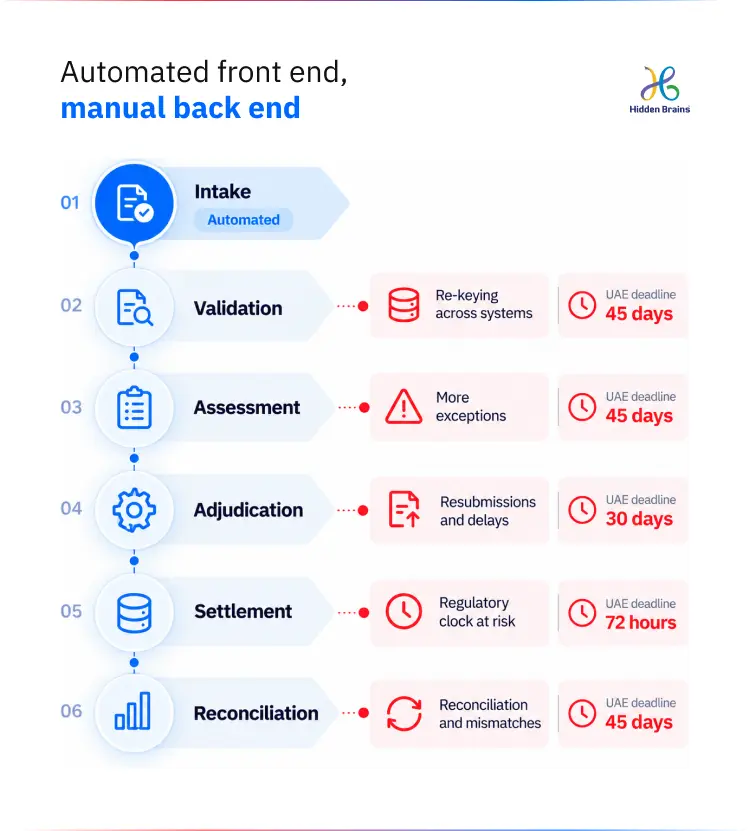
Insurance claims automation in the UAE is moving fast at the front door and stalling behind it. A claims team can now extract a police report or an Emirates ID in seconds, then wait days while that data is re-keyed into a core system, matched to a garage estimate or reconciled against an eClaimLink remittance.
That is the hidden cost of making insurance claims teams work across disconnected systems. It rarely appears as a line in the IT budget. It shows up as overtime, resubmissions, missed payment deadlines, and leakage that no single team owns.
This guide is for Heads of Claims, CIOs and COOs at UAE insurers, takaful operators and third-party administrators (TPAs). It covers where automation usually stops, what disconnection costs, which UAE platforms your systems must talk to, and how to choose between building, buying and integrating.
What Does insurance claims automation cover, and where does it usually stop?
Insurance claims automation is the use of software to move a claim from first notice of loss (FNOL) to settlement with as little manual handling as the risk allows. In most UAE operations it handles intake well, then stops wherever the claim has to cross into another system.
The toolset is familiar: rules engines, intelligent document processing (IDP), robotic process automation (RPA) and, more recently, AI agents. What differs between a fast claims operation and a slow one is rarely the tool. It is whether each stage can read from and write to the next one without a person in between.
| Claim stage | What is typically automated today | Where it usually stops |
|---|---|---|
| FNOL and intake | Email, portal and app capture; OCR/IDP on police reports, Emirates ID, invoices | Extracted data is re-keyed into the claims or core system when no API exists |
| Validation | Duplicate checks, completeness checks, basic policy lookup | Coverage rules live in a separate policy admin system and are checked against stale extracts |
| Assessment | Rules-based triage, photo-based damage estimates | Garage and surveyor estimates arrive as PDFs or email attachments |
| Adjudication (health) | Code edits and pre-authorisation rules | eClaimLink remittance and denial codes are reconciled by hand |
| Settlement | Payment file generation | Posting to finance/ERP and bank reconciliation run separately |
| Reporting | Operational dashboards | Regulator and reinsurer reports are assembled from spreadsheets |
The right-hand column is where the cost sits. If you are mapping this for your own operation, our guide to “how enterprise automation differs from task automation” is a useful companion.
What does “disconnected” look like inside a UAE claims operation?
A disconnected claims operation is one where a single claim depends on systems owned by at least four parties: the insurer or TPA, a regulator’s platform, a garage or healthcare provider, and a bank. Each system works. The problem is the number of times a person has to carry data between them.
Motor and health claims break in different places, so it helps to map them separately.
| Layer | Motor claims | Health claims |
|---|---|---|
| Intake | Email, WhatsApp, mobile app, call centre | Provider submissions, member reimbursement claims |
| Identity and evidence | Police accident report, Emirates ID, driving licence, vehicle registration (Mulkiya) | Emirates ID, medical reports, invoices |
| Core and claims systems | Policy admin system, claims module | Policy admin system, TPA platform, provider network database |
| Regulatory platform | Varies by line and emirate | eClaimLink (Dubai), Shafafiya (Abu Dhabi) |
| Third parties | Agency and non-agency garages, surveyors, salvage buyers | Hospitals, clinics, pharmacies, labs |
| Money | Finance/ERP, bank payment files | Finance/ERP, remittance and reconciliation |
Takaful operators often add another layer: separate accounting for the participants’ fund and the operator’s fund. Every extra ledger is another reconciliation point if claims data does not flow into it automatically.
Map Where Your Claims Process Loses Time
Schedule a Call
Where does the hidden cost of disconnected claims systems show up?
The cost of disconnection shows up in five places, and only one of them looks like an IT problem. The rest look like staffing, cash flow, compliance, and leakage, which is why they are rarely traced back to integration.
1. Re-keying between systems
Every manual transfer between two systems costs handling time and adds a chance of error. A claim that is captured digitally but re-typed into the core system has not been automated; the typing has only moved downstream. Measure it as touch time per claim and the share of fields entered more than once.
2. Exceptions pushed downstream
Automating intake without integrating validation creates more exceptions, not fewer. Claims that would once have been caught at the counter now arrive faster and fail later, at assessment or adjudication, where they are more expensive to fix.
3. Rejection and resubmission loops
Mismatched data between systems is a common cause of claim rejection. In Dubai, industry sources reported that insurers’ rejection rate rose from under 10% of submitted claims in 2017 to 14% by the end of 2018 (Gulf News). The figures are dated, but the mechanism holds: each rejection triggers a resubmission cycle that consumes both sides’ time.
4. Missed regulatory clocks
UAE regulators now set hard deadlines, and manual handoffs consume them. Dubai requires initial claims to be paid within 45 days and resubmissions within 30 days. Abu Dhabi requires coverage records to be updated on Shafafiya within 72 hours or three business days of any change. The next section covers both rules.
5. Reconciliation and leakage
When claims, finance and provider data live in separate systems, month-end reconciliation becomes a project. Duplicate payments, unrecovered excess and missed subrogation slip through the gaps. A 2013 study cited by Middle East Insurance Review found that about 8.6% of UAE medical claims were disputable between insurers and providers.
Each of these costs falls on a different budget owner, so none of them makes the case for integration on its own. Added together, they usually do. This is the problem our claims software integration services are built to solve.
What do UAE insurers’ automation results actually tell us?
Published UAE results show that intake automation works, and that its gains are concentrated at the front of the claim. Both examples below are useful precisely because they are honest about where the work still sits.
Tokio Marine Insurance UAE. The insurer was receiving up to 600 motor claims a day by email, each with documents such as police reports, Emirates ID, driving licences and vehicle registrations to be read by hand. After deploying AI-based document automation, it reported a 90% cut in claims registration time, three times the daily volume handled, and 60% fewer exceptions (Gulf News). Note the stage: these are registration gains.
Sukoon Insurance. Sukoon is preparing an agentic AI tool that reads incoming emails and documents, registers claims when information is complete, and drafts follow-ups when it is not, with agents reviewing the replies. The company also said most of its claims still need direct or email-based handling, because its self-service channels cover only certain accident types (MENA Startup Digest, citing Zawya).
What this means for your operation. Intake automation is now proven in the UAE market. Turning faster registration into faster settlement depends on what happens next: whether validated data reaches the core system, the garage or provider, the regulator’s platform and finance without being carried by hand.
Why do 2025–26 UAE regulations make integration the bottleneck?
Recent UAE health insurance rules turn claims speed from a service goal into a compliance requirement. When the deadline is fixed, every manual handoff spends part of it.
| Rule | Where | What it requires | What it means for your systems |
|---|---|---|---|
| DHA Health Insurance Claims Management Policy Directive (effective 16 November 2025) | Dubai | All claims submitted electronically via eClaimLink; initial claims paid within 45 days and resubmissions within 30; a 141-day adjudication cycle; up to two resubmissions per disputed claim | Remittance, denial codes and payment status must flow back into the claims and finance systems, not be re-entered |
| DOH Circular 2024/176 (24 September 2024) | Abu Dhabi | Insurers and TPAs upload and update coverage and personal records on Shafafiya within 72 hours or three business days of any change | Policy admin changes must trigger a Shafafiya update automatically, or a person must watch for every endorsement |
Sources: Al Tamimi & Co. on the Dubai directive; Zavis on the DOH circular. The Dubai Government Insurance Program is exempt from the Dubai directive.
Two practical consequences follow. First, the 45-day and 30-day clocks run regardless of how many internal systems a claim passes through. Second, the 72-hour Shafafiya rule is not a claims rule at all; it is triggered by policy changes, which means policy admin and claims cannot be integrated separately.
The health information exchanges are also converging: Riayati, Malaffi and NABIDH now exchange data through the National Unified Medical Record (Pabau). That is a provider-side development, but it raises payer expectations about data quality on claims that reference clinical records.
Do insurers need to integrate with NABIDH, Malaffi, eClaimLink or Shafafiya?
For most UAE insurers and TPAs, the platforms to integrate with directly are eClaimLink in Dubai and Shafafiya in Abu Dhabi. NABIDH, Malaffi and Riayati are health information exchanges built for providers’ clinical records. They matter to payers indirectly, through the quality of the data that reaches a claim.
The two groups are often confused, and an integration plan built on the wrong list wastes months.
| Platform | Run by | What it is | Who connects directly | Relevance to insurers and TPAs |
|---|---|---|---|---|
| eClaimLink | Dubai Health Authority (DHA) | Electronic claims and pre-authorisation exchange | Providers and payers in Dubai | Direct integration: submissions, remittance, denial codes |
| Shafafiya | Department of Health – Abu Dhabi (DOH) | Claims, eligibility and coverage platform | Providers, insurers and TPAs in Abu Dhabi | Direct integration: claims plus coverage updates within 72 hours |
| NABIDH | DHA | Health information exchange (clinical records) | Healthcare providers | Indirect: affects clinical data behind claims |
| Malaffi | DOH | Health information exchange (clinical records) | Healthcare providers | Indirect |
| Riayati | Ministry of Health and Prevention (Northern Emirates) | Health information exchange and unified record | Healthcare providers | Indirect |
On standards, the gap is real. NABIDH is built on HL7 v2.5.1, and connected systems are also asked to support HL7 FHIR R4 and Integrating the Healthcare Enterprise (IHE) profiles (Pabau). Many insurer core systems predate both. If your roadmap includes clinical data for fraud detection or medical review, plan for an interoperability layer rather than point-to-point connections from the core.

Cut Manual Handoffs From Your Claims Process
Talk to ExpertsRPA, IDP, or AI agents: which automation layer fits a legacy claims stack?
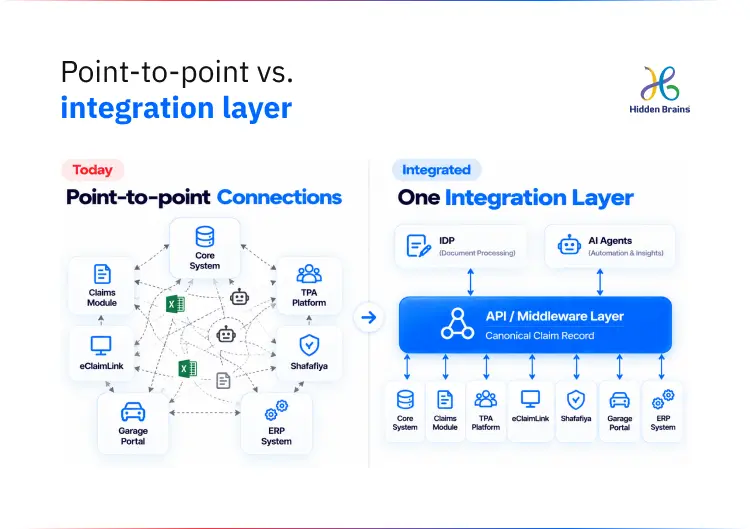
The right automation layer depends on the integration underneath it. RPA, IDP and AI agents all perform better on top of a stable API or middleware layer, and all become fragile without one.
| Approach | What it does well | Where it breaks | Use it when |
|---|---|---|---|
| Robotic process automation (RPA) | Mimics a user in screens that have no API | Breaks when a screen layout changes; hard to audit at scale | As a bridge while a legacy core waits for API enablement |
| Intelligent document processing (IDP) | Reads police reports, IDs, invoices and medical reports into structured fields | Output still needs somewhere to go; low-confidence fields need review | High document volume at intake |
| AI agents | Handle variable, multi-step tasks such as chasing missing documents | Need reliable read/write access to core data, plus human review on decisions | Data access and permissions are already governed |
| API and middleware layer | Gives every system one governed way to exchange claim data | Needs upfront design work and ownership | Always: this is the foundation the others sit on |
In practice, three design decisions matter more than tool choice:
- A canonical claims data model. Define one internal record for a claim, then map each system to it. Without it, every new connection becomes a separate translation project.
- Event-driven updates. A policy endorsement, a remittance or a garage estimate should publish an event that subscribing systems act on. This is how the 72-hour Shafafiya rule becomes routine rather than a daily checklist.
- RPA with an Exit Plan: Use bots to automate tasks in legacy systems that lack APIs, while leveraging legacy software modernization services to gradually replace temporary workarounds with scalable, API-driven integrations.
If you are planning agentic automation, our AI agent development services team starts with the same question: what can the agent safely read and write? For the integration patterns themselves, see our explainer on enterprise application integration solutions.
How should UAE insurers benchmark claims cycle time?
There is no reliable, current public benchmark for claims cycle time in the UAE, so the honest comparison is against your own baseline and the regulator’s deadlines. Global figures mix lines, markets and definitions, and most published numbers come from vendors describing their own deployments.
These measures show where disconnection is costing you:
| Metric | How to measure it | What it reveals |
|---|---|---|
| Straight-through processing (STP) rate | Share of claims settled with no manual touch, by line | How far automation actually reaches |
| Touch time per claim | Total handling minutes across all teams | Labour cost of handoffs |
| Exception rate by stage | Claims routed to manual review, per stage | Where integration gaps surface |
| First-pass acceptance rate | Share accepted on first submission via eClaimLink or Shafafiya | Data-quality cost of mismatched systems |
| Days to payment vs. deadline | Median and 90th percentile against 45 and 30 days | Regulatory exposure |
| Re-keyed fields per claim | Fields entered in more than one system | Direct measure of disconnection |
To build a baseline that holds up:
- Sample two to four weeks of closed claims per line of business, motor and health separately.
- Trace each claim’s timestamps across every system it touched, not only the claims module.
- Mark each wait between systems as a handoff and attribute its time.
- Compare the median and 90th percentile against the regulatory deadlines that apply.
- Re-measure the same metrics after each integration release, not only at the end.
Build, buy or integrate: how should GCC insurers decide?
Most mid-sized GCC insurers should integrate first, then buy or build only the parts that integration cannot fix. Replacing a core system to solve a connection problem is the most expensive way to solve it.
| Option | Best when | Main risks | Typical fit |
|---|---|---|---|
| Buy a claims platform | Your current claims module is the bottleneck, and the product supports UAE platforms and Arabic out of the box | Vendor lock-in; customisation for takaful or local workflows; integration still required at both ends | Insurers replacing an end-of-life claims system |
| Build custom claims automation | Your workflows are a competitive advantage, or the market has no product that fits | Longer delivery; you own maintenance | TPAs and specialist lines with unusual processes |
| Integrate and automate on top | Core systems are sound but disconnected | Needs clear data ownership and an API strategy | Most mid-sized insurers and TPAs in the UAE |
Three questions settle most decisions:
- Is the problem the system or the space between systems? If staff are re-keying between two working systems, it is the space.
- What must be true by the next regulatory deadline? Plan the first release around the 45-day, 30-day or 72-hour rule that hurts most.
- Who will own the integration in three years? A connection with no owner degrades into the next manual workaround.
Whichever route you take, local requirements should be in the contract, not assumed: Arabic interfaces and documents, takaful accounting, UAE data residency, and named support for eClaimLink and Shafafiya changes.
What should you ask a claims automation and integration partner in Dubai?
Ask a prospective partner to show how they would connect your systems before they show you any automation. A partner who leads with the tool has not yet understood where your claims slow down.
- Which of our systems have usable APIs today, and how will you handle those that do not?
- How will you connect to eClaimLink and Shafafiya, and who maintains those connections when the regulator changes a specification?
- What is your canonical claims data model, and who owns it after go-live?
- How will you measure STP rate, exceptions and days to payment before and after each release?
- How do you handle Arabic documents, takaful accounting and UAE data residency?
- Where would you use RPA, and when would you retire it?
- What quality and security processes govern delivery, and can you show the certificates?
How Hidden Brains approaches this?
Hidden Brains has built enterprise software since 2003 and delivers under CMMI Level 3 processes with ISO 27001 and ISO 9001 certifications. In insurance, our team built a commercial insurance platform for Layr, covering claims processing and analytics and third-party insurance API integrations with carrier aggregators. That was a US market build; the integration discipline transfers, and UAE platform specifics are scoped in discovery.
Our software integration services begin with understanding your existing systems, workflows, and handoffs, ensuring every connection supports your business needs. This approach also shapes how we deliver software development solutions in Dubai.
Frequently Asked Questions
What is the business case for integrating claims systems?
The business case rests on four outcomes: lower handling cost per claim, fewer rejections and resubmissions, lower regulatory exposure, and faster cash movement between insurer, providers and garages. Build it from your own baseline of touch time, exception rate and days to payment, not from vendor benchmarks.
How much does insurance claims automation and integration cost?
Cost depends on the number of systems to connect, whether they have usable APIs, the regulatory platforms involved, and how much legacy logic must be untangled. A scoped discovery that maps your systems and handoffs is the most reliable way to price it.
How soon will we see results?
Results should appear after each release, not only at the end of the programme. Prioritising the handoff that threatens your hardest deadline, such as eClaimLink remittance or Shafafiya coverage updates, usually gives the earliest measurable gain.
How should we measure ROI on claims automation?
Measure ROI against a baseline taken before the first release: straight-through processing rate, touch time per claim, first-pass acceptance rate, days to payment and re-keyed fields per claim. Re-measure after every release so the business can see which integration produced which gain.
Will claims automation reduce our claims team?
In most operations, automation changes the work more than the headcount. Routine re-keying and status chasing shrink, while adjusters spend more time on complex, high-value and disputed claims. It also lets a team absorb growth in claim volume without hiring at the same rate.
What is the business risk of leaving systems disconnected?
The risk is cumulative: overtime to meet regulatory deadlines, provider and garage disputes over payment timing, leakage from duplicates and missed recoveries, and weaker visibility for management and reinsurers. These costs sit in different budgets, so they are easy to underestimate.
Should we replace our core system or integrate around it?
Replace the core only if it is the bottleneck itself, for example when it is end-of-life or cannot support your products. If staff are mainly moving data between working systems, integration delivers results faster and with less disruption than replacement.
Who should own claims integration inside the business?
Claims integration works best with a business owner, usually the Head of Claims or COO, and a technical owner in IT. The business owner sets priorities against deadlines and cost; IT owns the data model, connections and security. Without both, integrations drift back into manual workarounds.
Do insurers need to integrate with NABIDH or Malaffi?
Usually not directly. NABIDH and Malaffi are health information exchanges for providers’ clinical records. For insurers and TPAs, the business-critical connections are eClaimLink in Dubai and Shafafiya in Abu Dhabi, because they carry claims, remittance and coverage data.



Conclusion
Insurance claims automation in the UAE has already sped up intake. The next gain comes from connecting what sits behind it: the core, eClaimLink or Shafafiya, garages, providers, and finance.
That is how claims teams meet 45-day, 30-day, and 72-hour deadlines without overtime, and how faster registration becomes faster settlement.
Start small: map one line of business, find where claims wait between systems, and put a cost against each handoff.
Talk One-to-One With Our Team → Book a One-to-One Call