












Summary
- Context engineering controls what an AI agent sees, uses, and remembers.
- Prompt engineering is one layer of context engineering, not the full system.
- Many agent failures come from weak context rather than weak AI models.
- Gartner says 40%+ of agentic AI projects may be cancelled by 2027.
- Benefits include better accuracy, lower cost, compliance, and easier scale.
- A five-layer framework keeps context structured, governed, and reusable.
- Start with one workflow, prove the model, then scale the same foundation.
- Bring in experts when agents span multiple systems or regulated workflows.
Context engineering is the discipline of deciding what an AI model sees at every step of a task, and it is fast becoming the difference between enterprise AI that works in a demo and enterprise AI that works in production.
Gartner summed it up in July 2025: “context engineering is in, and prompt engineering is out” (Gartner). It predicts that by 2028, 80% of the software tools used to build AI applications will include context engineering features.
For two years, most teams treated large language models like oracles: write a clever prompt, get a clever answer. That approach breaks the moment an AI system has to do real work. An agent that reads contracts, queries a CRM, calls five internal APIs, and hands its findings to another agent is not failing because its prompt lacks the right adjective. It fails because, somewhere around step twelve, it is looking at the wrong information.
That is the problem context engineering solves. It is also why prompt engineering is evolving into context engineering, why context degradation in multi-step AI agents has become a production problem, and why context will sit at the centre of enterprise AI architecture in 2027.
What is Context Engineering in AI?
Context engineering is the practice of designing the systems that decide which information, instructions, tools, and memory an AI model receives at each step of a task, so it has exactly what it needs and nothing that distracts it.
With agentic AI and autonomous systems moving toward an “autopilot” mode of operation, this becomes even more critical. An AI agent can act quickly, but speed does not guarantee accuracy. It can still hallucinate, retrieve outdated information, pull irrelevant context, or act on data that is not specific to the current user, workflow, or business situation.
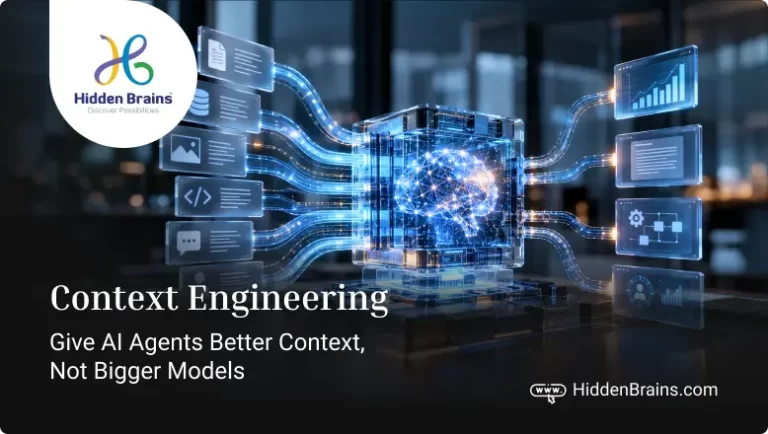
Every time an LLM generates a response or an agent takes an action, it works only from the tokens available in its context window. In an enterprise system, that window is not just a user’s question. It is assembled dynamically from multiple sources at runtime:
- System instructions and business rules
- Retrieved documents from a knowledge base (RAG)
- Tool definitions and the results of tool calls
- Conversation history and earlier agent steps
- Long-term memory about the user, account, or project
- Outputs handed over by other agents
The goal of context engineering is to give the model the smallest possible set of high-signal information needed to produce the right outcome at each step.
A simple way to distinguish the two:
- Prompt engineering asks: What should we say to the model?
- Context engineering asks: What should the model see, and when?
Why Prompt Engineering is Evolving into Context Engineering
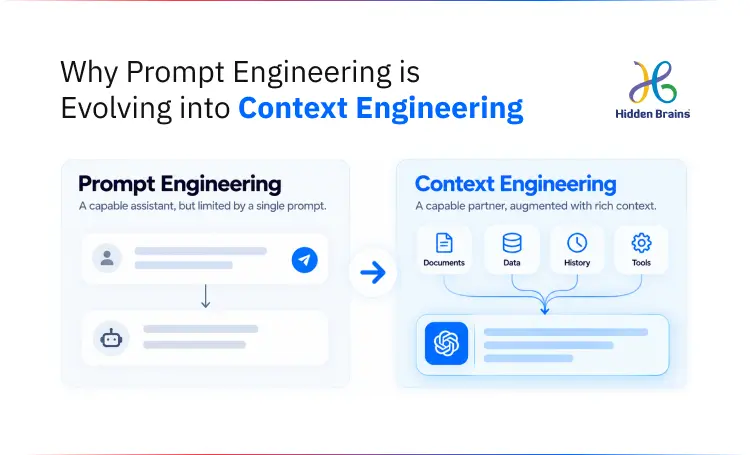
Prompt engineering is not dead; it has become one component inside a larger system. Three shifts forced the change.
1. AI moved from single answers to multi-step agents.
A chatbot answers once and forgets. An agent runs in a loop: plan, call a tool, read the result, decide again. Each loop produces more data that might matter for the next step, so someone has to decide what stays and what goes. Anthropic notes that this curation happens every time the model is called, not once when a prompt is written (Anthropic).
2. Bigger context windows did not fix the problem.
Million-token windows tempted teams to “just put everything in.” Research shows that backfires. Chroma’s 2025 study of 18 frontier models found that every one of them became less reliable as input length grew, even on simple tasks (Chroma Research). This effect is now widely called context rot.
3. Production has unit economics.
Every token costs money and adds latency. An agent that drags 80,000 tokens of stale tool output into every call is slower, more expensive, and less accurate than one that carries 8,000 well-chosen tokens.
| Dimension | Prompt engineering | Context engineering |
|---|---|---|
| Primary focus | How you ask the question (prompt wording, examples, formatting) | What the agent knows when it answers (data, metadata, memory, tools, policies) |
| Scope | Single prompt or session | Persistent, reusable context layer across agents and workflows |
| Main failure mode | Vague or poorly structured prompts | Stale, incomplete, or ungoverned context; missing semantics |
| Typical use cases | Summaries, reformatting, one-off analysis | Multi-turn agents, cross-system workflows, regulated decisions |
| Tooling | Prompt libraries, templates | Metadata catalogs, context registries, retrieval pipelines, governance engines |
The Anatomy of Context: What an AI Agent Actually Sees
An agent’s context is not written once; it is rebuilt from six kinds of sources before every model call, and the assembly step decides quality.
The feedback loop is where problems start: every tool call and agent step adds new material, so without deliberate assembly the context grows noisier with each turn.
- System instructions and rules set the agent’s role, constraints, and output format. Aim for the “right altitude”: specific enough to guide, flexible enough to generalise.
- Retrieved knowledge (RAG) brings in policies, documents, and records. Quality depends on chunking, ranking, and permission-aware filtering.
- Tool definitions tell the agent what it can do. Fewer, clearer tools beat many overlapping ones.
- Long-term memory carries facts about the user, account, or project across sessions.
- Other agents’ outputs arrive as handoffs in multi-agent systems and should be condensed summaries, not raw transcripts.
- History and tool results grow fastest and rot fastest, so they need the most active management.
Why Context Engineering is Becoming Critical for Enterprise AI in 2027
2027 is the year enterprise agent programmes either prove value in production or get shut down, and context quality is the main lever that decides which.
Gartner forecasts that more than 40% of agentic AI projects will be cancelled by the end of 2027, citing rising costs, unclear business value and weak risk controls (Gartner). The same firm expects a third of enterprise software applications to include agentic AI by 2028, up from under 1% in 2024. Adoption is coming either way; the open question is whose agents survive.
Each of Gartner’s three failure causes traces back to context:
- Rising costs. Bloated context windows inflate token spend and latency on every call. Disciplined context budgets are one of the fastest cost levers available.
- Unclear business value. Agents that perform well in a narrow pilot often drift once they meet messy real data, long workflows, and legacy systems. The model did not get worse; its context did.
- Weak risk controls. In an enterprise, context is also a security boundary. What an agent retrieves must respect user permissions, data residency, and audit requirements. A retrieval pipeline that ignores access controls is a data leak waiting to happen.
Four enterprise realities make this sharper in 2027:
- Multi-agent workflows are becoming normal. Handing work between agents multiplies the chances that a key fact is lost or distorted in transit.
- Tool ecosystems are exploding. Protocols such as MCP make it easy to connect dozens of tools. Anthropic warns that bloated, overlapping tool sets are one of the most common agent failure modes.
- Regulators want traceability. Teams increasingly need to show why an agent acted, which means logging exactly what was in its context.
- Enterprise RAG is maturing. Basic retrieval is table stakes. The competitive edge is in ranking, freshness, permission-aware filtering, and deciding how much retrieved text to include.
Benefits of Context Engineering For Enterprises
Instead of building a bigger, costlier custom-model solution, context engineering adds a brain and a gut to your AI agents: the judgment to know which information matters at each step. The result is agents that understand context accurately, cost less to run, and scale more easily, without retraining or replacing the underlying model.
- Higher accuracy and fewer hallucinations. Agents reason over relevant, current, verified information instead of noisy or stale data.
- Reliable long-running agents. Memory, compaction, and sub-agents keep multi-step workflows on track instead of drifting after a dozen steps.
- Lower token cost and latency. Smaller, sharper context windows cut spend per task and speed up responses.
- Built-in governance and compliance. Permission-aware retrieval and logged context make every agent decision traceable and auditable.
- Reuse across use cases. A shared context layer (sources, metadata, policies) serves many agents, so the second and third use cases ship faster than the first.
- Model independence. Because the value sits in your context layer, you can switch or upgrade models without rebuilding the system.
- Faster path from pilot to production. Most pilot-to-production failures are context failures, so fixing context removes the most common blocker.
A Context Engineering Framework for Production AI
A production context engineering framework is a layered stack: five layers that turn raw enterprise data into use-case-ready context, with identity, governance, and policy controls running across all of them.
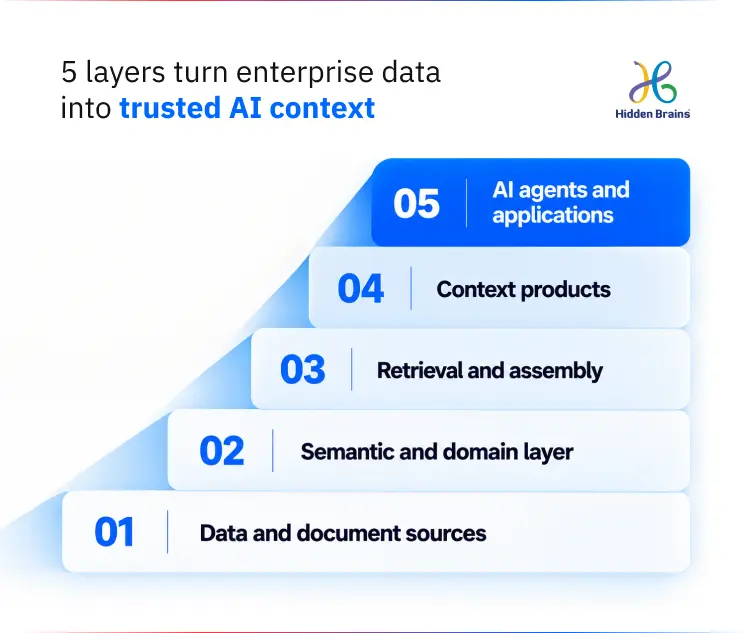
- AI agents and applications. The copilots, agents, and apps people use. They request context from the layers below; they should not each build their own.
- Context products (per use case). Packaged, versioned bundles of context for one use case, such as claims triage or contract review: which sources, instructions, tools, and token budget it uses. Many agents can reuse the same context product.
- Retrieval and assembly (RAG, SQL, graphs, MCP). Fetches and assembles context at runtime through vector search, SQL queries, knowledge-graph lookups, and MCP tool calls, then ranks, trims, and fits it to a token budget.
- Semantic and domain layer (glossary, ontology, rules). Gives the data its business meaning: what “active customer” or “net revenue” means, how entities relate, which rules apply. Without it, agents retrieve the right table and still misread it.
- Data and document sources. Warehouses, lakes, CRM, ERP, document stores and APIs. They stay where they are.
- Identity, governance and policy controls (across all layers). Who the user is, what they may see, data residency, PII masking and audit logs, enforced at every layer rather than bolted on at the end.
You do not need every layer on day one. Start with one context product for one use case, and build only the parts of the layers beneath it that the use case needs.
Production-readiness checklist
- Every context source has an owner and an access-control rule
- Token budgets are set per context component
- Long-running tasks have compaction or external memory
- Tool set reviewed for overlap; outputs trimmed
- Every model call’s full context is logged and replayable
- Evaluation suite built from real production traces
Fix AI Agent Context Gaps Without Rebuilding.
Book Your Assessment
Do You Have to Rebuild Your AI stack?
No. Context engineering is a layer you add around what you already run, not a rip-and-replace of your models, data platforms, or existing AI applications. Your data warehouse, document stores, APIs, RAG pipelines, and prompts all stay. What changes is how information flows from them into the model.
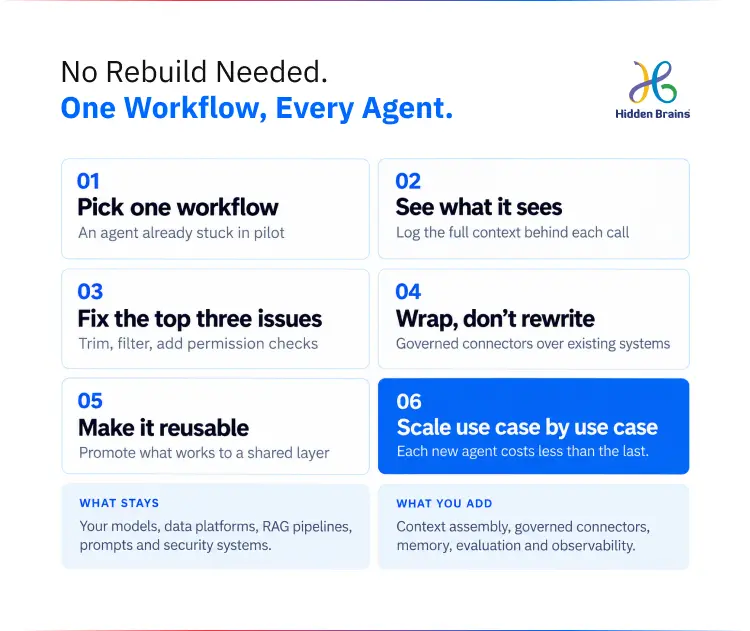
A practical, low-risk adoption path:
- Start with one high-value workflow. Pick an agent or RAG use case that already exists and is underperforming or stuck in pilot. Do not start a platform programme.
- Instrument before you change anything. Log the full context behind each model call for a few weeks. This alone usually reveals the biggest problems: oversized prompts, irrelevant retrieval, stale data, overlapping tools.
- Fix the top three context issues. Typical quick wins are trimming tool output, tightening retrieval filters, adding permission checks, and adding compaction for long tasks. These are changes to the pipeline, not to source systems.
- Wrap, don’t rewrite, your data sources. Expose existing systems through governed connectors or tool interfaces (for example, MCP servers) with metadata and access rules. The systems of record stay untouched.
- Promote what works into a shared context layer. Once a pattern proves itself, turn it into reusable components (source registry, retrieval policies, memory store) that the next agent can use.
- Expand use case by use case. Each new workflow plugs into the shared layer, so effort per use case falls over time.
| What stays | What you add |
|---|---|
| LLMs and model providers | Context assembly and token budgets |
| Data warehouses, document stores, CRM, ERP | Governed connectors and metadata |
| Existing RAG pipelines | Ranking, freshness and permission filters |
| Prompts and system instructions | Memory, compaction and sub-agent patterns |
| Security and identity systems | Context logging and evaluation |
Most enterprises see measurable gains on the first workflow within weeks, because the work starts with observation and targeted fixes, not migration.
Build In-house or Hire Context Engineering Experts?
Working with an experienced AI agent development company brings those disciplines together from day one, instead of stitching them across teams later.
Context engineering sits across disciplines that rarely live in one team: retrieval engineering, data governance, security, application architecture, and evaluation. Many enterprises discover the gap only after a pilot stalls.
| Signal | Build in-house | Hire context engineering experts |
|---|---|---|
| Use cases | One or two, narrow scope | Several, cross-functional |
| Data | Single, clean source | Many systems with mixed permissions |
| Agent design | Single agent, short tasks | Multi-step or multi-agent, long-running |
| Compliance | Low regulatory exposure | Audit trails and data residency required |
| Status | Early experimentation | Pilot works but fails in production |
What good context engineering solutions and AI development services should deliver:
- Context architecture review of your current agents, RAG pipelines and tool sets, with a prioritised fix list.
- Build in-house for one or two narrow use cases with a strong platform team. Bring in a custom AI development company when agents must span many systems, permissions, or regulated workflows, or when a pilot works but will not hold up in production.
- Enterprise RAG engineering with permission-aware retrieval, freshness rules, and ranking tuned to your content.
- Evaluation and observability so every model call is traceable, and regressions are caught before users see them.
- Knowledge transfer so your team owns the framework after go-live.
When evaluating an AI engineering company for enterprise RAG or agent work, ask to see production traces, not demos. Ask how they measure context quality, how they handle access control in retrieval, and what their degradation strategy is for long tasks.
Frequently Asked Questions
What is context engineering, in business terms?
It is how you make sure your AI agents work from the right company information, rules, and permissions at every step. Think of it as the briefing and governance system behind every AI decision.
Why should business leaders care about context engineering now?
Because it decides whether AI investments reach production. Most agent pilots that stall do so because the agent sees incomplete, outdated or ungoverned information once it meets real workflows, not because the model is weak.
Do we still need prompt engineering?
Yes, but as one part of a larger system. Well-written instructions still matter; context engineering makes sure they are paired with the right data, tools and policies.
Do we need to rebuild our existing AI systems?
No. Context engineering wraps your current models, data platforms, and RAG pipelines. You start with one workflow, fix what the agent sees, then reuse that pattern across other use cases.
How does context engineering reduce AI costs?
Agents that carry only relevant information use fewer tokens per task, respond faster, and need fewer retries and human corrections. A shared context layer also means each new use case reuses work instead of starting from scratch.
How does it help with compliance and risk?
It enforces who can see what at the point of retrieval, keeps sensitive data out of model inputs where it does not belong, and logs exactly what each agent saw before it acted. That gives risk and audit teams a clear trail.
Why do AI agents get less reliable on long, multi-step tasks, and how do you prevent it?
As agents work, their context fills with old tool output and history, and accuracy drops. This is called context degradation. It is prevented by summarising history, storing progress in external memory, fetching information only when needed, and splitting heavy work across sub-agents.
How do we measure the ROI of context engineering?
Track task accuracy, cost per completed task, human escalation rate, and time to launch each new use case, before and after changes to one workflow. Those numbers make the case for scaling.
Should we build this in-house or hire context engineering experts?
Build in-house for one or two narrow use cases with a strong platform team. Bring in specialists when agents must span many systems, permissions, or regulated workflows, or when a pilot works but will not hold up in production.
Conclusion
The AI model is no longer the main differentiator; the context around it is. Every enterprise can access the same leading models. What sets results apart is whether your agents work from accurate, governed, business-specific information at every step.
That makes context engineering a business decision as much as a technical one. It decides whether agent projects reach production, what they cost to run and whether you can stand behind their decisions in an audit. With Gartner expecting more than 40% of agentic AI projects to be cancelled by the end of 2027, the organisations that invest in context now are the ones most likely to be on the right side of that line.
The good news is that it does not require a rebuild. Start with one high-value workflow, see exactly what your agent sees, fix it, and scale what works.
Want to know where your AI agents stand? Book a 2-hour consultation with our context engineering team.