


































































































Summary
- Modernize legacy .NET app by app, not through blanket rewrites.
- Assess 8 factors across business, architecture, risk, cost, and compliance.
- Choose the right path: upgrade, refactor, API-enable, retain, or replace.
- One UAE enterprise modernized 28 components with zero downtime, improving release speed by ~35% and reducing support and regression effort.
- Use Blazor, Razor, and strangler migration for phased modernization.
- Build UAE and Saudi compliance requirements into the roadmap from the start.
Most legacy .NET modernization programs do not need a full rewrite. They need the right decision for each application, based on business risk, dependencies, test coverage, compliance requirements, and the system’s criticality to daily operations.
We learned this during a 30+ month engagement with a large UAE enterprise. Its portfolio of business-critical .NET applications could not simply be taken offline, and a full rewrite would have introduced unnecessary operational risk.
Instead, we assessed each application individually and built a phased modernization plan. Applications were gradually moved toward supported, API-based architectures while the existing estate continued to run.
The result: release cycles improved from 7.2 weeks to 4.7 weeks, while production support effort fell by around 32%.
That experience shaped the approach outlined in this article. It explains what worked, how the modernization was structured, and the key decisions enterprises should address before changing a legacy .NET estate.
Consider it a practical blueprint, a step-by-step guide to modernizing legacy systems without putting business continuity at risk.
Why is Late 2026 a Decision Point for Legacy .NET?
Because .NET 8 and .NET 9 both reach end of support on November 10, 2026. After that date, Microsoft stops shipping security updates for them, and .NET 10, the current Long-Term Support (LTS) release, is supported until November 2028.
This matters for two groups. Teams that already moved to modern .NET need an upgrade path to .NET 10. Teams still on .NET Framework face a different question.
One point is widely misreported: .NET Framework 4.8 and 4.8.1 have no announced end date. Older versions such as 4.5.2, 4.6 and 4.6.1 are already retired. So the honest driver for leaving 4.8 is rarely a deadline. It is slower delivery, harder hiring, Windows-only hosting, and integration limits.
If you want the background on how modern .NET differs from the Framework, see our guide on what .NET Core is and why it matters.
Assess Your .NET Apps. Plan Your Modernization.
Talk to Our Experts
The Project Behind These Lessons
The client is a large enterprise in the United Arab Emirates running a portfolio of interconnected business applications. Some were built on older .NET and ASP.NET MVC versions, others on newer stacks, and all of them depended on each other.
| Area | Detail |
|---|---|
| Region | United Arab Emirates |
| Industry | Enterprise services/technology |
| Engagement | 30+ months, ongoing, managed engineering team |
| Legacy stack | C#, ASP.NET MVC on older .NET versions |
| Target stack | .NET Core / modern .NET [INSERT: version], REST APIs, microservices, React, Angular, with Node.js and Spring Boot services where they fit |
| Connected systems | Microsoft Dynamics 365 / CRM, SharePoint, PowerApps, legacy databases, internal and third-party services |
| Hard constraint | Business-critical systems could not be taken offline |
8 Factors to Weigh Before You Rewrite Legacy .NET
Each factor below starts with the question to ask, then shows how it played out in the UAE program.
1. How Critical Is the Application to the Business?
The more an application carries revenue, regulated data, or daily operations, the less it tolerates a rewrite. Classify each system by revenue impact, regulatory exposure, customer-facing surface, and operational risk.
High-value, high-risk systems, such as order processing or customer records, rarely survive the downtime and uncertainty of a clean-slate rebuild. A low-value internal tool with mounting security debt is different: if fixing it costs more than replacing it, replacement can be the right call.
In the UAE program: The approach supported day-to-day operations across the enterprise and could not be taken offline. That single constraint ruled out an overhaul rewrite before any code was reviewed.
2. Is the Architecture Sound, or Structurally Broken?
Refactor when the architecture works but code quality has degraded. Consider a rewrite of a layer only when the platform itself has no modern path.
Warning signs include tightly coupled modules, copy-paste logic, five ways of doing the same thing, and deployments that depend on one person’s memory.
The UI framework matters here. ASP.NET MVC applications move to ASP.NET Core MVC with Razor views in a fairly direct way, because the model, controller, and view concepts carry over. ASP.NET Web Forms has no direct port to modern .NET. For Web Forms estates, Microsoft’s documented route is Blazor, whose component model is the closest match to Web Forms controls. Razor Pages suits simpler, page-centric forms.
In the UAE program: The estate mixed several technology generations. Each application was assessed on its own architecture and condition, which is why the outcomes differed per app. New front ends were built in React and Angular because [VERIFY: reason, e.g. customer channels already used them].
Where Razor and Blazor fit: If your estate is heavy on Web Forms, Blazor lets a .NET team rebuild the UI layer in C# while retaining business logic. If it is MVC, Razor views in ASP.NET Core are usually the shorter path. For a deeper comparison of both approaches, see our Razor vs. Blazor guide.
3. Do Your Dependencies Have an Upgrade Path?
Dependencies decide feasibility more often than your own code does. Audit every third-party package, UI control suite, and runtime dependency before choosing a target.
Common blockers are unmaintained packages, Windows-only APIs such as COM interop and P/Invoke, and WCF services. Many have workable routes: CoreWCF brings WCF services to modern .NET, and commercial control vendors such as DevExpress, Telerik, and Infragistics offer modern .NET versions. Price these replacements and wrapper strategies before concluding a rewrite is unavoidable.
Tooling has changed too. Microsoft has deprecated the .NET Upgrade Assistant in favor of the GitHub Copilot modernization agent in Visual Studio. Treat any tool’s output as a starting inventory, not a migration plan.
In the UAE program: Modernization started with dependencies rather than framework versions. The team mapped application flows, shared services, and integrations first, then sequenced work so that no change broke a downstream system.
4. Can you Prove the System Still Behaves the Same?
Automated tests are the only real safety net in a port or rewrite. Applications with meaningful automated coverage of their business-critical paths can be refactored in small steps. Applications with little coverage and undocumented behavior are risky to change in any way.
Without characterization tests, which record what the system does today, you rediscover old edge cases in production. Those are often the very bugs the legacy system already solved.
In the UAE program: Manual regression was a major cost. Each release needed about 280 QA hours of regression testing across interconnected applications. Running development and QA as one team, with automation and integration testing, brought this to about 157 hours per release, roughly 44% lower.
5. Who Understands the Code, and Can They Keep It Running While You Change It?
If business logic lives in the heads of a few developers, a rewrite inherits the same gaps. Before deciding, check whether the logic is documented and whether your team can ship modernization alongside daily support and feature work.
In the UAE program: Some older applications depended on a small number of people. At the same time, production issues and fixes consumed about 820 engineering hours a month, capacity that modernization needed. A managed team that owned both support and modernization reduced that support effort to about 558 hours a month and spread codebase knowledge beyond a few individuals.

Know Which .NET Apps to Upgrade, Integrate, or Replace.
Let’s Talk6. What does each path really cost, including what you stop delivering?
Price a rewrite and a phased roadmap side by side, and include opportunity cost. A rewrite usually freezes feature delivery while the team rebuilds what already works, and estimates tend to grow once hidden behavior surfaces.
Ask a simple question: can the business operate for 12 months or more without improvements to this system? If not, a phased approach with visible milestones is safer.
In the UAE program – The business kept receiving releases throughout. The average release cycle for applications in scope fell from 7.2 weeks to 4.7 weeks, about 35% faster, while modernization continued. See how we structure this in our application modernization strategy guide.
7. Is the security and compliance risk in the platform or in the application?
Separate platform-level risk from application-level risk. An unsupported runtime or outdated TLS support is a platform problem and can justify moving off that platform. Weak access control, hard-coded secrets, or unreviewed integrations are application problems that targeted refactoring usually fixes.
For GCC organizations, compliance also shapes the target architecture:
- UAE: the Personal Data Protection Law, Federal Decree-Law No. 45 of 2021, plus free-zone regimes such as the DIFC Data Protection Law, and the UAE Information Assurance Standards (originally issued by NESA) for government and critical-sector entities.
- Saudi Arabia: the Personal Data Protection Law, fully enforceable since September 14, 2024, with strict limits on transferring personal data abroad, the NCA Essential Cybersecurity Controls, and SAMA requirements for financial services.
These rules affect hosting region, data flows between old and new systems during transition, logging, and access control. Plan them in the assessment, not after go-live. Applications with Arabic interfaces should also be checked for right-to-left rendering and Hijri date handling when the UI layer changes.
In the UAE program, security stayed inside the modernization path. Role-based access was retained or updated as applications moved to newer frameworks, API access was governed, legacy integrations were reviewed, and production changes followed controlled release and validation.
8. Is the data model stable, or is the schema the bottleneck?
If the schema is sound and business logic sits above it, incremental modernization preserves years of edge-case handling. If the schema is the problem, with heavy denormalization, missing constraints, or core logic buried in stored procedures, any rewrite also needs a parallel data migration, which adds high cost and risk.
In the UAE program: legacy databases stayed connected throughout. New APIs and services were placed in front of them so modern channels could use business functions without being tied to older code.
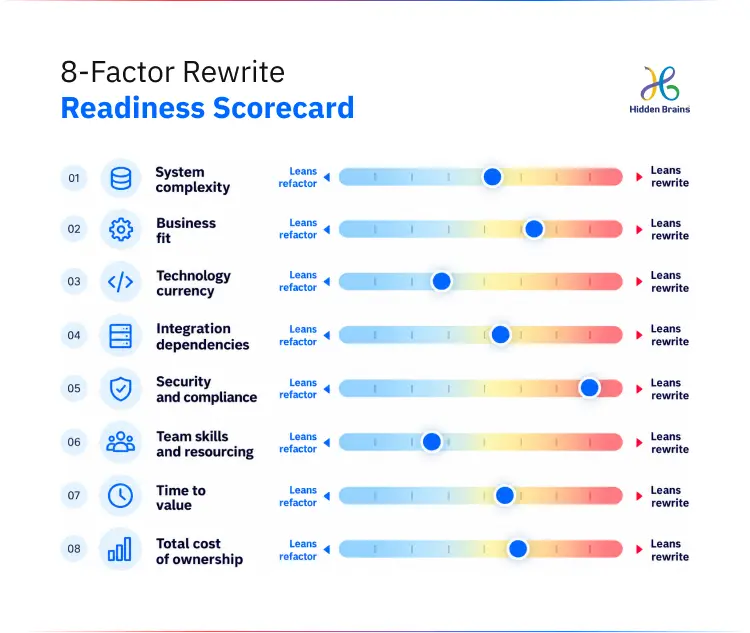
You now have a clear scorecard for assessing your application estate, and the key factors to weigh before deciding whether a legacy application should be modernized, rewritten, replaced, or retained.
Rewrite or Refactor? A Quick Decision Framework
Taken one at a time, the 8 factors can pull in different directions. A system may be business-critical, which leans toward refactoring, yet depend on a component with no upgrade path, which leans toward a rewrite. The table below puts all eight side by side so you can see where the weight falls. If most rows land in the refactor column, a phased approach is almost always the lower-risk choice.
| Factor | Leans refactor | Leans rewrite |
|---|---|---|
| Business value | High, core system | Low, replaceable tool |
| Architecture | Sound but degraded | Fundamentally incompatible |
| Dependencies | Upgrade path exists | End of life, no patches or equivalents |
| Test coverage | Meaningful automated suite | Little or none |
| Knowledge | Documented, team understands it | Tribal, original authors gone |
| Timeline | Improvements needed within weeks | Business can wait 12 to 24 months |
| Security risk | Application level | Platform level |
| Data model | Stable schema | Schema is the bottleneck |
In practice, the answer is rarely one of two. The UAE program used five outcomes, chosen per application:
| Path | When it was chosen |
|---|---|
| Upgrade | Sound code on an older but portable framework |
| Refactor | Working architecture with degraded quality |
| API-enable | Stable business logic needed by new web, mobile or enterprise channels |
| Retain | Low change demand and acceptable risk |
| Stage for replacement | No viable path, scheduled for later replacement |
All 28 prioritized components were moved to supported or API-based patterns. None required a portfolio-wide rewrite, and that per-application approach is how our legacy software modernization services are structured. For hands-on refactoring practices, see our guide to code refactoring.
How Do You Modernize Without Downtime?
You run old and new side by side and move functionality across in slices. Microsoft’s documented approach for ASP.NET applications uses the strangler fig pattern with a YARP reverse proxy: a new ASP.NET Core application sits in front of the old one and takes over routes one by one, with System. Web adapters bridge shared concerns such as authentication and session.
The UAE program applied the same principle at portfolio level:
- Assess and stabilize first. Map flows, dependencies, risks, and criticality before changing anything.
- Modernize progressively. Upgrade, refactor, API-enable, or stage replacement per application.
- Decouple through APIs. Put reusable REST APIs and clearer service boundaries between channels and legacy code.
- Keep enterprise systems connected. Maintain controlled integrations with Dynamics 365, SharePoint, PowerApps and legacy databases throughout. Our software integration services team handles this layer.
- Build quality into delivery. We review code, automate, test integrations, and validate releases on every change.
- Govern architectural change. Review major changes for maintainability, performance, integration impact, and continuity before release.
Typical Legacy .NET Modernization Roadmap in the Gulf
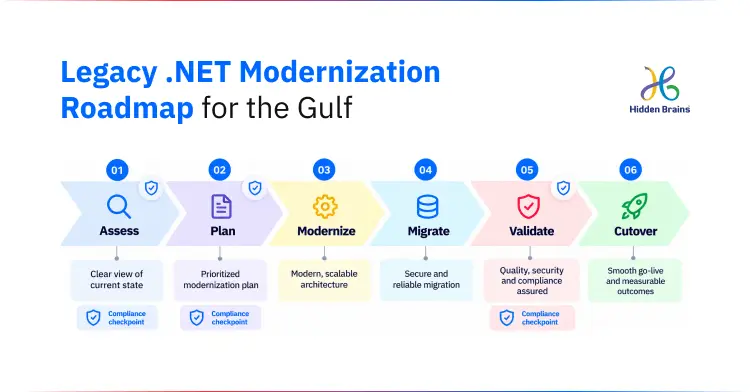
A Gulf modernization roadmap usually runs in six phases, with compliance planned from the first phase rather than added at the end.
| Phase | Activities | Outcome |
|---|---|---|
| 1. Assessment | Code audit, dependency mapping, compliance gap analysis, business workflow documentation | Modernization roadmap with risk ranking and sequencing |
| 2. Architecture design | Target architecture (cloud-native, microservices, API-first), stack selection, data residency plan | Blueprint aligned with UAE PDPL, Saudi PDPL, NCA ECC, and sector rules such as SAMA |
| 3. Phased refactoring | Incremental code modernization, containerization, API exposure, parallel running | Working production modules with automated test coverage |
| 4. Data migration | Schema transformation, data validation, integrity checks under load | Migrated data with parity validation |
| 5. Testing and validation | Functional parity tests, performance benchmarks, security audits | Sign-off on each component before cutover |
| 6. Cutover and support | Production migration with rollback plans, monitoring, ongoing support | Legacy system retired, or retained as fallback |
Timelines depend on estate size, dependency depth, and how much can run in parallel. There is no honest fixed number, which is why the assessment phase matters most.
Results: What Changed After the First 28 Components
| Outcome | Before | After | Change |
|---|---|---|---|
| Average release cycle | 7.2 weeks | 4.7 weeks | About 35% faster |
| Production support effort | 820 engineering hours/month | 558 hours/month | About 32% lower |
| Regression testing effort | 280 QA hours/release | 157 hours/release | About 44% lower |
| Legacy components modernized | 0 of 28 prioritized | 28 of 28 | All moved to supported or API-based patterns |
Candid Lessons from The Engagement
The results above are the easy part to share. These lessons are what we would tell any team starting a similar program.
- Start from dependencies, not framework versions. Upgrading the oldest framework first feels logical, but the riskiest changes were the ones that touched shared integrations. Sequencing by dependency kept production stable.
- Fix regression testing before you accelerate. Release speed improved only once QA and development worked as one team with automation.
- Free capacity from support before promising modernization. With 820 hours a month going into production support, modernization had to compete for the same people. Owning both under one team made that trade-off visible and manageable.
- Decide per application, and expect different answers. Forcing one approach across a mixed estate would have either overspent on stable systems or underinvested in risky ones.
AI was handled the same way. The team explored generative and agentic AI through governed proofs of concept using approved or sanitized data, kept outside production workflows until they were ready.
How Hidden Brains Approaches .NET Modernization in the UAE and Saudi Arabia
Our work on legacy estates usually starts before any technology choice: mapping where processes, systems, data and decisions depend on old code. From there, one managed team covers architecture, development, QA, and application support, so the business keeps running while the estate changes.
We bring 23+ years of enterprise delivery, CMMI Level 3 processes, and ISO/IEC 27001:2022 certified information security, which matters when modernization touches regulated data in the UAE or Saudi Arabia. Our Microsoft development services team works across legacy ASP.NET, ASP.NET Core development, Dynamics 365, SharePoint, and Power Platform. Clients in the region work with our software development team in Dubai.
Frequently Asked Questions
What is the business risk of not modernizing our legacy .NET applications?
The risk is gradual, then sudden. Releases slow down, support absorbs more engineering time, fewer people understand the code, and new channels become harder to connect. Applications on .NET 8 or .NET 9 also stop receiving Microsoft security patches after November 10, 2026, which turns a technical issue into an audit and compliance issue.
How should we budget for legacy .NET modernization?
Budget in phases, not as one large project. Fund an assessment first, which ranks applications by risk and value and gives a realistic range for each path. Each later phase is then approved against visible results, and the budget should account for support effort that modernization frees up, not only the new spend.
How do we measure the return on modernization?
Set a baseline before work starts and track the same few numbers throughout: release cycle time, production support hours, regression testing effort, incidents, and time to launch a new channel. In our UAE program, release cycles fell from 7.2 to 4.7 weeks and support effort from 820 to 558 engineering hours a month.
Will modernization disrupt our operations or customers?
It should not. A phased approach keeps legacy systems running while new components take over piece by piece, with rollback plans for every release. Our UAE client’s business-critical estate stayed in production for the entire 30+ month engagement.
Should we modernize with our in-house team or a partner?
It depends on capacity, not only skill. If your team spends most of its time keeping production stable, modernization will keep slipping. A managed partner team that owns both support and modernization can run them in parallel, provided knowledge is documented and shared with your people along the way.
What should we ask a .NET modernization partner before we sign?
Ask how they assess each application, how they protect live systems during releases, and how they will report progress against measurable outcomes. In the UAE and Saudi Arabia, also ask about experience with PDPL, NCA controls, data residency, and sector rules such as SAMA, and about their own information security certifications, such as ISO/IEC 27001.
How do UAE and Saudi compliance rules affect the cost and timeline?
They add planning work up front but reduce rework later. Data residency, cross-border transfer limits, and access-control requirements shape hosting choices and how data flows between old and new systems during transition. Building them into the assessment avoids redesigning the architecture after go-live.


Conclusion
If you are weighing a rewrite against a phased path, our legacy software modernization services start with an assessment that answers the 8 questions above for each of your applications.
Most legacy .NET estates do not need a rewrite. They need a clear decision for each application, made against the 8 factors above, and a way to act on it without stopping the business.
The UAE program proved this. By starting with dependencies instead of framework versions, the team moved 28 components to supported or API-based patterns with no planned downtime, and releases got faster along the way.
With .NET 8 and .NET 9 losing security support on November 10, 2026, assess now so you can sequence the work, not rush it.
Not sure where your applications stand? Book a free two-hour technology consultation to review your estate and its riskiest dependencies.