






























































































































Summary
- UK SMEs are shifting IT spend toward measurable outcomes across cloud, cybersecurity, AI, and custom software.
- Custom software can reduce licence costs, manual work, and process inefficiencies.
- Budget against expected business savings, not just the development quote.
- Model ROI using annual benefit, TCO, and a realistic payback period.
- Build custom only when the workflow, integration need, or business value justifies ownership.
- Use a disciplined build-vs-buy approach to keep 2027 technology investment defensible.
For UK SMEs planning 2027 IT budgets, custom software development has become a high-ROI lever for businesses that have outgrown off-the-shelf tools, but only if you budget for it deliberately. This guide gives you the numbers and the framework: what UK SMEs actually spend, how custom compares to SaaS over five years, which government funding and tax reliefs still exist after Help to Grow closed, and an honest test for when not to build.
Our leading software development company in the UK works with mid-market clients, as per their specific workflows, business model, and requirements.
The 2027 IT Budget Landscape for UK SMEs
UK SMEs aren’t cutting technology spend in 2027; they’re refocusing it toward measurable outcomes. Analysys Mason’s SMB Technology Forecaster describes 2026 onward as the shift from “foundational IT” (email, cloud storage, basic security) to “intelligent IT”, tools that actively improve performance, with UK SMB IT spending on a growth path of roughly 6% a year through the late 2020s.
Three priorities now dominate that spend: cloud, cybersecurity, and AI.
Cybersecurity alone has become the fastest-growing line; analyst data from Techaisle puts SME cybersecurity at around 14–15% of the IT budget in 2026, up sharply from a few years earlier. Custom software sits alongside these as the lever that ties them together: the system that automates the workflow, consolidates the SaaS sprawl, and gives AI somewhere useful to plug in.
A Planning-starting-Point IT Budget Split
Use this as a starting point to structure the conversation, not a fixed formula; the ranges overlap and won’t sum to 100%. Adjust to your sector and risk profile.
| Budget category | Indicative share of IT budget | Notes |
|---|---|---|
| Cloud infrastructure & SaaS | 25–35% | Largest line for most SMEs; includes migration and optimisation |
| Custom software development | 15–25% | Strategic enabler; 18–36 month ROI horizon |
| IT support & managed services | 15–20% | Includes monitoring and incident response |
| Cybersecurity | 10–15% | Higher for regulated sectors (~14–15% is now typical) |
| AI & automation tools | 10–15% | Often bought as add-ons to existing tools |
| Training & change management | 5–10% | Where ROI is won or lost |
Find The Manual Work Quietly Draining Your 2027 IT Budget.
Talk to Our Experts
The Custom Software ROI Case
Custom software is no longer enterprise-only. For UK SMEs stuck in spreadsheet workflows and SaaS sprawl, a bespoke build earns its budget in three concrete ways: eliminating subscription costs, recovering staff time lost to manual work, and cutting the errors that manual bridging creates.
The honest position on ROI figures: the market is full of eye-catching “4x return” and “300% ROI” claims, most of them from vendor blogs and none independently verifiable. We don’t repeat those. What we can stand behind is the mechanism and a conservative, transparent model.
Where Custom Software Fits in Your 2027 IT Budget
Set the custom-software line as a share of your planned IT spend, then pressure-test it against ROI; don’t back into it from a vendor quote. A common planning heuristic is that SMEs allocate somewhere in the region of 4–6% of revenue to IT overall.
A practical way to size it:
- Audit current spend. List every SaaS licence, tool, and manual workaround. Flag anything you’re paying for and barely using, and anything staff is working around with spreadsheets.
- Identify the bottleneck with a cost. Custom software earns its budget when it removes a quantifiable drag: hours lost to manual reconciliation, revenue blocked by a process you can’t scale, or licence fees you could consolidate.
- Size the line against that saving, not the sticker price. If a £40k tool removes £30k/year of wasted effort, the budget defends itself. If you can’t name the saving, the line isn’t ready.

Find Where Custom Software Can Cut Costs Before You Commit Budget.
Book a Budget ReviewHow to Model ROI and Break-even
For most UK SME custom builds, break-even typically falls 12–24 months after go-live, based on the type of project. Cost-elimination builds, replacing expensive SaaS stacks or high-labour manual work, pay back faster than capability-addition builds that open new revenue. The single biggest variable is adoption: a system used fully by the intended team returns far faster than one that’s half-used, which makes the first 90 days of onboarding as important as the build quality.
To model it before you commit budget:
- Quantify the annual benefit (hours saved × loaded labour cost, licences eliminated, error and rework reduction, new revenue enabled).
- Divide the three-year total cost of ownership by that annual benefit to get a rough payback period.
- Stay conservative on benefit and unforgiving on cost. The honest model is the one your finance lead can defend.
One UK-specific lever worth checking: qualifying software R&D may attract R&D tax relief. For accounting periods beginning on or after 1 April 2024, most companies claim under the merged RDEC scheme at a 20% credit rate, worth roughly 15% net for profitable companies, and only genuine advances in technology qualify. Confirm current eligibility with your accountant or HMRC before you factor it into the return.
The Honest Build-vs-Buy Gate: When Not to Go Custom
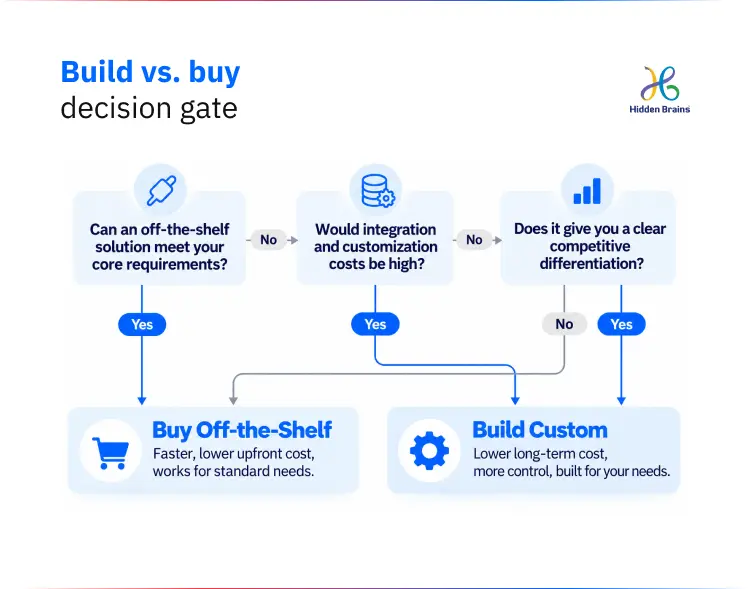
Do not build custom if an off-the-shelf tool already covers 80% or more of the need. You will pay to rebuild what you could licence and carry the maintenance forever.
Build custom when:
- You are spending £10,000+ a year on SaaS tools that do not integrate.
- Manual workarounds consume 5 to 10+ hours a week across staff.
- Off-the-shelf forces you to change your process rather than the reverse.
- The workflow is a genuine competitive differentiator.
Stick with SaaS when:
- The need is commoditised (accounting, email, video calls).
- If you lack the internal capacity to define and manage a software build, hire a dedicated development team to extend that capability, or start with a smaller, focused engagement and scale as you gain clarity.
- Your budget cannot yet support an 18- to 24-month payback horizon.
This is the gate most cost guides skip, because they only earn when you build. Applying it honestly is what keeps your 2027 budget defensible, and it is why our discovery stage will sometimes tell a client not to build.
Funding and tax levers worth checking
Spread cost across budget cycles and check what support genuinely applies to you. Availability and eligibility change, so treat this as general information, not tax advice, and confirm with your accountant.
- R&D tax relief may offset part of the cost where the build involves a genuine technological advance (merged RDEC scheme, periods from 1 April 2024). See HMRC guidance.
- Capital allowances or the intangible fixed assets regime may improve your year-one tax position on software spend. Confirm treatment with your accountant.
- Made Smarter Adoption offers eligible manufacturers match-funded grants of up to £20,000 (50% of costs) toward digital technology, delivered regionally. See Made Smarter.
- The Growth Guarantee Scheme helps smaller businesses access financing (loans, asset and invoice finance) with a government-backed guarantee to the lender. See gov.uk.
- Help to Grow: Management (leadership and digital-adoption training, 90% funded) remains available, though Help to Grow: Digital closed in 2023.
How Hidden Brains Approaches UK Custom Software Budgets
We work as a delivery partner, not a headcount supplier. In practice, that means transparent total cost of ownership from day one: development, maintenance, and support projected up front, so there are no Year 2 surprises, and a discovery process that scopes to the business outcome rather than the longest feature list.
As a CMMI Level 3, ISO/IEC 27001 and ISO 9001 certified company with 23+ years delivering software, our process is built to keep defects out of production and delivery predictable, which is what protects the ROI you budgeted for. If you are scoping this for 2027, our team can pressure-test your numbers first. See how we approach bespoke software development services for UK businesses, or start with a costed conversation.
Frequently Asked Questions
How do I justify custom software development in the UK to my board?
Lead with the cost it removes, not the technology. Quantify the annual drag, SaaS licences you’d cancel, staff hours lost to manual work, error costs, then show payback, typically within 18–36 months. A £40k build that eliminates £30k of recurring waste a year is a payback conversation, not a spend one.
What does custom software development cost in the UK?
It scales with scope: a focused module or integration from around £10,000–£40,000, an integrated platform replacing several SaaS tools from £40,000–£90,000, and a full custom CRM/ERP from £150,000+. Whatever the tier, budget 15–20% of the build cost per year for maintenance — the real number is the total cost of ownership, not the build quote.
Is bespoke software development worth it versus off-the-shelf?
Yes, when a standard tool can’t cover roughly 80% of your workflow or forces you to work someone else’s way. Bespoke software pays off when the system is close to how you make money; if the need is commoditised, licensing is cheaper and lower-risk. That build-vs-buy test is the single most important budgeting decision.
Is custom software cheaper than SaaS over time?
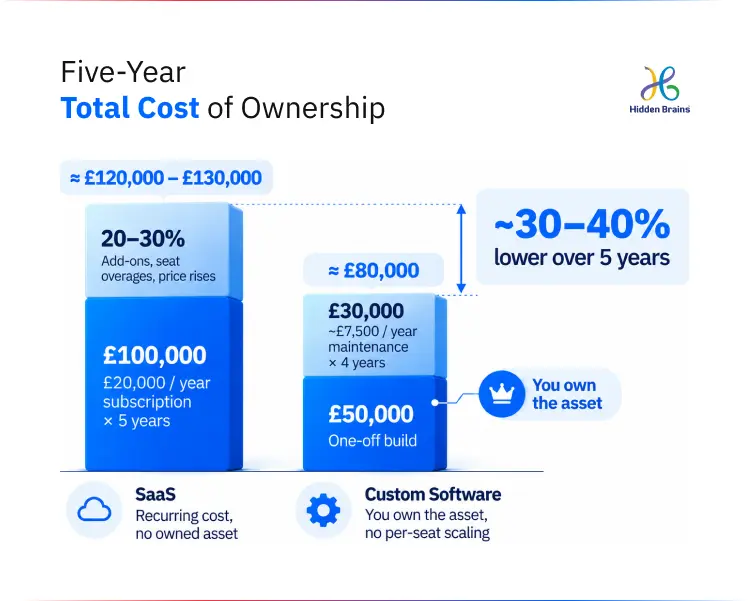
Often, across a five-year window. A rising annual subscription can exceed the five-year cost of a one-off build plus maintenance — frequently by 30–40% — while leaving you no owned asset. Consolidation projects usually break even at 18–24 months.
What’s the biggest financial risk in a software development project?
Low adoption and unbudgeted Year 2 running costs — not the build itself. De-risk by phasing: fund a scoped discovery, ship an MVP that proves the return, then extend on evidence. Treating the first 90 days of onboarding as part of the investment is what protects the ROI.
How do I fund a build without straining cash flow?
Spread cost across budget cycles and check the reliefs. Capital allowances or the intangible fixed assets regime may improve your year-one tax position; eligible manufacturers can access Made Smarter match-funding, and the Growth Guarantee Scheme covers financing — confirm tax treatment with your accountant. (General information, not tax advice.)
How do I choose a bespoke software development company in the UK?
Prioritise transparent pricing, code and data ownership, and a clear post-launch support model over the lowest quote. Ask for a full cost projection including maintenance, and favour a partner whose delivery is certified and predictable (for example, CMMI Level 3, ISO 27001). A partner that will tell you not to build when off-the-shelf fits is showing the judgment you’re paying for.
When should we start — now, or when 2027 budgets are locked?
Start discovery now; commit the build once budgets confirm. Discovery is low-cost, scopes the work accurately, and often shrinks it by cutting features you don’t need — so it de-risks the budget figure rather than pre-empting it. Every month on fragmented tools is another month of licence fees and lost time you could be recovering.



Conclusion
For UK SMEs, custom software in 2027 should be a deliberate investment, not an automatic technology spend. Protect the essentials, build only where there is a measurable cost saving or revenue opportunity, and buy where standard software already does the job.
The key is to look beyond the build quote. Model the five-year TCO, test the expected payback, and use available incentives where they genuinely apply.
Done well, custom software can reduce SaaS sprawl, remove manual work, and give the business a platform built around how it actually operates.
If you are planning your 2027 IT budget, start with a costed discovery before committing build spend. Explore our custom software development services for UK businesses, or book a 2-hour consultation with our experts to validate your assumptions, pressure-test the numbers, and identify where custom software could deliver the strongest return.