





























































































































































Summary
- AI works best when tied to a clear business outcome.
- High-value use cases include recommendations, AI search, customer support, copilots, vision, fraud prevention, and forecasting.
- The goal is to improve revenue, efficiency, customer experience, and risk control.
- Choose AI opportunities based on impact, available data, and implementation feasibility.
- Start small with one focused use case and one measurable KPI.
- Treat security, privacy, governance, and monitoring as part of the build, not an afterthought.
- Scale AI only after the first use case proves real business value.
AI in mobile apps works best when it solves a specific business problem, cutting support costs, catching fraud, or lifting conversion, not when it’s bolted on as a “smart” feature nobody asked for. The U.S. mobile AI market was valued at roughly $19.4 billion in 2024 and is projected to reach about $85 billion by 2030 (Grand View Research), but that growth only matters to your business if the AI you ship moves a number you actually care about.
Mobile app development companies are shifting toward a new core value: using AI to solve the right business problems. This guide explores the highest-value use cases, real benefits, verified U.S. examples, and how to identify and measure the right AI opportunity. If you’re building a new app or adding intelligence to an existing product, start with the problem, then choose the technology.
| Details | Information |
|---|---|
| Guide Focus | How businesses can identify the right AI opportunities in mobile apps, understand high-value use cases, evaluate business benefits, and measure ROI. |
| Business Challenge | Many businesses are adding AI without a clear problem to solve, creating more complexity, cost, and risk without improving the customer experience or business performance. |
| Target Audience | CIOs, CTOs, product leaders, mobile app owners, digital transformation leaders, founders, and businesses evaluating AI-enabled mobile app development. |
| TL;DR | AI creates the most value in mobile apps when it improves a specific decision, removes friction, reduces cost, or strengthens revenue and risk outcomes. Start with the business problem, then choose the technology. |
| High-Value Use Cases | Hyper-personalization, semantic search, conversational support, sales and field copilots, computer vision, fraud detection, forecasting, accessibility, and localization. |
| Business Benefits | Revenue growth, better customer experience, lower operational costs, improved productivity, faster decisions, reduced fraud and risk, and stronger product differentiation. |
| AI Opportunity Criteria | Business impact, data readiness, technical feasibility, user journey relevance, governance requirements, and ability to measure a clear KPI. |
| Implementation Approach | Start with one narrow use case, select the right AI pattern, choose on-device, cloud, or hybrid deployment, build governance in early, and scale after proving value. |
| ROI Measurement | Conversion uplift, revenue impact, support deflection, productivity gains, fraud reduction, task completion, accuracy, and A/B testing against a baseline. |
| Real-World Examples | Bank of America’s Erica, Layr’s AI-powered insurance platform, and PayPal’s real-time fraud detection demonstrate AI embedded around real business and customer needs. |
What is AI in Mobile Apps?
AI in mobile apps is the use of machine learning (ML), natural language processing (NLP), computer vision, and predictive models inside an app to interpret data and act on it, personalizing content, answering questions, detecting anomalies, or forecasting outcomes, instead of following fixed, pre-programmed rules.
In practice, that means an app that adapts to each user rather than showing everyone the same screen. A rules-based app says “if the user taps X, show Y.” An AI-powered app learns from behavior and decides what to show, flag, or recommend based on patterns in the data.
AI as a Business Driver, Not Just Another Feature
The businesses that win with AI treat it as a lever on a metric, not a checkbox on a roadmap. The question is never “should our app have AI?”, it’s “which decision, cost, or friction point in our app is worth automating or improving?”
That reframing matters because most AI initiatives that stall do so for the same reason: they start with the technology (“let’s add a chatbot”) instead of the bottleneck (“support tickets cost us X and 40% are the same five questions”). Anchor every AI decision to a measurable business outcome, and the technical choices get much simpler.
Take Your App to the Next Level with Advanced Features
Talk to Us
Highest-value AI Use Cases in Mobile Apps
The use cases below are ordered by how directly they tend to move revenue, cost, or risk for U.S. businesses. Each one starts with the problem it solves.
Hyper-personalization and Recommendations
- Problem it solves: Generic content that ignores what each user actually wants, hurting engagement and repeat purchases. ML models analyze in-app behavior and surface the products, content, or actions a user is most likely to want next. This is the engine behind retail, media, and fitness apps that feel “made for me.”
Semantic Search and Product Discovery
- Problem it solves: Users who can’t find what they want and abandon. Instead of exact-keyword matching, NLP-based search understands intent, so “warm jacket for hiking under $100” returns the right results even if the product titles don’t contain those words.
Conversational Customer Service
- Problem it solves: High support volume and slow response times. AI assistants and chatbots resolve common questions instantly inside the app and escalate the complex ones to a human. Done well, this deflects routine tickets without frustrating users.
Sales and Field-work Copilots
- Problem it solves: Frontline staff buried in manual lookups and data entry. In-app copilots summarize account history, draft responses, or surface the next best action — turning a phone into a productivity tool for reps and technicians.
Computer Vision
- Problem it solves: Slow, manual, or error-prone visual tasks. Computer vision powers document scanning (OCR), visual search, damage assessment, and identity verification directly from the camera, useful across insurance, retail, logistics, and healthcare.
Fraud, Risk, and Trust
- Problem it solves: Financial loss and eroded user trust from fraudulent activity. ML models score transactions and behavior in real time, flagging anomalies faster than any rules engine. This is now table stakes for U.S. fintech and banking apps.
Forecasting and Optimization
- Problem it solves: Decisions made on stale data. Predictive models forecast demand, pricing, delivery times, or churn, and feed those predictions back into the app so users and operators act on them.
Accessibility and Localization
- Problem it solves: apps that exclude users. AI-driven voice control, real-time captioning, and translation widen the addressable audience and improve compliance with accessibility standards.
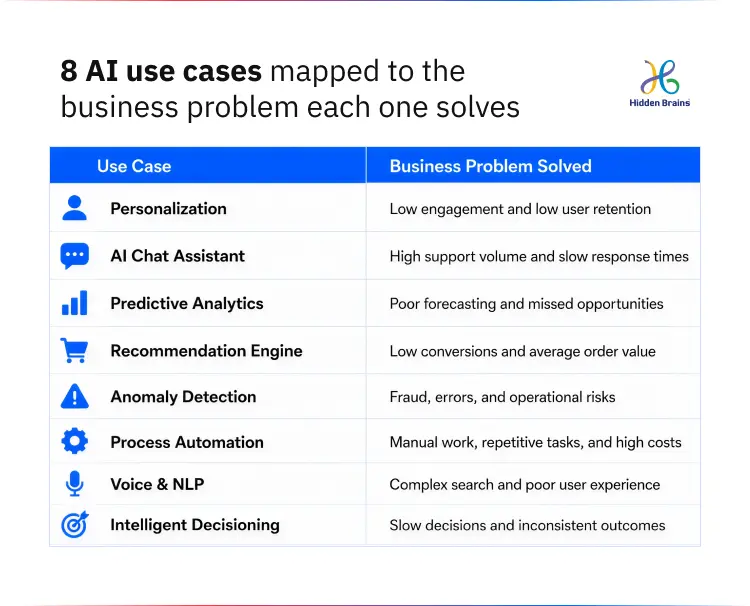
Core Business Benefits
The use cases above translate into six measurable benefits:
- Revenue growth — Personalization and smart discovery lift conversion and average order value.
- Better customer experience — Faster answers, relevant content, and less friction.
- Cost and productivity gains — Automation of repetitive support and back-office tasks.
- Faster decision-making — Real-time insights replace delayed reporting.
- Risk and fraud reduction — Anomaly detection protects revenue and trust.
- Product differentiation — Intelligent features that competitors’ rules-based apps can’t match.
AI Feature vs. AI Embedded in the Customer Journey
A bolted-on AI feature is a novelty; AI embedded in the customer journey is a business advantage. The difference is whether the AI sits off to the side (a chatbot icon nobody taps) or lives inside the moments that matter: onboarding, checkout, support, renewal.
Ask where in your user’s journey a better decision would change the outcome. That’s where AI belongs. Everywhere else, it’s cost without return.
The clearest way to see this is to map AI to the stages of your app’s journey and ask what a better decision is worth at each one:
- Onboarding — Smart defaults and guided setup so users reach first value faster, cutting early drop-off.
- Discovery — Personalized recommendations and semantic search that shorten the path to the right product or content.
- Checkout/conversion — Real-time fraud scoring and friction removal that protect revenue without blocking good users.
- Support — In-app assistants that resolve routine questions instantly and escalate the rest to a human.
- Retention/renewal — Churn prediction and proactive nudges that reach the user before they leave.
A useful benchmark to follow is AI that works within the user journey, not as a standalone feature. The goal is simple: surface the right insight at the right moment, make the experience smarter, and drive a measurable business outcome. That’s the standard we aim for.
Real-world Examples of AI in Mobile Apps
Bank of America — Erica (Conversational service + Personalized insights)
Erica, Bank of America’s in-app virtual financial assistant, has handled more than 3 billion client interactions since its 2018 launch and now averages tens of millions of interactions a month (Bank of America). It answers routine questions, surfaces proactive insights about spending and subscriptions, and hands off complex cases to a human. It’s the clearest U.S. proof that conversational AI inside a mobile app can operate at massive scale while improving service.
Layr — AI-powered Commercial Insurance (a Hidden Brains project)
Layr, an Atlanta-based insurtech, runs an AI-powered platform that gives U.S. small businesses tailored policy recommendations, matches them to the right coverage, and predicts carrier pricing, automating what used to be a slow, broker-heavy process. Hidden Brains built the Layr platform and supported its SOC 1 and SOC 2 compliance, embedding security and governance into the product rather than adding it later.
PayPal — Real-time Fraud Detection
PayPal uses deep-learning models to analyze transaction signals in real time and block fraudulent payments before they settle, a use case that protects both the platform and its users.
For more product concepts in this space, see our roundup of top AI app ideas.
How to Identify the Right AI Opportunity
Pick the one journey where a better decision changes a number you’re measured on. Score candidate use cases on three questions:
- Impact — does it move revenue, cost, or risk meaningfully?
- Data readiness — do you have the data (and the rights to use it) that the model needs?
- Feasibility — can it ship as a narrow first version in weeks, not quarters?
The best first project is small, measurable, and close to money or cost. Prove value there, then expand.
Implementation Approach
A pragmatic rollout follows four steps:
- Start with a narrow, measurable journey. One use case, one metric, one user segment. Scope creep kills AI projects.
- Match the right AI pattern to the use case. Recommendation engine, NLP assistant, computer vision, or forecasting model — the pattern follows the problem, not the hype.
- Choose on-device, cloud, or hybrid AI. On-device keeps data local and cuts latency (good for privacy-sensitive or offline features); cloud handles heavier generative and analytical workloads; most production apps use a hybrid split.
- Build governance into the mobile experience from day one, not as a retrofit (see below).
This is the point where a mobile app development partner and an AI integration services team need to work from the same plan — the model, the app, and the data pipeline are one system, not three.
AI Governance and Security Considerations
Trust is a feature. For any AI that touches user data or makes decisions, bake in:
- Privacy and consent — clear disclosure of what the AI uses and why.
- Data minimization — collect and retain only what the model needs.
- Grounded, reliable responses — connect generative features to verified data sources to reduce hallucination.
- Human escalation — always give users a path to a person.
- Monitoring and auditability — log AI decisions so they can be reviewed.
- Bias, hallucination, and prompt-injection testing — test adversarially before and after launch.
- User opt-out and fallback experiences — the app must still work if a user declines AI features.
This is where certifications earn their keep. As a CMMI Level 3, ISO 27001:2022, and ISO 9001:2015-certified company, Hidden Brains treats these controls as delivery standards, the same discipline that helped Layr reach SOC 1 and SOC 2 compliance.
How to Add AI to Your App: Build In-house vs. Integrate With a Partner
You have three paths: build an in-house AI team, integrate existing AI services and models into your app, or work with a partner who does both. For most mid-market U.S. businesses, integration is faster and cheaper than building an AI team from scratch; you’re combining proven models and APIs with your app and data rather than hiring scarce ML talent for a single project.
Cost depends on a few drivers, not a single sticker price:
- Scope — One AI feature vs. an AI-first app.
- Model approach — Using existing APIs/foundation models vs. training custom models on your data.
- Data work — Clean, labeled data is often the highest hidden cost.
- Infrastructure — On-device vs. cloud inference, and expected usage volume.
- Compliance — Regulated industries (finance, healthcare) carry added security and audit costs.
For a fuller breakdown, see our guide on the cost to make an app. When you’re ready to scope a specific build, our AI app development services can map your use case to an approach and estimate, or you can hire mobile app developers to extend an existing product.
How to Measure ROI and Business Impact
Decide the metric before you build, then measure it against a baseline:
- A/B testing — Ship the AI feature to a subset and compare against control.
- Conversion and revenue — Did personalization or search lift purchases?
- Service deflection — What share of support tickets did the assistant resolve?
- Productivity — Time saved per task for staff using copilots.
- Fraud reduction — Losses prevented vs. false-positive rate.
- Task completion and accuracy — Did users finish the job faster and correctly?
If you can’t name the metric a use case will move, it isn’t ready to build yet.
Frequently Asked Questions
What is AI in mobile apps?
AI in mobile apps is the use of machine learning, natural language processing, computer vision, and predictive models inside an app to interpret data and act on it — personalizing content, answering questions, detecting fraud, or forecasting outcomes — rather than following fixed rules.
How do I add AI to an existing mobile app?
Start with one measurable use case, choose whether to integrate existing AI services or train a custom model, confirm your data is ready, and decide between on-device, cloud, or hybrid processing. Integrating proven models into your current app is usually faster than building an in-house AI team.
How much does it cost to build an AI mobile app?
There’s no single price — cost depends on scope, whether you use existing models or train custom ones, the amount of data preparation required, infrastructure, and compliance needs. A narrow first feature costs far less than an AI-first app. See our [cost to make an app] guide for detail.
Should I build AI in-house or hire an AI app development company?
For most mid-market businesses, partnering or integrating is faster and lower-risk than building an in-house ML team for a single project. Building in-house makes sense when AI is core to your product and you’ll ship many models over time.
On-device or cloud AI — which should I choose?
Use on-device AI for privacy-sensitive, low-latency, or offline features; use cloud AI for heavier generative and analytical workloads. Most production apps use a hybrid of both.
Which AI features actually improve retention?
Personalization, relevant recommendations, fast conversational support, and features that remove friction from the core journey tend to move retention most, because they make the app more useful every time it’s opened.



Conclusion
The apps getting real returns from AI didn’t start with “let’s add AI.” They started with a specific, expensive problem, slow support, undersold policies, fraud losses, and used AI to fix it inside the user’s journey. Choose one measurable problem, ship a narrow first version, govern it properly, and measure the result. That’s the whole playbook.
Don’t get stuck in the ifs and buts of AI. Start with a simple roadmap that actually makes sense for your business, your team, and your goals. Book a free consultation, get clarity on what to do next, and decide the path from there.