
























































![Sales & Distribution [Oil & Gas]](https://www.hiddenbrains.com/blog/wp-content/themes/blankslate/assets/images/sales_and_distribution-icon.74d08193.svg "Sales & Distribution [Oil & Gas]")

![Fluid Terminal Management [Oil & Gas]](https://www.hiddenbrains.com/blog/wp-content/themes/blankslate/assets/images/fluid_terminal_management-icon.4b3a27a4.svg "Fluid Terminal Management [Oil & Gas]")


![Sales & Distribution [Oil & Gas]](https://www.hiddenbrains.com/blog/wp-content/themes/blankslate/assets/images/sales_and_distribution-icon.74d08193.svg?1.0.0 "Sales & Distribution [Oil & Gas]")
![Fluid Terminal Management [Oil & Gas]](https://www.hiddenbrains.com/blog/wp-content/themes/blankslate/assets/images/fluid_terminal_management-icon.4b3a27a4.svg?1.0.0 "Fluid Terminal Management [Oil & Gas]")














































































Summary
- Indonesia’s logistics costs still run ~14.29% of GDP (Bappenas), with land transport driving over half of domestic cost; much of that waste traces back to disconnected systems, not geography alone.
- The real value of custom logistics software is connection: fleet, warehouse, supply chain and finance in one operational view, rather than another standalone tool.
- ERP isn’t a separate “third option”; its modules (finance, procurement, inventory) connect into the custom build.
- Fleet management, WMS and supply chain visibility each close a distinct gap; distributors and 3PLs usually need all three connected.
- Four engagement models- dedicated team, staff augmentation, offshore development centre, or fixed-scope project- suit different roadmaps and levels of in-house control.
- Vet an Indonesian provider on logistics domain proof and integration ability first; weigh a software house in Jakarta against a global partner by how complex the build is.
A logistics operator in Indonesia can own the trucks, run the warehouses, and already have an ERP, and still not know where a shipment is right now, how full a warehouse is today, or why last week’s route lost money.
That gap, between recording transactions and actually seeing operations, is what most software quietly fails to close, so choosing a software development company in Indonesia for logistics is less about who can build an app and more about who can connect fleet, warehouse, and supply chain data into one operational picture your team can act on.
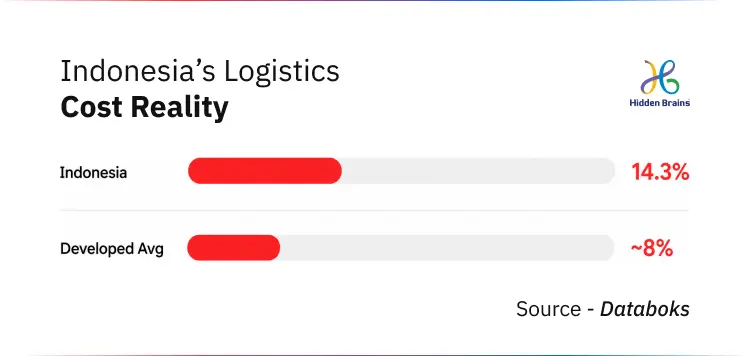
The stakes are national: Indonesia’s logistics costs still run at roughly 14.29% of GDP (Bappenas) with a government target of 8% by 2045; land transport alone drives more than half of domestic logistics costs, and the country slipped to around 63rd on the World Bank’s 2023 Logistics Performance Index, down from 46th in 2018- inefficiency that disconnected systems quietly feed.
This guide is written for logistics, distribution, and supply chain leaders evaluating a build. It covers what a connected solution actually solves, how fleet, warehouse, and supply chain visibility fit together, how you can engage a development partner, and a practical checklist for vetting an Indonesian provider before you sign.
The Price of Running Logistics on Disconnected Systems
Indonesia’s logistics costs run higher than most of its ASEAN neighbours, and fragmented software is part of the reason. For context, Malaysia’s logistics costs sit around 13% of GDP against Indonesia’s ~14.29% (Bappenas), and that headline figure comes with a caveat worth knowing before it lands in a board deck: older World Bank estimates put Indonesian logistics costs as high as ~23–24% of GDP, so the lower Bappenas number reflects a newer, different methodology rather than a sudden overnight improvement.
The direction of travel matters more than the exact decimal: costs are meant to fall toward 8% of GDP by 2045, while the country’s slide on the World Bank’s Logistics Performance Index shows how much operational ground there is to make up.
Two structural facts sit underneath those numbers.
- Archipelagic complexity: With 17,000+ islands, shipments often move across road, sea, and air in a single journey.
- High transport costs: Land transport accounts for over half of Indonesia’s domestic logistics costs.
- Limited visibility: Shipment data is frequently scattered across multiple systems—or tracked manually via paper and WhatsApp.
- Operational inefficiencies: Disconnected information leads to empty backhauls, idle trucks, stockouts, and slow reconciliation.
Software doesn’t fix geography. But disconnected software makes every one of those problems worse, because no one has a single, current view to act on. The right logistics software development services target exactly this: turning scattered operational data into decisions people can make in time.
Discover where logistics visibility breaks down—and how to fix it.
Book Free Consultation
How Connected Logistics Software Fixes Operational Gaps
A connected logistics solution replaces the question “Which system do I check?” with a single, up-to-date operational view. Instead of finance seeing one version of performance, operations another, and the warehouse a third, the same data flows across fleet, warehouse, procurement, and finance, so a delay, a stockout, or a margin problem is visible while you can still do something about it.
In practice, that means:
- Real-time status instead of end-of-day reports — Where a shipment is, whether a warehouse can accept it, whether a route is running late.
- One source of truth — No reconciling three spreadsheets to answer one question about inventory or delivery cost.
- Fewer manual handoffs — Orders, dispatch, proof of delivery, and invoicing connect instead of being re-keyed at each step.
This is also where the “should I buy off-the-shelf, build custom, or add an ERP module?” question usually resolves itself. In most Indonesian logistics builds, ERP modules- finance, procurement, inventory- aren’t a separate third option. They get connected into, or embedded within, a custom solution so the warehouse and fleet layers talk to the financial layer natively. A packaged tool might handle one function well; the value of custom software development services is stitching those functions, including your existing ERP, into one workflow rather than another silo.
Fleet Visibility That Drives Better Decisions
Fleet management software earns its keep when it turns raw GPS data into decisions, not just a map full of dots. Live vehicle location is the easy part; the harder, more valuable part is connecting that location to routes, fuel, maintenance, driver behaviour, and delivery commitments.
Fleet visibility: from GPS tracking to smarter decisions
A connected fleet management solution helps operators:
- Plan smarter routes across road, sea, and multimodal transport networks.
- Reduce vehicle downtime with preventive maintenance scheduling and service alerts.
- Control fuel costs by monitoring fuel consumption, idling, and driver behaviour.
- Capture proof of delivery digitally using mobile-based electronic Proof of Delivery (ePOD).
- Improve fleet utilisation by reducing empty backhauls and idle vehicles.
- Give operations teams real-time visibility through a single dashboard shared with warehouse, inventory, and finance systems.
Result: Better utilisation, lower operating costs, and faster, data-driven decisions across the logistics network.
Warehouse & Inventory: One Accurate View Across Locations
A warehouse management system (WMS) is worth building when you need one accurate, real-time view of stock across multiple locations, not just a digital stock ledger. For distributors and 3PLs operating across islands, the core problem is rarely “we don’t record inventory.” It’s that each site records it slightly differently, and head office learns about a mismatch days later.Practical WMS scope includes barcode/RFID-based receiving and picking, multi-location stock visibility with automated replenishment triggers, put-away and space optimisation, and returns handling. The point is capacity and status you can see now, so procurement stops ordering blind, and sales stops promising stock that isn’t there. This connects directly to a broader warehouse and inventory management solution rather than living as an isolated app.
Supply Chain Visibility: Connecting Supplier to Port
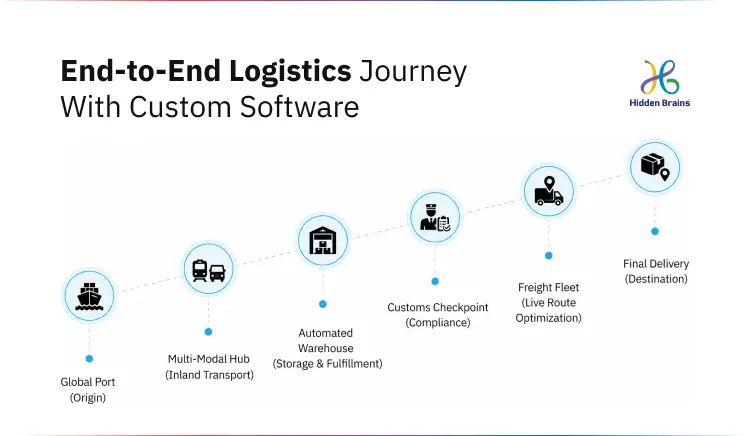
Warehouse automation is a core enabler of end-to-end supply chain visibility, ensuring inventory movements are tracked in real time. Supply chain visibility means tracing a shipment end-to-end, supplier to warehouse to multimodal transport to port to customer, through one system rather than piecing it together after the fact. In Indonesia’s multimodal reality, this is where most of the hidden cost and most of the customer-experience risk actually lives.
A visibility layer pulls procurement, inventory, transport, and delivery events into a shared timeline, so a delay at a port or a hand-off between carriers is flagged as it happens, not explained afterwards.
For industries such as manufacturing, distribution, FMCG, and commodities, end-to-end traceability is critical. In complex supply chains like palm oil operations—where goods move from plantations through multiple logistics stages to ports—connected visibility helps businesses identify issues early, intervene faster, and maintain operational control. Hidden Brains has delivered connected logistics platforms, including solutions for Cymax Group of Technologies, contributing to operational improvements and supporting a 68% growth in client base.

Connect Fleet, Warehouse & Finance into One Unified Logistics Platform.
Talk to Our ExpertsHow to Engage the Right Development Partner in Indonesia
You don’t have to choose between “hire a full team” and “outsource the whole project”; most logistics builds use one of four engagement models, and the right one depends on how much in-house control and continuity you need. Here’s how they compare in practice:
- Dedicated development team. Best when you have an ongoing roadmap, a multi-phase logistics platform, and want a stable, long-term team. You control priorities, sprint direction, and the roadmap; the trade-off is that it requires internal product ownership on your side.
- Staff augmentation. Best when you already have a team but lack a specific skill, such as IoT/GPS integration or WMS expertise. You retain day-to-day management; the trade-off is that delivery accountability remains with your organization.
- Offshore Development Centre (ODC). Best when you want a scalable extension of your engineering function over several years, supported by proper governance. You build long-term capability and retain IP ownership; the trade-off is a longer setup period and sufficient project volume to justify the model.
- Managed / fixed-scope project. Best when you have a clearly defined build, such as a single WMS or fleet management module, with well-documented requirements. You gain predictable outcomes and timelines; the trade-off is reduced flexibility for scope changes during development.
For a first logistics build, a dedicated team or managed project is usually the cleaner start; skill-gap fills lean toward dedicated developers. The distinction that matters isn’t headcount; it’s whether you’re buying people or accountable delivery. A good partner should be able to explain which model fits your roadmap rather than defaulting to the biggest one.
How to Evaluate an Indonesian Software Provider: a Practical Checklist
Vet a logistics software partner on domain proof and integration ability first; technology stack comes later. Anyone can list “custom software development.” Far fewer can show they’ve connected a fleet, a warehouse, and a finance system into one working operation. Run any shortlist against these:
- Logistics domain proof. Can they show real fleet, WMS, TMS, or supply chain work, with specifics, not just logos? Ask what broke and how they fixed it.
- Integration ability. Can they connect to your existing ERP, GPS/IoT hardware, port/customs systems, and payment/e-invoicing platforms? This is where most logistics projects succeed or stall.
- Certifications and process. Look for genuine quality and security standards (e.g., CMMI, ISO 27001), not as a footer badge, but reflected in how they run delivery and handle data.
- Data security and governance. Logistics data is commercially sensitive. Ask about access control, hosting and data-residency options, and audit trails.
- Local and multimodal context. Do they understand Indonesian operational realities—multimodal transport, multi-island distribution, and local compliance—or are they applying a generic template?
- Support and continuity. Who maintains the system after launch? What’s the plan if a key developer leaves? Knowledge continuity is a real risk in long logistics builds.
- Engagement flexibility. Can they move between different engagement models as your needs change, or do they only offer one approach?
Software House in Jakarta vs. an Offshore or Global Partner
A local software house in Jakarta offers proximity, time-zone overlap, and on-the-ground context; a global or offshore partner typically offers deeper enterprise-integration experience and more mature delivery governance. The right choice depends on the complexity of your build. For a straightforward local app, proximity may be enough.
For a connected fleet-warehouse-finance platform that has to integrate with an ERP and scale across islands, weigh delivery maturity, integration track record, and support continuity over location alone. Some partners, Hidden Brains among them, combine enterprise software development in Indonesia with global delivery experience, which is often the practical middle ground.
How Hidden Brains Approaches Logistics Builds
At Hidden Brains, a logistics engagement usually starts before technology selection, with where processes, systems, and data are actually breaking down. The first questions are operational: where does visibility drop, which decisions arrive too late, and which reconciliations eat the most hours. Only then does the conversation move to fleet, warehouse, supply chain, and how the ERP connects into it.
That approach reflects 23+ years building enterprise systems, CMMI Level 3 and ISO 27001 / 9001 certification, and delivery across 107 countries, including connected logistics platforms and, through the ROCKEYE ERP ecosystem, modular enterprise operations spanning procurement, inventory, transport, and finance. The goal isn’t to add another system. It’s to connect the ones you have into operations you can actually see.
Explore our capabilities as an enterprise software development company in Indonesia, or our broader logistics software development services, to see where they fit your operation.
Frequently Asked Questions
How much does logistics software development cost in Indonesia?
There’s no single price; cost is driven by scope (a single WMS or fleet module vs. a connected fleet-warehouse-finance platform), integration complexity (existing ERP, GPS/IoT hardware, port and e-invoicing systems), and engagement model (fixed-scope project vs. dedicated team). A focused module is a very different investment from an end-to-end platform, and timeline scales the same way, usually a few months for a defined module, longer for a phased platform. The most reliable way to get a real number is a scoped estimate against your actual workflows.
Should I choose off-the-shelf or custom logistics software?
Off-the-shelf works when one function (say, basic tracking) fits your process closely and you don’t need it connected to everything else. Custom is worth it when the value is in connecting fleet, warehouse, and finance, especially with an existing ERP, into one workflow. Many Indonesian operators end up with a custom layer that ties packaged tools and their ERP together, rather than a pure buy-or-build choice.
Do I need a TMS, a WMS, or both?
A WMS manages what happens inside your warehouses (receiving, picking, stock accuracy across locations); a TMS manages goods in motion (routing, carriers, shipment tracking). Distributors and 3PLs usually need both; connected, the handoff between warehouse and transport is exactly where visibility is often lost.
Can new logistics software connect to my existing ERP?
Yes, and it usually should. Finance, procurement, and inventory modules are best connected into the logistics build so the operational and financial views match, rather than run as separate systems that have to be reconciled. Ask any prospective partner specifically about their ERP integration track record.
Software house in Jakarta or an offshore partner, which is better?
For simple, local builds, a Jakarta software house offers proximity and context. For a connected, enterprise-grade logistics platform that integrates with an ERP and scales across islands, prioritise integration experience, delivery governance, and long-term support over location. A partner that combines local context with mature global delivery is often the strongest fit.



Conclusion
The biggest logistics challenge isn’t technology; it’s disconnected systems. Costs come down, and performance improves when fleet, warehouse, supply chain, and finance work from the same source of truth, not separate tools. That’s what to look for in a software development company in Indonesia: a partner that understands your operations, integrates with your existing ERP, and solves the root cause instead of adding another application.
Start by identifying where visibility breaks down. Then decide whether you need a WMS, fleet management, supply chain visibility, or an integrated solution. Choose a partner with proven logistics expertise and strong integration capabilities.
Ready to connect your logistics operations? Talk to our Experts for software that gives you complete visibility and scales with your business.