













































































































































Summary
- Enterprise full stack development goes beyond frontend and backend to include data, security, infrastructure, and operations.
- A modular architecture provides a practical foundation for scaling without premature microservices complexity.
- API contracts, stateless services, asynchronous processing, and idempotency improve reliability as workloads grow.
- Database design, query performance, caching, and data architecture are critical to application scalability.
- Security, automated testing, CI/CD, observability, and disaster recovery should be built into the development lifecycle.
- The right full-stack development team should be evaluated on architecture, performance, security, and end-to-end ownership—not just framework skills.
Most business applications don’t fail on launch day. They fail when the business changes faster than the architecture can handle.
HealthCare.gov is a well-known example. At launch, it received five times the expected traffic, while software defects, infrastructure limitations, and weak monitoring contributed to frequent outages. CMS later estimated the site was unavailable for as much as 60% of the time during some weeks in October 2013.
The lesson applies to any growing enterprise: an application that works at 500 users can struggle at 50,000, with slow APIs, overloaded databases, failed integrations, duplicate transactions, or fragile releases.
That gap between “it works” and “it scales” requires more than infrastructure. It requires scalable architecture, disciplined engineering, and developers who understand the application end to end. This is why enterprises hire full stack developers who can work across frontend, backend, APIs, data, security, and operations.
This guide covers the best practices for building scalable business applications, the key architecture trade-offs, and how to evaluate the full-stack talent needed to support enterprise growth.
Key Takeaways
- Scalability is a business, architecture, engineering, and operations concern — not just “adding servers.”
- Start with a modular architecture, define measurable performance targets, and keep services stateless where practical.
- Design the data layer deliberately; it’s the most common bottleneck as load grows.
- Automate security, testing, deployment, and observability from the first release, not after problems appear.
- Avoid premature microservices; they add real cost and are only justified by specific, measured needs.
- The team model (in-house, dedicated, staff augmentation, or remote) should follow the problem, not the other way around.
What Is Enterprise Full Stack Development?
Enterprise full stack development is the practice of designing, building, and evolving complete business applications across frontend, backend, APIs, data, infrastructure, security, and operations.
General full-stack development often focuses on whether a feature works across the front and back end. Enterprise full-stack development adds the engineering disciplines that determine whether that feature remains secure, observable, maintainable, reliable, and performant as the organization grows.
The full application stack typically includes:
- Frontend: Interfaces employees, customers, partners, or administrators use.
- Backend: Business logic and rules that must remain correct under concurrency.
- APIs: Contracts that allow internal and external systems to communicate reliably.
- Data: Models, queries, indexes, storage, backups, and data-access patterns designed for growth.
- Infrastructure: Deployment, compute, networking, scaling, and recovery.
- Security: Authentication, authorization, encryption, secrets, compliance, and auditability.
- Operations: Monitoring, logging, alerting, tracing, reliability, and cost visibility.
The distinction matters because scaling challenges often emerge beyond the feature layer, in data, infrastructure, and operations. Scosche is a useful example: its e-commerce platform was already supporting 50K+ active users, yet the modernization involved a Magento 1 Enterprise Edition to Magento 2 migration and a move to Magento Cloud. Hidden Brains reports a 20% performance improvement, 30% codebase optimization, and a 15% increase in traffic following the modernization.
The lesson: building features is only one part of building for scale. The data, deployment, infrastructure, and operational layers must evolve with the application.
Full Stack vs Microservices: Clearing Up the Confusion
Full stack and microservices are not competing choices. They answer different questions.
Full stack describes the breadth of development responsibility, from frontend through backend and data. Microservices describes how an application is architected, divided, deployed, and operated.
When a Modular Monolith Makes Sense
For many enterprise applications, a modular monolith is a better starting point than immediately adopting microservices.
A single deployable application can still have strong internal boundaries around domains such as:
- Users and identity
- Orders
- Payments
- Inventory
- Reporting
- Notifications
The benefit is architectural separation without immediately introducing distributed-system problems such as network failures, service discovery, cross-service authentication, distributed tracing, and data consistency.
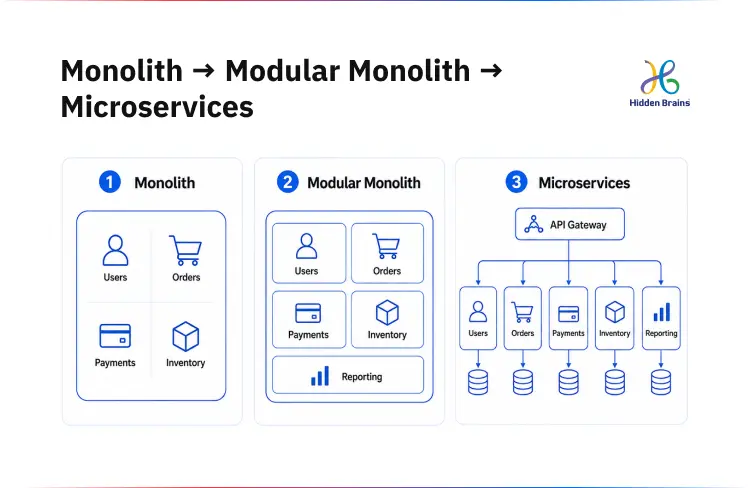
When Microservices Become Justified
Microservices become more compelling when a specific module needs:
- Independent deployment
- Independent scaling
- Separate team ownership
- Strong security isolation
- A substantially different workload profile
- Independent technology choices
The principle is simple: extract services in response to measured pressure, not architectural fashion. See our guide to client-server architecture.
The Enterprise Web Application Development Process
Scalable applications come from a repeatable process, not heroics. Six stages carry a business application from idea to sustained operation:
- Discovery — Clarify the business problem, users, workflows, data, integrations, compliance needs, and expected load. Ambiguity here is the most expensive kind.
- Architecture — Choose the module boundaries, data model, integration approach, and non-functional targets (performance, availability, security) before writing feature code.
- Development — Build against documented API contracts and coding standards so the codebase stays consistent as more people touch it.
- Testing — Verify business rules, integrations, security, performance, and failure behavior — not just the happy path.
- Deployment — Ship through an automated pipeline with progressive rollout and a documented way to roll back.
- Optimization — Use real production data to tune performance, cost, and reliability continuously.
The stages that get compressed under deadline pressure- discovery, architecture, and non-happy-path testing- are exactly the ones that determine whether the application scales. For an example of carrying an application from early product to enterprise-grade, see scaling from MVP to enterprise development.
Best Practices for Building Scalable Business Applications
Scalability should be treated as a system of engineering practices across architecture, code, security, delivery, and operations.
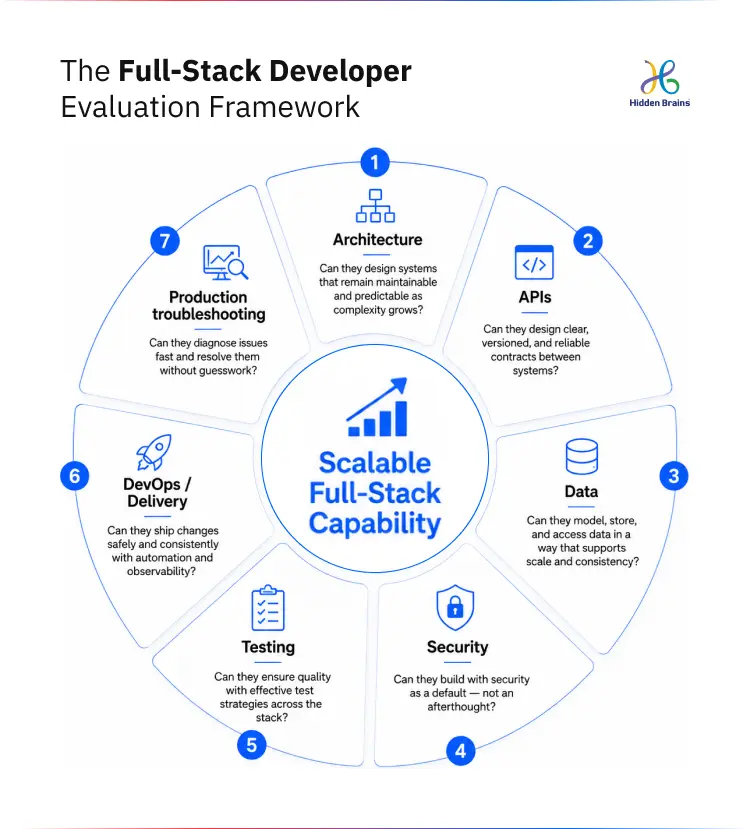
Architecture
Start with a modular monolith unless independent deployment or scaling is genuinely required.
Organize modules around business domains rather than framework layers. Clear boundaries make it easier for developers to understand where business logic belongs and reduce unwanted dependencies between components.
Keep application services stateless where practical so multiple instances can scale horizontally. Store uploaded documents and files in object storage rather than application-server disks.
Move long-running work away from synchronous requests. Use queues and background workers for:
- Report generation
- Notifications
- Document processing
- Bulk imports
- ERP/CRM synchronization
- AI processing
Make write operations idempotent so retries do not create duplicate payments, orders, or records.
External dependencies should have:
- Timeouts
- Retry limits
- Exponential backoff
- Circuit breakers
- Graceful fallback behavior
Finally, record major architecture decisions—such as database selection, caching strategy, authentication model, or service extraction—as lightweight Architecture Decision Records. This preserves the reasoning behind technical choices as teams change.
Code & APIs
Consistency is a scalability feature.
Use shared project structures, naming conventions, linting, formatting, and code-review standards so a growing development team does not create multiple ways of solving the same problem.
Keep controllers thin and business logic in services or domain modules.
At every API boundary:
- Validate requests against schemas.
- Standardize error responses.
- Never expose stack traces or internal implementation details.
- Use pagination, filtering, and maximum-result limits.
- Design write operations for safe retries.
On the data-access side, actively look for N+1 queries, slow endpoints, unnecessary database calls, and inefficient query patterns. Create indexes based on actual workload rather than assumptions.
Use backward-compatible database migrations so old and new application versions can coexist during deployment.
Centralize configuration by environment and never hardcode credentials, secrets, or production URLs.
One practice becomes particularly valuable at enterprise scale: correlation IDs. Attach a correlation ID to requests so developers can trace a single user action across the frontend, API, queue, worker, database, and external services.
That turns “we cannot reproduce it” into something the engineering team can investigate.
Security
Security should be an engineering requirement, not a pre-launch checklist.
Enforce authentication and authorization on the backend for every protected resource. Frontend role checks can improve the user experience, but they should never be the final security control.
Use OAuth 2.0/OpenID Connect where appropriate, apply RBAC or ABAC, and follow least-privilege principles.
Protect application data through:
- Encryption in transit and at rest
- Managed secret storage
- Input validation
- Parameterized queries
- API rate limiting
- Request-size limits
- Abuse monitoring
- Immutable or controlled audit logs
For high-risk functionality—such as payments, healthcare data, administration, or third-party integrations—perform threat modeling before implementation.
Security scanning should also become part of CI/CD, covering dependencies, source code, containers, and infrastructure-as-code.
The objective is not simply to find vulnerabilities before release. It is to make secure behavior the default engineering pattern.
Testing & Delivery
Test for the failures that actually take systems down, not just correctness.
Use different testing layers for different risks:
- Unit tests for critical business logic
- Integration tests for databases, queues, and external services
- Contract tests between APIs and dependent systems
- End-to-end tests for revenue- and compliance-critical workflows
- Regression tests for established business behavior
Before major releases, test realistic peak traffic and failure conditions.
Simulate:
- An unavailable dependency
- A slow database
- Duplicate queue messages
- Failed background jobs
- Retry exhaustion
- Unexpected traffic spikes
CI/CD should automatically build, test, scan, deploy, smoke-test, and verify releases.
For high-impact applications, use canary or blue-green deployment rather than exposing every user to a new version immediately.
Database changes also need to be deployment-aware. During a rolling release, the database should remain compatible with both the old and new application versions.
And every production deployment should have a rollback plan.
Operations & Scalability
Developers need visibility into the production behavior of the code they ship.
Define SLOs for availability, error rates, p95/p99 latency, and recovery time. Monitor metrics, logs, and distributed traces from the first production release.
Use structured logs and correlation IDs. Alert on signals that indicate actual user impact, including:
- Payment failures
- Queue backlog
- Failed integrations
- High p99 latency
- Database saturation
- Job processing delays
Every deployable service should expose appropriate health, readiness, and liveness checks.
Configure autoscaling around meaningful workload signals rather than relying exclusively on CPU utilization.
Use caching for repeated, read-heavy data that can safely tolerate staleness—but define expiration and invalidation rules explicitly.
Introduce read replicas, partitioning, archival, or search indexes only when workload data justifies them. Disaster recovery should also be tested rather than assumed. A backup that has never been restored is not a proven recovery strategy.
Finally, measure the economics of scale. Track cost per:
- Transaction
- Tenant
- Order
- Active user
A system that handles ten times the traffic but costs twenty times more to operate has not achieved sustainable scalability.
Good Read – Why software scalability is key to future-proof businesses.
Practical Delivery Checklist
Before calling an enterprise feature production-ready, ask:
- Are performance and availability targets defined?
- Are module and API boundaries clear?
- Are APIs validated and retry-safe?
- Have critical database queries been measured?
- Are security and authorization enforced server-side?
- Are critical workflows covered by automated tests?
- Has realistic load been tested?
- Are logs, metrics, traces, and correlation IDs available?
- Is the deployment reversible?
- Have backup restoration and recovery procedures been tested?
- Is the cost impact understood?
The goal is not maximum technical complexity. It is predictable performance, safe change, operational visibility, and controlled cost as the business grows.
Get the full-stack capability to scale without the technical drag
Talk to Us
Challenges in Enterprise Full-Stack Engineering
Enterprise full-stack engineering becomes difficult because technical decisions have consequences across the entire system.
Premature Microservices
Breaking an application into services too early creates more deployment pipelines, network boundaries, authentication concerns, observability requirements, and data-consistency problems.
Database Bottlenecks
The application tier may scale horizontally while the database remains a shared constraint. Poor queries, missing indexes, connection saturation, or inefficient data models can undermine an otherwise scalable architecture.
Distributed-System Complexity
Retries, queues, eventual consistency, duplicate messages, and partial failures require developers to think beyond a single request-response cycle.
Technical Debt
Short-term implementation decisions accumulate. Without regular refactoring and architecture reviews, every new feature becomes more expensive to deliver.
Security and Compliance
Enterprise applications often handle sensitive data and connect to systems that have their own security requirements. Security therefore becomes part of architecture and development rather than a separate testing activity.
Cloud Cost
Autoscaling and managed services solve operational problems but can introduce unpredictable spending. Engineering teams need visibility into the relationship between usage, architecture, and cost.
When and How to Hire Full Stack Developers for Enterprise Scale
Hire full stack developers when you need end-to-end ownership of a business application and the ability to move across frontend, backend, data, and delivery without handoffs slowing everything down. For enterprise scale, the real decision isn’t just who to hire — it’s which engagement model fits the problem, and how to evaluate for the skills that matter under load.
In-House vs Dedicated vs Staff Augmentation vs Remote
Each model solves a different problem. The right choice depends on how long the need lasts, how specialized the skills are, and how much delivery ownership you want the partner to hold.
| Model | Best for | Ownership | Speed to scale | Trade-off |
|---|---|---|---|---|
| In-house | Long-term core product, deep domain context | Full internal control | Slow (hiring cycles) | Fixed cost; hard to find niche skills fast |
| Dedicated team | Sustained roadmap needing an accountable, integrated team | Partner-owned, aligned to your priorities | Fast | Needs clear priorities and communication |
| Staff augmentation | Filling specific skill gaps inside your existing team | You retain ownership | Fast | You still manage delivery and integration |
| Remote/freelance | Short-term, well-defined tasks | Fragmented | Very fast | Limited coverage across the full lifecycle |
A dedicated full stack development team suits a sustained roadmap where you want an accountable group that scales up or down with the work. Staff augmentation suits a strong internal team that simply needs specific skills. For a deeper comparison of these models, see why and when to hire a dedicated development team.
How to Evaluate a Full-Stack Developer or Partner for Scalability
Vet for the capabilities that decide whether an application survives growth, not just whether a feature works:
Vet for the capabilities that decide whether an application survives growth — and ask for evidence, not assurances. The strongest proof a partner can offer is delivered work that already exhibits each capability:
- Technical breadth — Genuine competence across frontend, backend, APIs, and data, not one strong layer and two weak ones. Complex, multi-domain builds are where breadth shows: see our ecommerce and logistics platform and online marketplace case studies.
- Architecture judgment — Can explain module boundaries, when a monolith is right, and when (and how) to re-architect or extract a service. Our legacy system migration and trading platform case studies show those decisions in practice.
- Production engineering — Has run systems in production: monitoring, security, compliance, incident response, and cost. See our HIPAA-compliant application and real-time monitoring system case studies.
- Problem-solving under real constraints — Reasons about failure modes, trade-offs, and load, not just tutorials.
- Communication — Explains technical decisions to business stakeholders and works inside your delivery process.
Ask candidates or partners to walk through a system they scaled: what broke, what they measured, and what they changed. The answer separates people who maintain applications from people who can scale them.
How Hidden Brains Approaches Enterprise Full-Stack Delivery
At Hidden Brains, enterprise full-stack work starts before technology selection — with understanding where a business’s processes, data, and workflows are breaking down. From there, delivery follows a consistent path:
- Discover — Clarify the business problem, users, load, integrations, and compliance needs.
- Architect — Set module boundaries, data models, and measurable non-functional targets.
- Build — Develop against documented API contracts and shared engineering standards.
- Secure — Apply backend authorization, encryption, threat modeling, and CI/CD security scanning.
- Test — Cover business rules, integrations, performance, and failure behavior.
- Deploy — Ship through automated pipelines with progressive rollout and rollback.
- Monitor — Track SLOs, traces, and alerts from the first release.
- Optimize — Tune performance and cost against real production data.
As a CMMI Level 3, ISO 27001 and ISO 9001-certified engineering company with 23+ years of delivery across 107 countries, our value is connecting business understanding with accountable engineering execution, not simply supplying headcount. When it makes sense to hire full-stack developers or scale through enterprise software development services, the goal is an integrated team that owns outcomes across the full lifecycle.
Frequently Asked Questions
How do we know our application won’t scale before it becomes a business problem?
The warning signs usually appear as business symptoms before they look like technical ones: response times that climb as usage grows, releases that get slower and riskier, reports that arrive too late to act on, and small changes that require disproportionate effort. If adding customers, locations, or transaction volume increases operational firefighting rather than revenue efficiency, the application is signalling an architecture or engineering-standards limit, and it’s cheaper to address before a peak event than during one.
What actually drives the cost of building a scalable enterprise application?
Cost is driven less by the feature list and more by the non-functional requirements — expected load, integrations, compliance and security needs, availability targets, and how much of the lifecycle (security, testing, operations) is done properly versus deferred. Deferring those layers lowers the initial invoice and raises the total cost, because re-architecting under load and paying down technical debt is far more expensive than building to standard the first time. The most useful budgeting lens is cost per transaction or per active user over time, not just the build price.
Should we hire full stack developers in-house or engage a dedicated team?
It depends on how long the need lasts and how much delivery ownership you want to hold. Build in-house when the application is long-term core intellectual property you want to own and staff around fully. Engage a dedicated full-stack team when you have a sustained roadmap but want an accountable partner that can scale capacity up or down without carrying fixed hiring risk. Many enterprises run a hybrid, an internal core for domain knowledge and a dedicated team for delivery velocity — so growth isn’t bottlenecked by hiring cycles.
How do we protect delivery quality and security as the team scales?
Consistency has to be engineered, not assumed. As more people touch the codebase, quality holds only when standards are encoded into the system, reusable templates, CI/CD quality gates, automated security scanning, architecture checklists, and clear definition-of-done criteria. That turns quality, security, and scalability from individual developer effort into a repeatable process, which is exactly what protects an enterprise from a growing team quietly increasing risk. Certifications such as CMMI Level 3 and ISO 27001 exist to verify that this discipline is in place.
Who is accountable for outcomes when we hire an external full-stack team?
Accountability should be defined by the engagement model, in writing, before work starts. A dedicated-team model is designed for outcome ownership — the partner owns delivery against agreed priorities, SLOs, and quality gates, and integrates into your governance. Staff augmentation keeps accountability with your internal leadership, since you’re filling skill gaps inside your own delivery structure. The mistake to avoid is assuming ownership without agreeing it: clarify who owns architecture decisions, security, incident response, and roadmap trade-offs up front.



Conclusion
Scalability is decided long before traffic spikes, in the architecture you choose, the standards you enforce, and the team model you put behind the application. The organizations that scale cleanly aren’t the ones that added servers fastest; they’re the ones that treated scalability as a business, architecture, engineering, and operations discipline from the first release, and made those practices repeatable instead of heroic.
For most enterprises, the decision isn’t whether to invest in full-stack capability; it’s how to structure it. Start by being honest about where your current application is under strain, what your next stage of growth demands, and how much delivery ownership you want to hold internally versus hand to an accountable partner. Get those three answers right, and the question of whether to build in-house, hire full-stack developers, or engage a dedicated team stops being a guess and becomes a straightforward match between the problem and the model.
