



















































































































































Summary
- AI is transforming fleet operations from reactive to predictive and data-driven.
- Predictive maintenance helps reduce breakdowns, downtime, and maintenance costs.
- AI-powered routing improves delivery efficiency, fuel usage, and ETA accuracy.
- Driver analytics can improve safety, fuel efficiency, and overall performance.
- Connected systems bring fleet, inventory, orders, and back-office operations together.
- A five-layer AI stack supports reliable and scalable logistics solutions.
- Custom development makes sense for complex workflows and deep integrations.
- Start with a focused use case, measure ROI, and scale what works.
AI is moving logistics and fleet management from reactive, manual work to data-driven, increasingly autonomous operations, cutting cost per mile, reducing unplanned downtime, and making delivery promises more reliable. For operators weighing whether to buy an off-the-shelf platform or partner with a logistics software development company to build something that fits how they actually run, the more useful question isn’t “should we use AI?”, it’s “where does it pay off first, and what has to be true for it to work?”
This guide answers both, from the perspective of a team that builds these systems rather than sells a single product. We’ll cover what AI in logistics actually means, the forces pushing the shift, where it delivers measurable results today, how the technology is structured under the hood, and how to decide between buying and building.
| Aspect | Details |
|---|---|
| What does this guide cover? | AI in logistics and fleet management, including predictive maintenance, route optimization, dynamic dispatch, driver safety, fuel efficiency, inventory visibility, automation, AI architecture, and build-vs-buy decisions. |
| TL;DR | AI is transforming fleet operations from reactive and manual processes into predictive, data-driven operations. The biggest opportunities are in maintenance, routing, safety, fuel, visibility, and automation. |
| Who should read this guide? | Fleet managers, logistics leaders, COOs, CIOs, CTOs, operations teams, transportation businesses, and decision-makers evaluating AI or custom logistics software. |
| What will you learn? | Where AI delivers measurable value, how the five-layer AI stack works, what data and infrastructure are required, how to evaluate fleet platforms, and when custom development makes sense. |
| Expected outcome | Identify the highest-value AI use cases for your operation, understand implementation requirements, evaluate build-vs-buy options, and create a practical roadmap for AI adoption. |
| Key takeaway | Start with a high-impact use case, establish clean data and measurable KPIs, prove ROI in production, and then scale. AI success depends more on data, integration, governance, and adoption than on the model alone. |
What AI in Logistics and Fleet Management Actually Means
AI in logistics and fleet management is the use of machine learning and increasingly autonomous decision-making applied to physical operations: forecasting demand, selecting routes and carriers, predicting equipment failure, scoring driver behaviour, and handling exceptions with less human intervention.
In practice, it’s the difference between a dispatcher rebuilding routes by hand each morning and a system that continuously re-optimizes them as traffic, weather, and orders change. The technology isn’t new to logistics; telematics and GPS have been around for years. What changed is that the cost of collecting operational data collapsed, and the models that turn that data into decisions became good enough to run in production, not just in a pilot.
A quick distinction worth making: fleet management is the operational discipline of running vehicles efficiently (tracking, maintenance, compliance, cost), while AI fleet management adds a predictive and autonomous layer on top; the system doesn’t just report what happened; it anticipates what will happen and acts on it.
What’s Changing the Dynamics of Logistics and Fleet Management?
Four forces are pushing logistics and fleet operations toward AI at the same time, and it’s the combination, not any single one, that makes 2026 different from earlier automation waves.
Cost pressure that manual planning can’t absorb. Fuel, labour, and the driver shortage have compressed margins to the point where a 5–10% routing or fuel improvement is the difference between a profitable lane and a loss-making one. Manual route planning and spreadsheet-driven maintenance leave that money on the table.
Customer expectations that used to be premium are now baseline. Accurate ETAs, real-time visibility, and next-day delivery are table stakes. Meeting them consistently across a fleet requires continuous optimization, not once-a-day planning.
Volatility as a constant. Port congestion, weather, and supply disruptions are more frequent, and reactive scrambling is expensive. Predictive systems that flag risk 24–72 hours ahead change disruption from a fire drill into a managed exception.
Data and models finally caught up. Nearly every commercial vehicle now emits telematics and diagnostic data, cloud compute is cheap, and models have matured from experimental to dependable. The bottleneck moved from can we do this? to is our data clean enough to trust it?
The honest read on adoption is mixed, and that matters for setting expectations. Accenture’s 2026 Pulse of Change research found 86% of executives plan to increase AI spending, yet only 42% feel prepared for the pace of change. AI in logistics is genuinely in use, but usually in narrow, high-value applications rather than a wholesale redesign, and the constraint is almost always data quality, integration, and skills rather than access to models.
Where AI is Changing Fleet Management
Most operators see measurable ROI by going deep on a few use cases rather than running many shallow pilots. These four are where the economics are clearest today.
Predictive Maintenance and Uptime
AI predicts component failures before they cause a breakdown, shifting fleets from fixed schedules and reactive repairs to condition-based maintenance. Models analyze engine diagnostics, telematics, and historical failure patterns to forecast issues weeks in advance, so a part gets replaced during a planned service window instead of on the roadside. The payoff is fewer breakdowns, higher asset utilization, and longer equipment life; this is often the fastest win for fleets with aging or high-mileage vehicles.
Route Optimization, Dynamic Dispatch, and Real-time Tracking
AI ingests live traffic, weather, delivery windows, and vehicle status to continuously re-optimize routes and rebalance the fleet in real time. Unlike static route planning, it re-plans automatically when a delay or new order appears.
Paired with a modern GPS-based fleet vehicle tracking solution, this gives dispatchers real-time visibility and drivers updated sequences, reducing empty miles, fuel burn, and failed deliveries while improving ETA accuracy. This is also where remote and multi-depot fleets gain the most, because the system coordinates across locations that a human dispatcher can’t watch simultaneously.
Driver Behaviour, Safety, and Fuel
AI scores driving patterns, harsh braking, idling, speeding, tailgating, and, combined with computer-vision dashcams, flags risk and recommends coaching. The direct effects are fewer incidents, lower insurance costs, and reduced fuel consumption from less idling and smoother driving. Safety and sustainability improve together, which increasingly matters for emissions reporting.
Connected Fleet and Inventory Visibility, Plus Back-office Automation
AI connects fleet movement to inventory and order data so the two stop operating in separate silos. Integrated fleet and inventory visibility means dispatch decisions account for what’s actually on each vehicle and what a location needs. On the back office, generative and agentic AI automate document processing, carrier vetting, freight billing, and exception handling, compressing cycle times from days to minutes.
This is where a connected transport management system and warehouse and inventory visibility turn scattered data into coordinated action.
Future-Proof Your Fleet With Intelligent Technology
Talk to Our Experts
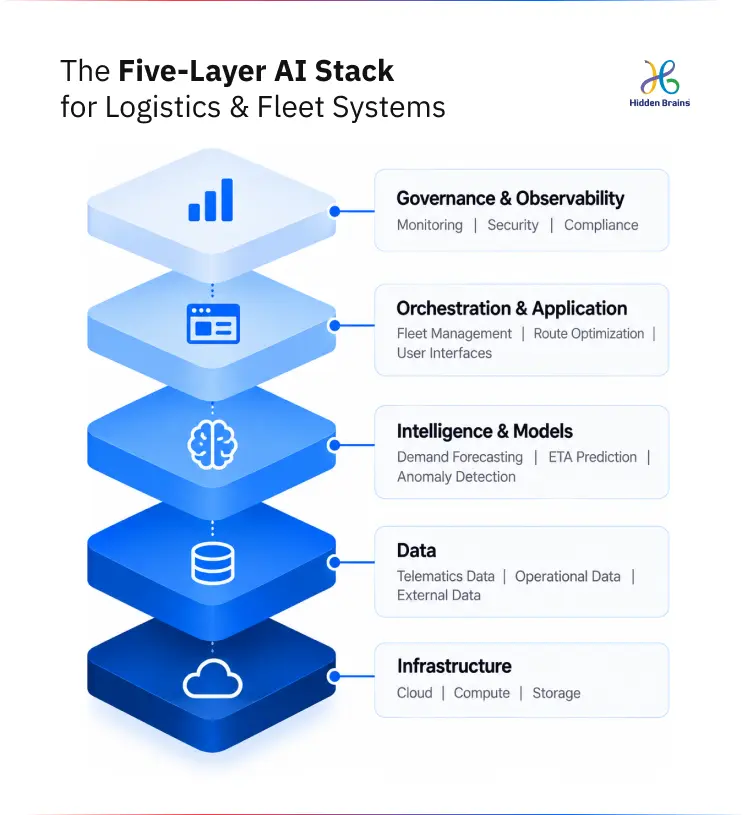
How AI Actually Works Under the Hood: The Five-layer Stack
Most enterprise and mid-market logistics architectures converge on five core layers:
Infrastructure → Data → Intelligence→ Orchestration → Governance.
Understanding this stack is the difference between buying a black box and knowing what you’re actually accountable for.
| Layer | What it does (in plain terms) | What sits here in a fleet/logistics build |
|---|---|---|
| 1. Infrastructure | Where everything runs | Cloud and edge compute, on-vehicle devices and sensors, connectivity |
| 2. Data | The fuel the system needs | Telematics, GPS, engine diagnostics, TMS/ERP/WMS feeds; ingestion, cleaning, and data-quality checks |
| 3. Intelligence (Models) | The reasoning | ML for prediction (travel time, demand, failure); graph and network optimization for multi-stop routing; reinforcement learning / multi-agent systems for dynamic dispatch |
| 4. Orchestration / Application | Where decisions become actions | Agentic workflows that reprioritize and act; routing and dispatch engines; the dashboards drivers and planners actually use |
| 5. Governance & Observability | Keeping it trustworthy | Model monitoring, data security, human-in-the-loop oversight, and KPI tracking |
Two things practitioners learn quickly.
First, the Data layer is where projects succeed or fail; no model overcomes fragmented feeds, inconsistent vehicle IDs, or missing telematics.
Second, the Governance layer isn’t optional. Fleet data is sensitive, autonomous decisions need audit trails, and someone has to watch whether the model still performs as conditions drift.
At Hidden Brains, that layer maps directly to how we already work: our ISO/IEC 27001:2022 information-security certification and CMMI Level 3 delivery process exist precisely because governance and observability determine whether an AI system stays trustworthy in production.
What the Data Actually Shows
The most credible numbers on AI in logistics come from independent research firms, not software vendors quoting their own dashboards, a distinction worth keeping in mind when you read “500% ROI” claims elsewhere.
Here’s what the properly sourced data says.
| Metric | Reported impact | Source |
|---|---|---|
| Inventory reduction | 20–30% | McKinsey (2024) |
| Logistics cost reduction | 5–20% | McKinsey (2024) |
| Procurement spend reduction | 5–15% | McKinsey (2024) |
| Additional warehouse capacity unlocked | 7–15% | McKinsey (2024) |
| Large organizations adopting AI-based forecasting by 2030 | 70% | Gartner (2025) |
| Enterprises planning to increase AI spend (2026) | 86% (only 42% feel prepared) | Accenture Pulse of Change (2026) |
Two caveats, stated plainly. These ranges are broad because where you land depends heavily on data quality and how well models integrate with your existing WMS, TMS, and planning systems. And market-size forecasts for “AI in logistics” vary wildly between research firms; treat any single projection as an estimate, not a fact.
Fleet Management Platform vs. Custom-built System – Which is the Right Option
An off-the-shelf fleet management platform gets you standard capabilities fast; a custom build fits your operation and gives you ownership. Neither is universally “better”; the right choice depends on how standard your operations are and how much a fleet capability differentiates your business.
| Dimension | Off-the-shelf fleet platform | Custom-built system |
|---|---|---|
| Time to value | Fast (days–weeks) | Slower (weeks–months) |
| Fit to your workflow | Generic; you adapt to it | Built around how you operate |
| Integration with ERP/TMS/telematics | Prebuilt connectors, often limited | Designed for your exact stack |
| Cost model | Per-vehicle subscription | Upfront build, then ownership |
| Data and model ownership | Vendor-controlled | You own it |
| Best fit | Standard operations, small–mid fleets, quick wins | Complex or multi-region operations, tight system integration, competitive differentiation |
Buy when your operations are standard and speed matters; build when your logistics process is a competitive advantage or your systems are too interconnected for a generic tool. Most operators start with an off-the-shelf platform for a fast win, then hit its limits: the platform can’t model their specific constraints, won’t integrate cleanly with their ERP, or locks their data where they can’t use it.
That’s the point where working with a logistics software development company earns its keep. Custom logistics software development services make sense when you need the system built around your workflow rather than the reverse, when integration across telematics, TMS, ERP, and warehouse systems is the hard part, and when owning your data and models is strategically important.
In one online logistics platform built for Delivery Any, our team developed a connected digital platform designed to simplify logistics operations, improve shipment visibility, and bring multiple delivery workflows into one system. The solution helped create a more scalable operational foundation while giving the business greater control over how orders, deliveries, users, and logistics processes were managed.
The pragmatic answer for many mid-market operators isn’t purely one or the other: buy for commodity capabilities, build for the parts that differentiate you, and make sure the two integrate.

Make Fleet Operations Smarter With Real-Time Visibility
Talk to Our ExpertsGetting Started: Implementation Realities
The fastest route to ROI is to pick one or two high-signal use cases with clear P&L impact, get the data foundation right, prove it in production, then expand. AI programs in logistics rarely fail on the model; they fail on data quality, integration, and adoption.
A Realistic Path Looks Like This:
- Start where the money is. Prioritize route optimization or predictive maintenance — whichever maps to your biggest cost driver, on a defined scope (one region, one vehicle group), with baseline KPIs captured first.
- Build a lean data foundation. You don’t need a data lake; you need clean, connected feeds for the chosen use case. Standardize vehicle IDs, fix broken integrations, and check data completeness before scaling.
- Prove it, then expand. Stabilize the first use case in production, measure against your baseline, then layer in adjacent capabilities and agentic workflows as confidence grows.
- Govern and measure. Track cost per mile, on-time delivery, mean time between failures, fuel per drop, and incident rates, and keep humans in the loop on autonomous decisions.
The two most common failure modes are trying to do everything at once and underinvesting in the people who have to trust the system’s recommendations. Both are avoidable with a phased, KPI-driven rollout.
What to Include in Your Logistics and Fleet Management System
A capable logistics and fleet management system — sometimes called a vehicle management solution — pulls the scattered pieces of an operation into one place. Whether you buy an off-the-shelf platform or build custom, these are the capabilities worth insisting on:
- Real-time GPS tracking and telematics — Live location, speed, fuel, and engine data. This is the foundation every other feature depends on, and the core of any serious fleet management tracking solution.
- Predictive maintenance — Condition-based servicing driven by diagnostic data instead of fixed schedules, so failures are caught before they become breakdowns.
- Route optimization and dynamic dispatch — Continuous re-planning around live traffic, weather, and new orders, with fleet automation handling the routine re-sequencing.
- Driver behaviour and safety monitoring — Scoring and coaching that cut incidents, insurance costs, and fuel waste.
- Fuel management — Idle reduction, eco-routing, and consumption tracking by vehicle and driver.
- Integrated fleet and inventory visibility — Dispatch decisions that account for what’s actually on each vehicle. Integrated fleet management and fleet inventory management stop the two from operating in separate silos.
- Compliance and documentation — Automated logs for inspections, driver hours, and audit trails.
- Analytics and KPI dashboards — Cost per mile, on-time percentage, downtime, and utilization in a single view.
- Remote and mobile access — Managers and drivers working from anywhere, which is what makes true remote fleet management possible.
- An open integration layer — Clean APIs into your ERP, TMS, and WMS so the system strengthens your stack instead of becoming another silo.
- Data security and governance — Encryption, role-based access, and model oversight (the Governance layer described above).
- Scalability — An architecture that grows from a pilot fleet to your whole operation without a rebuild.
The difference between a basic fleet management platform and a system that actually moves the needle is usually the last four: integration, security, governance, and scalability. Generic tools most often fall short here, and custom software development services for logistics industry earns its place.
Frequently Asked Questions
What’s the business case for AI in logistics and fleet management?
It comes down to margin and reliability: AI reduces the costs that dominate fleet operations — fuel, maintenance, and labour — while improving the on-time performance that retains customers. McKinsey’s research on AI in distribution operations reports logistics cost reductions of 5–20% and inventory reductions of 20–30%.
How do we justify the investment to leadership or finance?
Frame it around a single, measurable use case with a clear baseline, not a blanket “AI transformation” budget. Pick the biggest cost driver — usually routing or maintenance — capture current KPIs, run a scoped pilot, and present the delta in cost per mile, downtime, or on-time percentage.
What ROI can we realistically expect, and how soon?
Be skeptical of headline ROI figures from software vendors. Independent research points to meaningful but bounded gains that depend heavily on data quality and integration; a focused pilot typically shows measurable results within a few months, with fuller returns as adoption matures.
What’s the risk of not adopting AI?
Competitors using AI can quote tighter ETAs, run leaner routes, and absorb cost pressure you can’t. As real-time visibility becomes the customer’s baseline expectation, manual operations increasingly lose on both price and service.
Should we buy a platform or invest in custom development?
Buy when your operations are standard and speed matters; build when logistics is a competitive advantage or your systems are too interconnected for a generic tool. Many operators do both — buy commodity capabilities, build the differentiating parts, and integrate them.
How do we measure whether it’s working?
Track a small set of hard KPIs against your pre-AI baseline: cost per mile, on-time delivery, mean time between failures, fuel per drop, unplanned downtime, and incident rate. Whether staff actually use the system’s recommendations — adoption rate — matters as much as system uptime.
What internal resources or skills do we need?
Less than most expect to start a pilot, more than most expect to scale. You need clean data, an internal owner (a fleet or ops lead) who champions it, and usually a delivery partner for the build. The scarce skill is people who understand both operations and AI, so plan for training.
How will AI affect our team?
In logistics, AI mostly augments rather than replaces — dispatchers review optimized plans instead of building them from scratch, and technicians act on predictions instead of reacting to breakdowns. Change management, not the technology, is usually the harder part.
How do we keep our data secure and stay compliant?
Treat security and governance as part of the build, not an afterthought: encryption, role-based access, audit trails, and model monitoring. A partner’s certifications (ISO 27001, CMMI Level 3) and a defined governance layer matter here, because fleet and customer data is sensitive and autonomous decisions need accountability.
Where should we start to keep risk low?
Start narrow. One high-impact use case, one region or vehicle group, clean data, and a clear success metric. Prove it in production, then expand. The biggest avoidable risk is trying to transform everything at once.

Conclusion
AI is shifting logistics and fleet management from reactive, manual work to predictive and increasingly autonomous operations, and the operators who benefit most aren’t the ones who adopt the most tools, but the ones who pick the right first use case, get their data right, and scale what works. The technology is ready; the real differentiator now is execution and data discipline.
The build-vs-buy answer stays simple: buy for standard needs and quick wins, build where logistics is your competitive edge or your systems are too interconnected for a generic platform, and make sure whatever you choose integrates cleanly, stays secure, and can grow. Start narrow, prove ROI on one high-impact use case, then expand from evidence rather than hype. Not sure where to start or how to pilot with a small use case? Get a free 2-hour tech consultation with us.