






























































































































Summary
- Google I/O 2026 marks the shift from AI features to AI-first applications.
- AI agents are transforming workflows into autonomous business systems.
- Multimodal intelligence is redefining enterprise user experiences.
- Businesses must build adaptive intelligence layers, not static software.
- AI-native applications are becoming the future of digital transformation.
There are tech events that feel like product updates, and then there are moments that quietly reset the direction of the entire industry.
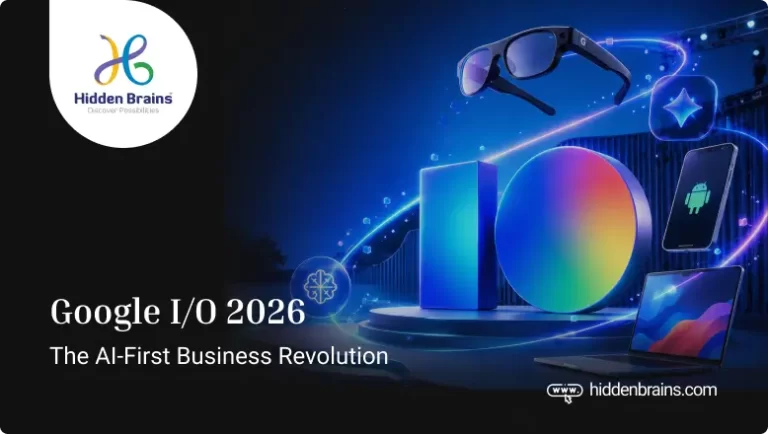
Google I/O 2026 falls firmly into the second category.
What we witnessed wasn’t just another cycle of announcements. It felt like a deliberate shift in how software will be imagined, built, and scaled from here onward. If previous years were about adding AI features into products, this year was about something more fundamental: redefining applications as AI-native systems from the ground up.
And for anyone building next-generation apps, this is not just interesting news. It is a clear signal of where the market is heading. Let’s break it down in a way that actually matters for builders, product teams, and founders.
The Big Shift: From AI Features to AI-First Applications
For years, businesses have been “adding AI” to existing workflows. A chatbot here, a recommendation engine there, maybe some automation in the backend.
But Google I/O 2026 made one thing extremely clear:
The future is not AI-enhanced apps. It is an AI-orchestrated application. It means applications are no longer static systems with AI plugged in. Instead, AI becomes the core reasoning layer that drives decisions, workflows, and even user experience.
Think of it like this:
- Old model: App + AI features
- New model: an AI system that creates and adapts the app behavior dynamically
This shift is what makes Google I/O 2026 feel like a turning point.
Gemini Evolution: The Engine Behind AI-Native Experiences
A major highlight this year was the continued evolution of Google’s Gemini ecosystem. But the real story is not just “a better model.”
It’s about the depth of context, multimodal intelligence, and persistent reasoning across workflows.
For developers and businesses, this changes everything:
- Applications can now maintain long-running contextual memory across user journeys
- AI can interpret text, images, audio, and structured business data together
- Decision-making becomes continuous rather than request-based
It unlocks a new category of applications: systems that don’t just respond but actively manage tasks and outcomes over time. Imagine a CRM that doesn’t just log customer data but actively predicts deal movement and rewrites sales strategy suggestions in real time. That is the direction this is pointing toward.
AI Agents Are Becoming the New Application Layer
One of the strongest signals from Google I/O 2026 is the rise of AI agents as core components of applications.
Instead of users clicking through multiple workflows, agents can now:
- Execute multi-step tasks autonomously
- Interact with APIs, databases, and external tools
- Coordinate between different systems without manual intervention
For businesses, this is where the real disruption begins.
Because suddenly:
- Workflow automation becomes intelligent orchestration of AI agents.
- SaaS tools start behaving like “teams of agents” rather than dashboards
- User interaction shifts from navigation to delegation
This is not an incremental improvement. It is a structural redesign of how software is consumed.
The Developer Stack is Getting Reinvented
Another major theme at Google I/O 2026 was the evolution of the developer ecosystem itself. We are moving into a world where building software no longer starts with writing static logic. It starts with defining intent, constraints, and data access boundaries.
Developers are increasingly working with:
- AI-assisted code generation systems
- Natural language-driven development environments
- Embedded reasoning layers inside cloud platforms
Platforms like Google Cloud and Vertex AI are no longer just infrastructure providers. They are becoming co-pilots for application architecture itself.
For teams building AI-first business applications, this reduces time-to-market dramatically while increasing experimentation speed.
But it also raises a new expectation: Builders are now expected to think in systems, not just features.
Multimodal Intelligence is Reshaping Business Interfaces
One of the most practical upgrades to emerge from Google I/O 2026 is the maturation of multimodal AI systems.
Applications are no longer restricted to text-based interaction. They now seamlessly combine:
- Voice input
- Image understanding
- Document parsing
- Real-time data interpretation
This is particularly powerful for industries like:
- E-commerce
- Healthcare
- Logistics
- Enterprise SaaS
For example, a business user can now upload a dashboard screenshot, ask questions in natural language, and receive structured operational insights instantly. It removes friction between data and decision-making. And that is where productivity gains multiply.
Why This Moment Matters for Businesses
If we step back, the real significance of Google I/O 2026 is not just technical. It is strategic.
We are entering a phase where:
- Software becomes adaptive rather than static
- Business logic becomes AI-mediated
- User experience becomes conversational and predictive
It directly impacts how companies will:
- Design products
- Structure workflows
- Hire technical teams
- Build a competitive advantage
The biggest takeaway is simple: AI is no longer a feature layer. It is becoming the operating layer of modern businesses.
Companies that understand this early will not just optimize operations. They will redefine entire categories.
What Businesses Should Focus on Right Now
If you are building or scaling next-generation applications, this shift is less about technology choice and more about structuring your business around intelligence itself.
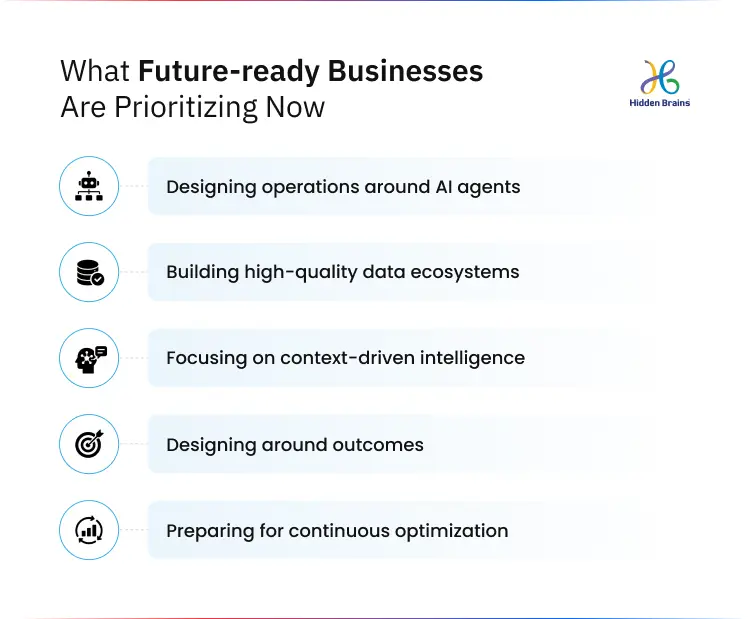
Here are the real focus areas that matter at the business level:
- Designing operations around AI agents, not just digital workflows
Businesses need to move beyond static process automation and start thinking in terms of autonomous agents that can execute, coordinate, and optimize business functions in real time.
- Building unified, high-quality data ecosystems
AI is only as strong as the business data it can interpret. Clean, connected, and context-rich data pipelines become a strategic asset rather than a backend requirement.
- Shifting from feature thinking to context-driven intelligence
Instead of adding isolated features, businesses should focus on enabling systems that understand context across customers, operations, and decision layers.
- Designing around outcomes, not interfaces
The focus is moving away from “what the user clicks” to “what the business outcome should be.” Interfaces become secondary to intelligent execution.
- Preparing for continuous optimization as a default operating model
Applications will no longer be static. They will continuously learn, adapt, and improve processes, pricing, engagement, and decision flows in real time.
The winners in this new era will not necessarily be the businesses with the most digital tools or the most polished interfaces. They will be the ones that successfully build an adaptable intelligence layer across their operations where AI becomes part of how decisions are made, not just how tasks are performed.
Build AI-First Applications That Lead the Next Era
Let’s Talk
Frequently Asked Questions
Why is Google I/O 2026 being called a defining moment for AI-first business applications?
Google I/O 2026 marked a major shift from AI-assisted software to truly AI-native systems. Instead of positioning AI as a feature layered on top of applications, Google showcased how intelligence can become the core operating layer for products, workflows, and enterprise decision-making. From Gemini-powered reasoning to autonomous agents and multimodal experiences, the announcements signaled that future business applications will increasingly think, adapt, and act rather than respond.
What exactly are AI-first business applications?
AI-first business applications are platforms designed from the ground up around intelligence. In these systems, AI does not just automate repetitive tasks; it actively interprets context, predicts outcomes, coordinates workflows, and supports real-time decision-making. Unlike traditional software that follows rigid, predefined logic, AI-first applications continuously evolve based on user behavior, operational data, and business objectives.
How will AI agents impact enterprise software and business operations?
AI agents are expected to reshape how businesses interact with software fundamentally. Instead of having employees manually navigate dashboards and workflows, AI agents can autonomously complete multi-step tasks, such as analyzing reports, coordinating operations, managing customer interactions, and triggering business actions across multiple systems. It reduces operational friction while enabling businesses to move toward more intelligent and outcome-driven automation models.
Why is multimodal AI becoming important for modern business applications?
Multimodal AI allows systems to understand and process multiple types of inputs simultaneously, including text, voice, images, documents, and structured data. It creates more natural and efficient business interactions. For example, a logistics manager could upload shipment images, speak operational queries, and receive AI-generated insights instantly. Google I/O 2026 highlighted how multimodal intelligence is making enterprise applications more intuitive, accessible, and context-aware.
How does Google’s Gemini ecosystem influence the future of AI-powered applications?
The evolution of Gemini signals a move toward deeper contextual reasoning and persistent intelligence across workflows. Businesses can now build applications capable of maintaining long-term memory, understanding complex operational context, and orchestrating tasks across systems. It enables a new generation of enterprise platforms that behave less like static software and more like intelligent business collaborators that adapt continuously.
What should businesses prioritize when preparing for the AI-first era?
Businesses should focus on building strong data ecosystems, integrating AI into operational decision-making, and redesigning workflows to rely on intelligent orchestration rather than manual execution. The priority is no longer simply digitizing processes but creating systems that can continuously learn, optimize, and scale intelligently. Organizations that invest early in adaptable AI infrastructure are likely to gain a long-term competitive advantage.
Will AI-first applications replace traditional SaaS platforms completely?
Traditional SaaS platforms are unlikely to disappear overnight, but they are rapidly evolving. The future points toward hybrid systems where intelligent agents, predictive workflows, and conversational interactions increasingly enhance static interfaces. Over time, businesses will expect software not only to store information but also to actively interpret, recommend, automate, and optimize outcomes in real time.
Final Thought
We Are Entering the AI-Native Software Era
Google I/O 2026 didn’t just showcase new tools. It quietly confirmed a shift that many in the industry have been anticipating for years.
We are moving from software that executes instructions to software that understands intent.And once that shift completes, everything changes:
how apps are built, how users interact with systems, and how businesses scale.
For developers, founders, and product teams, this is not a distant future. It is already unfolding.
The real question is no longer “How do we add AI to our product?” It is “What does our product look like if AI is the foundation?”