
























































Summary
- Vibe coding is transforming how startups build MVPs by enabling faster, AI-driven development.
- It removes technical barriers, allowing non-technical founders to actively build and iterate.
- Startups can prototype, test, and validate ideas much quicker than traditional methods.
- Modern tools make full-stack development, UI design, and integrations more accessible.
- It reduces costs while increasing flexibility and experimentation.
- Combined with expert support, vibe coding ensures scalable, secure, and growth-ready products.
Traditionally, building an MVP meant relying heavily on developers or agencies, dealing with high upfront costs, and waiting through long validation cycles. These bottlenecks often delay real market feedback and slow down innovation. Today, AI vibe coding is transforming rapid MVP development by changing that equation. Founders can now build functional prototypes faster, test ideas in real-world scenarios, and iterate without being weighed down by heavy engineering overhead, making execution far more agile and efficient.
According to Forbes, the biggest unlock for non-technical founders right now is this method, and the numbers back it. Nearly 51% of all code committed to GitHub is now AI-generated or significantly assisted by this approach. This shift is redefining how startups approach MVP development, allowing founders to move from idea to execution much faster without being limited by technical resources.
What Is AI Vibe Coding? (And Why It Matters Now)
AI vibe coding is a new way of building software where you describe what you want in plain language, and AI turns it into working code, interfaces, or workflows. It goes beyond traditional development, where every feature requires manual coding and technical expertise. At the same time, it is more flexible than no-code or low-code platforms, which often limit customization.
At its core, it relies on generative AI, context-aware prompts, and real-time iteration. Founders can refine features instantly, fix bugs on the go, and reshape their product without long development cycles. Instead of waiting weeks to see a working version, startup owners can build, test, and improve their ideas almost instantly.
Struggling to Turn Your Idea Into a Working MVP Fast?
Hire Vibe Coders Now
Ways Vibe Coding Helps Startups
Vibe coding is not just a convenience. It directly solves some of the biggest challenges founders face while building MVPs.
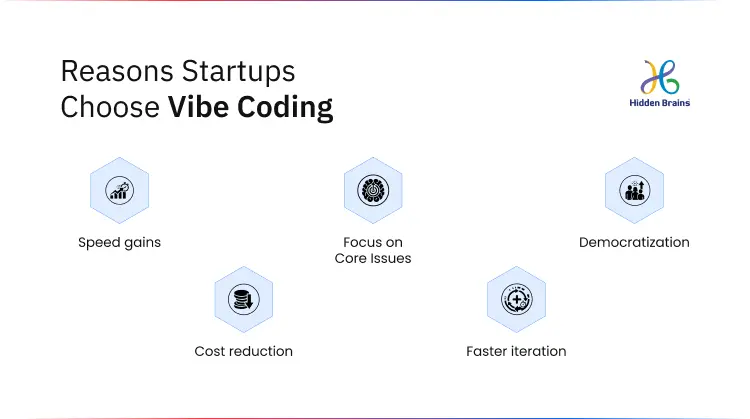
- Speed gains: MVPs that once took 3–9 months can now launch in as little as 3–14 days, sometimes even over a weekend. Development tasks are completed 3–5 times faster, and in many cases, founders are able to ship interactive applications within just a few days.
- Cost reduction: Early prototypes can now be built at a fraction of the cost compared to traditional development approaches. In many cases, founders only need minimal resources to get a functional version up and running. This is a significant shift from relying on agencies that often require large upfront investments.
- Democratization: Around 63% of Vibe coding users are non-developers, including founders, product managers, and designers. It means non-technical founders no longer need to wait for a technical co-founder or hire a full team just to validate an idea.
- Faster iteration: Small prompt changes can instantly modify features, workflows, or UI elements. Founders can test multiple variations quickly and discard ineffective ideas without significant loss of time or money.
- Focus on what matters: Instead of spending time on boilerplate code or debugging syntax, founders can focus on product vision, user feedback, and business strategy. This shift allows startups to validate ideas faster and make more informed decisions early in their journey.
Do You Know?
As of now, almost 41% of new code is AI-generated and the AI coding tools market has surged to ~$4.7B+.
How Vibe Coding Speeds Up MVP Creation
Speed has always been the biggest differentiator for startups, and AI vibe coding is redefining what “fast” actually means. By removing traditional development bottlenecks, it enables you to move from concept to working product in a fraction of the time.
This shift is also reflected in trends like Y Combinator’s Winter 2025 batch, where a significant share of startups had codebases largely generated by AI. The result is a new wave of lean, experimental “vibe startups” that build quickly, test with real users, and iterate based on feedback rather than assumptions.
Instant Code Generation from Prompts
It allows founders to translate ideas directly into functional code using simple prompts. Instead of writing every line manually, they can describe features, workflows, or interfaces and get immediate outputs. It dramatically reduces the time spent on initial development and helps teams move from idea to prototype almost instantly.
Rapid Iteration Without Deep Technical Dependencies
One of the biggest advantages is the ability to iterate without relying heavily on developers. Founders can tweak prompts, adjust features, and refine product flows on their own. It reduces delays and empowers smaller teams to experiment freely without being constrained by technical bandwidth.
Real-time Debugging and Optimization
Debugging, which traditionally takes significant time, becomes much faster with AI-assisted suggestions and fixes. Issues can be identified and resolved in real time, allowing continuous improvement without halting development. It keeps the momentum going during the critical early stages.
Reduced Back-and-forth Between Stakeholders and Developers
Vibe coding minimizes the communication gap between business and technical teams. Since ideas can be directly translated into working outputs, there is less need for lengthy explanations, revisions, and alignment cycles. This streamlines collaboration and accelerates execution.
Faster Idea-to-product Cycles
What once took weeks or months can now be achieved in days. This acceleration is at the core of rapid MVP development, enabling founders to validate ideas quickly and move forward with confidence. By lowering barriers to entry, vibe coding makes it possible for solo founders and small teams to test multiple ideas, refine them based on real-world feedback, and scale only what truly works.
Top Features of Vibe Coding for Rapid MVP Development
What makes it truly powerful is not just speed, but how naturally it fits into the way founders think and build. Instead of forcing you to adapt to complex development workflows, it adapts to you. Whether you are validating an idea or shaping your prototype, these features make the process far more intuitive and efficient.
- Natural language-based development: You can describe what you want in plain English, and the system translates it into working code or features. It removes the need to learn programming languages just to get started.
- Context-aware code suggestions: The AI understands your project context and provides relevant suggestions, making development smarter and more aligned with your goals.
- Built-in debugging and error resolution: Instead of spending hours identifying issues, you get instant fixes and recommendations, keeping your development flow uninterrupted.
- Seamless integration with APIs and databases: Connecting your prototype to external services or data sources becomes much easier, enabling you to build functional, real-world applications quickly.
- UI/UX generation with minimal effort: You can generate clean, usable interfaces without deep design expertise, helping you present a polished product from the early stages.
- Continuous learning and improvement from user input: The more you interact, the better the system adapts, refining outputs based on your preferences and project needs.
- Scalability from prototype to production-ready product: What starts as a simple prototype can gradually evolve into a more structured and scalable application without starting from scratch.
It allows non-technical founders to move fast while ensuring the underlying architecture, security, and scalability are not compromised as the product grows.
Top Vibe Coding Tools for Startups
The real power of vibe coding comes alive through the tools that make it accessible. Today’s ecosystem is not just about writing code faster, but about enabling founders to build complete, testable products with minimal friction. The following tools stand out for how effectively they support rapid MVP development, especially for startups aiming to move fast without compromising on functionality.
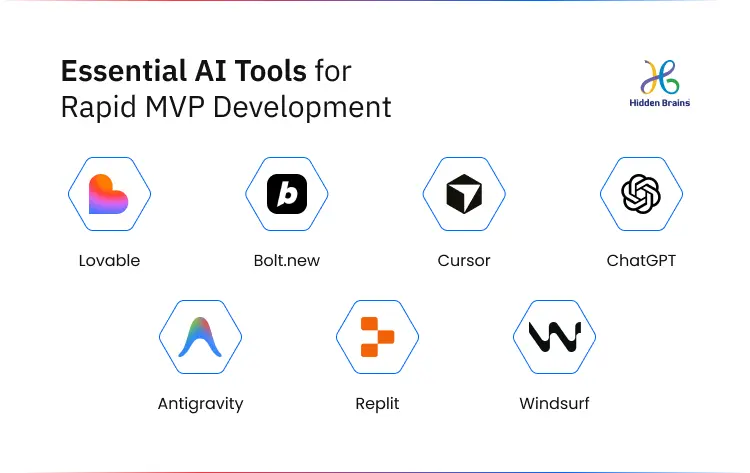
The following tools stand out for how effectively they support rapid MVP development, especially for startups aiming to move fast without compromising on functionality.
Lovable – Best for Non-technical Founders Building Full-stack MVPs
Lovable stands out for turning plain-english conversations into complete, production-ready web apps, including frontend, backend, authentication, and payments. It generates clean, exportable code with GitHub sync, making it ideal for solo founders validating SaaS ideas quickly.
Why it accelerates MVPs: With no setup required, hiring Lovable AI experts enable founders to quickly transform ideas into fully functional, testable products, complete with essential integrations, making early validation faster and more seamless.
Bolt.new (by StackBlitz) – Best for Browser-based Rapid Prototyping
Bolt.new enables developers and founders to build and run full-stack applications directly in the browser. It eliminates the need for local setup and allows instant development using AI-assisted workflows.
Why it accelerates MVPs: The zero-setup environment and real-time previews make it easy for your hired Bolt.new AI development team to quickly test ideas, iterate on features, and share working prototypes instantly.
Cursor – Best AI-Native IDE for Developers and Scaling Prototypes
Cursor is an AI-first code editor designed to integrate AI into the development workflow deeply. It understands entire codebases, assists with edits, and helps refactor or extend applications efficiently.
Why it accelerates MVPs: Startups can hire Cursor AI consultants who can move faster while maintaining control, making it especially useful when evolving a prototype into a more structured MVP.
Google Antigravity – Best for Agent-first, Parallel Workflows and Google Ecosystem Integration
Google Antigravity introduces an agent-based approach where multiple AI agents can work simultaneously on different parts of a project. It integrates seamlessly with Google’s ecosystem, enhancing collaboration and scalability.
Why it accelerates MVPs: Parallel execution of tasks significantly reduces development time for Google Antigravity developers and enables faster experimentation across multiple features.
Replit (with Replit Agent) – Best All-in-one Collaborative Platform
Replit combines coding, deployment, and collaboration into a single platform. With its AI agent, it assists in building, debugging, and deploying applications in real time.
Why it accelerates MVPs: Replit AI development team offers an end-to-end environment where teams can build, test, and launch without switching tools, making it ideal for quick iterations.
Windsurf – Best for AI-powered Developer Flow and Productivity
Windsurf focuses on enhancing developer productivity through AI-assisted workflows, helping teams write, refine, and manage code more efficiently across projects.
Why it accelerates MVPs: It streamlines development workflows and minimizes manual effort, allowing businesses to hire Windsurf AI developers to accelerate delivery while maintaining consistency and high-quality output.
ChatGPT – Best for Idea-to-code, Iteration, and Problem Solving
ChatGPT acts as a versatile AI coding partner that helps founders and teams generate code, debug issues, design workflows, and even plan product architecture through conversational prompts. It is widely used across the entire MVP lifecycle, from ideation to refinement.

High Development Costs Slowing Down Your Startup Launch?
Talk to an AI ExpertTips for Leveraging Vibe Coding for Quick Prototyping
- Start with a clear problem statement before writing prompts
- Break your idea into small, testable features
- Use simple, specific prompts
- Iterate quickly instead of aiming for perfection
- Validate core functionality before adding advanced features
- Leverage pre-built integrations to save time
- Test with real users as early as possible
- Keep refining prompts based on results and feedback
- Document what works to maintain consistency
While these tips help you move faster, combining them with the right expertise can make a significant difference. Many startups choose to hire vibe coding developers to ensure their prototypes are not only built quickly but are also structured, scalable, and ready for the next stage.
How Hidden Brains Helps Startups Leverage Vibe Coding
At Hidden Brains, we go beyond being just a development partner; we act as growth enablers for startups navigating the shift to AI-driven development. As an AI-powered company, we have delivered 6,000+ successful projects with a team of 700+ experts across 100+ markets. We focus on building precise, purpose-driven solutions that help founders move from idea to validation with confidence, backed by a strong MVP strategy and consulting.
We accelerate this journey with AI-enabled vibe coders who bring agility and precision to every build. From rapid prototyping to full-scale product development, we combine AI speed with deep engineering expertise. It ensures every product we build is scalable, secure, and ready for long-term growth while helping startups launch faster without compromising on quality.
Frequently Asked Questions
1. Is AI-generated code reliable for building apps for manufacturing industry?
Yes, but only with proper testing and human oversight. Critical manufacturing systems require validation, compliance checks, and structured engineering practices.
2. When should startups choose Vibe coding over no-code platforms
Choose vibe coding when you need customization, scalability, or complex integrations that no-code tools cannot support.
3. Is vibe coding more cost-effective than traditional software development?
Yes. It reduces upfront costs by enabling faster prototyping and minimizing reliance on large development teams.
4. Can non-technical founders build an MVP using vibe coding?
Yes. It allows founders to create and iterate on prototypes using simple prompts without deep coding knowledge.
5. Does vibe coding replace developers completely?
No. It enhances developer productivity while developers handle architecture, scaling, and complex logic.
6. How secure is Vibe coding for startup applications?
It can be secure if best practices like code reviews, data protection, and proper authentication are followed.


Conclusion
Vibe coding is redefining how startups build, test, and launch products. Removing technical barriers and accelerating development, it allows founders to focus on what truly matters: validating ideas and creating real user value. As the pace of innovation increases, adopting AI-driven development is no longer optional.