































































Summary
In 2026, enterprises face critical choices in AI-assisted coding. This blog compares Cursor AI vs Google Antigravity, highlighting strengths, trade-offs, and workflows for large codebases, legacy systems, and greenfield projects. Learn how CTOs balance control with autonomy and use AI as a productivity multiplier with guardrails. Discover practical insights, real enterprise use cases, and strategies to build hybrid workflows using Cursor AI development services and AI coding assistant integration services for scalable engineering outcomes.
AI coding tools are no longer experimental. They are becoming core to how modern software is built. CTOs and engineering leaders now evaluate Cursor AI vs Google Antigravity based on speed, accuracy, and how well each fits real-world development workflows.
AI-assisted coding promises faster builds and fewer bottlenecks. But reality is more nuanced. Around 62% of developers now use an AI coding assistant or agent. Yet 66% say the output is often “almost correct.” Fixing it sometimes takes longer than writing from scratch.
The real tension lies in choosing between autonomous agents that act independently and coding assistants that remain fully controllable.
Enterprises worry about scale, security, and governance. Startups care about speed, focus, and survival. Both expect real productivity gains, not polished demos.
This is exactly why Cursor AI vs Google Antigravity coding assistant matters in 2026. This Enterprise AI coding tools comparison helps leaders choose clarity over hype. And control over chaos.
Cursor AI vs Google Antigravity: What CTOs Really Expect
CTOs expect AI to improve delivery without increasing risk. They care less about demos and more about predictable outcomes. Coding AI must reduce cycle time, lower defect rates, and scale across teams.
Leaders expect AI to work across the full development lifecycle. Planning. Coding. Testing. Reviews. Not just autocomplete.
They also expect control. AI should suggest, not decide. Every change must be traceable, reviewable, and reversible. This is where the real divide becomes clear. Cursor focuses on fast, controllable execution inside real codebases.
Google Antigravity pushes toward agent-led development, where AI can plan, modify multiple files, run tests, and iterate with minimal intervention.
But for most enterprises, off-the-shelf tools alone are not enough. Real success depends on tailoring models, workflows, and governance to internal systems.
With Custom AI Development Services, organizations can build AI development solutions that align with compliance needs, engineering pipelines, and real operational constraints.
In 2026, the best AI coding assistant for CTOs is not just the smartest model. It is the tool that delivers speed, quality, and governance at scale through the right workflow fit.
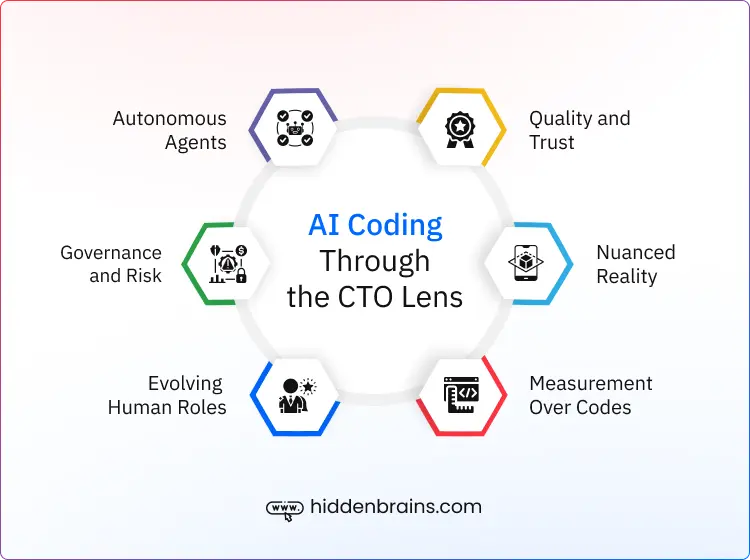
Autonomous Agents Over Assistants
CTOs want AI that does more than autocomplete. They expect agentic SDLC. Industry reports suggest a relative decline in coding queries as IDE-native tools gain adoption. Agents refactor code, fix bugs, and handle ops. They suggest features. They delegate to sub-agents. They escalate issues to humans via Slack or email. Developers become managers of agents.
Quality and Trust Are Non-negotiable
Speed without control creates debt. That is no longer acceptable. CTOs demand AI to review AI code. Automated tests in CI/CD. Built-in security and license scans. Manual reviews miss spikes in defects. AI must validate logic and security. Not just syntax.
Human Roles Are Evolving Fast
Developers are becoming Renaissance professionals. They steer agents. They design systems and architecture. They engineer context, not just prompts. Juniors gain the biggest productivity lift. Seniors gain leverage through orchestration. CTOs now invest in upskilling for coordination. Not memorizing syntax.
Governance and Risk Management Matter More
Failed pilots often fail on data and ownership. Not on models. CTOs standardize tools. They embed checks early. They plan for repatriation from over-reliance. Multiplayer AI will outperform solo tools. Collaboration beats isolated copilots.
Measurement Goes Beyond Lines of Code
Output alone is misleading. CTOs track iteration speed and reduce toil. They measure focus on novel problems. To solve this, proper AI integration through an experienced organization is a must. Real gains come from this and not disconnected tools. This insight shapes every enterprise AI coding tools comparison.
The Reality Is More Nuanced
Vibe coding looks fast. But quality often drops. Readability suffers. Null risks increase. Agentic tools shine in large codebases. And long-horizon work. But trust must be earned over time. Enterprises bet on reliability, pipelines, and partners. Not hype or benchmarks.
Discover How AI Can Transform Your Development Teams
Talk to Our Experts
Cursor AI vs Google Antigravity – Quick Comparison
At a glance, Cursor AI and Google Antigravity appear to solve the same problem. In reality, they represent two very different development philosophies. Control versus autonomy. Execution versus orchestration. Speed versus governance.
For CTOs, this is not just a tooling decision. It is an operating model decision. That is why discussions around this issue are becoming strategic boardroom topics, not developer preferences.
Cursor AI: Built for Developers Inside the IDE
The Cursor AI is focused and precise. It lives where developers already work. Inside the IDE. Its growth tells a clear story. From about $1M in revenue in 2023 to $100M in 2024. One of the fastest SaaS products to reach $100M ARR. Reportedly crossed 1M users, with a significant paid user base (as per public interviews and estimates). Teams at OpenAI, Shopify, and Perplexity use it daily. Cursor is embedded in real workflows.
Cursor AI is built to live inside the developer’s editor. That single design choice shapes everything else. There is no context switching. No workflow friction.
Cursor focuses on deep code understanding. It handles large, multi-file refactors with confidence. Debugging feels deliberate. Changes are traceable and reviewable.
This makes Cursor especially effective for long-lived systems. Enterprise monoliths. ERP solutions. Complex legacy repositories.
In the broader debate, Cursor is widely viewed as the faster and more stable option for daily execution. It keeps humans fully in control while still delivering significant productivity gains.
The trade-off is autonomy. Cursor is built for high-trust, human-steered workflows. It accelerates engineering output, but it is not designed to own an end-to-end development lifecycle without full developer oversight.
Google Antigravity: Emerging Google-led Research
Google Antigravity is referenced as an emerging agent-first concept expected around 2025–26. It is built for autonomous execution. Agents can plan projects, edit multiple files, run tests, and debug end-to-end workflows. Its goal is not assistance. It is end-to-end ownership. It shifts development from writing code to managing outcomes.
Antigravity stands out for autonomy, not speed. It is slower per step. But it aims to eliminate entire steps. Governance is central to its appeal. Autonomy is adjustable. Human-in-the-loop modes are built in.
It makes enterprises watch closely. However, adopting Antigravity at scale requires specialized engineering support and workflow tuning. Enterprises exploring early implementation can hire Google Antigravity Developers to build secure agent workflows, accelerate pilots, and ensure governance-ready deployment.
The reality today is maturity. Antigravity is powerful, but still evolving. It feels more like a controlled lab than a polished daily tool.
How Their Approaches Fundamentally Differ
Cursor AI prioritizes precision and speed. Google Antigravity prioritizes autonomy and scale. This is why this competition has no single winner. In 2026, leaders combine strengths.
- Cursor for execution.
- Antigravity for automation experiments.
This layered strategy defines how modern software teams will operate. The table below summarizes how each tool fits enterprise workflows.
| Dimension | Cursor AI | Google Antigravity |
|---|---|---|
| Primary Role | In-IDE execution & assistance | Autonomous agent workflows |
| Best Use Case | Legacy systems & daily dev tasks | Greenfield builds & workflow automation |
| Autonomy Level | Low to medium (Human-steered) | High (Configurable agent control) |
| Speed | Very fast and responsive | Slower per step; faster end-to-end |
| Enterprise Readiness | High today | High, but still maturing |
| Control & Traceability | Strong (Diff-based, human review) | Strong (Policy-driven governance) |
| Ideal Team Fit | Teams wanting speed with guardrails | Teams exploring agent-led delivery |
The Trade-offs CTOs Cannot Ignore in 2026
AI tools do not fail in pilots. They fail at scale. This section focuses on what actually breaks, slows, or compounds risk once adoption spreads.
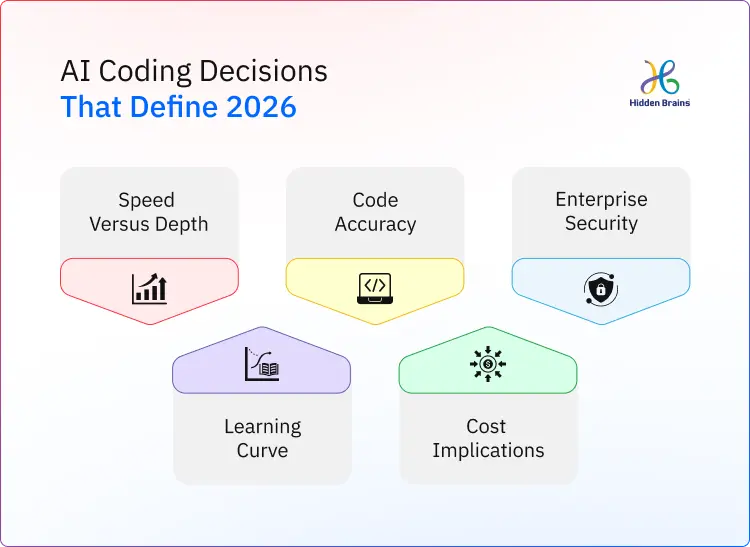
Think of this as a Cursor AI vs Google Antigravity features comparison from a leadership lens. This comparison looks at outcomes, not features.
Speed Versus Depth of Understanding
Cursor AI delivers immediate speed. It accelerates day-to-day coding and refactoring. Developers feel the gain almost instantly.
Google Antigravity shifts the metric. Single steps may feel slower. But entire workflows run autonomously. Value appears over longer cycles.
Code Accuracy and Long-term Maintainability
Velocity without quality creates silent debt. CTOs see this clearly. Cursor’s human-in-the-loop approach keeps accuracy high. Engineers review changes before merging. It supports maintainability in large codebases.
Antigravity increases surface area for risk. Autonomous agents can propagate mistakes. Without strong validation, issues scale quietly.
Enterprise Security and Data Handling
Security decisions are rarely reversible. Cursor aligns well with existing controls. Code stays close to the developer environment. Audit trails remain intact.
Antigravity emphasizes governance by design. Policy-aware agents. Centralized oversight. This is why large enterprises are evaluating it carefully.

Unlock AI Coding Insights for Your Enterprise Today.
Talk to Our ExpertsLearning Curve and Team Readiness
Adoption speed defines early ROI. Cursor feels intuitive. Developers require little retraining.
Antigravity requires a mindset shift. Teams must learn to manage agents. Not just write code. It slows adoption but changes roles fundamentally.
Cost Implications at Scale
License cost is only one line item. Cursor delivers fast, predictable value. Savings appear through reduced effort and rework.
Antigravity introduces additional coordination and computing costs. Its ROI depends on how much autonomy teams truly adopt.
Leadership Takeaway
This comparison reveals no single winner. Only aligned choices.
- Cursor multiplies execution.
- Antigravity experiments with autonomy.
The most effective organizations in 2026 will not pick one tool. They will design a system around them.
How Enterprises Actually Win With AI-assisted Engineering in 2026?
Enterprises are no longer asking whether AI works. They are deciding how far to push it. And where humans must stay firmly in control.
Early trials showed high reliability in controlled front-end and test-heavy environments. But the real shift was cultural. Engineers moved away from typing code toward architecture, testing, and reviews.
Large Codebases, Legacy Systems, and Trust
This is where AI earns its place. Enterprise teams modernizing old ERP-style systems increasingly rely on Cursor. Adoption at companies like Shopify and Perplexity signals why. Cursor understands deep context. It works incrementally. It does not force risky rewrites.
A typical pattern looks like this. A team refactors legacy services step by step. Cursor proposes full diffs. AI generates tests for fragile modules. Review load drops. Risk stays contained. Scenarios like this, where Hire cursor AI developers create real value. Not flashy demos. But steady modernization.
Compliance, Audits, and Governance Come First
Enterprises never optimize for speed alone. They optimize for survivability. AI must fit audit trails. It must respect data boundaries. It must support traceability. This is why agentic systems are evolving carefully.
Newer tools allow AI to interact with environments. File systems. Commands. CI pipelines. But always with supervision.
Many leaders now describe this as the “Cursor of 2026.” Agentic. But accountable. Powerful. But governable.
Cross-team Collaboration Is the Real Multiplier
The biggest gains do not come from individual productivity. They come from alignment. Auto-review tools now catch logic and security issues early. AI reviews AI code. Humans focus on intent and architecture. It reduces defect spikes. And improves consistency across teams.
Amazon CTO Werner Vogels describes this shift clearly. Developers are becoming “renaissance engineers.” They combine AI speed with human judgment.
How Hidden Brains Supports Enterprise AI Adoption
Adopting coding AI at scale is not just about choosing Cursor or Antigravity. It is about integrating them into real engineering pipelines with governance, security, and measurable ROI. Hidden Brains helps enterprises operationalize AI-assisted development across legacy systems and modern cloud stacks.
With 22+ years of enterprise delivery experience, 6000+ solutions built, and clients across 107+ countries, we support CTOs in building AI-ready engineering workflows. Our 700+ experts help teams set up secure IDE integrations, agent governance models, validation pipelines, and AI-powered SDLC automation.
If your goal is faster delivery without compromising trust, we help you implement AI the right way. Contact us.
Frequently Asked Questions
What is Cursor AI used for in software development?
Cursor AI is used for real-time coding inside the IDE. It helps with refactoring, debugging, test generation, and working safely across large and legacy codebases.
What is Google Antigravity designed for?
Google Antigravity is designed for agent-driven development workflows. It focuses on autonomous planning, multi-file execution, testing, and end-to-end automation with governance controls.
Which AI coding assistant is best for large-scale projects?
There is no single best tool. Large-scale projects benefit from Cursor for controlled execution and Google Antigravity for automation-heavy workflows and scalable governance.
Can AI-generated code be trusted in production systems?
Yes, but only with guardrails. Enterprises rely on human reviews, automated testing, security scans, and traceable changes to maintain quality and compliance.
Will AI replace software engineers in the future?
No. AI will reshape engineering roles. Developers will focus more on architecture, decision-making, and managing AI agents, while AI handles repetitive coding tasks.

Final Verdict: There Is No Single Winner
In 2026, the real question is not whether AI can write code. It is whether it can scale safely across teams, systems, and compliance boundaries. That is where most tools fail, not in pilots, but in production.
The Cursor AI vs Google Antigravity coding assistant debate reflects two enterprise priorities. Cursor wins when precision, speed, and human control matter. Antigravity wins when autonomy, governance, and workflow automation become the goal.
For CTOs, the best AI coding assistant for CTOs is the one that fits their delivery model and risk posture. The smartest teams will not bet on one tool. They will build a hybrid engineering stack that turns AI into a measurable capability. This is the real outcome of any enterprise AI coding tools comparison.