

















































































































































Overview
The AI era is here, and software integration is changing fast. Traditional APIs have powered apps for years, handling structured requests with speed and reliability. But modern AI agents and large language models need context, reasoning, and dynamic workflows. Enter MCP, the Model Context Protocol introduced by Anthropic in 2024. MCP lets AI talk to tools, data, and workflows in real time, making apps smarter and more adaptive. Businesses and developers now face a new question: how to balance APIs and MCP for maximum efficiency and future-ready AI-powered applications.
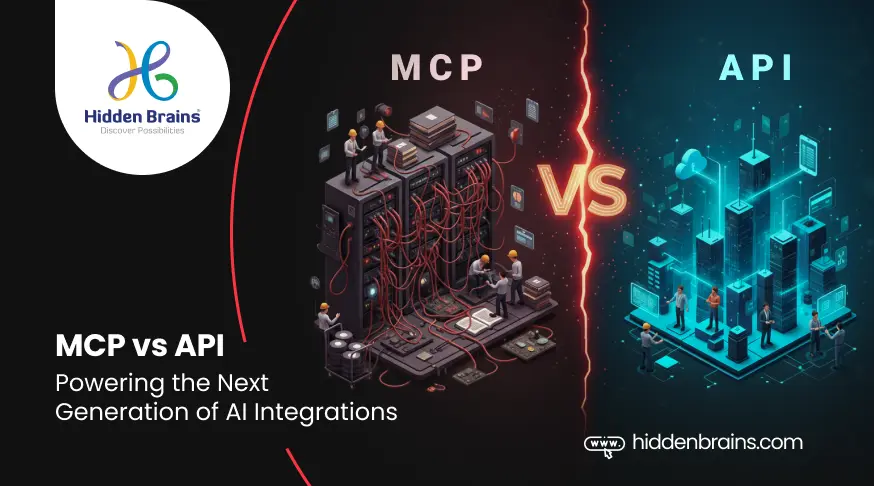
MCP vs API. That’s the new hot topic in the tech world today.
Over the years, APIs have been the foundation of software integrations. They have made websites, mobile apps and enterprise systems run on structured, predictable data exchange. Every developer knows them. Every business relies on them.
But the game changed in November 2024. That’s when Anthropic introduced the Model Context Protocol (MCP), the most crucial element in building future AI apps. And suddenly, the rules of building AI-powered apps started to shift.
Why? Because traditional APIs work well for static requests. But modern AI agents and large language models (LLMs) need context and real-time information. Dynamic responses. That’s precisely what MCP brings, an open-source framework built for the AI era.
Developers are curious. Businesses are watching. The debate has just begun. Do you want to know everything about the API vs. MCP debate and how it will affect future AI integration services? This blog is for you.
Why is Everyone Talking About MCP vs API in the AI Era?
The MCP vs API buzz is not mere technological hype. It is occurring because the relationship between software and AI has transformed overnight. The traditional APIs still power most apps.
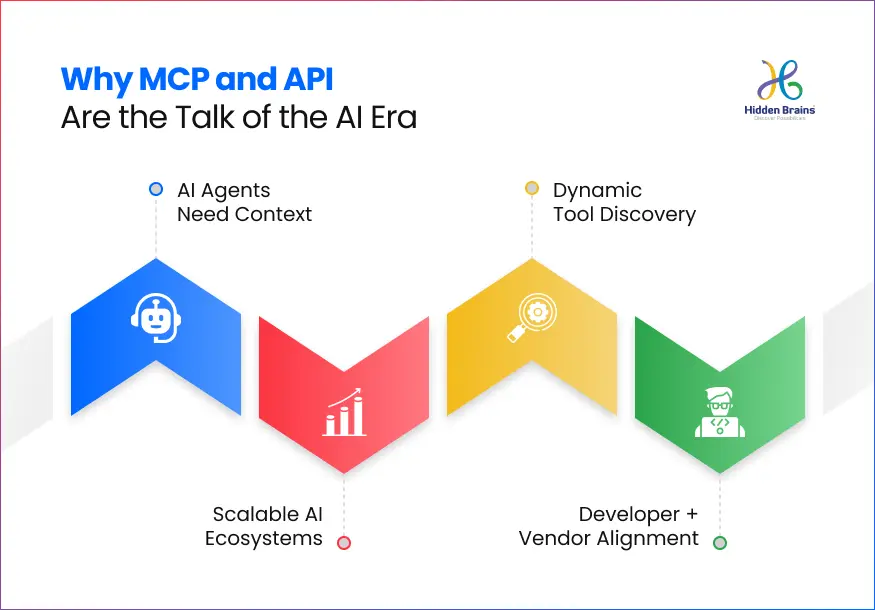
However, modern AI tools and large language models (LLMs) require more than simple data calls. They need a deep learning development context, speed and flexibility. This is the reason MCP has come into the limelight. Let’s break it down.
AI Agents Need Context
APIs are great when you want a simple, predictable answer, like checking weather data or processing a payment. But AI agents work differently. They don’t just fetch data; they analyze, reason, and act. To do that, they need real-time context. MCP delivers this by letting AI dynamically pull the correct information at the right time.
Dynamic Tool Discovery
With APIs, developers hardcode integrations for every tool or service. Add a new tool? Write more code. But MCP changes the game. It lets AI agents discover tools automatically at runtime. Imagine adding a new CRM or calendar service to your workflow, and the AI instantly knows how to use it no coding is required.
Scalable AI Ecosystems
APIs work fine for single integrations. But when multiple AI tools, models, and services are talking to each other, things get messy fast. MCP simplifies this by offering one universal framework. It reduces repetitive coding and creates a cleaner, scalable system for AI-powered apps.
Developer and Vendor Alignment
Each API contains its style, rules and documentation. It takes hours for developers to figure them out. MCP resolves this by providing a standard protocol among vendors such as Anthropic and OpenAI. That will result in less developer complexity and accelerated adoption by businesses.
It is a simple way for one app to talk to another. One app asks for data or services, and the API delivers it.
APIs have been the backbone of software for years. They make apps work together without building everything from scratch.
How APIs Help in Different Types of Apps
- Classic Mobile and Web Apps
APIs pull data and updates. Social media apps, news apps, and content platforms all rely on them. - External Service Access
Need payments or maps? APIs connect apps to services like Stripe, Google Maps, or messaging tools. - IoT, AR, VR, and Blockchain
APIs help smart devices and emerging tech talk to apps. They move data between systems seamlessly. - Enterprise Data Management
APIs connect databases, internal tools, and analytics. They keep workflows smooth for big organizations.
APIs are fast, reliable, and easy to use. They are perfect for predictable tasks. But when apps need AI with context and real-time reasoning, something new is required.
What Exactly Is MCP and How Can It Power My App
MCP stands for Model Context Protocol. Anthropic introduced it in November 2024. Think of it as a new way for AI apps to talk to data and tools. Unlike APIs, MCP is built for AI. It gives context, understands multi-step tasks, and works in real time.
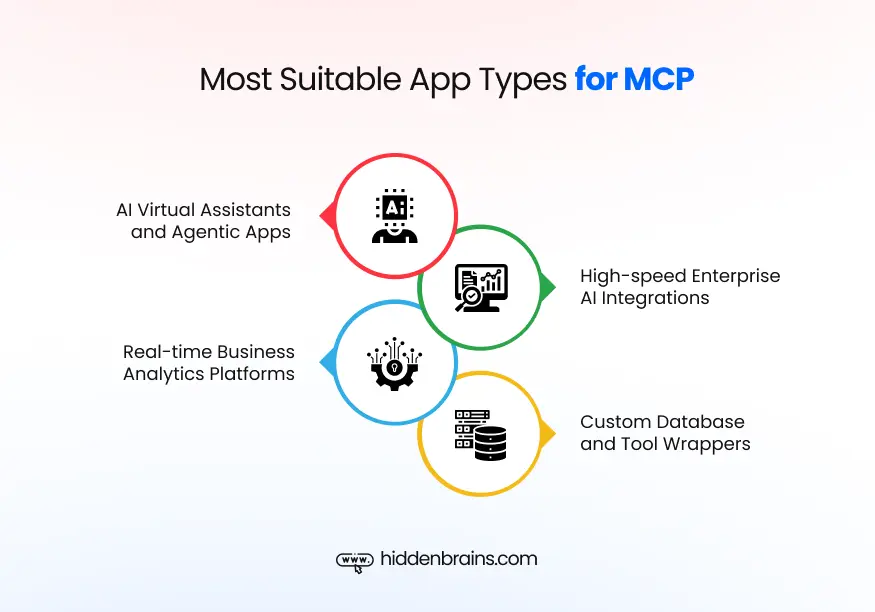
With MCP, AI can act, reason, and fetch the right information when it needs it. You do not need to hardcode every tool or workflow to build AI integration strategies. It is designed for apps where AI does more than fetch data.
How MCP Helps Different Types of AI Apps
- AI Virtual Assistants and Agentic Apps
AI assistants can plan, schedule, and take actions using live information. MCP makes this fast and flexible. - Business Analytics Platforms
MCP lets AI pull data from multiple sources. Reports, dashboards, and insights are generated automatically. - Enterprise AI Integrations
Large companies can connect multiple AI models and tools. MCP keeps everything talking without messy custom code. - Custom Database and Tool Wrappers
MCP can wrap existing APIs or tools. AI apps access them in a standard way.
MCP is best when apps need real-time context, multi-step reasoning, or agentic AI. It is a step ahead of traditional APIs for AI-driven workflows.
Do MCP and APIs Do the Same Thing, or Are They Different?
No, MCP and APIs do not work similarly. Both allow the software to interact with other systems, and this is where the similarity stops. APIs are general-purpose tools. They help apps talk to other apps, fetch data, or trigger actions. They work great for predictable tasks and structured data.
MCP is different. It is built specifically for AI. It helps models like LLMs interact with tools, databases, and workflows in real time. MCP often uses. APIs are behind the scenes, but they hide the complexity. This way, AI can focus on reasoning and acting without extra code.
Key Similarities
- Both let systems talk to each other.
- Both rely on defined rules and endpoints.
- Both can access external data or services.
Now let’s have a look at the MCP vs. API differences:
Key Differences
- Purpose: APIs are general-purpose; MCP is AI-focused.
- Complexity: APIs need custom logic for AI tasks; MCP simplifies AI interactions.
- Context: APIs are mostly static; MCP provides real-time context for AI reasoning.
- Workflow: APIs are usually one-step; MCP supports multi-step agentic workflows.
Are They Interchangeable?
Not really. They are better together. APIs handle core functions. MCP handles AI-driven tasks.
Example:
Imagine an app that manages user data. You use APIs to fetch user profiles. Then an AI agent analyzes the data across systems using MCP. The MCP server might use the Slack API to expose a “send_message” tool to the AI. The developer never touches the API directly; they use MCP.
In short, APIs and MCP complement each other. So, the MCP server vs. API debate may not be useful when you try to build a modern, dynamic app. Use APIs for predictable tasks. Use MCP for AI-powered reasoning and dynamic actions.
Which Industries Rely Heavily on APIs Today, and Why?
APIs are everywhere. As of 2025, the API management market has touched $6.89 billion. It is growing at a massive 25% CAGR. Why? Because 71% of digital businesses now rely on third-party APIs to power their apps and services.
Some industries simply cannot function without APIs. They use APIs to connect systems, deliver services fast, and innovate quickly. Here’s a simple look at the industries and the key reasons they depend on APIs so much:
| Industry | Why APIs Are Essential |
|---|---|
| Finance & Banking | Real-time payments, fraud detection, open banking, and customer account access |
| eCommerce & Retail | Product catalogs, payment gateways, shipping, and inventory management |
| Healthcare | Patient data sharing, telemedicine, insurance claims, and secure health records |
| Travel & Hospitality | Flight booking, hotel reservations, pricing engines, and location-based services |
| Media & Entertainment | Content streaming, recommendation engines, and subscription management |
| Logistics & Supply Chain | Fleet tracking, warehouse management, and demand forecasting |
| Enterprise Software | CRM, ERP, and business intelligence integrations |
Industries That Could Benefit Most from MCP in the Next 5 Years
MCP is still new, but it is growing fast. Based on recent analyses, the global MCP market size in 2025 is expected to range from $1.8 billion to $10.3 billion. Most reports agree that the MCP server segment alone could reach $10.3 billion. This shows how fast enterprises are adopting MCP to power AI-driven workflows.
Here’s a simple look at the industries that stand to gain the most in the next five years:
| Industry | Key Benefits It Can Receive in the Next 5 Years |
|---|---|
| Healthcare & Life Sciences | AI-powered diagnosis, real-time patient data analysis, clinical decision support |
| Finance & Insurance | Fraud detection, predictive risk modeling, AI-driven customer advisory services |
| Retail & eCommerce | AI chatbots for customer support, real-time pricing, demand forecasting |
| Manufacturing & Industry 4.0 | Smart factories, predictive maintenance, supply chain automation |
| Enterprise Software & SaaS | AI copilots for workflows, data orchestration, dynamic decision-making |
| Education & EdTech | Personalized learning, AI tutors, real-time analytics on student performance |
| Energy & Utilities | Grid optimization, energy forecasting, AI for sustainability initiatives |
What Does a Mobile App Built Only with APIs Look Like?
An API-only app follows a simple structure. The app’s front end talks to APIs for everything it needs.
- The architecture is straightforward. APIs connect the app to databases, payment systems, and third-party services. The app itself stores very little.
- For data retrieval, APIs fetch user data, product info, or notifications in real time.
- For service integration, APIs handle payments, maps, chat systems, or shipping tools.
- User interactions stay basic. The app shows data from APIs and lets users trigger actions like buying, booking, or messaging.
- AI integration is limited. APIs can call AI services like chatbots or recommendations, but without deep context or reasoning power.
In short, API-only apps work well for predictable tasks and simple workflows. But for complex, AI-driven decisions, APIs alone may fall short.
How the Same App Works Using MCP
With MCP, the same app works smarter.
- Everything connects through a unified integration layer so that AI can talk to all tools and data sources easily.
- Agentic workflows let AI plan multi-step tasks like checking data, analyzing it, and acting on results, without manual coding.
- Through dynamic adaptation, the app responds to real-time changes, like traffic for delivery routes or stock levels in stores.
- AI-driven context means the app understands history, preferences, and goals before acting.
- Stateful communication keeps conversations and tasks consistent across sessions.
- With AI model integration, the app blends LLM development with enterprise tools for deep insights and decisions.
This is where MCP goes beyond APIs, making apps intelligent rather than just functional. In the MCP vs.API contest, MCP has a slight advantage in this case.
Here’s a simple comparison to show how use cases differ for APIs and MCPs:
| App Category | API-suited Example | MCP-suited Example |
|---|---|---|
| Social Media Apps | Social media content feed | AI assistant summarizing trending topics |
| Travel & Booking Apps | Online ticket booking | AI agent planning complete multi-city trips |
| Weather & Logistics Apps | Weather updates in real time | AI predicting weather impacts on deliveries |
| eCommerce Platforms | Online product catalog | AI-driven pricing and stock optimization |
| Customer Support Systems | Basic customer support chatbot | Context-aware AI agent resolving complex queries |
Can We Completely Replace APIs with MCP in the Future?
So, in the final MCP vs API faceoff, who is the winner? Can we replace APIs with MCPs?
Short answer: No. MCP will not fully replace APIs in the next 5–10 years. But it will reduce the need for direct API coding in AI-driven apps.
APIs are still the backbone of most digital services like Google, Stripe, and AWS. MCP servers often wrap these APIs, not replace them. APIs are fast and perfect for simple, non-AI tasks.
MCP, with AI reasoning and JSON-RPC, adds more power but also more complexity. In the future, services may ship native MCP servers. APIs may shift to a backend role while MCP drives AI workflows.

What is the Right Balance Between Using APIs and MCPs for Your Business?
The best approach is to use both in your software integration technique. Use APIs for core tasks like payments, data syncing, and user login. These need speed and stability.
Use MCP for AI workflows where context and automation matter. Think of virtual assistants or AI agents analyzing data. This way, you keep the strength of APIs and add the power of MCP. Over time, you can shift more tasks to MCP as it grows.
Build the Future with Hidden Brains
With 22+ years of experience and 6,000+ projects delivered, Hidden Brains leads the way in custom AI development. Our team knows AI agents and MCP inside out. We help businesses build smarter apps that stay ahead in the AI era.
Frequently Asked Questions
Here are some quick answers to common questions about MCP vs API.
MCP vs API: what is the main difference in simple terms?
APIs connect apps to data and services. MCP lets AI understand context, reason, and act across multiple tools.
Can we combine MCP and APIs for smarter software integrations?
Yes. Use APIs for core tasks and MCP for AI workflows. Together, they make apps flexible and powerful.
What should be my integration strategy for API vs MCP?
Start with APIs for predictable tasks. Add MCP where AI needs context and multi-step reasoning.
Will MCP slow down my app?
MCP adds some processing overhead, but it is worth it for AI-driven, context-rich tasks.
Which apps benefit most from MCP right now?
AI assistants, analytics platforms, enterprise integrations, and apps needing multi-step decision-making.



Conclusion
The MCP vs API debate is just getting started. Both have their own strengths. APIs are great for structured, reliable tasks. MCPs bring intelligence and adaptability to workflows. The best approach is to use both together. Let APIs handle the core, and let MCPs power the AI side. This balance keeps your apps smart, flexible, and ready for the future.