

























































































































Summary
Have a small clinic or health care practice? Your silent super weapon can be conversational AI. Whether it is booking appointments, decreasing no-shows, availability around the clock, and offloading your team from administrative work, AI-powered chatbots and virtual assistants are optimizing how care is provided. The blog discusses how small practices have adopted conversational AI to increase efficiency, mitigate stress, and enhance patient experience without emptying the bank. Learn how even a little step with AI can make a big difference.
Running a small healthcare practice today is no small feat. Whether you’re a local GP (General Practitioner) juggling back-to-back appointments or a clinic owner trying to keep up with a flood of phone calls, the daily grind can feel never-ending. Staff are stretched thin. Patients want faster answers. And everyone expects more, often with fewer resources. But here’s the good news: help is no longer just for the big players. Conversational AI in healthcare has arrived to rescue small healthcare businesses.
AI-powered smart chatbots and virtual assistants quietly reshape how small practices connect with patients. And it’s already happening right here. A recent survey found that around 79% of global healthcare organizations, including the USA, have adopted conversational AI to improve their workflows.
This blog explores how conversational AI is becoming a game changer for efficiency, patient experience, staff wellbeing, and long-term growth. And if you own a healthcare facility or a small practice decision-maker, this might be the time to hire AI developers to build AI-enabled healthcare solutions.
What is Conversational AI – and Why It Matters for Modern Healthcare?
Let’s make it simple.
Conversational AI technology makes it possible for applications to converse with people in a standard, conversational way. It’s already out there and can be found in intelligent chatbots used on websites and voice assistants such as Alexa and Siri.
In healthcare, the same principle applies with greater focus: enabling patients to book appointments, get answers to their queries, keep missed appointments in mind, and get simple health details, all often through chat and with no human usually involved.
So, how does it work?
Imagine a virtual assistant on your practice’s website or mobile app. A patient asks, “Can I book a check-up for next week?” The AI understands the request, checks availability, and books the slot—all within seconds. Or maybe someone rings after hours, and the system answers with helpful voice prompts, guiding them calmly through their options. That’s conversational AI in action.
Three big reasons:
- Patients expect quick, digital solutions especially the younger crowd who prefer messaging over calling.
- Healthcare teams are under pressure, and small practices often can’t afford extra staff to handle admin tasks.
- We’re living in a digital-first world, and healthcare is catching up fast.
In short, conversational AI isn’t about replacing the human touch. It’s about making sure your team can focus on what matters, caring for people, while the tech handles the rest.

Core Technologies Behind Conversational AI in Healthcare
A robust tech backbone lies behind the simplicity of a chatbot or voice assistant. Here are some of the key technologies making it all work:
- Natural Language Processing (NLP): Helps AI understand everyday patient questions-no medical jargon needed.
- Machine Learning (ML): Allows systems to learn from past interactions and improve over time.
- Text-to-Speech (TTS) & Speech-to-Text (STT): Powers voice conversations, making AI accessible to patients who prefer speaking over typing.
- Electronic Health Record (EHR) Integration: Links AI tools to your patient data so replies are more accurate and useful.
- Cloud Infrastructure: Ensures flexibility, data security, and real-time access from anywhere.
- Multilingual Support Engines: Let you serve patients in the language they’re most comfortable with.
These tools work quietly in the background, making Conversational AI feel smooth, helpful, and genuinely human.
Key Benefits of Conversational AI for Small Healthcare Practices
Every minute matters if you’re running a small clinic or local GP practice. You’re managing patient care, answering phones, sorting schedules, and doing it all with limited time and staff.
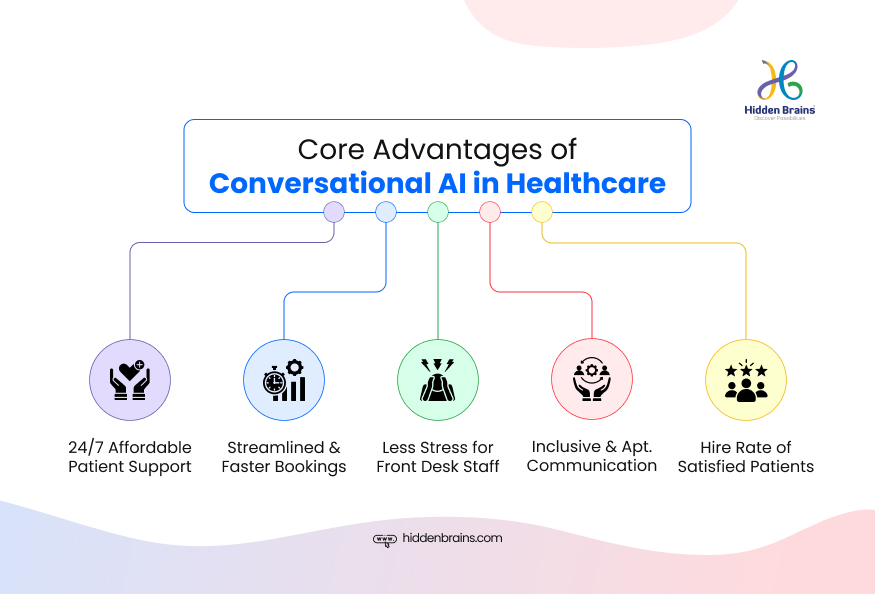
That’s where conversational AI in healthcare steps in, not as a replacement but as an extra pair of digital hands. It quietly takes care of the repetitive tasks so your team can focus on the real, human side of healthcare.
Here are some of the biggest benefits of Conversational AI in healthcare:
24/7 Patient Support Without the Overhead
Your patients don’t just have questions during business hours. With conversational AI for healthcare, they can ask about opening times, services, and prescriptions or book an appointment at any time, even at 2 am. It means fewer voicemails and no more missed opportunities.
Less Stress for Front Desk Staff
Reception teams are often the unsung heroes. But mistakes can happen when they’re drowning in phone calls and admin work, and morale can dip. AI takes care of routine questions and tasks, allowing your staff to focus on people, not paperwork.
Smoother Scheduling and Fewer No-shows
Conversational AI healthcare can handle appointment bookings and send out automatic reminders. Some even allow easy rescheduling with just a quick message. The result? Better time management, more filled slots, and fewer last-minute cancellations.
Happier, More Engaged Patients
They notice when patients get fast, friendly answers without waiting on hold. Whether it’s a chatbot that remembers their last visit or a voice assistant that greets them by name, it creates a feeling of care and attention, even before they walk through the door.
Accessible and Inclusive Communication
The future of conversational AI will support multiple languages and offer voice options for patients who struggle with reading or typing. It helps small practices better serve diverse communities and reach those who may otherwise feel left out.
Proven Use Cases: How Small Clinics are Leveraging This Technology
Let’s be honest
Technology can sound complicated. But conversational AI for healthcare? It’s already working in small clinics across the UK and Europe. Quietly. Reliable. And often without anyone even noticing.
Here’s how it’s helping small practitioners and clinics right now.
Booking Appointments, Without the Back-and-forth
MediChat, a clinical communication and collaboration platform, streamlines how care teams handle shift planning, internal updates, and patient appointment coordination. Its real-time messaging features and intelligent appointment handling help reduce phone traffic and missed bookings. Patients can request slots or receive confirmations automatically, while staff stay updated without the constant back-and-forth. It is beneficial for fast-paced clinics or facilities managing multiple departments.
Welcoming New Patients with Less Fuss
Book My Pharma, an intelligent medicine delivery app solution, streamlined how users register, upload prescriptions, and get started with care. From the first interaction, patients were guided through simple chatbot prompts that collected essential information, verified details, and explained the next steps. This approach can be easily adapted for small clinics aiming to automate patient on boarding—eliminating long lines, repetitive forms, and manual entry delays.
Helping Patients Find You Easily
Someone’s sick and googling where to go. The Healthgrades’ AI assistant helps them discover what might be wrong and shows nearby clinics or pharmacies. The USA’s prominent clinics and pharmacies use its conversational AI healthcare to help patients locate nearby healthcare facilities. It’s smart. And if your practice appears on that list, you’ve already made their life easier.
No More Missed Pills or Jabs
Walgreens rolled out an AI-powered medication reminder bot across some US private pharmacies. It nudges patients to refill prescriptions or get their vaccines. Its conversational AI chatbot uses SMS or app notifications and simple texts. No fuss. A dental or GP clinic can also use the same approach for aftercare instructions. The results are great, too. Missed vaccinations are reduced by around 20%.
Getting Ready for a Scan? The Bot Has It Covered
Before a diagnostic test, patients always have questions. What do I bring? Can I eat? The UK’s National Health System ( NHS,) with help from Infobip, now uses a chatbot to walk patients through it. Saves time. Reduces confusion and less chance of last-minute cancellations. It sends automated messages, videos, and FAQs to send patients instructions for the medical test. It supports more than 15 languages and can deliver messages via text, audio, and video formats.
Need to Talk to a Doctor Fast? No Problem
Teladoc, a USA-based AI triage bot, can help you find the right doctor by talking with you. It is like your digital triage nurse. It listens, asks follow-up questions, and connects the patient to a real doctor. It is a perfect example of using healthcare conversational AI to connect patients with specialized practitioners. By communicating with patients, it identifies symptoms and connects to specialists via video call or chat within minutes. Clinics use similar tools to give quick post-treatment advice, too. Helpful when you’re short on hands but still want to stay responsive.
Health Insurance Questions? Handled
Paperwork is tedious, but it doesn’t have to be painful. Allianz Care in Europe now uses an AI-powered healthcare chatbot (based on Premera Blue Cross tech) to help with health insurance claims. It automates health insurance claim submissions, status tracking, and coverage queries. Patients don’t have to call five times. They follow simple prompts. Small clinics offering private care can plug into this easily.
Patient Feedback That Feels Natural
Saba Clinics in Poland found a clever way to collect patient feedback over WhatsApp. This healthcare conversational AI is integrated with Microsoft CRM. The chatbot sends a friendly message after the visit. Just like post-treatment feedback by asking tailored questions about doctor interaction No pressure. Just a quick check-in. People reply, and the clinic gets honest insights without bothering anyone.
Getting the Word Out About Flu Shots and More
WHO’s HealthBuddy helped spread flu awareness across the world. It shared tips, answered common questions, and reminded people to get their jabs. It supports over 19 languages. Local practices can also be part of this, such as running small campaigns and reaching patients with updates that matter.

Why Now is the Right Time to Embrace Conversational AI in Healthcare
Suppose you’ve been thinking about trying Conversational AI but haven’t taken the step yet. Let us tell you why this is the perfect time to build a customized healthcare app with conversational AI capabilities.
Patients Now Expect Digital Convenience
Let’s face it: we all like things to be quick and easy these days. Whether ordering a meal, booking a cab, or checking our bank account, we want answers fast.
It’s no different in healthcare. Patients now expect that same ease from their GP, local clinic, or care home.
If they have to wait on hold for days for a reply, they may feel a bit let down or go elsewhere next time.
That’s where Conversational AI helps. It lets patients ask questions, book appointments, or get reminders at any time of day. No need to call or chase. It’s not about replacing anyone. It’s just about making things smoother for the people you care for. And they’ll remember that.
Waiting Could Cost You More Than You Think
Let’s be honest: every missed call or no-show appointment results in lost revenue. Every delay adds pressure on your staff. And whenever a patient can’t reach you, they might look elsewhere.
Small clinics, care homes, and even larger facilities already use healthcare conversational AI to fix these gaps. Technological innovations are rapidly changing the future of conversational AI. In the future, it will reduce stress, save time, and keep patients engaged. Waiting too long to adopt it? That could cost you more than the tool itself.
The Numbers Tell the Story
The growth of Conversational AI in healthcare has been fast, and it’s still climbing.
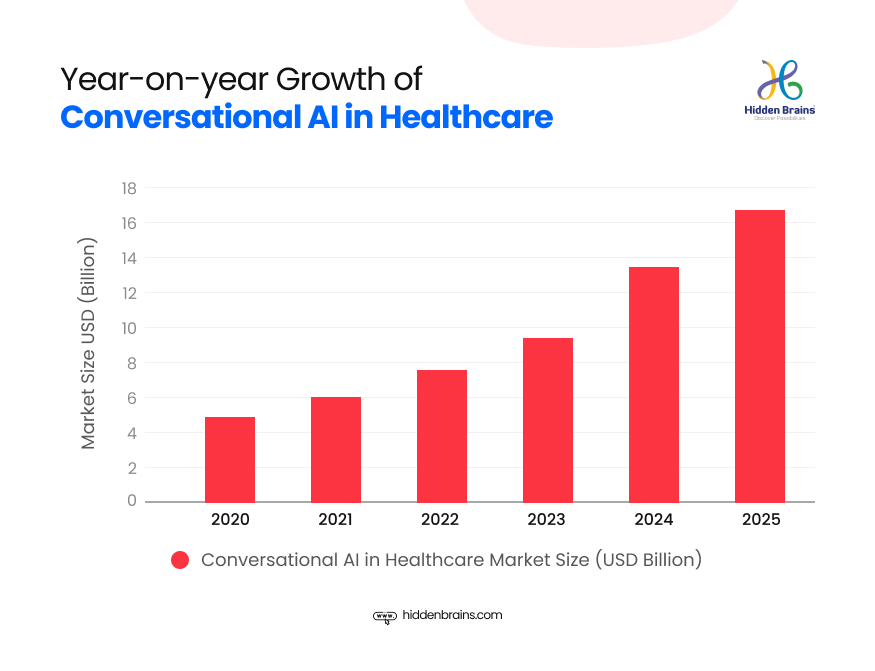
According to Research And Markets, the growth of conversational AI in healthcare is relatively consistent. Let’s take a look.
- In 2020, the global market was $4.97 billion.
- By 2022, it reached $7.63 billion.
- In 2024, it stands at $13.53 billion.
- And by 2025, it’s expected to hit $16.76 billion.
Conversational AI – How Hidden Brains Can Support This Shift
We’ve built innovative, secure, scalable digital solutions at Hidden Brains for over 21 years. We take pride in crafting top-notch healthcare IT solutions.
That’s the same mindset we bring to Conversational AI.
We don’t just build bots; we design mobile-friendly, secure, and customizable tools that fit into your existing systems. We focus on EHR integration, data privacy, and multilingual support to ensure every patient feels seen and heard.
More than anything, we build with empathy. Because good technology should feel like a helping hand, not another system to figure out. So whether you’re a small clinic or a growing care centre, we’re here to help you step into the future with confidence. Hire dedicated developers from us today!
Frequently Asked Questions
Would Conversational AI work in your facility? You have plenty of companies that offer AI development services. If you’re unsure about your desired course, that aspect is fine, too. Here, we’ll share some typical questions small practice owners have, along with direct, easy-to-understand answers.
Do you need to build a full healthcare CRM to make this work?
Not at all. Many Conversational AI tools are designed to plug into what you already have. You can add them to your website or patient system without starting from scratch. You must have access to the best AI development services to build such solutions. Some even work as standalone apps. No complex tech setups are needed.
Can patients use it easily on their phone?
Yes. Most AI chatbots and voice assistants today are made to work on mobiles, tablets, or desktops. So whether your patient is on WhatsApp, a browser, or a clinic app they can talk to the AI in seconds. No downloads or tech knowledge is required.
What if you don’t have a tech team?
You don’t have to worry about that. The provider usually handles setup, and support is often included. You can be up and running in days, not months. Furthermore, you can take the help of a leading AI development company that offers the best AI assistant software solutions.
Will it replace your staff?
It isn’t supposed to be that way. Using natural language, you can book, set reminders, and get quick answers with AI. Your team can concentrate on their most significant task, caring for patients. Think of it as helping you, not replacing you.
Is it safe for patient data?
Yes, if you choose the right tools. Look for providers that follow strict regulations, such as GDPR in the UK or HIPAA in the US. Trusted platforms always mention their privacy standards; many are already used in NHS-backed systems.
Will it cost a lot to customise?
Not anymore. Many AI tools are now affordable and flexible. You can start small, add a chatbot to your site or app and grow later if needed. Some even offer free trials or pay-as-you-go plans so you can test things first.



Key Takeaways
Change doesn’t have to be big to be meaningful.
The future of conversational AI is bright. For small practices and clinics, Conversational AI isn’t just a buzzword; it’s a quiet, steady way to ease the load, connect better with patients, and make everyday care smoother.
The tools are ready. The support is there. And patients are already expecting more digital ease in their healthcare journey. The question is, when will you be prepared to implement conversational AI-powered solutions in your healthcare facility?