






























































































































Summary
Building a healthcare app in the USA is exciting, but it comes with one big question: What is the healthcare app development cost in the USA?
From basic appointment apps to advanced AI-powered platforms, costs vary based on features, security, compliance, and emerging tech like IoT or AR/VR. This blog simplifies everything: key cost drivers, estimation models, types of healthcare apps, and ways to save money without cutting corners. Whether you’re a startup or a hospital looking to go digital, this guide helps you plan smarter, budget better, and partner with the right development team to bring your vision to life.
Thinking about building a healthcare app but worried about the cost? You’re not alone. Figuring out the price tag for healthcare app development is tricky. Unlike regular software projects, healthcare apps need extra care with features, compliance, and security. According to experts, the healthcare app development cost in the USA may begin at approximately $50,000. However, when you want something more sophisticated and full-featured, the price can easily rise above $200,000.
So, how do you plan smart? How do you make sure your every dollar is well spent?
Here, we break it all down for you. So that you can make informed decisions before partnering with a healthcare IT solutions company. From cost factors to budgeting tips, here’s everything you need to know about medical app development pricing in the USA.
Types of Healthcare Solutions and Their Approximate Costs
Okay, let’s talk about real numbers.
Building MedTech solutions? The cost depends on what you’re making. There are many categories in this domain and feature variations. These varieties also make it difficult to determine the average cost of healthcare apps in the USA.
Some apps are small. Others have complex features, including strict security, heavy AI integrations, and AI capabilities.
Let’s break it down. One by one.
Electronic Health Records (EHR/EMR) Systems
Purpose: These apps store and manage patient health data. Keep everything secure. Help doctors, nurses, and admins stay on the same page.
Costs? For an MVP, you’ll need $50K–$100K. A full version? $150K–$300K. It all depends on features and compliance needs.
Telemedicine Platforms
Purpose: These platforms enable video calls, chat, and remote care anytime, anywhere.
A simple telemedicine MVP? $40K–$80K. But in case you want to create it with advanced features, the telemedicine app development pricing can be $100K to $250K.
Remote Patient Monitoring (RPM) Solutions
Purpose: These solutions track patients with sensors or wearables, support chronic care, and handle post-surgery follow-ups.
RPM apps in the USA? Around $60K–$120K for MVPs. Bigger systems? $150K–$350K.

Health & Wellness Apps
Purpose: These apps provide fitness tracking solution, mental health tools, medication reminders, and chronic care management.
The mHealth app development costs usually range from $30K–$70K for MVPs. Full solutions with smart features? $80K–$200K.
Hospital/Clinic Management Systems
Purpose: A hospital/clinic management system manages appointments, billing, inventory, and staff management all in one place.
Start small with $50K–$100K. Or go big with $150K–$400K for enterprise systems.
Medical Billing & Revenue Cycle Management Software
Purpose: These apps automate billing, speed up payments, and reduce errors effectively.
MVP costs: $40K–$90K. Full-featured platforms: $100K–$250K.
AI-driven Diagnostics & Predictive Analytics Tools
Purpose: These tools use AI for disease detection, risk prediction, and treatment recommendations.
Costs? $80K–$150K for MVPs. Advanced AI tools? $200K–$500K.
Healthcare CRMs & Patient Portals
Purpose: These platforms handle patient messaging, appointment booking, test results, and education.
Prices range from $70K–$250K depending on integrations and features.
E-prescription (eRx) Apps
Purpose: These apps send prescriptions straight to pharmacies, removing paperwork and hassle.
Basic eRx apps? $28K–$45K. Simple and budget-friendly. High-end solutions are still not so common in this genre.
The following table gives a glance at the cost comparison and range of various healthcare app developments in the USA. Please take a look.
| Healthcare App Type | Purpose | MVP Cost Range | Full Version Cost Range |
|---|---|---|---|
| Electronic Health Records (EHR/EMR) | Store/manage patient data, ensure compliance & care coordination | $50,000 –$100,000 | $150,000–$300,000 |
| Telemedicine Platforms | Remote consultations via video, chat, or voice | $40,000 – $80,000 | $100,000–$250,000 |
| Remote Patient Monitoring (RPM) | Track health metrics via wearables/sensors | $60,000 –$120,000 | $150,000–$350,000 |
| mHealth & Wellness Apps | Fitness, mental health, medication reminders, chronic care | $30,000 – $70,000 | $80,000 – $200,000 |
| Hospital/Clinic Management Systems | Manage appointments, billing, inventory, and staff workflows | $50,000 –$100,000 | $150,000–$400,000 |
| Medical Billing & RCM Software | Automate billing, claims, and payment processing | $40,000 – $90,000 | $100,000–$250,000 |
| AI-Driven Diagnostics & Analytics Tools | AI-based disease detection, risk prediction, and treatment planning | $80,000 –$150,000 | $200,000–$500,000 |
| Healthcare CRMs & Patient Portals | Messaging, appointment booking, test results, and education | $70,000 –$150,000 | $150,000–$250,000 |
| E-prescription (eRx) Apps | Electronic prescription management with pharmacy integration | $28,000 – $35,000 | $35,000 – $45,000 |
10 Factors That Decide the Healthcare App Development Cost
Wondering why healthcare software development rates are too high?
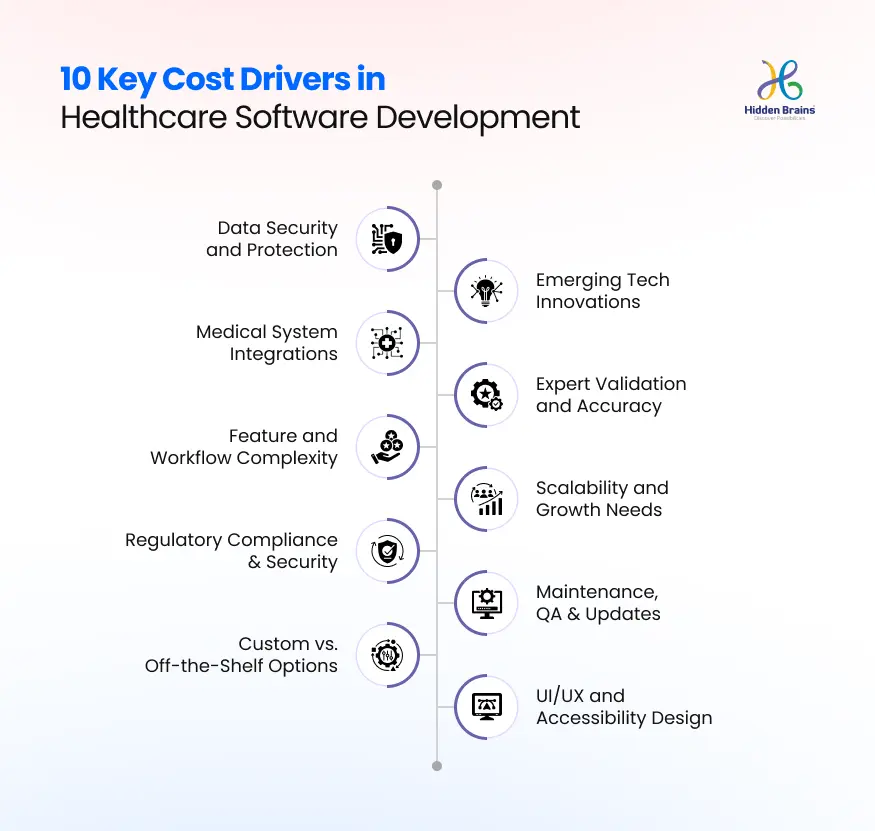
It’s not just about coding or design. Many small things add up. Let’s look at the biggest cost drivers in simple words:
1. Regulatory Compliance and Security
Healthcare apps need to follow strict rules like HIPAA or GDPR. This means extra steps like encryption, access controls, and audits. These layers of safety can increase costs by 20–30%.
2. Integration with Medical Systems and Devices
Most apps need to connect with EHRs, lab tools, or Wearables. Each connection takes time, money, and custom work, especially with old systems.
3. Feature and Workflow Complexity
Basic apps are cheaper. But if you want AI diagnostics, clinical workflows, or advanced reporting, costs go up quickly.
4. Data Security Architecture
Patient data must stay safe. So, you need strong security like encryption, intrusion detection, and recovery plans. It takes extra time and budget.
5. UI/UX Design and Accessibility
A user-friendly design for doctors, patients, and admins with smooth navigation and accessibility across all devices. It can increase costs but greatly improves the overall experience.
6. Customization vs. Off-the-Shelf
Choosing between Off-the-Shelf Software vs Custom Software: custom offers tailored solutions, while off-the-shelf is cheaper but less adaptable.
7. Use of Emerging Technologies
Adding AI, chatbots, or telemedicine features makes your app powerful. But these need expert teams. It can push costs 20–50% higher.
8. Scalability Requirements
If you plan to grow, you need cloud infrastructure that can handle more users. It costs more in the beginning but saves a lot of money later.
9. Ongoing Maintenance and Updates
Healthcare rules change often. You’ll need regular updates, security fixes, and support. Experts say 15–25% of yearly costs go here.
10. Testing and Clinical Validation
Healthcare apps must be tested well for safety and accuracy. Clinical trials and FDA checks can add time and cost.
How Can You Estimate the Cost to Develop a Healthcare App?
Let’s move on to something interesting. You want to know the cost of building a healthcare app, right?
But before that, there’s one thing you need. A way to estimate healthcare app development cost in the USA properly. For instance, if you want to approach a software development company in California to build a healthcare solution, you must understand their price quotes properly.
Without it, you can’t compare service providers. You can’t plan your budget. And you won’t know if someone is overcharging you.
Most software development companies follow specific engagement models to define how pricing works. There are two common ways to do it:
1. Fixed-price Proposals
Here, you get a set price for the entire project. No surprises. Perfect if your app requirements are crystal clear from day one.
- Pros: Easy to plan. No hidden costs. Great for small, well-defined projects.
- Cons: Not flexible. Changes during development cost extra.
2. Time and Materials Proposals
Here, you pay for the hours and resources used. It’s like paying for electricity;
You pay for what you consume.
- Pros: Flexible. Perfect if your app needs to evolve during development.
- Cons: Harder to predict final cost. Needs close monitoring.
Let’s take a look at the quick comparison table for Fixed-Price vs. Time & Materials estimation, which helps you determine the cost of building a medical app in the USA.
| Criteria | Fixed-Price Proposal | Time & Materials Proposal |
|---|---|---|
| Cost Predictability | High–cost set before the project starts | Low cost depends on the time spent |
| Flexibility | Low – changes cost extra | High – easy to adjust features anytime |
| Best For | Small, well-defined projects | Large or evolving projects |
| Risk for Client | Lower risk – price agreed upfront | Higher risk – needs close monitoring |
| Speed | Faster if requirements stay fixed | It may take longer to change the scope |
| Budget Planning | Easier to plan and control | Harder to forecast the final cost |
Emerging Trends Shaping Healthcare Software Development Costs in the USA
Healthcare apps are evolving fast. New tech brings big opportunities, but also adds to medical app development pricing, depending on what you want. So, it’s crucial to be extra careful when building your healthcare solution.
- Take AI and predictive analytics. They help doctors spot risks early or plan treatments automatically. Great feature, but it needs experts and extra work.
- Voice chatbots make it easy for patients to ask questions anytime. Yet, building natural conversations takes time and skill.
- IoT wearables can send real-time health data to doctors. But smooth and secure connections add layers to development.
- AR/VR brings virtual health training and remote care to life. Still, it needs powerful devices and heavy testing.
- And blockchain keeps health records secure and transparent. But it needs specialized setups.
Simply put, the more advanced the feature, the higher the cost.
Cut Costs, Save Time, Maintain Quality in Your Next Healthcare App
Looking to cut costs and speed up healthcare app development without compromising quality? Check out these expert tips from Hidden Brains.
- Start with MVP: Build only core features first. Add extras later.
- Use cloud services: Cut hardware and infrastructure costs.
- Pick reusable components: Don’t reinvent the wheel for every feature.
- Outsource smartly: Hire skilled teams from cost-effective regions.
- Automate testing: Saves time and reduces errors early.
- Plan for scalability: Avoid costly redesigns as users grow.
- Stay lean: Validate ideas before spending big.
Build Your Healthcare App with Hidden Brains
For 22+ years, Hidden Brains has helped many health organizations in transforming their ideas into scalable, secure, and user-friendly mobile applications. From telemedicine to artificial intelligence solutions, we get innovation accurately and fast. And so, work with us and let’s make that fantasy a reality, and let’s make your next healthcare project sustainable for the long term.
Frequently Asked Questions
We understand that the process of determining the cost of developing a healthcare app can be daunting. Hence, we have addressed the most frequently asked questions by businesses regarding their intentions to build a healthcare app.
1. What’s the cost of a simple healthcare app?
A basic healthcare app in the USA typically starts at around $50,000. The cost can rise if you add features like telemedicine, AI-driven analytics, or advanced EHR integrations. But don’t worry! Our experts are here to help you cut unnecessary costs and plan your budget smartly. Reach out to us, and we’ll guide you every step of the way.
2. Why are healthcare apps more expensive?
Strict rules like HIPAA compliance in healthcare apps, GDPR, real-time analytics, device integrations, and security layers make them costlier than regular apps.
3. How can I reduce costs?
Start with an MVP, use cloud for healthcare, reusable components, and work with an experienced partner.
4. How long does it take?
MVPs take 3–5 months; full-scale healthcare systems may need 9–12 months or more.
5. Which pricing model works best?
A fixed price is great if your scope is clear. Go for time-and-materials if requirements may change.



Conclusion
Determining the healthcare app development cost in the USA is not always complicated if you have a proper objective. The right development partner is the one that will see your vision come to life and will also comprehend your goals and budget simultaneously. Small and big thinking is the way to go and grow during it. Healthcare is becoming digitalized- make sure you are a part of it.