



















































































































































Overview
AI is transforming healthcare, from faster diagnosis to more innovative treatments, but it also raises tough ethical questions. Can patient data stay private? Will AI be fair to everyone? Who takes responsibility when machines make mistakes? In this blog, 8 industry veterans share their real-world insights on healthcare’s most pressing AI ethical issues. From data privacy and bias to transparency and patient safety, they uncover the challenges and suggest practical ways forward. This is a must-read to understand how ethics and innovation must go hand-in-hand in healthcare’s AI future.
AI is changing healthcare in many ways. It can help doctors find diseases early, suggest treatments, and improve patient care. These benefits sound exciting, but they also bring new problems. Especially regarding AI ethical issues in healthcare. How do we keep patient data safe? Can we be sure AI is fair to everyone? And who is responsible if it makes a mistake?
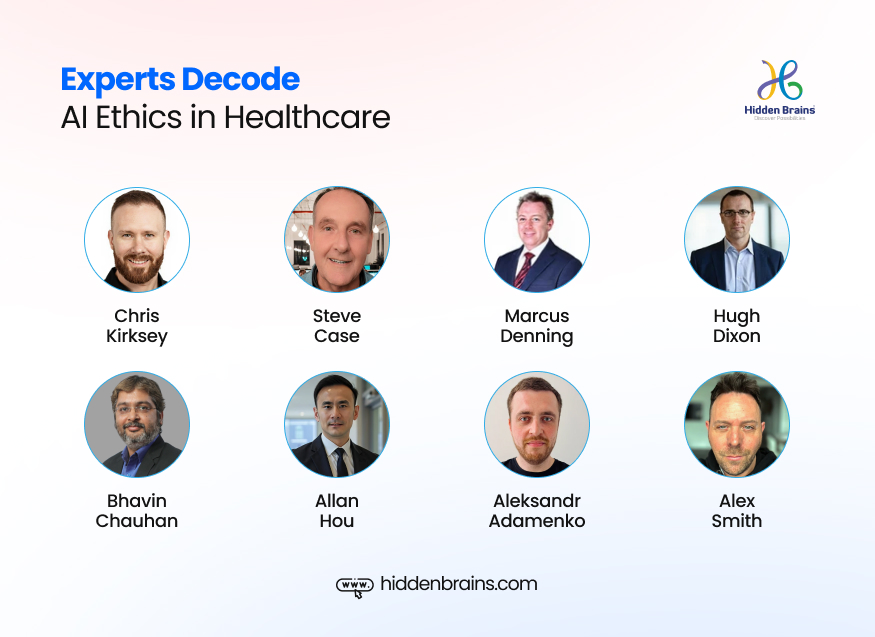
We spoke with 8 experts: founders, leaders, and innovators to learn more. They shared their honest thoughts on the ethical challenges of using AI in healthcare. In this blog, you’ll hear their views and ideas on moving forward safely and fairly.
1 Safeguarding Patient Data with Strong Cybersecurity
Hugh Dixon, Marketing Manager at PSS International Removals, believes the power of new technology in healthcare is “enormous.” But he warns it also brings significant risks for data privacy and security. “Medical data is the healthcare industry’s core,” he explained. If this data is misused or attacked, the results can be “catastrophic” for patients and healthcare providers.
Hugh stressed that hospitals must use encryption, safe data storage, and access controls. He also said it is vital to “constantly educate the healthcare personnel on the ethical use of these systems and the possible risks.” Clear rules for collecting and using patient data will help build trust and ensure responsible use of healthcare technology.

2 Tackling Bias in AI for Fair Healthcare
We had the good fortune to receive an insightful response from Allan Hou, Sales Director at TSL Australia. With his experience in AI adoption, he raised a serious concern: bias in healthcare systems.
“The issue of bias in healthcare presents serious ethical challenges,” Allan said. AI models trained on past data “may not represent diverse populations.” This can mean minority groups get “less accurate diagnoses or treatment recommendations.” In his words, these systems may “unwittingly reinforce the current systems of inequality in healthcare,” which harms vulnerable patients.
Allan suggested solutions, too. He recommended continuous monitoring and auditing to catch new biases. He also stressed working with “a diverse group of healthcare professionals and patient groups” during development and testing. He believes this will create fairer artificial intelligence solutions that “support the needs of all patients, regardless of their background.”
3 Legal and Ethical Safeguards in AI Healthcare
We also heard a clear, grounded take from Marcus Denning, Senior Lawyer at MK Law. “In a profession where the results can be life or death, ethical guardrails cannot be an intellectual exercise but rather a reality.”
First, he points to privacy. “Data privacy is the first ethical fault line.” Health records are sensitive and long-term. Once inside AI systems, they face the risk of misuse. He urges “contracts, mechanisms of consent, and access protocols” with “no ambiguity.” Data given for diagnostics “should not have the data reused for unrelated investigations or commercial modelling without express consent.”
Next, bias. “The second problem is bias in data sets.” It can appear when data is thin for “rural populations,” “underrepresented ethnic groups,” or “patients with rare diseases.” Fixing this needs “incessant auditing,” clear limits, and “obligatory incorporation thresholds” to expand representation.
Finally, accountability. “Algorithms should be reviewed by independent panels with no financial ties. AI models also need version histories, clear records of decisions, and audit logs that are open to review.” And a “human clinician must be present who has the power to override the recommendation.”
Generative AI in healthcare can produce data and handle operations, but human intervention remains essential throughout the process to avoid major fallacies.
4 Safeguarding Trust and Fairness in AI-driven Healthcare
We heard a stark warning from Chris Kirksey, Founder and CEO of Direction.com. “Data privacy in healthcare is a big concern and a matter of trust,” he said. Patients share very private details. AI systems now handle more of that data. Chris noted that “more than half of healthcare data breaches last year were linked to AI systems.” That is a wake-up call.
He said there is “no room for mishandling information when using AI in the healthcare industry.” He urged constant vigilance. He called for clear accountability and continuous security checks. “AI has great potential,” he added, “and continuous security and study is needed, no time to waste.”
Chris also stressed fairness. He pointed to research showing AI “misdiagnosed non-whites 19 per cent more than it did the whites.” That gap is unacceptable. He asked for diverse data and continuous testing. AI must help everyone. It must not paralyse care when it fails for Chris;
protecting trust matters as much as building new tools.
5 AI as a Helping Hand in Medical Imaging
Bhavin Chauhan, AVP – Product Engineering AppsDevPro, acknowledged that while ethical issues of AI in healthcare often raises concerns about over-reliance, one area where it can truly shine is medical imaging. “It helps radiologists detect issues like tumours, fractures, and pneumonia from MRIs and X-rays,” he explained.
For him, this is one of the most ethical uses of AI. AI improves accuracy. It reduces fatigue-related errors that can impact diagnosis. But Bhavin is clear on one point: “Doctors’ opinion is the best and highly reliable.” AI, in his view, is not a replacement. It is a helping hand. The goal is simple: better outcomes for patients.
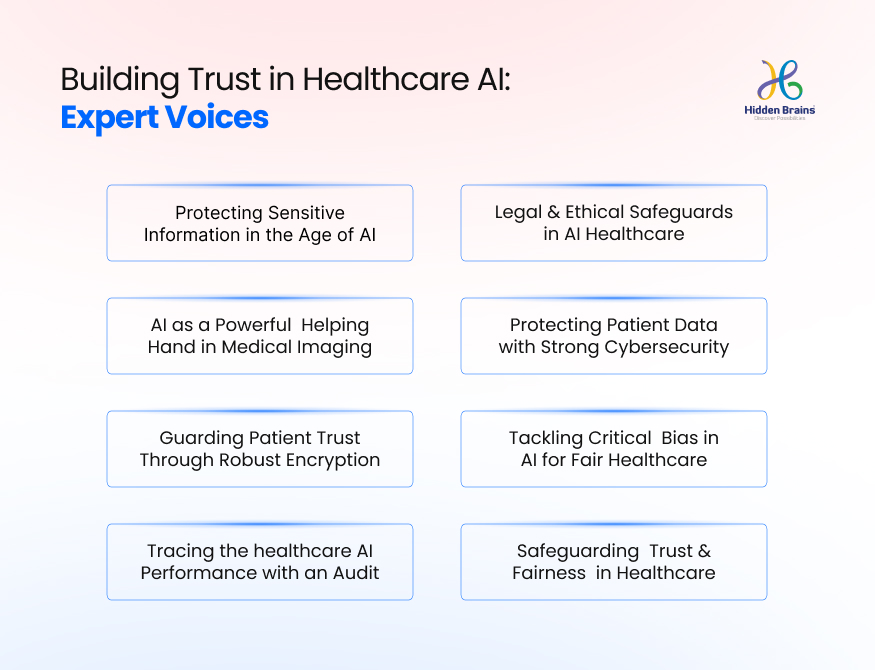
6 Protecting Sensitive Information in the Age of AI
Steve Case, a financial and insurance consultant at Insurance Hero, shared a concern that often gets overlooked in AI ethical issues in healthcare: data privacy.
AI needs a lot of patient data to read scans, predict risks, or suggest treatments. Steve explained that the real issue is not AI but how this data is stored and shared. “When health records are handled without clear rules, patients risk having their private information exposed,” he said.
The problem becomes bigger when outside vendors or third-party companies step in. Even with advanced systems, gaps remain. It can leave patients open to identity theft, money loss, or even stress if their data is misused.
Still, Steve is hopeful. He believes stronger security, clear data-sharing rules, and honest communication can change things. “Privacy must move from being an afterthought to a priority,” he noted. Only then can AI win patient trust while bringing real benefits.
Given these challenges, custom AI development services can understand the importance of secure data handling, optimizing processes, enhancing decision-making, and delivering personalized experiences tailored to users’ needs.
7 Guarding Patient Trust Through Encryption
Aleksandr Adamenko, Co-founder and Product Owner at Winday.co, brought a fresh perspective to the AI ethical issues in healthcare debate, focusing less on data privacy and more on the solution: data encryption.
He explained that AI systems thrive on large amounts of sensitive medical data, from health records and lab results to genetic information. “The real ethical challenge,” Aleksandr noted,”
is not just about privacy on paper, but about how securely this data is stored, transmitted, and accessed in practice.”
Aleksandr thinks that this is one of the methods of saving face. Encouraging the adoption of AI is a move that can be achieved by ensuring that encryption becomes a standard that cannot be compromised, so that healthcare institutions can demonstrate that adopting AI does not imply the loss of patient confidentiality. Instead, it reveals that technology and ethics can proceed simultaneously.
Aleksandr believes this approach is key to preserving trust. By making encryption a non-negotiable standard, healthcare institutions can prove that embracing AI doesn’t mean sacrificing patient confidentiality. Instead, it shows that technology and ethics can move forward together.
8 Tracing the AI Performance with an Audit Trail
We received a clear, practical view from Alex Smith, Manager and Co-owner of Render3DQuick.com. He says the biggest ethical gap is that AI often leaves no clear audit trail.
“It is not enough for an AI to be accurate 99 percent of the time; a person needs to know how the AI arrived at its conclusion,” he warns. If a diagnosis cannot be explained, patients and doctors cannot check or challenge it. That breaks trust.
Alex asks for built-in explanation tools. He wants reports that show the exact data points used, and how each point was weighted. “An industry benchmark ought to have a detailed report, just like an engineer has a blueprint of a building,” he says. Such reports would help find bias and fix errors fast.
He also calls for training and standards so every AI system can show its work. With clear audit trails, doctors can trust AI, and patients can ask questions with real answers.

Hidden Brains: Driving Digital Transformation in Healthcare
At Hidden Brains, we have spent over 22 years building healthcare IT solutions that support healthcare. Our focus is simple: create solutions that make care better and easier.
We design telemedicine apps, hospital systems, AI productivity tools, and secure platforms that help doctors and patients connect with ease. From data management to patient experience, we make technology work for people and not the other way around.
In reality, it’s the way we think about things that distinguishes us. We don’t settle for the usual. We are looking for better, faster, safer ways to solve problems. We’re collaborating with healthcare providers to shape a future to make healthcare solutions accessible and connected.



Conclusion
The future of healthcare with AI looks promising, but it must be built on strong ethics. Protecting patient privacy, removing bias, and keeping humans in control are key. AI should support doctors, not replace their judgment. By focusing on trust and fairness, we can use AI to make healthcare safer, more personal, and truly centered on people.