







































































































































Quick Summary:
Choosing between outsourcing and a Global Capability Center (GCC) isn’t just about cost; it’s about control, innovation, and long-term impact.
This blog breaks down 8 key differences every tech leader should know, showing why GCCs are becoming the go-to strategy for companies that want agility, top talent, and real business transformation.
In today’s digital world, tech companies are constantly rethinking how they run operations. One big question they face is: “Should we outsource tasks or build our own Global Capability Center (GCC)?“
This guide explains what GCC is in outsourcing, how it differs from Business process outsourcing, and when to choose GCC over outsourcing. We’ll also look at how it applies to payroll, medical billing, R&D, and other specialized areas.
What Does “GCC” Mean?
A Global Capability Center (GCC) is a centralized hub set up by a company, usually a multinational, to handle critical business functions, technology operations, or research and development in a specific region outside its home country. Unlike traditional outsourcing, GCCs are owned and operated by the company itself, giving them greater control, flexibility, and alignment with strategic goals. A GCC is:
- A fully or mostly owned hub of your company (not a third-party vendor).
- Designed to handle both strategic and operational work, not just cheap tasks.
- Located where talent, cost, and time zones make sense, like India, Eastern Europe, or the Philippines.
So when people talk about “GCC outsourcing” or “GCC business process outsourcing services,” they usually mean work done through these owned centers, not classic outsourcing.
Tech Outsourcing vs GCC: What’s the Difference?
- Tech Outsourcing: Partnering with an external service provider to manage specific technology functions or projects, such as software development, support, maintenance, or IT operations, without building in-house capabilities.
- Global Capability Center (GCC): A captive or semi-captive internal center owned by your company, handling a broader range of functions with tighter control and alignment.
Key Differences
| Feature/Aspect | Global Capability Centers (GCC) | Outsourcing |
|---|---|---|
| Ownership & Control | Fully owned and managed by the parent company. High control over processes, team, and IP. | Managed by a third-party vendor. Control is limited; dependent on the vendor’s processes. |
| Knowledge Retention | In-house team builds long-term expertise and keeps critical knowledge within the company. | Knowledge may reside with the vendor; risk of losing expertise when contracts end. |
| Customization & Alignment | Processes, culture, and strategies fully aligned with company objectives. | Limited alignment; vendors may follow standard practices, with less flexibility. |
| Cost Structure | Higher initial investment (infrastructure, hiring, training), but better ROI long-term. | Lower upfront cost; pay-as-you-go model, but long-term costs may accumulate. |
| Innovation & Strategic Impact | Encourages innovation, internal collaboration, and proprietary solutions. | Focused on task completion; limited scope for strategic innovation. |
| Talent Management | Full control over recruitment, training, and retention. Can nurture talent aligned with company goals. | Vendor manages talent; limited influence over skill development or retention. |
| Security & Compliance | High security and regulatory control; ideal for sensitive data and IP. | Dependent on vendor’s security practices; higher compliance risks. |
| Scalability | Scales gradually based on strategic goals and internal capacity. | Quick scaling for short-term needs but may lack long-term consistency. |
Takeaway: Ask yourself, do you need just cost-efficient delivery, or a strategic extension of your business?

Why Now? The Shift from Outsourcing to GCC
Businesses are evolving. Companies no longer want just low-cost outsourcing. They want:
- Digital transformation demands: Organisations want centres that can handle advanced analytics, cloud engineering, and custom AI development, not just simple processing.
- Talent availability in offshore markets: Hiring skilled teams in regions such as India and Eastern Europe is rising, enabling companies to build GCCs with higher value.
- Control, IP & data security concerns: Organisations want tighter governance and less risk of vendor lock‑in or brand dilution.
- Long‑term value over short‑term cost: GCCs represent strategic investment, not just cost arbitrage.
For CEOs, CTOs, and CFOs, the decision is strategic, not just financial.
When Does Outsourcing Still Make Sense?
Outsourcing is still useful when:
- Tasks are non-core, repetitive, like payroll or customer service.
- You need quick deployment without building infrastructure.
- Demand is short-term or fluctuating.
- Deep integration with your brand or IP isn’t required.
Outsourcing is one tool. The key question: “When should you move to a GCC for long-term strategic value?”
GCC vs Outsourcing vs In‑house Operations
A further nuance is comparing three options: Insourcing (in‑house), outsourcing (third‑party vendor), and GCC (captive/affiliate). As one analysis shows, a GCC provides a hybrid approach combining outsourcing cost efficiency with insourcing control.
In‑House (Insourcing)
- Full control, integration, direct culture alignment, highest cost.
- Best for core business functions and strategic risks.
Outsourcing (Third‑party vendor)
- Low cost, fast implementation, limited control.
- Best for non‑core, commoditised processes.
GCC (Global Capability Center)
- Middle ground: you own/control it, access global talent, strategic alignment, moderate cost.
- Good for functions that are beyond commoditised but not necessarily 100% strategic core.
For tech leaders, making the decision requires looking at criteria like strategic importance, process complexity, talent availability, cost sensitivity, data risk, and long‑term roadmap.

How to Evaluate the Decision: Questions for the C‑Suite
When your leadership team (CEO, CFO, CTO) debates GCC vs outsourcing, ask these questions:
1. Strategic Importance
Is the function core to our competitive advantage?
- If yes → lean GCC or in‑house.
- If not → outsourcing may suffice.
2. Control & IP Sensitivity
Do we need tight control over operations, data, culture, and IP?
- High need → GCC.
- Low need → outsourcing.
3. Talent & Capability
Can we access the necessary talent pool (offshore) to build the capabilities we need?
- If yes → GCC.
- If no → rely on vendor outsourcing.
4. Cost vs Investment
Are we willing to invest upfront (infrastructure, hiring) for long‑term value, or do we need immediate cost savings?
- If long‑term value matters → GCC.
- If short‑term savings matter → outsourcing.
5. Growth & Scalability
Are we expecting rapid growth or strategic transformation (digital, analytics, R&D)?
- If yes → GCC.
- If steady-state operations → outsourcing.
6. Governance & Risk
What is our risk tolerance regarding vendor lock‑in, data breach, and regulatory exposure?
- Low tolerance → GCC.
- Higher tolerance → outsourcing.
Tech leaders should consider strategic importance, complexity, talent, cost, data risk, and long-term roadmap when choosing.
The Future of Global Capability Centers
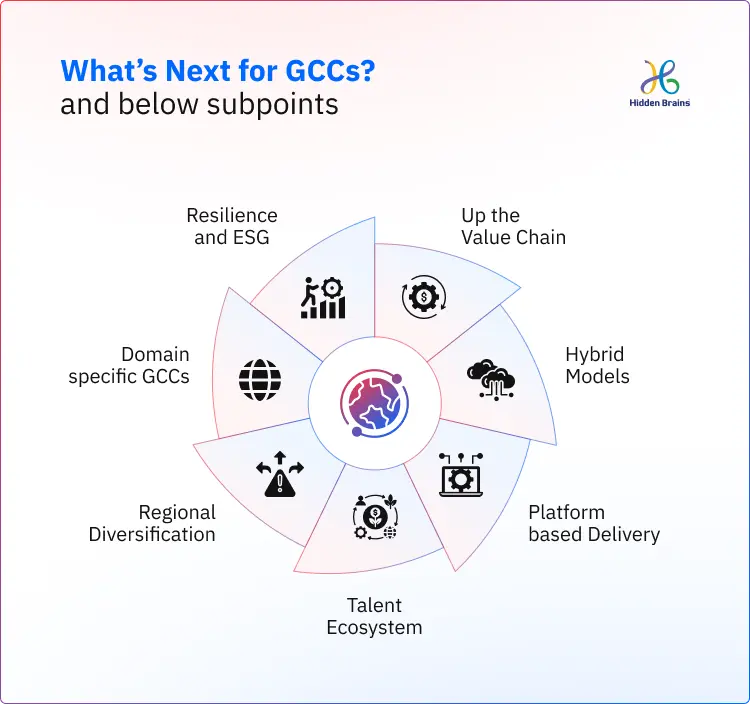
The future of GCCs is not just about offshoring – it’s about co-creation.
- Up the Value Chain: GCCs are moving from cost centers to labs, R&D, and analytics, with GCC-as-a-Service enabling plug-and-play access to high-value capabilities.
- Hybrid Models: Start with outsourcing non-core tasks, then build GCCs for strategic work, leveraging GCC-as-a-Service for faster scalability.
- Platform-based Delivery: GCCs increasingly leverage cloud, AI, automation, and GCC-as-a-Service platforms for flexible, outcome-driven solutions.
- Talent Ecosystem: Killing, culture, and access to on-demand talent through GCC-as-a-Service become differentiators.
- Regional Diversification: GCCs expand in Eastern Europe, Southeast Asia, and Latin America, with GCC-as-a-Service enabling distributed operations.
- Domain-specific GCCs: Specialized GCCs, e.g., medical billing, R&D labs, formulation development, are powered by GCC-as-a-Service offerings.
- Resilience & ESG: GCCs are designed for compliance, sustainability, and risk mitigation, with GCC-as-a-Service supporting agile, resilient operations.
GCC decisions are long-term capability plays, not one-off choices.
How to Decide: A Framework
1. Map functions: Core vs non-core, growth-oriented vs legacy.
2. Assess fit: Does it need integration, culture alignment, or innovation?
- Yes → GCC or insourcing
- No → Outsourcing works
3. Evaluate location & talent: Are there suitable geographies?
4. Estimate cost vs value: Build a GCC business case.
5. Check risks & governance: Vendor vs captive risk.
6. Design roadmap: Start with outsourcing for immediate needs; gradually migrate to GCC.
7. Measure KPIs: Cost savings, agility, innovation, talent retention.
How Can Hidden Brains Help?
Thinking about setting up a GCC, but unsure where to start?
Hidden Brains offers GCC-as-a-Service, helping enterprises build and manage scalable Global Capability Centers without the usual headaches.
With Hidden Brains, you can:
- Access global talent quickly for tech, analytics, AI, and more.
- Maintain control and alignment with your company culture and processes.
- Scale efficiently with flexible delivery and engagement models.
- Focus on innovation while they handle operations, compliance, and infrastructure.
Whether you’re considering payroll, R&D, or advanced analytics, Hidden Brains can help you transition from outsourcing to a full-fledged GCC model seamlessly.
Frequently Asked Questions
Explore answers to the most pressing questions about building and leveraging AI-capable GCCs. Gain insights on strategy, talent, technology, and innovation to drive real business value.
How can a GCC leverage AI/ML capabilities rather than just being a cost-centre?
A Global Capability Center (GCC) can move beyond traditional cost-centric operations by embedding AI/ML capabilities into its core functions. Instead of merely executing repetitive tasks, the GCC can build predictive analytics engines, automation pipelines, recommendation systems, and real-time business insights for the parent company.
By aligning AI initiatives with strategic business objectives, such as customer experience, supply chain optimization, fraud detection, or R&D acceleration, the GCC evolves into a value-driving innovation hub.
Metrics like ROI from AI models, time-to-market improvements, and operational efficiency gains demonstrate the shift from cost-saving to value creation.
What are the key technology talent and skill requirements to build an AI-driven GCC in India (or neighbouring hubs)?
To create an AI-capable GCC, you need a mix of skills across AI/ML, data engineering, software development, and domain expertise. Key roles include:
– Data scientists with experience in predictive modeling, NLP, computer vision, and reinforcement learning.
– Machine learning engineers to deploy scalable AI models in production.
– Data engineers skilled in ETL pipelines, cloud platforms, and big data frameworks.
– AI architects to design scalable and secure AI infrastructure.
– Domain specialists (finance, healthcare, telecom, mobile apps) who bridge business needs with AI solutions.
– DevOps and MLOps professionals for model lifecycle management.
– Tier-1 hubs like Bangalore, Hyderabad, Pune, and Gurgaon offer deep AI talent pools, while tier-2 cities provide cost-effective staffing with emerging AI skills. Upskilling programs, partnerships with universities, and AI certifications are crucial for sustainability.
What models exist for combining GCC, GBS, and outsourcing when AI/automation is involved, and how to choose among them?
Enterprises typically adopt one of these hybrid models:
1. GCC + GBS (Global Business Services): AI/automation is embedded within shared services to enhance finance, HR, IT, and analytics operations. The GCC handles strategic AI initiatives while GBS executes standardized AI workflows.
2. GCC + Outsourcing: Critical AI/ML capabilities (IP-heavy, proprietary) stay in the GCC, while non-core AI services (data labeling, model testing) are outsourced to specialized vendors.
3. GBS + Outsourcing only: Suitable for companies with limited AI maturity; the vendor delivers AI automation under SLA while GBS orchestrates outcomes.
Choosing the right model depends on the function’s strategic importance, data sensitivity, and long-term capability goals. A hybrid GCC-outsource model is often optimal for balancing innovation, speed, and cost.
What are the risk/benefit trade-offs of setting up an AI-capable GCC vs outsourcing AI work to third-party vendors?
1. Benefits of GCC: full IP control, alignment with company strategy, long-term talent development, ability to innovate beyond vendor constraints.
2. Risks of GCC: high upfront investment, ramp-up time, talent retention challenges, and infrastructure complexity.
3. Benefits of outsourcing: quick ramp-up, lower capital investment, vendor expertise, scalability.
4. Risks of outsourcing: less control over IP and quality, risk of vendor lock-in, potential misalignment with business objectives, and slower innovation.
A hybrid approach, core AI in GCC, peripheral tasks outsourced, often mitigates risks while optimizing value.
What infrastructure/governance / regulatory / data-security considerations must be addressed for an AI-enabled GCC?
Key considerations include:
– Infrastructure: Scalable cloud platforms (AWS, Azure, GCP), GPU clusters for ML workloads, and high-bandwidth data pipelines.
– Governance: Strong AI governance frameworks for model accuracy, explainability, auditability, and regulatory compliance.
– Regulatory: Compliance with GDPR, HIPAA (healthcare), financial regulations, and industry-specific AI guidelines.
– Data security: Robust access controls, encryption (in transit and at rest), secure multi-tenant architectures, and continuous monitoring to prevent breaches.
– Ethics & AI fairness: Policies for unbiased AI, monitoring of ML models for ethical decision-making, and internal AI review boards.
How should a mobile-app developer or tech lead think of leveraging the GCC model for mobile innovation / AI features (e.g., ML on device, backend analytics)?
GCCs can centralize AI-driven mobile innovation by providing dedicated ML/AI teams and shared infrastructure. Mobile app developers can:
– Use the GCC for backend AI analytics, aggregating user behavior to improve personalization and recommendations.
– Build on-device ML models for predictive features, offline capabilities, and low-latency AI operations.
– Collaborate with GCC CoEs for AI experimentation, prototyping, and feature validation.
– Leverage GCC expertise for A/B testing, anomaly detection, NLP-powered chatbots, and computer vision integration.
This enables faster innovation cycles, standardization of AI pipelines, and scaling features across multiple mobile apps.
Which locations (tier-1, tier-2 cities) are viable for GCCs with an AI/ML focus, and what are the talent ecosystem implications?
– Tier-1 cities (Bangalore, Hyderabad, Pune, Gurgaon, Chennai): Large talent pools in AI/ML, mature ecosystem with universities, incubators, and tech communities. High cost but better for advanced AI research.
– Tier-2 cities (Ahmedabad, Jaipur, Kochi, Bhubaneswar): Emerging AI talent, lower operating costs, potential for building loyalty, but may require upskilling and partnerships with universities or training institutes.
GCCs in hybrid tier-1/tier-2 models balance cost, innovation, and talent sustainability.
How do you build a Centre of Excellence (CoE) inside a GCC for AI, analytics, and automation, and how does it operate differently from standard delivery?
A GCC CoE is a specialized hub for AI and advanced technologies. Steps include:
1. Define focus areas: AI/ML, data analytics, automation, and AI ethics.
2. Hire domain experts, AI engineers, and data scientists.
3. Establish standardized frameworks for ML pipelines, CI/CD, and MLOps.
4. Create collaboration channels with product, R&D, and business teams.
5. Track KPIs beyond delivery: model accuracy, automation ROI, adoption, and innovation impact.
Unlike standard delivery (transactional or SLA-driven), a CoE focuses on strategic innovation, research, reuse of AI models, and enterprise-wide knowledge sharing.
What does the ramp-up timeline look like for setting up an AI-capable GCC (structure, hiring, tooling, culture) and what pitfalls to anticipate?
Typical ramp-up:
– Months 0-3: Define vision, charter, location, initial hires, and infrastructure planning.
– Months 3-6: Recruit core AI team, deploy basic AI pipelines, start pilot projects.
– Months 6-12: Scale AI/ML hiring, integrate CoE, establish governance, begin enterprise-wide adoption.
– Months 12-24: Mature AI platforms, optimize models, deliver strategic AI solutions.
Common pitfalls: unclear charter, underestimating talent requirements, insufficient governance, poor alignment with parent company strategy, and lack of culture for innovation.
How to align the AI roadmap of the parent company with the GCC’s charter, ensuring the centre isn’t just “cheap dev” but value-creation for mobile/digital platforms?
– Establish a joint steering committee with parent company leaders and GCC leads.
– Define KPIs linked to business impact: revenue growth, user engagement, cost optimization, and AI-driven insights.
– Embed CoE-led innovation: prototype AI features, test new models, and integrate with enterprise systems.
– Maintain continuous knowledge transfer: workshops, shared dashboards, and quarterly roadmap reviews.
– Align budget, resources, and talent strategy to long-term enterprise AI goals rather than short-term cost metrics.
The GCC becomes a strategic partner for mobile/digital platforms, not just a development arm.
Wrapping Up
For CEOs, CTOs, and CFOs:
- Looking for quick cost reduction? → Outsourcing may suffice.
- Want a global hub aligned with your culture and innovation goals? → GCC is the way.
Often, the best approach is hybrid: start with outsourcing for non-core tasks, then gradually move strategic functions to a GCC as you scale.