


























































































































































Quick Summary
AI agents are redefining business intelligence across the GCC nations, transforming data into instant, actionable insights. From UAE to Kuwait, enterprises are moving from reports to real-time decisions powered by automation, machine learning, and intelligent analytics. The result? Smarter forecasting, faster growth, and a new era of AI-driven leadership.
Introduction: Why GCC Is Betting Big on AI Agents
Data is the new oil, but only if you know how to refine it. In 2025, the GCC nations are doing just that.
From Dubai’s Digital Economy Strategy to Saudi Vision 2030, the region is investing billions in AI-powered transformation. Yet, what’s truly changing the game isn’t just AI development services, it’s AI agents.
These AI agents are turning BI from a back-office function into a boardroom advantage, giving leaders instant answers, forecasts, and insights that once took days.
So, what’s really driving this shift? Let’s break it down.
What Exactly Are AI Agents and Why They’re Revolutionizing BI
Think of AI agents in business intelligence as your digital analysts on autopilot. They don’t just analyze data; they think, learn, and act. Unlike traditional BI dashboards that wait for you to ask questions, AI agents ask questions for you, spotting patterns, predicting risks, and suggesting actions.
Here’s how they’re changing the rules:
- Automation first: They replace repetitive reporting with continuous insight generation.
- Contextual learning: They learn from your company’s data, sales, logistics, finance, and HR.
- Proactive insights: They send alerts like, “Customer churn is 18% higher this quarter.”
- Decision acceleration: C-suites get faster, data-backed calls without needing analysts.
In essence, AI agents bring business intelligence automation for enterprises under one roof, freeing up leaders to focus on strategy, not spreadsheets.
This becomes even more powerful when you consider switching from legacy connectors exploring FiveTran competitors can unlock more flexible and cost-effective pipelines that feed cleaner data directly into your AI-driven BI workflows.

Supercharge Your Business with AI Agents Contact Us
The BI Landscape in GCC – What’s Changing Fast
The GCC nations have always been ambitious. But now, it’s data-driven. Governments, banks, startups, and oil conglomerates are all adopting AI for business intelligence tools to stay ahead.
Common pain points driving adoption:
- Disconnected data silos
- Slow manual reporting cycles
- Lack of actionable insights
- Talent shortages in data analytics
AI agents fix all that by turning chaos into clarity. Whether it’s a fintech in Saudi Arabia, a logistics startup in Kuwait, or an energy firm in Qatar, everyone wants one thing:
Smarter, faster, real-time decisions.
5 Ways AI Agents Are Powering Smarter, Faster Decisions
Here’s where it gets exciting. GCC enterprises are already reaping massive benefits.
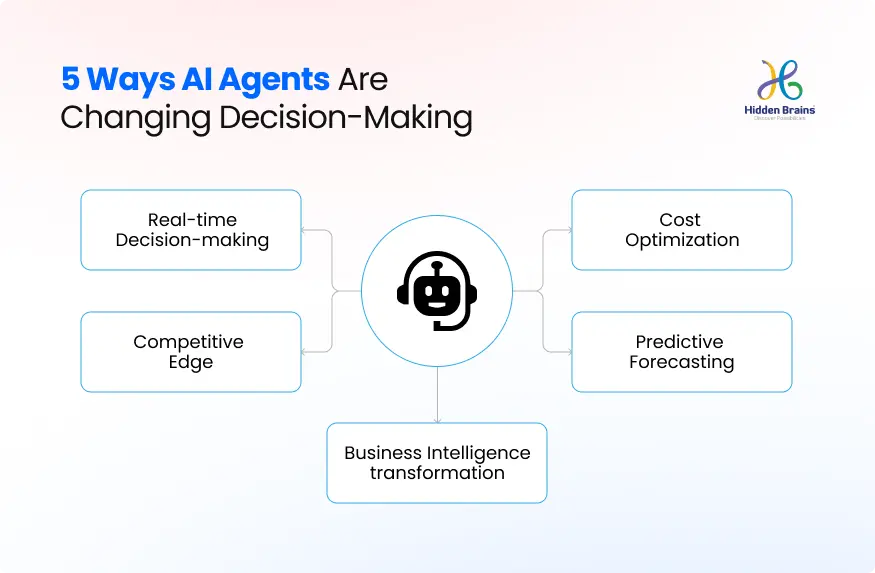
Real-time Decision-making
Forget waiting for weekly BI reports. AI agents deliver real-time AI-powered business analytics directly to dashboards, emails, or chat.
Predictive Forecasting
They use machine learning in business analytics to forecast sales, demand, and risk. For instance, a retailer in Oman can now predict Ramadan season spikes weeks in advance.
Cost Optimization
By automating BI processes, companies cut costs by up to 30%, according to PwC Middle East.
Competitive Edge
Startups move faster. Enterprises scale smarter. Everyone gains an edge by using AI agents to bridge intuition and intelligence.
Business Intelligence Transformation
What was once a tool for analysts is now a core enabler of C-suite strategy, turning raw data into a narrative of growth.
“AI agents are transforming the DNA of decision-making in GCC; from reactive to predictive.”
The Tech Behind the Trend: Tools Driving AI-powered BI
So, what’s fueling this transformation? A new generation of AI tools for business growth.
Top innovations include:
- Generative AI BI assistants
- AutoML tools for easy model building
- Cloud-native BI platforms with built-in AI agents
- Integrated ERP + CRM analytics layers
Example: A Dubai-based enterprise uses AI agents integrated with SAP + Microsoft Power BI to generate instant performance summaries in Arabic and English.
This shift is also fueled by massive data infrastructure investments across the Gulf, giving regional businesses the backbone they need to scale intelligent software development automation for enterprises.
Industry Deep Dive: How GCC Businesses Are Putting AI Agents to Work
Let’s look at where this transformation is most visible.
Finance & Banking
AI agents detect fraud, monitor compliance, and assess risk across vast datasets. They save millions by catching anomalies faster than human auditors ever could.
Retail & Ecommerce
Personalized recommendations, real-time inventory updates, and demand forecasting, all powered by AI for business intelligence. A UAE retailer, for example, uses AI agents to predict next-day demand and cut overstock by 22%.
Logistics & Supply Chain
Agents track fleet performance, optimize routes, and predict shipment delays. A Saudi logistics firm improved fuel efficiency by 18% using predictive route analytics.
Healthcare & Pharma
AI agents in hospitals predict patient admission surges and optimize staff allocation. That’s the power of business intelligence automation meeting human care.
The Road Ahead: Where BI in GCC Is Headed
The next phase? Autonomous analytics and conversational BI. Imagine talking to your system: “Hey, what’s our revenue forecast for Q2 in Saudi Arabia?”
And it instantly provides context, charts, and suggested actions. This is where business intelligence transformation is heading. As GCC’s digital vision matures, we’ll see more:
- Voice-based BI interfaces
- Cross-language data querying (Arabic-English)
- Auto-generated executive summaries
The future belongs to enterprises that don’t just collect data; they let AI agents act on it. So, get on with hiring a leading AI development company and get started already.
Ready to turn insights into advantage,
we’ll help you get there.

Frequently Asked Questions
Got questions? We’ve got the insights you’re looking for; clear, concise, and built to guide your next big move in GCC nations.
What is the role of AI in business intelligence?
AI plays a powerful role in modern business intelligence (BI) by turning raw data into clear, actionable insights. Instead of manually analyzing reports, AI agents in business intelligence automatically detect trends, forecast outcomes, and suggest next steps.
With the rise of machine learning in business analytics, organizations can now predict customer behavior, optimize operations, and identify new growth opportunities, all in real time.
In short, AI makes BI faster, smarter, and more strategic.
What are the latest business intelligence trends in the GCC nations?
Across the GCC nations, companies are rapidly moving toward AI-powered business analytics and data-driven decision-making.
Some key trends include:
• Adoption of AI agents for real-time forecasting and scenario planning.
• Integration with cloud BI tools for better accessibility and collaboration.
• Intelligent automation for enterprises, reducing manual data handling.
• Enhanced data governance, ensuring compliance and trust in analytics.
From the UAE to Saudi Arabia, AI in business intelligence is becoming a top investment area for digital transformation leaders aiming to boost efficiency and competitiveness.
How are enterprises using AI for decision-making?
Enterprises are using AI and business intelligence automation to make decisions based on facts, not assumptions. AI agents can instantly process millions of data points, from sales trends to customer interactions, and provide recommendations backed by predictive analytics.
For example, a retail chain in Dubai might use AI-powered business analytics to decide which products to restock based on buying patterns. This kind of insight helps C-level leaders act faster, reduce risks, and make every decision data-driven.
What are the benefits of AI in business analytics?
The benefits of AI in business analytics go far beyond speed and automation. Here’s how it’s transforming businesses:
• Real-time insights: No more waiting for weekly reports. AI delivers instant answers.
• Predictive forecasting: Anticipate customer demand, market shifts, and risks.
• Smarter resource allocation: Optimize budgets, inventory, and workforce in real time.
• Deeper insights: Discover hidden trends humans might overlook.
In essence, AI for business intelligence empowers organizations to make smarter, faster, and more confident decisions.
Why does AI matter for business intelligence transformation?
AI is the backbone of modern business intelligence transformation. Traditional BI focuses on historical data, but AI shifts the focus to what’s happening now and what’s likely to happen next.
With intelligent automation for enterprises, AI agents can clean, analyze, and interpret data at scale. This transformation helps organizations in GCC move from reactive analytics to proactive strategy, where decisions are guided by AI-driven insights instead of gut instinct.
How do AI Agents boost business performance?
AI agents act like digital business assistants, always analyzing, learning, and recommending the next move.
They improve performance by:
• Automating repetitive BI tasks
• Predicting future outcomes using machine learning in business analytics
• Identifying growth and cost-saving opportunities
• Delivering accurate reports in seconds
By combining AI-powered business analytics with human decision-making, enterprises achieve faster execution, reduced operational costs, and more consistent performance outcomes.
How can AI-powered insights help GCC businesses grow?
GCC businesses are increasingly adopting AI agents in business intelligence to navigate market volatility and identify new revenue streams. For instance, AI-powered insights can help a logistics firm forecast shipping delays or a retail brand predict which products will sell fastest next season.
These insights allow leaders to act before competitors do, resulting in smarter investments, greater efficiency, and long-term growth. In a fast-evolving digital landscape, AI in business intelligence is no longer optional; it’s essential for staying ahead in the GCC market.

Quick Takeaways for Business Leaders
In conclusion, successful AI adoption starts with small, focused experiments. Select a single BI process and test AI integration. Ensure your tools are cloud-ready and compatible with existing ERP and CRM systems, while training teams to collaborate with AI rather than fear it. Maintain high data quality, as AI’s insights are only as effective as the information it receives. Align initiatives with your national AI vision to ensure compliance and access to funding. By taking these steps, organizations can build a practical, future-ready approach that transforms insights into actionable intelligence.
Pro Tip: The earlier you integrate AI agents into your BI workflow, the more your organization learns and stays ahead.