






























































![Sales & Distribution [Oil & Gas]](https://www.hiddenbrains.com/blog/wp-content/themes/blankslate/assets/images/sales_and_distribution-icon.74d08193.svg "Sales & Distribution [Oil & Gas]")

![Fluid Terminal Management [Oil & Gas]](https://www.hiddenbrains.com/blog/wp-content/themes/blankslate/assets/images/fluid_terminal_management-icon.4b3a27a4.svg "Fluid Terminal Management [Oil & Gas]")


![Sales & Distribution [Oil & Gas]](https://www.hiddenbrains.com/blog/wp-content/themes/blankslate/assets/images/sales_and_distribution-icon.74d08193.svg?1.0.0 "Sales & Distribution [Oil & Gas]")
![Fluid Terminal Management [Oil & Gas]](https://www.hiddenbrains.com/blog/wp-content/themes/blankslate/assets/images/fluid_terminal_management-icon.4b3a27a4.svg?1.0.0 "Fluid Terminal Management [Oil & Gas]")





















































































Summary
- The next AI advantage is value realization.
- Narrow agentic workflows will outperform broad experimentation.
- AI cost shifts from build-time to run-time.
- Model choice should follow the use case.
- Strong data foundations remain non-negotiable.
- Decision intelligence will become a core enterprise capability.
- Controls, traceability, and oversight need funding.
- Execution discipline will separate pilots from production value.
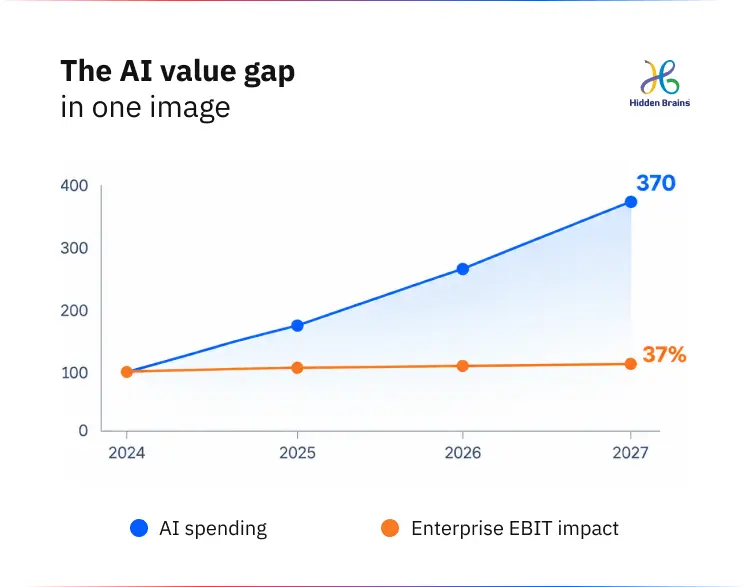
The most important thing to understand about AI Trends heading into the future is not a new model or a bigger benchmark. It is a gap. Enterprises have spent heavily on artificial intelligence (AI) for three years, yet most cannot point to a line on the profit statement that moved because of it.
In the State of AI survey, McKinsey found that 94 percent of organizations saw no material earnings impact from their AI spending, and only 6 percent reported a significant one. Roughly 80 percent of respondents reported individual productivity gains, but only about 37 percent could attribute any measurable financial impact to AI at the enterprise level.
That gap is the real story of 2027. The ten trends below are not a list of technologies to admire. They are a map of where the money is going and, more usefully, where it actually converts into results. For technology leaders planning next year’s investment, the question is no longer “should we adopt AI?” It is “which of these shifts closes the distance between what we spend and what we can bank.”
A quick note on how to read this: each trend includes what the market is excited about, what the evidence says actually works, and a direct implication for your budget.
The 10 Enterprise AI Trends Shaping 2027 Technology Investment
1. Agentic AI Crosses From Pilots to Production
Agentic AI, meaning systems that carry out multistep tasks with limited human input rather than only answering prompts, is moving from experiment to production in 2027, but the failure rate will be high.
Gartner predicts that more than 40 percent of agentic AI projects will be canceled by the end of 2027, driven by escalating costs, unclear business value, and inadequate risk controls.
Both facts are true at once: Adoption is accelerating, and abandonment is common. The projects that survive tend to target bounded, high-volume workflows with measurable outcomes, such as ticket triage, code review, and operations coordination.
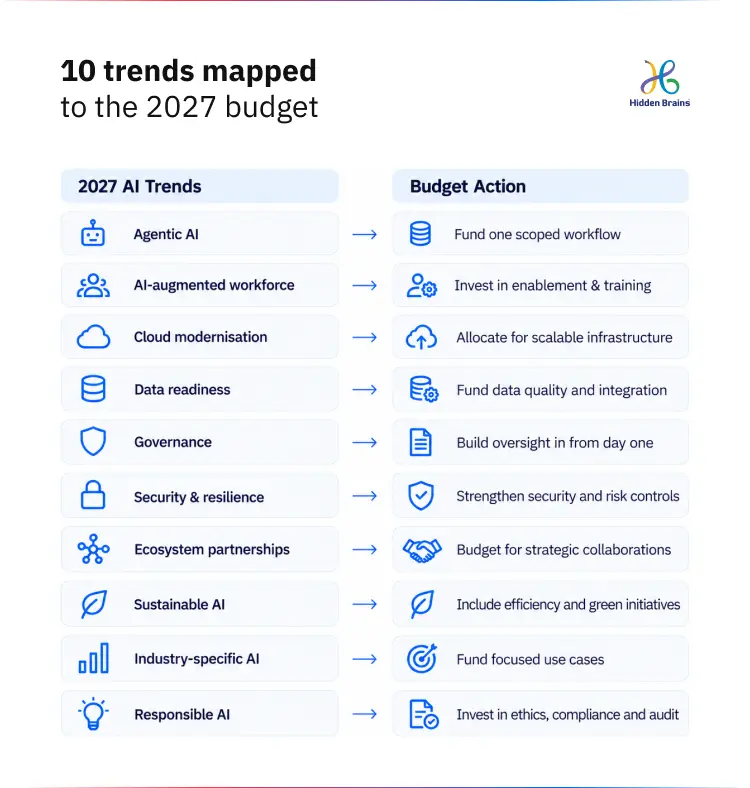
2027 budget implication: Fund a small number of agentic workflows tied to a specific process and a specific number, not a broad “agent platform” with no owner. If you want a primer on where agents create value inside analytics and operations, our overview of AI agents in business intelligence is a useful starting point.
2. The ROI Gap Becomes the Boardroom’s Central AI Question
In 2027, boards stop asking whether AI works and start asking why it has not shown up in earnings. This is a direct consequence of the value gap: McKinsey’s 2026 data shows conviction growing faster than attributable returns. The dividing line between the 6 percent capturing significant impact and everyone else is not budget size or model choice. It is deployment discipline, whether AI completes work or merely assists it.
The evidence points one way. McKinsey reported that agentic AI early adopters were far more likely to see returns in the first year than gen-AI users overall, because agents finish tasks rather than sitting beside a human who still does the work. 2027 budget implication: shift spending from copilots that assist toward workflows that complete, and measure cost per resolved ticket or per closed task, not total AI invoice. This is exactly the conversation an AI strategy consulting engagement should start with: attribution before ambition.
Find Out If Your Architecture, Data, and Tech Stack Are Ready for 2027.
Talk to Experts
3. Multi-agent Orchestration Replaces Single-task Bots
The next stage of agentic AI is not smarter individual agents. It is agents that coordinate. Gartner predicts that by 2027, one-third of agentic AI implementations will combine agents with different skills to manage complex tasks across applications and data. A single agent handles one function; an orchestrated set can move a process end to end, for example, intake, validation, decision, and follow-up, without a person stitching each step together.
This matters because most real business processes cross several systems. Orchestration is where integration, not model quality, becomes the constraint. 2027 budget implication: invest in the connective layer, meaning the interoperability standards, shared context, and governance that let agents hand work to each other safely. Custom work here usually needs custom generative AI integration rather than an off-the-shelf tool.
4. AI Governance Moves from Afterthought to Budget Line
Governance stops being a compliance checkbox and becomes a funded capability. Gartner projects that by 2027, around 60 percent of organizations will struggle to realize AI value specifically because of weak governance, and that fragmented AI regulation will reach roughly half of the world’s economies, driving billions in compliance investment. The EU AI Act’s phased obligations are already pushing enterprise buyers toward platforms that build transparency, monitoring, and policy enforcement in by default.
Operational risk is also sharper. Gartner has warned that by 2027, a meaningful share of ungoverned decisions made with large language models (LLMs) could cause financial or reputational loss, because of human bias, weak oversight, and model overconfidence.
2027 budget implication: treat governance as part of every AI project’s cost, not a separate initiative, and build in human oversight, audit trails, and access controls from day one. For a deeper treatment of why governance belongs inside implementation, see our piece on enterprise automation.
5. Sovereign AI and Data Localization Reshape Where Models Run
Where AI runs becomes a strategic decision in 2027, not just a technical one. IDC attributes a growing share of new AI infrastructure investment to sovereign AI programs across the Middle East, Southeast Asia, and Europe, as governments and enterprises seek control over data, models, and the underlying compute. Regulatory pressure, national AI missions, and data-residency requirements are pulling deployments into specific regions and platforms.
For enterprises operating across borders, this raises real design questions about data residency, model hosting, and vendor lock-in. 2027 budget implication: for regulated or multi-country operations, factor localization and sovereignty into architecture early, because retrofitting it later is expensive. This is a live concern for enterprises in the GCC, Europe, and Southeast Asia in particular.

Turn Enterprise AI Trends Into Results
Plan Your Roadmap6. AI Infrastructure Spending Shifts from Training to Inference
The center of gravity in AI infrastructure moves from building models to running them. Gartner forecasts that in 2026, spending on inference workloads (the cost of running trained models to generate answers and actions) will reach about 23.3 billion dollars, overtaking the roughly 19 billion dollars spent on training, with inference climbing toward 59 percent of AI-optimized infrastructure-as-a-service (IaaS) spending by 2027. IDC puts total AI infrastructure spending near half a trillion dollars in 2026.
This is a signal of maturity: Enterprises are past model-building and into operating AI at scale, and agentic systems that call models repeatedly push inference costs higher. The implication for finance is that AI becomes a recurring operating cost, measured per transaction, rather than a one-time build. 2027 budget implication: model your unit economics, meaning cost per inference and per completed workflow, and choose fit-for-purpose infrastructure across cloud and edge rather than paying premium rates for every workload.
7. Vertical AI and Industry-specific Models Mature
Generic, one-model-for-everything strategies give way to models tuned for specific industries and tasks. Menlo Ventures reported that vertical AI became a 3.5 billion-dollar investment category in 2025, roughly triple the prior year, as buyers favored systems that understand the language, data, and rules of their sector. Smaller, domain-specific models increasingly outperform large general models on narrow enterprise tasks while costing far less to run, which connects directly to the inference-cost pressure in Trend 6.
For most enterprises, the practical takeaway is that the biggest general model is rarely the right default. 2027 budget implication: match the model to the task. Use smaller, specialized, or fine-tuned models where accuracy and cost matter, and reserve frontier models for genuinely open-ended work. This is where AI integration services that connect the right model to your actual data and systems earn their keep.
8. Enterprise Knowledge Intelligence and RAG Grow Up
The quality of AI outputs in 2027 depends less on the model and more on the data feeding it. Across recent enterprise surveys, missing or fragmented data foundations rank as the single largest barrier to scaling AI, ahead of workforce and process readiness. Retrieval-augmented generation (RAG), a method that grounds AI answers in an organization’s own governed documents and records, is the technique most enterprises use to make AI reliable, but shallow implementations that simply “chat with PDFs” do not survive contact with real operations.
Mature knowledge intelligence means contextual, governed, role-aware access to information that lives across documents, emails, systems, and support histories. 2027 budget implication: invest in the data foundation first, meaning connected sources, clean records, access controls, and source validation, before layering advanced intelligence on top. A company cannot become AI-driven meaningfully while its underlying information stays fragmented.
9. Decision Intelligence Becomes a Core Enterprise Function
Decision intelligence, the practice of engineering how business decisions get made and improved with data and AI, becomes a named enterprise capability in 2027. Gartner published its inaugural Magic Quadrant for Decision Intelligence Platforms in early 2026, formally recognizing it as a distinct software category, and predicts that by 2027, half of business decisions will be augmented or automated by AI agents for decision intelligence. The shift is from being “data-driven,” meaning you have dashboards, to being “decision-centric,” meaning the decision itself is modeled, executed, tracked, and improved.
This is the most direct fit with how strong operators already think: the value of data is not the report; it is the decision it enables and the action that follows. 2027 budget implication: identify the handful of high-frequency, high-value decisions in your business, such as pricing, inventory, credit, or scheduling, and invest in making those specific decisions faster and more consistent, rather than buying analytics in general. [INSERT: real Hidden Brains example of a decision workflow, such as procurement approvals or profitability visibility, that moved from delayed reporting to real-time decision support.]
10. Workforce Redesign and Human-in-the-Loop as a Discipline
AI’s 2027 impact on work is less about replacement and more about redesign, with human oversight built in by design. McKinsey found that high-performing organizations were far more likely to have defined human-in-the-loop (HITL) validation processes, at 65 percent versus 23 percent for the rest, meaning people supervise, audit, and intervene as a deliberate part of the workflow. Expectations of AI-driven job cuts have risen, but reported actual reductions have consistently lagged those expectations.
The organizations getting value are redesigning roles so people handle exceptions and judgment while AI handles repetition, and they are building AI literacy across functions, not only in technical teams. 2027 budget implication: budget for change management, role redesign, and training alongside the technology, because the value gap in Trend 2 is very often a people-and-process gap wearing a technology costume.
Where Enterprises Will Invest in AI in 2027
The table below separates what tends to get hyped from what the evidence says moves return on investment (ROI), with a suggested budget priority for each theme.
| Trend | What gets hyped | What actually moves ROI | 2027 budget priority |
|---|---|---|---|
| Agentic AI | Autonomous “do-everything” agents | Bounded workflows with a named owner and metric | High, if scoped tightly |
| ROI and value gap | Productivity anecdotes | Attribution: cost per completed task | Foundational |
| Multi-agent orchestration | Agent marketplaces | Integration and shared context across systems | Medium, rising |
| AI governance | Policy documents | Built-in oversight, audit, and access control | High, non-negotiable |
| Training to inference | Biggest model wins | Unit economics per inference and workflow | High for finance |
| Vertical and small models | Frontier model everywhere | Right-sized model matched to the task | High, cost-saving |
| Knowledge intelligence and RAG | “Chat with your documents” | Governed, connected, role-aware data foundation | Foundational |
| Decision intelligence | More dashboards | Modeled, tracked, high-value decisions | High, differentiating |
How to Decide Where Your AI Budget Goes in 2027
Start with the decision, not the technology. The trends above only matter to the extent they close the gap between spending and results, so the planning question for 2027 is narrow: which specific bottleneck, if solved, produces a measurable improvement your finance team would recognize.
A practical way to prioritize:
- Assess maturity honestly. Map where you sit on connected data, governance, and process readiness. Advanced intelligence layered on fragmented data underperforms every time.
- Pick decisions and workflows, not tools. Name the three to five high-frequency, high-value processes or decisions worth improving, and attach a number to each.
- Decide build versus buy per workflow. This choice is shifting. McKinsey reported that roughly a third of respondents chose not to buy certain software because agentic coding tools now let them build in-house instead. Buy for commodity capability, build where the workflow is a genuine differentiator, and be honest about the cost of maintaining what you build.
- Fund governance and change management inside each project, not as separate line items to be cut later.
- Instrument everything. If you cannot measure the before-and-after, you will end up in the 94 percent that cannot attribute impact.
This is the sequence Hidden Brains uses on enterprise AI initiatives. Our work usually starts before technology selection, by understanding where processes, systems, data, and decisions are breaking down, then determining where AI, automation, or integration creates measurable improvement. That business-first approach, backed by CMMI Level 3 process maturity and ISO 27001 and ISO 9001 certifications, is deliberately the opposite of adopting a trend because it is trending. For teams planning next year’s roadmap, our AI strategy consulting practice helps translate these trends into a prioritized, ROI-anchored plan.
How Hidden Brains Helps Enterprises Turn AI Trends into Results
Hidden Brains helps enterprises close the gap between AI spending and results by starting with the bottleneck, not the technology. Most AI projects fail because a capability gets bought before anyone names the decision or workflow it is meant to improve. Our work starts before tool selection: we find where processes, systems, data, and decisions break down, then determine where AI, automation, or integration produces a measurable improvement.
That plays out directly across these trends. We scope agentic workflows to a bounded process with an owner and a metric, build the integration and governance layer that lets agents work across your systems, put the data foundation in place before layering intelligence on top, and move high-value decisions such as pricing, procurement approvals, or profitability visibility from delayed reporting to real-time support. Backed by CMMI Level 3 process maturity and ISO 27001 and ISO 9001 certifications, governance and security are built into how we work, not added at the end. For teams planning next year’s roadmap, our AI strategy consulting practice turns these trends into a prioritized, ROI-anchored plan, and our custom generative AI integration work connects the right models to your actual data and workflows.
Frequently Asked Questions
is the ROI of AI consulting, and how soon should we expect it?
The return on AI consulting comes from avoiding the far larger cost of misdirected AI spending, since most enterprises currently see no measurable earnings impact from AI at all. A good engagement pays for itself by pointing your budget at the two or three decisions or workflows that actually move a number, and by killing projects that would have been canceled later anyway. Realistic timelines depend on scope: a prioritization and roadmap engagement delivers value in weeks, while a scoped production workflow typically shows measurable results within one to two quarters when it is tied to a specific metric from the start.
How much do AI advisory and strategy services cost?
AI advisory pricing depends on scope, depth, and engagement model rather than a fixed rate, so the honest answer is that it scales with the problem. The main cost drivers are the number of workflows or decisions in scope, the state of your existing data and systems, governance and compliance requirements, and whether the engagement stops at strategy or continues into build and integration. A focused assessment and roadmap is a contained, predictable investment; a full transformation program is sized to the outcomes it targets. [INSERT: Hidden Brains’ specific advisory engagement tiers or starting price points, if approved for publication.] The most useful first step is a scoped conversation that ties price to a defined outcome, not an open-ended retainer.
Should we build AI capabilities in-house or work with a partner?
Build where the workflow is a genuine competitive differentiator, and you can maintain it; partner where you need speed, specialist skills, or governance you do not have in-house. This calculation is shifting, because agentic coding tools now let teams build more themselves, and McKinsey found roughly a third of organizations chose not to buy certain software for exactly that reason. The trap is underestimating the ongoing cost of maintaining what you build. A partner earns its place by accelerating the work, bringing patterns from prior implementations, and building governance in from the start, then handing over capability rather than creating permanent dependence.
How do we choose the right AI consulting company?
Choose a partner that starts with your business problem and delivery track record, not one that leads with the technology or a list of models. The signals that matter are whether they scope work to measurable outcomes, how they handle governance and security, their process maturity and certifications, and whether they can move from strategy through to integration rather than stopping at slideware. Ask any prospective partner to show how they would tie a specific workflow to a number, and be cautious of anyone promising broad transformation without first understanding where your processes and data break down.
How do we know if our organization is ready for AI?
You are ready for AI in a given area when the underlying data is connected and reliable, the process is well understood, and there is a clear owner for the outcome. AI readiness is less about the technology and more about foundations: fragmented data and undefined processes are the most common reasons projects stall, ahead of any model limitation. A short maturity assessment across data, governance, and process readiness usually reveals which use cases are ready to fund now and which need groundwork first, which prevents the expensive mistake of layering intelligence on top of a broken foundation.
Where should a mid-market enterprise start with AI in 2027?
Start with one high-frequency, high-value decision or workflow, prove measurable impact, then expand, rather than launching a broad AI program across the business. This sequencing matters because scaled, unfocused adoption is precisely what produces activity without earnings impact. Identify a bottleneck your leadership already recognizes, attach a metric to it, fund governance and change management inside that first project, and use the result to build the case and the internal capability for the next one. Momentum from one measurable win is worth more than a portfolio of pilots.


Conclusion
The enterprises that pull ahead in 2027 will not be the ones that adopted the most AI. They will be the ones that pointed a smaller amount of spending at the right decisions, governed it properly, ran it on infrastructure they could afford, and measured what changed. The trends are real, but the advantage comes from discipline, not enthusiasm. Start with the bottleneck, connect the systems, move AI into the actual workflow, and hold every project to a number.