

























































![Sales & Distribution [Oil & Gas]](https://www.hiddenbrains.com/blog/wp-content/themes/blankslate/assets/images/sales_and_distribution-icon.74d08193.svg "Sales & Distribution [Oil & Gas]")

![Fluid Terminal Management [Oil & Gas]](https://www.hiddenbrains.com/blog/wp-content/themes/blankslate/assets/images/fluid_terminal_management-icon.4b3a27a4.svg "Fluid Terminal Management [Oil & Gas]")


![Sales & Distribution [Oil & Gas]](https://www.hiddenbrains.com/blog/wp-content/themes/blankslate/assets/images/sales_and_distribution-icon.74d08193.svg?1.0.0 "Sales & Distribution [Oil & Gas]")
![Fluid Terminal Management [Oil & Gas]](https://www.hiddenbrains.com/blog/wp-content/themes/blankslate/assets/images/fluid_terminal_management-icon.4b3a27a4.svg?1.0.0 "Fluid Terminal Management [Oil & Gas]")





















































































Summary
- AI is transforming QA as a service and quality engineering in 2027.
- AI-generated tests, self-healing automation, and risk-based testing are becoming production-ready.
- Autonomous testing and AI-feature validation are still evolving.
- Continuous testing, synthetic data, and shift-left/shift-right practices are gaining momentum.
- Testers are shifting from repetitive execution to strategy, risk, and AI validation.
- Strong governance, compliance, and human oversight remain essential for responsible AI adoption.
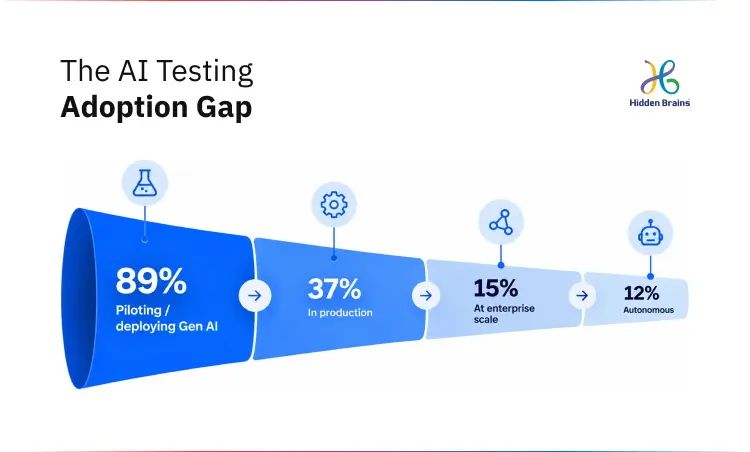
AI is changing software testing services faster than most teams can absorb, but far more slowly than the headlines claim. Nearly 90% of organisations are now using generative AI somewhere in quality engineering, yet only about 15% have scaled it across the enterprise, and just over one in ten call their testing genuinely autonomous (Source: World Quality Report 2025-26).
That gap- enormous interest, narrow real-world deployment- is the story of AI in testing heading into 2027. It is also reshaping QA as a Service, as businesses look for faster testing, broader coverage, and specialist quality engineering without adding more internal complexity. This guide walks through the 10 shifts reshaping the discipline and, for each, whether it’s production-ready today or still an experiment you should treat with caution. We write this from the perspective of a team that runs these decisions on live client projects, not a vendor selling a single tool.
| Element | Details |
|---|---|
| Business Challenge | Growing software complexity, faster release cycles, AI-generated code, emerging AI features, and limited QA capacity are making traditional testing approaches harder to scale. |
| Target Audience | CIOs, CTOs, QA leaders, engineering leaders, DevOps teams, product leaders, enterprise architects, and technology decision-makers evaluating AI-driven testing. |
| TL;DR | AI is transforming software testing through automated test generation, self-healing scripts, risk-based prioritisation, synthetic test data, and continuous quality. Enterprises should adopt proven use cases while carefully evaluating emerging autonomous testing capabilities. |
| Key Evaluation Criteria | AI testing maturity, automation coverage, application complexity, release frequency, risk-based testing, CI/CD integration, AI validation capabilities, security, governance, compliance, scalability, and ROI. |
| 2027 Focus Areas | AI-generated test cases, autonomous and agentic testing, self-healing automation, AI-feature testing, synthetic test data, predictive test prioritisation, continuous testing, and evolving tester roles. |
From QA to Quality Engineering: What Actually Changed?
Quality Engineering (QE) moves quality out of a final pre-release gate and into every stage of development. Traditional Quality Assurance (QA) checked whether finished software worked before shipping. QE asks a harder question continuously: Is this change safe to release right now? It uses automation, monitoring, and data from design through live production.
The shift matters because release cadence broke the old model. Teams deploying multiple times a day cannot pause for a separate testing phase. AI is the accelerant here: it makes continuous, always-on validation feasible at a scale humans alone can’t sustain. Every shift below is really a facet of this one change: QA becoming QE.
1. AI-generated Test Cases From Requirements
Production-ready, with review.
AI can now read a requirement, user story, or design doc and draft test cases and scripts from it, one of the fastest-maturing use cases in QE. In the World Quality Report 2025-26, test case design and requirements refinement have become leading GenAI use cases, shifting AI from analysing outputs to shaping inputs.
The practical value is coverage speed: a first draft of a regression suite in minutes rather than days. GenAI increasingly drafts not just the test steps but the input variations and expected-output “oracles” for complex scenarios, so testers spend more time curating and reviewing than typing. The catch is that AI drafts miss edge cases and misread ambiguous requirements, so a tester still reviews, prunes, and hardens the output. Treat it as a fast junior pair, not a replacement.
Good Read – The Importance of QA in Software Development Life Cycle Models
2. Autonomous and Agentic Testing — Hype Vs. Reality.
Emerging, not mainstream.
“Autonomous testing” systems that decide what to test, generate and run the tests, then maintain them, are the most over-claimed term in the field. The reality check: only 15% of organisations have scaled Gen AI in QE to enterprise level at all, and genuinely autonomous testing is rarer still; by one 2026 industry analysis, around 12%, even as agentic testing dominates conference agendas.
What is real in 2027 is semi-autonomous workflows: AI agents that generate test cases from requirements, analyse code changes, and prioritise what to run, with humans approving the high-risk calls. Fully self-directed testing across a complex enterprise system is still the exception, not the standard. Buy the capability for the routine regression layer; keep humans on anything that can break the business.
Get QA that’s Both Intelligent and Governable
Get Free Consultation
3. Self-healing Test Scripts
Production-ready for UI automation.
Self-healing scripts automatically update locators and selectors when the application’s UI changes, instead of failing the whole test run. This directly attacks the single biggest cost in test automation: maintenance.
For any team running large UI or web application test suites, this is one of the highest-ROI AI features available today, because brittle locators are what quietly kill automation programmes. It doesn’t eliminate maintenance; it moves the effort from “fix hundreds of broken scripts” to “review what the AI changed.”
4. Testing AI Itself: Generated Code and AI-powered Features
The new risk surface — necessary and under-served.
AI creates two new things testing now has to validate: the code AI writes, and the AI-powered features products ship. Both behave differently from traditional software, and most testing programmes haven’t fully closed either gap.
On AI-generated code, as teams ship more machine-written code, testing has to validate not just whether it runs, but whether it behaves consistently and safely. Generated code can pass unit tests and still carry subtle logic, security or licensing issues, so Quality Engineering in 2027 adds behavioural, security and consistency checks specifically for it.
On AI-powered features, this is the faster-growing discipline. QA teams now validate LLM-based features, retrieval-augmented generation (RAG) pipelines and autonomous agents for hallucination, bias, prompt injection and model drift, failure modes that don’t exist in conventional apps.
New testing artefacts come with it: evaluation harnesses, “golden” reference datasets, and continuous monitoring of agent behaviour in production. In an AI-native product, “quality” increasingly means does the AI behave safely and reliably in the wild?, not just does the function return the right value? Teams building this often pair it with broader AI integration services rather than treating it as a bolt-on.
Also Read – How Agile and DevOps Transform QA Testing for Mobile and Web Apps
5. Shift-left Meets Shift-right: Testing in Production
Mainstream direction.
Testing now runs both earlier (shift-left, at code commit) and later (shift-right, in live production via observability). Production behaviour has become one of the strongest quality signals available, because real users exercise paths no test suite fully anticipates.
The 2027 model is a loop, not a line: quality signals from design, build, deploy and live systems all feed back into what gets tested next. For web and mobile products with real traffic, web application testing increasingly pulls from production monitoring, not just pre-release scripts.
6. Synthetic and AI-generated test data
Rising fast.
Synthetic test data, realistic but artificial datasets generated by AI,lets teams test thoroughly without exposing real customer data. Its use in testing rose from 14% in 2024 to an average of 25% in 2025, and it now ranks as a top Gen AI use case in QE.
The driver is privacy and scale at once: you get representative data for edge cases and load testing while sidestepping regulatory exposure from using production data in test environments. The limit is fidelity, synthetic data must genuinely reflect production patterns, or your tests pass against a world that doesn’t exist.
7. Predictive, Risk-based Test Prioritisation
Production-ready.
Instead of running everything, AI predicts where defects are most likely and ranks what to test by risk. Models analyse code churn, defect history and architectural complexity to forecast which changes are most likely to break something that matters, so testing effort follows predicted risk, not what happens to be easiest to automate. Risk-based assurance is replacing coverage-driven testing, where enterprises prioritise what can damage the business over inflating test counts.
This is where AI earns its keep on large systems: it compresses long regression cycles by focusing effort on the highest-risk changes, which is especially valuable in regulated or high-stakes domains. It shifts the KPI from “how many tests did we run” to “did we catch the failures that would have hurt.”
8. Continuous Quality Inside CI/CD Pipelines
Standard practice.
Continuous testing embeds automated quality gates directly into CI/CD pipelines, so every build is validated automatically before it advances. This is now table stakes: the large majority of DevOps teams already run automated testing inside their pipelines.
AI raises the ceiling by making these gates smarter, selecting relevant tests per change and flagging anomalies rather than running fixed suites blindly. If a testing partner in 2027 isn’t operating inside your pipeline, they’re operating in the past. This capability sits naturally alongside DevOps and CI/CD practices.
9. The Tester’s Role Shifts — It Doesn’t Disappear
Reframe, not replacement.
AI is not eliminating software testers; it’s changing what they do. Industry commentary through 2026 is consistent: AI augments experienced engineers rather than replacing them, and using AI tooling has become a core skill for both manual and automated QA roles.
The testers who thrive in 2027 move up the value chain, designing test strategy, validating AI output, managing risk and owning quality outcomes, while AI handles repetitive generation and maintenance. The skills gap is real: half of organisations report missing the Gen AI skills to use these tools well, which is exactly why many buy the expertise rather than build it.

Move From Script Maintenance to Quality Intent and Risk Modeling.
Hire QA Testers10. Governance, Compliance and Reliability Guardrails
The real ceiling on adoption.
The barrier to scaling AI in testing isn’t capability, it’s trust. The top obstacles reported in 2025 are data-privacy risk (67%), integration complexity (64%) and hallucination/reliability concerns (60%).
Read together, three of those four are verifiability problems: can I trust and prove what this AI did? That’s why governance, documented validation strategies, human oversight of AI decisions, and clear ownership, is becoming a defining feature of mature testing services, not an afterthought.
Regulation has turned that governance question into a compliance requirement, and it now reaches well beyond the EU. Under the EU AI Act, the bulk of high-risk obligations take effect from August 2026, extending to high-risk AI embedded in regulated products from August 2027, with explicit demands for logging, data governance and audit trails that let a regulator independently verify how a system behaved (Source: EU AI Act guidance).
In financial services, DORA applies to EU entities and their ICT providers, including non-EU software and cloud vendors serving EU clients, demanding real-time evidence and defensible data lineage rather than after-the-fact paperwork. Standards such as ISO/IEC 42001 (AI management systems) and the NIST AI Risk Management Framework are becoming the practical scaffolding teams use to satisfy these overlapping rules.
For testing, the consequence is concrete: your QE process has to produce an audit trail, what was tested, by which AI, against which requirement, with what result, that survives external scrutiny. Any organisation building or operating high-risk or financial software for these markets, wherever it is headquartered, is in scope.
Teams treating this as an engineering-security concern rather than a paperwork exercise increasingly fold it into their enterprise IT security posture. In 2027, the question enterprise leaders ask isn’t “can AI test this?” but “can we adopt it, and prove it, with confidence?”
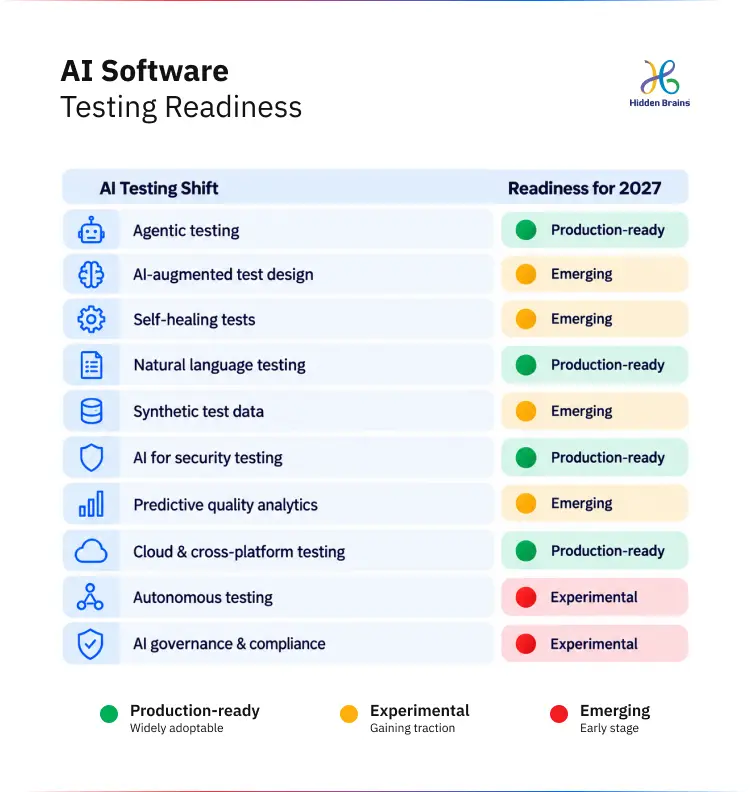
Which AI Testing Shifts are Actually Ready in 2027?
Here’s the honest scorecard, the differentiation this guide is built on. Not every trend deserves equal weight in your roadmap.
| AI testing shift | 2027 readiness | Best first use |
|---|---|---|
| AI-generated test cases | Production-ready (with review) | Regression suite drafting |
| Autonomous/agentic testing | Emerging | Routine regression only |
| Self-healing scripts | Production-ready | Large UI / web test suites |
| Testing AI code & AI features | Emerging / necessary | Behaviour, security & LLM eval |
| Shift-left + production testing | Production-ready | Live web & mobile products |
| Synthetic test data | Rising | Privacy-sensitive datasets |
| Predictive, risk-based prioritisation | Production-ready | Large regression cycles |
| Continuous quality in CI/CD | Standard | Every pipeline |
| Evolving tester role | Now | Upskilling / strategy |
| Governance & compliance guardrails | Now (mandatory) | Before scaling AI in regulated software |
What This Means When Choosing a Software Testing Service
The right question in 2027 isn’t “do you use AI?”; almost everyone will say yes. It’s “where is your AI actually in production, and how do you govern it?” Given that only 15% of organisations have scaled Gen AI in QE, a partner who can show real deployment, not pilots, is a genuine differentiator.
Look for a provider that ties AI to risk-based decisions, runs inside your CI/CD pipeline, validates AI-generated code, and can prove its governance and regulatory compliance with a real audit trail. Hidden Brains’ quality assurance and software testing services are built around that model: CMMI Level 3 process discipline applied to AI-assisted testing, so speed doesn’t come at the cost of verifiability.
Frequently Asked Questions
Is it worth investing in AI-driven testing in 2027, or should we wait?
Invest now, selectively. Waiting has a real cost as competitors compress release cycles, but a blanket “adopt everything” approach wastes money on immature capabilities. The pragmatic move is to fund the production-ready shifts (self-healing, risk-based prioritisation, AI-drafted tests) where returns are measurable, and pilot the emerging ones (autonomous testing, AI-feature validation) on low-risk workloads first.
What’s the realistic ROI of AI in testing?
Meaningful but uneven. Organisations adopting Gen AI in quality engineering report an average 19% productivity improvement, but roughly one third see minimal gains — the difference comes down to integration and skills, not the tool. Expect returns in reduced test-maintenance effort, faster feedback and fewer escaped defects rather than an immediate headcount cut. Set a baseline (regression cycle time, escaped-defect rate, automation maintenance hours) before you start so the gain is provable.
Should we build an AI testing capability in-house or outsource it?
It depends on scale and how fast you need results. Building in-house makes sense if testing is core to your product and you can hire and retain scarce QE and AI-evaluation skills. For most mid-market and growing enterprises, the skills gap makes an experienced partner the faster route — half of organisations cite missing Gen AI skills as their main blocker, and buying that expertise avoids a long, expensive ramp. A common hybrid: partner to stand up the capability and governance, then transfer ownership to your team.
What’s the risk of not adopting AI in testing?
Falling behind on release speed and cost per release while competitors don’t. As AI-generated code and AI-powered features become normal, teams still testing them with traditional methods also carry a growing quality and compliance risk they can’t see. The bigger near-term danger, though, is over-adopting without governance, deploying AI you can’t verify, which becomes a reliability and audit liability, especially in regulated sectors.
How do we measure whether AI testing is actually working?
Track outcome metrics, not activity. The ones that matter: escaped-defect rate (bugs reaching production), regression cycle time, test-maintenance effort, and mean time to detect and resolve. Rising test counts or “AI usage” are vanity metrics. Tie the programme to business signals, release frequency, downtime, and defect-related incidents, so quality reads as a competitive capability, not a cost centre.
Will AI testing reduce our QA team or costs?
Usually it reshapes cost rather than simply cutting it. AI absorbs repetitive test generation and maintenance, so budget shifts from manual execution toward higher-value roles (test strategy, risk modelling, AI-output validation) and toward tooling. Teams that treat it purely as a headcount-reduction play tend to see the disappointing end of that 19% average; teams that redeploy people to higher-value work see the better end.

Conclusion
Treat AI in testing as a capability to adopt deliberately, not a switch to flip. The technology is real and several shifts are production-ready today, self-healing scripts, predictive risk-based prioritisation, AI-drafted test cases and continuous quality in CI/CD, while fully autonomous testing and end-to-end AI-feature validation are still maturing. The teams that win won’t be the ones running the most AI; they’ll be the ones who match the right shift to the right problem and can prove what their AI actually did.
The practical path is to start where the ROI is provable and the risk is contained: self-healing and risk-based prioritisation on your largest, most brittle suites. Build in governance and compliance from day one, especially for regulated software. And to be honest about the skills gap, with half of organisations citing missing Gen AI skills as the blocker, the fastest route to results is often an experienced testing partner rather than a from-scratch internal build.