










































































































Summary
- AI is moving from a tool to an operating layer across software development.
- Architecture and platforms need to scale without adding unnecessary complexity.
- Security, compliance, and sovereignty are becoming core architecture decisions.
- Cloud and AI costs need active management as infrastructure spending grows.
- Engineering teams and delivery models are evolving with changing skill and capacity needs.
- Some trends are worth piloting, not blindly adopting, especially agentic AI and low-code.
- The goal isn’t to follow all 12 trends; it’s to identify the 2–3 that solve your biggest business bottlenecks.
The hardest part of reading the software development trends for 2027 isn’t spotting them; it’s deciding which ones deserve your budget and which will quietly add technical debt while promising the opposite. Every list looks similar. What’s missing is a way to tell a genuine shift from a well-marketed one.
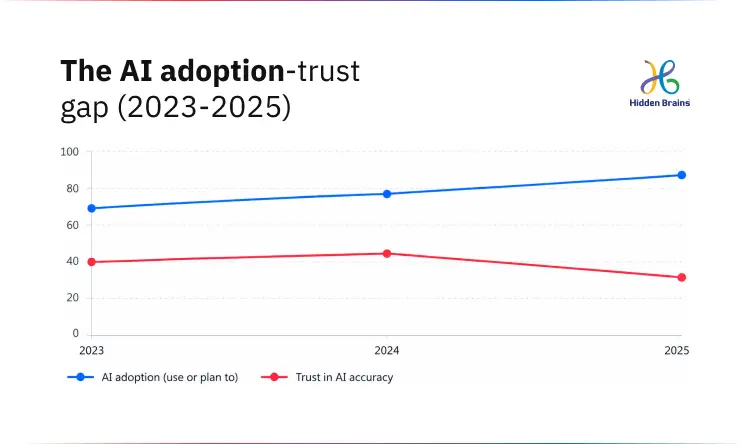
Here’s the uncomfortable backdrop. AI has become near-universal in engineering: Google’s 2025 DORA research put adoption among software professionals at around 90%, and Stack Overflow’s 2025 survey found 84% of developers using or planning to use AI tools. Yet in that same Stack Overflow survey, trust in the accuracy of AI output fell to roughly 33%, its lowest reading yet, with “almost right, but not quite” code named the single biggest frustration. Adoption is not the open question anymore. Judgment is.
This isn’t another “12 exciting trends” list. Alongside each trend, we’ve decoded whether it’s worth adopting, piloting, watching, or genuinely skipping.
Some will be a strong fit for your business. Others will depend entirely on your use case, readiness, and priorities. Use these insights to cut through the hype, understand what deserves your attention, and decide what makes sense for you next.
| Details | Information |
|---|---|
| Guide Focus | The 12 software development trends CTOs should evaluate in 2027, with practical guidance on what to adopt, pilot, watch, or skip. |
| Business Challenge | Rapid AI adoption, growing technical complexity, security requirements, rising infrastructure costs, and evolving engineering needs are making technology decisions harder. |
| Target Audience | CTOs, CIOs, engineering leaders, technology decision-makers, enterprise architects, and product leaders planning their 2027 technology roadmap. |
| TL;DR | Not every trend deserves investment. CTOs should focus on the 2–3 trends that solve real business bottlenecks while considering scale, risk, governance, and readiness. |
| Key Evaluation Criteria | Business impact, technical readiness, scalability, security, governance, cost, technical debt, regulatory requirements, and alignment with business priorities. |
How to Read This List: A CTO’s Four-Question Filter
Before a trend earns a line on your roadmap, run it through four questions:
- Which business bottleneck does it actually remove?
If you can’t name the process, cost, or delay it fixes, it’s a technology looking for a problem.
- Is this trend really worth it for us — or are we just following the industry?
A trend can be real and still be wrong for your scale, sector, or stage. Ask what actually breaks if you skip it this year. This is where most hype-driven adoption fails.
- Does it create more value than hidden risk or technical debt?
Look at the honest net impact. Not just what looks exciting. Not just what the vendor pitch says. What are you actually gaining, and what are you quietly adding in risk, complexity, cost, or technical debt?
That trade-off is worth looking at closely before you move ahead. And if you are still not sure where it lands for your business, a free consultation with experts can give you a clearer direction.
- Is your data and governance ready for it?
Most trends assume a foundation- connected data, oversight, security- that many organizations don’t yet have.
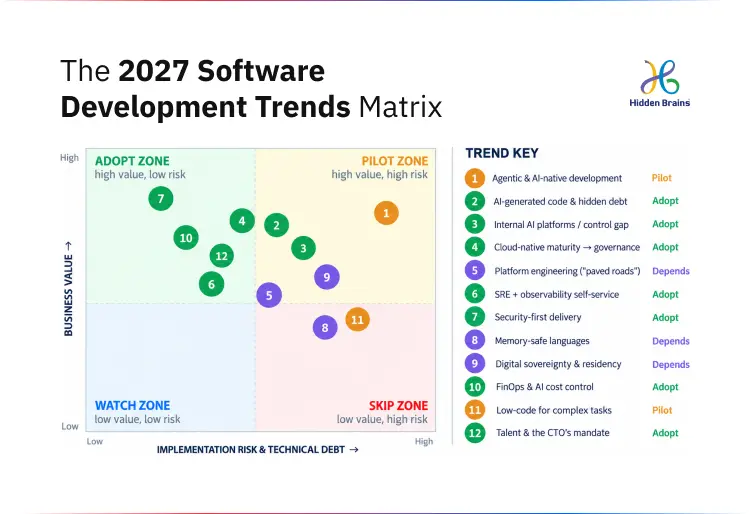
The table below is the short version. The sections after it explain the reasoning.
| Trend | Bottleneck it solves | Watch out for | Verdict |
|---|---|---|---|
| Agentic & AI-native development | Fragmented multi-step processes | ~40% of agentic projects scrapped by 2027 (Gartner) | Pilot |
| AI-generated code & hidden technical debt | Slow delivery pressure | Shipping “almost right” code as-is | Adopt (with guardrails) |
| Internal AI platforms & the AI control gap | Ungoverned shadow AI | Platforms before data + oversight are ready | Adopt governance now / Pilot platform |
| Cloud-native maturity, governance | Brittle monoliths, cloud sprawl, legacy debt | Big-bang rewrites; composing for its own sake | Adopt (incremental) |
| Platform engineering & “paved roads” | Developer cognitive load | Overhead below a team-size threshold | Adopt at scale / Skip if small |
| SRE + observability as self-service | Can’t debug what you can’t see | Old tools reused for AI unadapted | Adopt as you scale |
| Security-first delivery (shift-left, supply chain, zero trust) | Compliance + threat load | “Zero trust” as a slogan | Adopt (non-negotiable) |
| Memory-safe languages as a compliance requirement | Memory-safety CVEs; CRA liability | Blanket rewrites where risk is low | Adopt in regulated paths / Watch elsewhere |
| Digital sovereignty & data residency | Cross-border legal exposure | Confusing residency with sovereignty | Adopt if cross-border / Watch if single-region |
| FinOps & AI infrastructure cost control | Runaway cloud + inference spend | Optimizing tooling before fixing architecture | Adopt |
| Low-code / no-code for complex tasks | Delivery outside the core backlog | Complex core logic on platforms that can’t sustain it | Pilot (hype-check) |
| Talent, operating model & the CTO’s mandate | Slow hiring, niche-skill gaps | Treating flexible delivery as “extra headcount” | Adopt (ongoing) |
Shift 1 — AI Stops Being a Fancy Feature and Becomes The Operating Layer
Agentic and AI-native development
Agentic AI is software that plans and executes multi-step tasks with limited human prompting, rather than answering one question at a time, and it’s the fastest-rising trend on this list. Enterprises are moving quickly to adopt Agentic AI development to remove repetitive human effort from the loop and let agents run whole workflows the way a team would.
The bottleneck it targets is real: Processes that span several systems and still need a person to move work between them. The risk is just as real. Gartner has predicted that more than 40% of agentic AI projects will be scrapped by the end of 2027, not because the technology fails, but because organizations point it at broken processes instead of redesigning them first. The rule worth keeping: automating a poor process just makes poor outcomes arrive faster.
Verdict: Pilot. Start with one bounded AI pilot program. Once the workflow is well understood and the process is proven, you can hand it off to an agent for production.
2. AI-generated Code and Hidden Technical Debt
AI-assisted coding is now standard, but treating its output as finished is where teams lose the time they thought they saved.
The evidence is direct: developers report that “almost right, but not quite” code is their top frustration, and a majority say they spend more time fixing near-correct AI output than they would have writing it themselves. The productivity gain is genuine, but it moves the work from writing to reviewing, not away entirely. The bottleneck it addresses is delivery speed; the hidden cost is a slow accumulation of code no one fully understands.
Verdict: Adopt, with guardrails. Mandatory human review, test coverage requirements, and clear ownership of AI-generated modules. This is exactly the discipline custom software development services should build in from the start, not retrofit later.
3. Internal AI Platforms and the AI Control Gap
In most enterprises, AI use spreads faster than the governance around it. Teams adopt tools independently; no one has a clear view of what data those tools touch or what they’re allowed to do. An internal AI platform, a controlled, shared environment with logging, access control, and approved models, closes that gap. But the platform is the second step, not the first. It assumes your data is connected and your policies are in place. Building the platform before the foundation is ready produces expensive infrastructure that governs nothing.
Verdict: Adopt the governance now.
AI Guardrails protect your data and avoid giving AI extra ownership.
Make Your Software Ready for What’s Next—Assess Your Architecture for Free.
Talk to Us.
Shift 2 — Architecture and platforms built for scale, not just launch
4. Cloud-native maturity moves from adoption to governance
The question in 2027 is no longer whether to be cloud-native; it’s whether your cloud estate is governed, cost-aware, and modernized where it needs to be. Most organizations now carry a mix: some cloud-native services, some hybrid workloads, and a core of aging systems that were never touched during earlier budget freezes and are now more brittle for it.
The trend is a shift toward composable, API-first architecture and deliberate legacy modernization, done incrementally, not as a single high-risk rewrite. The failure mode is the big-bang replacement that overruns, and its opposite, decomposing systems into microservices no one needed.
Verdict: Adopt, incrementally. For teams weighing where to start, a staged approach to legacy modernization almost always beats a full rewrite on both risk and cost. When we modernized the platform for Scosche, a US consumer-technology accessories brand selling in more than 50 countries, the work was a phased migration off an end-of-life Magento 1 Enterprise stack to Magento 2 (Adobe Commerce), paired with a move from self-managed AWS to managed cloud infrastructure.
5. Platform Engineering and “Paved Roads”
Platform engineering gives developers a set of supported, self-service defaults, “paved roads”, so they ship without reinventing infrastructure each time. This bottleneck removes cognitive load and inconsistency across teams.
The honest catch: It becomes useful when the company gets bigger. For a small team, building and maintaining an internal platform can take time away from building the actual product.
Verdict: Adopt at scale; skip if you’re small. If your engineers aren’t yet losing meaningful time to environment setup and inconsistent tooling, this is a “watch,” not a “now.”
6. SRE and Observability as a Self-service Capability
Site reliability engineering and observability are shifting from a specialist function to a self-service capability every team taps into.
The bottleneck is simple: you cannot trust, debug, or improve what you cannot see, and that is doubly true once AI components enter production. The common mistake is extending yesterday’s monitoring tools onto AI systems and agents without adapting them, which leaves blind spots exactly where behaviour is least predictable.
Verdict: Adopt as you scale, and treat AI observability as a first-class requirement rather than an afterthought.
Shift 3 — Security, Compliance, and Sovereignty Move to the Front of the Pipeline
7. Security-first Delivery: Shift-left, Supply chain, and Zero Trust That’s Actually Implemented
Security is moving to the start of the pipeline, not the end of it. Three things converge here: shifting testing and threat modelling left into development, taking the software supply chain seriously (dependencies, SBOMs, provenance), and implementing zero-trust architecture rather than citing it in a slide. The bottleneck is the widening gap between rising regulatory and threat pressure and the speed at which teams can respond.
The trap is treating “zero trust” as a marketing phrase while access still defaults to trust.
Verdict: Adopt — non-negotiable. Security-first delivery is now table stakes for enterprise software development, not a premium tier. This is also where a partner’s cloud and DevOps maturity shows up in practice.

Turn the Trends That Matter Into Clear Priorities for Your 2027 Roadmap.
Talk to Us.8. Memory-safe Languages as a Security and Compliance Requirement
This is the trend most CTOs underestimate. Roughly two-thirds to three-quarters of serious software vulnerabilities trace back to memory-safety errors in languages like C and C++.
Regulators have noticed: US authorities now classify the use of memory-unsafe languages for new critical-infrastructure software as a bad practice and have urged published “memory-safety roadmaps,” and the EU Cyber Resilience Act attaches manufacturer liability for exploitable vulnerabilities, with its main obligations landing in December 2027. That makes memory safety a procurement and compliance issue, not just an engineering preference. The caveat: this is targeted, not a mandate to rewrite everything.
Blanket migrations where the risk doesn’t justify them waste effort.
Verdict: Adopt
Prioritize it for regulated, business-critical, or EU-market-facing code paths where security, compliance, and software assurance requirements are higher.
9. Digital Sovereignty and Data Residency Constraints
For any company operating across borders, where your data lives and whose laws govern it has become an architecture decision.
The market signal is loud: sovereign cloud spending reached roughly $80 billion in 2026 on the back of about 36% year-on-year growth, as enterprises moved regulated workloads off general-purpose hyperscaler regions.
The reality check most teams miss: Data residency (the physical location of your data) and data sovereignty (which country’s laws can compel access to it) are not the same thing. Storing data “in Europe” on a provider subject to foreign law satisfies the first and not the second. With EU AI Act data-governance obligations enforceable from August 2026, this is now a live constraint.
Verdict: Adopt
If you operate across borders or handle regulated data, treat data residency and data sovereignty as separate architecture and compliance requirements. Storing data in a specific region may satisfy residency rules, but it does not necessarily determine which jurisdiction can legally compel access to that data.
Shift 4 — Cost, Code, and the Shape of the Engineering Organization
10. FinOps and AI infrastructure cost control
Cloud maturity in 2027 is measured less by how much you’ve migrated and more by how well you control what it costs, and AI has made that harder. Model inference, GPU capacity, and data movement create spend that grows quietly and is rarely owned by anyone in particular.
FinOps brings that spend into daily engineering decisions rather than a quarterly surprise. The mistake is optimizing tooling and dashboards while leaving a wasteful architecture in place underneath.
Verdict: Adopt.
Cost visibility is now part of good engineering, not a finance afterthought.
11. Low-code / No-code Taking on More Complex Tasks
Low-code and no-code platforms are handling more than simple forms and workflows now, which genuinely helps deliver software outside the core engineering backlog. The bottleneck is delivery pressure: more requests than the backlog can absorb. But this is a hype-check trend. Pushing complex, business-critical core logic onto a platform that can’t sustain it creates a different kind of debt: systems you can’t extend, audit, or migrate off.
Verdict: Pilot, selectively.
Excellent for edge workflows and internal tools; treat core systems as a place for bespoke software development where control and longevity matter. The build-versus-configure question deserves a real answer, not a default.
12. Talent, Operating Models, and the CTO’s Changing Mandate
The final shift is organizational. The CTO role is moving from keeping systems up to orchestrating business value, which changes how engineering capacity is sourced. Slow hiring and niche-skill gaps remain the bottleneck that delays roadmaps, and flexible hiring models (dedicated teams, staff augmentation, offshore development centers) address it. The failure mode is treating these as “extra bodies” rather than accountable capability with clear ownership and continuity. Done well, dedicated development teams and structured application development outsourcing extend a roadmap without diluting it.
Verdict: Adopt as needed
Hire resources that do more than just fill a capability gap. They should also fit your budget, your business goals, and the level of expertise the work actually demands.
What These 12 Trends Mean for Your 2027 Roadmap
There’s a sequence hidden in this list. Fix the foundation first: connected data, governance, and security-first delivery, because agentic AI, internal AI platforms, and observability all assume it. Then adopt AI where you can govern it, with review and cost controls in place. Then invest in platform engineering and optimization once your scale justifies them.
Everything else is situational: memory safety and sovereignty depend on your markets and regulatory exposure; flexible delivery depends on your specific skill gaps. The goal isn’t to adopt all twelve. It’s to adopt the two or three that remove a bottleneck you can name, and to say no to the rest without apology.
How Hidden Brains Approaches This
At Hidden Brains, enterprise technology work usually starts before technology selection, with understanding where a client’s processes, data, systems, and decisions are actually breaking down. That’s why our view of these trends is deliberately practical: modernization staged around risk rather than rewritten wholesale, AI moved into governed workflows rather than bolted on, and engineering capacity structured as accountable capability. As a CMMI Level 3-appraised, ISO 27001- and ISO 9001-certified partner working across 107 countries, our bias is toward implementations that hold up under audit, scale, and real operational pressure, not demos.
Frequently Asked Questions
What are the biggest software development trends for 2027?
The biggest software engineering shifts are moving beyond faster development toward more secure, sovereign, governed, and cost-aware technology delivery.
Agentic & AI-native development
Security-first delivery
Software supply chain security
Zero trust architecture
Digital sovereignty & data residency
Memory-safe languages
Platform engineering
FinOps for AI cost control
AI governance
Which trends should a CTO prioritise in 2027?
Prioritise the foundation first: connected data, AI governance, and security-first delivery, because agentic AI and internal AI platforms depend on them. Then adopt AI with review and cost guardrails. Treat memory safety, sovereignty, and platform engineering as situational, driven by your markets and scale.
Why do so many agentic AI projects fail?
Because they automate processes that are broken or poorly understood. Gartner has predicted that more than 40% of agentic AI projects will be scrapped by the end of 2027. Redesigning the process first — then applying an agent to a sound, bounded workflow — is what separates the pilots that succeed.
Is offshore or outsourced software development still relevant in 2027?
Yes, but the framing has changed. The value is accountable engineering capability that closes a specific skill or capacity gap, not simply lower-cost headcount. Dedicated teams and structured application development outsourcing work best when matched to a defined gap with clear ownership and continuity.
What’s the difference between data residency and data sovereignty?
Data residency is where your data physically sits. Data sovereignty is which country’s laws govern who can compel access to it. Storing data in an EU region on a foreign-owned provider can satisfy residency while still leaving it exposed under foreign law — a distinction that matters for compliance in 2027.
Should we build custom software or use low-code in 2027?
Use low-code and no-code for peripheral workflows and internal tools where speed matters more than long-term control. Choose custom software for complex, business-critical core systems you’ll need to own, audit, and extend for years. The decision should follow the system’s longevity and risk, not the trend cycle.


Conclusion
The teams that come out ahead in 2027 won’t be the ones that adopt the most from this list—they’ll be the ones that adopt with judgment. Every trend here is real, but “real” and “right for us” are two different tests, and the gap between them is where budgets quietly disappear.
Treat the four-question filter as the real takeaway: identify the bottleneck, weigh value against hidden debt, confirm your data and governance can support it, and ask honestly whether it deserves investment this year. Foundation before features. Governance before autonomy. Evidence before hype.
Do that, and twelve trends become a short, defensible roadmap instead of a wish list. To understand which trends fit your current technology landscape and where to move next, get a free, insightful consultation with our experts.
