

























































































































































Summary
- Learn what digital transformation in fintech actually means for a scaling finance SME, and who it’s for.
- See the growth barriers capping SMEs and how cloud transformation removes each one.
- Understand why secure cloud architecture, built on zero trust, is the foundation for scaling safely.
- Know the components and compliance frameworks every fintech platform needs.
- Apply one rule to spend wisely: buy the commodity, build the differentiator.
- Get a phased, fundable roadmap to transform without disrupting the business you already run.
Digital transformation in fintech is the shift from disconnected, manual financial operations to connected, cloud-based systems that scale without adding headcount. For a growing finance SME, the practical question is rarely “should we transform” it’s “what do we build, what do we buy, and how do we do it securely without a bank’s budget?” This guide answers that. It is written for finance SME leaders evaluating a fintech software development partner, not for a large bank with an in-house engineering division.
What Does Digital Transformation in FinTech Mean, and Why is it the Need of the Hour?
Digital transformation in fintech means re-architecting how a financial business runs- data, payments, onboarding, compliance, and reporting- so those functions operate in real time on scalable infrastructure instead of on spreadsheets, siloed tools, and manual reconciliation.
It is urgent now for three reasons.
- First, customer expectations have moved: instant onboarding, real-time payments, and mobile-first access are baseline, not differentiators.
- Second, the market is expanding fast; estimates vary by research firm, but Fortune Business Insights values the global fintech market at roughly $395 billion in 2025, projecting it toward $1.76 trillion by 2034 at about 16.2% CAGR.
- Third, the cost of standing still is measurable: manual processes cap how many customers a small team can serve, and every disconnected system adds reconciliation time and error risk.
Who this matters for: Growing finance SMEs, digital lenders, payment providers, neobanks and neo-brokerages, wealth and insurance mid-market firms, and finance teams inside non-financial SMEs.
Who it does not target: Tier-one banks, whose scale, legacy estate, and regulatory obligations demand a different playbook.
If you are a 20–500 person finance business trying to scale a product without your operations breaking, this is the guide you have been looking for.
What Does Digital Transformation Actually Look Like?
The clearest way to understand fintech transformation is through the specific operational shifts it produces, not abstract “innovation.”
Common examples for finance SMEs:
- Manual reconciliation → real-time ledger. Nightly spreadsheet reconciliation between a payment processor and an accounting tool becomes an automated, continuously reconciled ledger.
- Branch or email-based KYC → digital onboarding. Document collection and identity checks that took days move to an automated KYC/AML flow that verifies in minutes.
- Static reporting → live dashboards. Month-end reports assembled by hand become real-time views of exposure, cash position, and portfolio health.
- Monolithic core → API-first services. A single rigid application is decomposed so new products (a lending line, a card program) can be launched without rebuilding everything — the same shift driving how APIs are reshaping the banking and payments sector.
Let’s look at a real-world example of how an Atlanta, USA-based insurtech, Layr, partnered with Hidden Brains to transform its operations through technology, achieving a 47% reduction in manual work and a 300% improvement in system performance.
Get a Clear Development Roadmap and Transparent Pricing Estimate
Book Free Consultation
Key Growth Barriers, and How Transformation Removes Them
The barriers that cap a finance SME’s growth are usually operational, not strategic, and each has a direct technology fix. The table below maps the most common ones.
| Growth barrier | What it actually costs you | How transformation addresses it |
|---|---|---|
| Disconnected systems (payments, CRM, accounting don’t talk) | Staff hours lost to reconciliation; delayed decisions | API-led integration into a single connected data flow |
| Manual, people-dependent processes | Growth requires linear headcount; knowledge lives in a few people | Workflow automation so volume scales without proportional hiring |
| Slow, manual compliance (KYC/AML) | Onboarding drop-off; regulatory exposure | Automated, auditable compliance built into the onboarding flow |
| Legacy or rigid core platform | New products take months; every change is risky | Modular, API-first architecture that supports faster product launches |
| On-premise or fragile hosting | Downtime, hard scaling, unpredictable capacity cost | Elastic cloud infrastructure that sc |
The common thread: Transformation converts fixed operational drag into scalable capability. That is why it earns budget, not because it is modern, but because it removes a specific bottleneck.
How Does Secure Cloud Architecture Help Finance SMEs Scale?
Secure cloud architecture is the foundation that makes every other fix affordable and safe for an SME, because it delivers enterprise-grade scalability, resilience, and security without enterprise-scale capital spend. Instead of buying and securing your own servers, you provision infrastructure that scales up for demand spikes and down when they pass, and inherit hardened security controls from the platform.
Security is not a nice-to-have in finance; it is the business core element. According to IBM’s Cost of a Data Breach 2024 report, the global average breach cost reached $4.88 million, and for financial-industry organizations the average was $6.08 million, about 22% above the cross-industry average. For an SME, a single breach is often not a line item but an existential event. A well-designed cloud architecture reduces that risk structurally rather than relying on after-the-fact patching.
This is where delivery discipline matters: Hidden Brains builds financial platforms on secure cloud infrastructure services under an ISO/IEC 27001:2022-certified security process, so controls are designed in, not bolted on.
Key Components of a Secure Cloud Architecture
A secure fintech cloud architecture rests on a defined set of components; skipping any one of them is where most SME platforms become vulnerable. Each component below maps to a specific risk.
| Component | What it does | Why an SME can’t skip it |
|---|---|---|
| Identity & access management (IAM) | Controls who can access what, with least-privilege and MFA | Stolen credentials are among the most common and costly breach causes |
| Encryption (at rest and in transit) | Protects data in storage and as it moves | Baseline requirement for PCI DSS and most financial regulations |
| Network segmentation | Isolates workloads so one breach doesn’t reach everything | Contains blast radius; limits lateral movement by attackers |
| Observability & monitoring | Detects anomalies and threats early | Faster detection directly lowers breach cost and impact |
| Backup & disaster recovery | Restores service and data after failure or attack | Downtime and data loss erode customer trust immediately |
| Compliance controls | Enforces and evidences regulatory requirements | Turns audits from fire drills into routine checks |
Build From Scratch, Buy, or Combine?
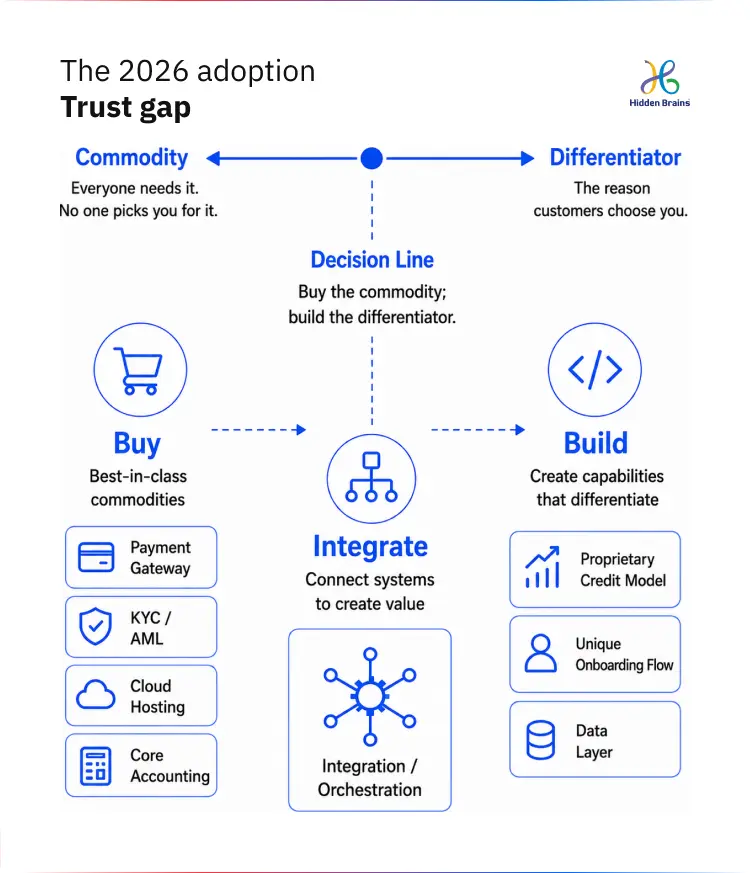
The right approach for a finance SME is rarely pure build or pure buy; it is a deliberate hybrid governed by one rule: buy the commodity; build the differentiator. Commodity capabilities are the things every fintech needs, and no customer chooses you for. Differentiators are the things that make your product yours.
| Approach | Best for | Examples | Trade-off |
|---|---|---|---|
| Buy / off-the-shelf (commodity) | Standard, non-differentiating functions | Payment gateways, KYC/AML vendors, cloud hosting, core accounting | Fast and cheap, but limited control and customization |
| Build custom (differentiator) | Anything that is your competitive edge | Proprietary risk/credit models, unique customer workflows, your data layer | Higher cost and time, but full ownership and defensibility |
| Hybrid (recommended) | Almost every scaling SME | Buy compliance and payments infrastructure; build your product logic on top | Requires clear architecture and a partner who can integrate both |
Spending scarce engineering budget rebuilding a payment gateway that a vendor already provides, and diverting it away from the credit model that actually wins customers, is the most common mistake we see. The hybrid model exists to prevent exactly that. If you do outsource the build, it is worth knowing the common mistakes enterprises make while outsourcing before you sign.
What Actually Needs Custom Development?
Custom development should be reserved for what differentiates your business and cannot be bought off the shelf. For most finance SMEs, that list includes:
- Proprietary risk, credit, or pricing logic — The models that determine who you lend to, insure, or price, and how.
- Unique customer-facing workflows — Onboarding, application, or servicing journeys designed around your specific product.
- Integration and orchestration layers — The connective tissue that makes bought components (payments, KYC, banking APIs) work as one system.
- Your proprietary data model and analytics — How you capture, structure, and act on your own transaction and customer data.
This is where a specialist fintech software development company earns its place: not to rebuild commodities, but to engineer the differentiators securely and integrate them with everything you buy. For customer-facing delivery, that often includes mobile banking app development as the front end to the custom logic underneath.
What Does Custom Fintech Development Cost?
There is no single price for custom fintech development; cost is driven by scope, complexity, compliance burden, and engagement model, not by a fixed rate card. The main cost drivers to budget against:
- Scope and product complexity — A single-feature MVP versus a multi-product platform.
- Compliance and security requirements — PCI DSS, regulated data, and audit needs add engineering effort.
- Integrations — Each external system (payments, KYC, banking, accounting) adds connection and testing work.
- Engagement model — Fixed-scope (predictable, best for well-defined builds) versus a dedicated development team (flexible, best for evolving products).
Check our Pricing & Engagement Model to explore the options that best fit your project.
Must-have Factors in Your Fintech Platform
Regardless of what you build or buy, a fintech platform that can scale must demonstrably have all of the following; treat this as a pre-launch checklist:
- Security — Encryption, IAM, and monitoring designed in (see components above).
- Compliance — PCI DSS, GDPR, AML/KYC, and PSD2/Open Banking handled by design.
- Scalability — Elastic cloud infrastructure that absorbs demand spikes.
- Reliability & observability — High uptime with real-time monitoring and alerting.
- Integration-readiness — API-first, so new products and partners plug in without rebuilds.
- Usability — A customer experience simple enough to reduce onboarding drop-off.
If a platform is missing any one of these, it will eventually cap growth or create risk, usually at the worst possible time, during a demand spike.
Step-by-Step Transformation Roadmap
A finance SME should sequence transformation in phases, not attempt everything at once; the goal is compounding value with controlled risk. A practical roadmap:
- Assess. Map current systems, data flows, and bottlenecks. Identify where manual work and disconnection cost the most.
- Prioritize. Rank fixes by business impact versus effort. Start where the operational drag is heaviest, and the fix is well understood.
- Architect. Design the target secure cloud architecture and decide, component by component, what to buy and what to build.
- Build & integrate. Develop the differentiators; integrate bought commodities; embed compliance and security throughout.
- Migrate. Move data and workloads in controlled stages, with rollback plans, never a single high-risk cutover.
- Govern & scale. Monitor, harden, and iterate. Add products on the now-modular foundation as the business grows.
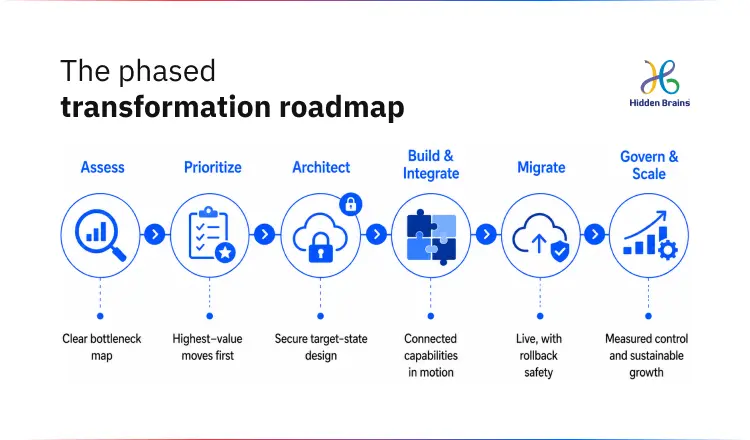
This phased approach is also how transformation stays fundable: each phase delivers a measurable improvement that justifies the next. It reflects Hidden Brains’ broader digital transformation approach: start with the business problem, not the technology. For a wider view beyond fintech, see our enterprise digital strategy roadmap.
Frequently Asked Questions
Is digital transformation actually worth the investment for a finance SME?
Yes, when it’s scoped to remove real bottlenecks rather than chase trends. The return shows up as capacity you don’t have to hire for: automated reconciliation and onboarding let a small team serve far more customers, and a modular platform lets you launch new products in weeks instead of months. Tie each phase to a measurable operational cost it removes, and the investment justifies itself phase by phase.
What’s the real risk of staying on manual, disconnected systems?
The risk is a growth ceiling and rising exposure. Manual processes force you to add headcount for every increase in volume, and disconnected systems multiply reconciliation time and error rates as you scale. On the security side, a single breach is disproportionately damaging for a smaller firm; IBM puts the average financial-industry breach at $6.08 million, a figure most SMEs cannot absorb. Standing still is a decision with its own cost.
How do we modernize without disrupting the business we’re already running?
Transform in controlled phases, never a single cutover. A phased roadmap, assess, prioritize, architect, build and integrate, migrate in stages with rollback plans, then govern and scale, keeps the current business running while you improve it underneath. This is also why the first step is prioritizing by business impact: you fix the most expensive bottleneck first and prove value before touching anything mission-critical.
Where does the money actually go in a fintech build, and how do we avoid overspending?
The highest avoidable cost is building commodities you could have bought. Payment gateways, KYC/AML, hosting, and core accounting are available off the shelf; spending engineering budget rebuilding them diverts money from the proprietary logic that actually wins customers. Control spend by drawing that line deliberately: buy the commodity, build the differentiator, and hold the rest to a defined scope. Cost is then driven by product complexity, compliance burden, integrations, and engagement model, not a fixed rate card.
Should we hire in-house or work with a fintech software development company?
For most scaling SMEs, a hybrid is the most cost-effective path: a specialist partner engineers your differentiators and integrates the commodity services you buy, without the fixed overhead of a full in-house engineering team. In-house makes sense once a capability is core, permanent, and large enough to keep a team fully utilized. The decision is about which capabilities are durable enough to own versus which you need built well, once, and integrated.
How do we choose the right fintech development partner?
Look for evidence, not adjectives: relevant financial-domain experience, a security and compliance track record you can verify (for example, ISO/IEC 27001 certification), a clear position on build-vs-buy rather than a push to custom-build everything, and a delivery model that fits how you want to engage. The right partner starts from your business problem and constraints, and is honest about trade-offs and limitations, not one that leads with a feature list.
How quickly will we see a return?
Faster than a single big-bang project, because a phased approach ships value in stages. Early phases typically target the heaviest operational drag- automating a manual process or connecting two systems- so the first measurable benefit arrives before the full transformation is complete. Each phase’s payoff funds and de-risks the next, which is what keeps time-to-first-value short.



Conclusion
Digital transformation in fintech is not a technology upgrade; it’s the difference between a finance business that scales and one that hits a ceiling its operations can’t push past. For a finance SME, the winning approach is disciplined, not maximal: fix the barriers that actually cost you (disconnected systems, manual compliance, fragile hosting), stand it all on secure cloud architecture built to a zero-trust, compliance-by-design standard, and follow one rule on what to build: buy the commodity, build the differentiator. Sequenced in phases, each step pays for the next, so transformation stays fundable instead of becoming a single high-risk bet.
The practical takeaway: don’t spend scarce budget rebuilding what you can safely buy, and don’t outsource the logic that makes your product yours. Get that split right, on secure infrastructure, and you scale customer volume without scaling headcount or risk. If you’re weighing the build-vs-buy line for your own platform, start with the business problem, not a feature list. In a 2-hour consultation, our specialists can help you assess what to build, what to buy, and where a hybrid approach makes more sense.
