


































































































































Summary
- Legacy .NET can quietly increase costs, risks, and technical constraints.
- Modernization helps improve performance, security, scalability, and release speed.
- The right approach depends on business priorities, system complexity, and downtime tolerance.
- A phased strategy enables continuous delivery with minimal operational disruption.
- Cloud-ready architecture creates room for new integrations, AI, and future growth.
- The right roadmap balances modernization investment with the cost of staying legacy.
A legacy .NET application rarely fails loudly. It keeps running, keeps taking orders, and keeps the business moving, while quietly consuming the budget, blocking new integrations, and making every release slower and riskier than the last. The real question for most leadership teams is not whether the platform needs to change, but how to change it without a single day of disruption to operations that customers depend on.
This is what we have covered for you. Why modernizing legacy .NET has moved from “someday” to “now,” what modernization actually delivers, how the three real migration approaches compare, and the phased path that lets you replace the engine while the business keeps driving. Where a decision needs deeper treatment- whether to modernize, replace, or keep a system at all- we point you to a dedicated framework rather than repeat it here.
Why Modernizing Legacy .NET Now is Business-critical
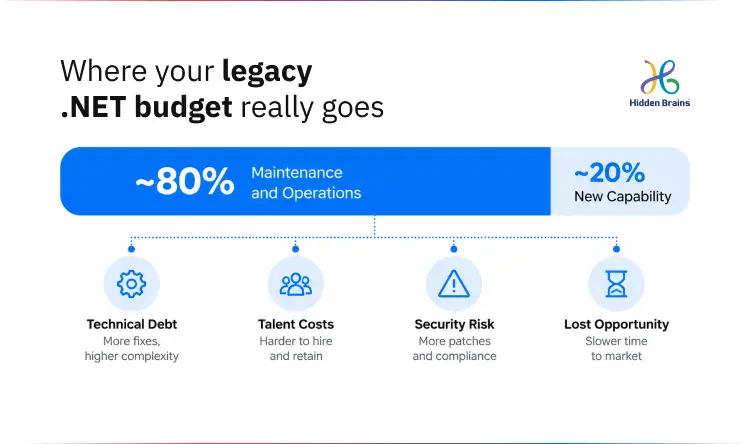
The cost of keeping a legacy .NET application “as is” is almost always higher than it looks, because most of that cost never appears as a single line item. It shows up as maintenance hours, security exposure, delayed releases, and revenue that never arrives because the platform could not support a new integration in time.
The scale of the drain is well documented. A 2025 U.S. Government Accountability Office review found federal agencies spend roughly 80% of a $105 billion-plus annual IT budget operating and maintaining existing systems rather than building new capability. Private-sector research points in the same direction: a Deloitte survey of CIOs found technology teams spend about 55% of their budget sustaining existing operations and only 19% on new technology. When four of every five dollars go to standing still, innovation is not underfunded by choice; it is underfunded by architecture.
Plan Your Legacy .NET Modernization With a Phased Approach
Talk to an Expert
Three Forces are Turning a Slow-burn Problem Into an Urgent One for .NET Specifically:
- Framework end-of-support. Applications still on .NET Framework or early .NET Core are increasingly cut off from performance improvements, modern security patching, and the current tooling ecosystem. Running on an unsupported runtime is a compliance and security liability, not just a technical one.
- Talent and maintainability. Engineers who want to work exclusively on aging stacks are harder to hire and keep. McKinsey has noted that roughly 70% of Fortune 500 companies still run software more than two decades old, and the workforce that understands it is retiring.
- Blocked growth. Modern partners, cloud services, mobile front-ends, and AI features assume modern APIs. Legacy .NET code frequently cannot integrate with them without disproportionate effort, so opportunities quietly pass by.
The broader economic signal is hard to ignore: the Consortium for Information & Software Quality (CISQ) estimated that poor software quality, driven largely by accumulated technical debt, cost the U.S. economy about $2.41 trillion in 2022. Legacy .NET debt is a slice of that number sitting on your own balance sheet.
If the underlying question for your team is ‘Should we even modernize this system, or replace or retire it, that is a separate strategic decision with its own criteria. However, there is no one specific criterion for this; it consists of multiple factors.
What .NET Modernization Delivers
.NET modernization moves an application from an aging runtime and architecture to modern .NET (for example, .NET 8), and, where it makes sense, to cloud-native infrastructure, so the same business capability runs faster, costs less to operate, and can evolve. The gains are not abstract; they land in four measurable areas.
Lower operating cost. Modern .NET runs more efficiently, removes per-server licensing tied to legacy Windows dependencies, and unlocks managed cloud services that replace hand-maintained infrastructure. Freeing budget from maintenance is the point; every percentage point moved from “keeping the lights on” to “building” compounds.
Faster, safer releases. A modern codebase with automated tests and CI/CD pipelines shortens release cycles from weeks to hours and reduces the defect rate that legacy deployments carry. Teams spend more time on features and less on firefighting.
Stronger security and compliance posture. Supported frameworks receive security patches; modern architectures make it far easier to meet standards such as SOC 2, GDPR, or HIPAA where they apply. Modernization often turns a failed or at-risk audit into a passable one.
Platform flexibility. Modern .NET is cross-platform and cloud-ready, so the application can integrate with partner APIs, adopt AI or analytics capabilities, and scale elastically — the things legacy code blocks today.
Benefits of Cloud Migration for .NET Applications
Cloud migration is where much of the operating-cost and scalability benefit is realized, because modern .NET is optimized for cloud environments. Moving to managed services (for example, an application platform plus a managed database) shifts fixed infrastructure spend to elastic, usage-based cost, adds built-in resilience and scaling, and removes a class of patching and capacity work entirely.
The honest caveat: A pure “lift-and-shift” to the cloud rarely delivers these benefits on its own; the cost savings come from re-platforming onto modern .NET and cloud-native services, not from relocating an unchanged legacy app. That distinction is exactly what the next section is about.
Which Approach is Best for Your .NET Application?
There is no single “right” way to modernize a .NET application; there are three legitimate approaches, and the best one depends on your risk tolerance, timeline, and how much the application’s architecture is actually holding you back.
The table below compares them on the factors that matter to the people signing off on the work.
| Approach | What it is | Business disruption | Best when | Main trade-off |
|---|---|---|---|---|
| Strangler Fig (incremental) | Build modern components alongside the legacy app and route traffic to them gradually, module by module, until the old system is fully replaced. | Very low — old and new run in parallel; rollback is fast. | The system is mission-critical, and downtime tolerance is near zero; you want value delivered throughout. | Longer overall timeline; requires disciplined architecture and routing. |
| Big-Bang rewrite | Rebuild the application from scratch on modern .NET, then switch over in one planned cutover. | High — a hard cutover carries real risk if anything is missed. | The legacy architecture is beyond repair and no longer meets business needs; a clean slate is justified. | Highest cost and risk; no new value ships until the end. |
| Lift-and-Shift (rehost) | Move the existing application to modern infrastructure (usually cloud) with minimal code change. | Low — but limited. | Infrastructure, not the application, is the immediate constraint, and speed matters most. | Doesn’t fix the underlying code or unlock most modernization benefits; often an interim step. |
How to Know Which One Fits Best
Ask four questions, in this order:
- How much downtime can the business absorb?
For core revenue systems, the honest answer is usually “almost none” — which points strongly toward the incremental Strangler Fig approach.
- Is the problem the infrastructure or the application itself?
If the code is sound but the hosting is the bottleneck, a rehost may be enough for now. If the architecture blocks change, rehosting only relocates the problem.
- Is the legacy architecture salvageable?
If years of business logic still work and can be preserved and extended, incremental modernization beats a rewrite. If the system is a black box no one fully understands, a rewrite may be unavoidable.
- Do you need value during the journey, or only at the end?
Incremental approaches ship improvements every sprint; a big-bang rewrite delivers nothing until cutover, which is harder to sustain politically and financially.
For most mission-critical .NET systems, the answer lands on the Strangler Fig pattern, which is why it’s the backbone of the path we describe next. If you want the wider view of how this fits an enterprise-scale program, see our enterprise modernization process.

Not Sure If Your Legacy System Needs Modernization? Let’s Assess
Talk to UsThe Path to Modernize a Legacy .NET Application Without Downtime
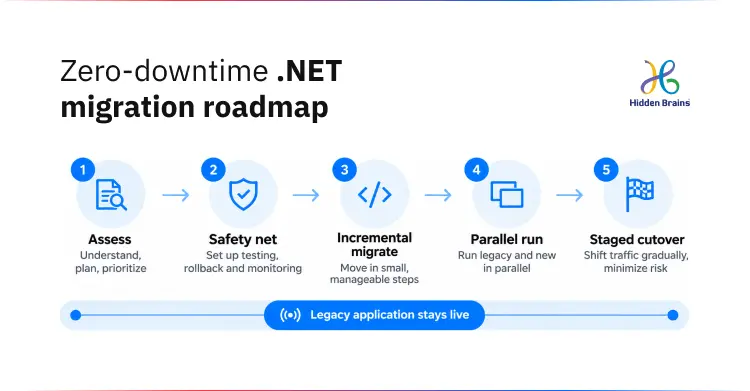
The way to modernize without disruption is to never require a single high-stakes switchover. Instead of replacing the whole system at once, you replace it in small, reversible increments while the legacy application keeps serving users. Here is the phased path we use.
- Assess and quantify. Inventory the application, dependencies, and data. Map the business capabilities it supports and quantify the cost of inaction, maintenance spend, security exposure, compliance gaps, and revenue lost to slow delivery. This is what turns modernization from a technical wish into a funded business case.
- Establish a safety net. Before changing anything, put automated tests and observability in place around current behavior. You cannot migrate safely what you cannot measure, and this baseline is what makes fast rollback possible later.
- Migrate incrementally (Strangler Fig). Build each new capability on modern .NET alongside the legacy system and route a slice of traffic to it. Validate the business outcome, not just the code, before moving to the next module. The legacy app continues running the whole time.
- Run in parallel and migrate data carefully. Keep old and new components operating together while data is migrated and reconciled. Parallel running is what makes the transition invisible to customers.
- Cut over safely, with rollback. Decommission each piece of the legacy system only after its modern replacement is proven stable and performs better. Because each step targets one capability, a failure rolls back in minutes, not months.
This sequence is deliberately conservative. The goal is not to modernize as fast as possible; it is to modernize without the business ever noticing the platform changed underneath it.
What Successful .NET Legacy Modernization Looks Like
A successful modernization is measured in business outcomes, not just a newer framework version. Done well, organizations see meaningfully lower operating costs, faster release cycles that let them respond to the market sooner, a stronger security and compliance position, and — often the real prize — the ability to integrate with modern partners, cloud services, and AI capabilities that were previously out of reach.
What “good” looks like in practice: the migration ships value continuously rather than in one risky drop; the team’s time shifts from maintenance toward new features; and audits that were once a scramble become routine. Crucially, none of it comes at the cost of an outage during the transition.
We’ve applied this approach across three real-world engagements, each with different scenarios, challenges, and demands. Across these case studies, we combined our expertise and experience to transform operational data and business logic into modern, scalable solutions.
How Much Does .NET Modernization Cost?
There is no fixed price for .NET modernization; cost is driven by scope, not a rate card. The most useful thing a provider can do is help you understand the variables, because a phased modernization of a mid-sized application and a full rebuild of a complex enterprise system are different orders of magnitude.
The main cost drivers are:
- Application size and complexity — Number of modules, integrations, and how tightly coupled the code is.
- Data migration — Volume, quality, and how much reconciliation the data needs.
- Integrations — How many external systems and partner APIs must keep working throughout.
- Testing and observability — The safety net that protects operations is real work, and it is not where you cut corners.
- Downtime tolerance — Near-zero-downtime approaches cost more up front than a hard cutover, and are worth it for revenue-critical systems.
- Approach — An incremental Strangler Fig program spreads cost over time; a big-bang rewrite front-loads it.
The more important number is the one on the other side of the ledger: the cost of not modernizing. When maintenance is already consuming the majority of the IT budget, the modernization business case is often less a debate and more arithmetic. A credible provider will model both sides for your specific application before quoting anything.
How Hidden Brains Delivers .NET Modernization Services and What You Get
Hidden Brains approaches .NET modernization as a business-continuity exercise first and a technical one second. Our legacy software modernization services start before framework selection: we assess where processes, systems, data, and decision-making are breaking down, quantify the cost of inaction, and then design an incremental path that keeps operations running throughout.
That work sits on a mature engineering foundation. Hidden Brains is a CMMI Level 3, ISO 27001, and ISO 9001-certified software company with more than 23 years of delivery experience and clients across 107 countries- the kind of process discipline and security posture that migrations of business-critical systems require. Our teams work across the modern Microsoft technology stack and current ASP.NET Core development practices, so modernization is delivered by people who work in these frameworks every day.
What you get from an engagement:
- A modernization assessment and a costed, phased roadmap tied to business priorities, not a generic strategy deck.
- An incremental migration that keeps the legacy application live until each modern replacement is proven.
- Automated testing, observability, and rollback built in, so risk is contained at every step.
- A modern, cloud-ready .NET platform that lowers operating cost and can actually support your next integration, mobile front-end, or AI initiative.
- A partner accountable for outcomes, positioned to connect strategy with execution, not additional headcount.
Frequently Asked Questions
How do we build the business case for .NET modernization?
Start with the cost of inaction, not the technology. Quantify what the legacy system already costs — maintenance hours, security and compliance exposure, and revenue lost to slow delivery — then weigh it against a phased modernization over the same period. When maintenance is consuming most of the IT budget, the case largely makes itself.
Will modernization disrupt our operations or customers?
It shouldn’t. With an incremental, parallel-run approach, the legacy application stays live while modern components take over gradually, so customers see no outage and each step is reversible. Visible disruption is a signal of the wrong approach, not an unavoidable cost of modernizing.
Isn’t it cheaper to keep maintaining our current .NET system?
Rarely, once the full picture is counted. The visible maintenance line hides talent premiums, security exposure, lost productivity, and deferred revenue — and those compound every year. The right comparison is total cost over several years, not this quarter’s maintenance bill.
Can we modernize without pausing new feature development?
Yes — that’s a core advantage of incremental modernization. New capabilities ship throughout the migration rather than only at the end, so the product roadmap keeps moving and stakeholders see progress every sprint, instead of a multi-month freeze while a rewrite is built.
How do we choose the right .NET modernization partner?
Look for a partner who leads with your business case and a phased, reversible plan rather than a framework pitch — and who can show real migration experience, security certifications such as ISO 27001, and process maturity such as CMMI. Explaining trade-offs in business terms matters as much as technical skill.
When will we actually see the savings?
Phased approaches often start returning value early, because reduced maintenance and efficiency gains begin with the first migrated modules rather than waiting for a full cutover. A credible provider will model expected savings against your current run cost before you commit.



Conclusion
Modernizing a legacy .NET application is not, at its core, a technology project; it is a decision to stop funding stagnation and start funding growth, without gambling on operational continuity to do it. The organizations that get this right treat modernization as a sequenced, reversible program: quantify the real cost of standing still, choose the migration approach that matches their risk tolerance, and move incrementally so the business never feels the change.
The tools and patterns to do this without downtime are proven. What separates a smooth modernization from a stalled one is planning, discipline, and a partner who has done it before on systems that could not afford to stop. If legacy .NET is quietly setting the ceiling on what your business can do next, the path off it is more accessible, and less disruptive, than most teams assume.
Not sure where to start? Book a 2-hour free tech consultation with our experts to assess your application, modernization options, and next steps.
