






















































































































































Summary
- AI is driving measurable ROI in real estate.
- Operational AI should be the first priority.
- Strong data foundations enable scalable AI.
- Governance is critical for responsible automation.
- Custom software offers greater flexibility and control.
- Local regulations shape global PropTech solutions.
- The right development partner should have proven domain expertise.
The real estate software conversation in 2026 has moved past novelty. The question is no longer whether to adopt AI, but which workflows pay back first, in what order, and how to govern them. This guide maps where the value is landing, gives you a sequencing model and a 2026 roadmap, and shows what to look for when you engage a real estate software development company to build it.
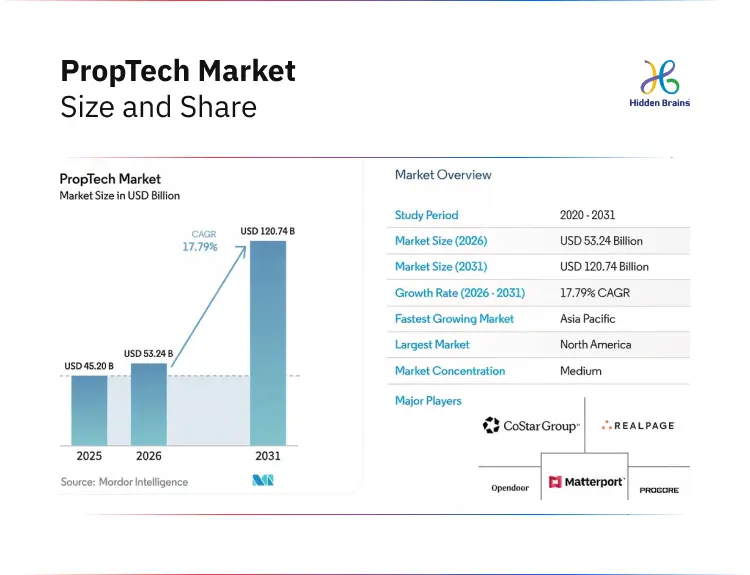
The market backdrop is real: Analysts size the global PropTech market at roughly US$54.66 billion in 2026, growing toward US$185.31 billion by 2034 at about a 16.4% CAGR, with agentic tools like HomeLight’s EVA, marketed as the industry’s first AI escrow officer- already automating parts of transaction closing. Estimates vary by firm, but the direction is unambiguous. (Source: Grand View Research)
What’s Actually Changing in Real Estate Software in 2026?
The shift is from feature-chasing to outcome engineering. Two years ago, adding a chatbot was enough to signal innovation. In 2026, serious operators are putting AI where it can move a real metric: leasing, maintenance, energy, underwriting, and finance.
That is why more businesses are turning to real estate software development solutions built around specific operational needs, rather than forcing their workflows into off-the-shelf platforms. The goal is a more connected PropTech experience across buying, renting, financing, managing, maintaining, and even building property.
Where is AI Delivering Measurable Value First?
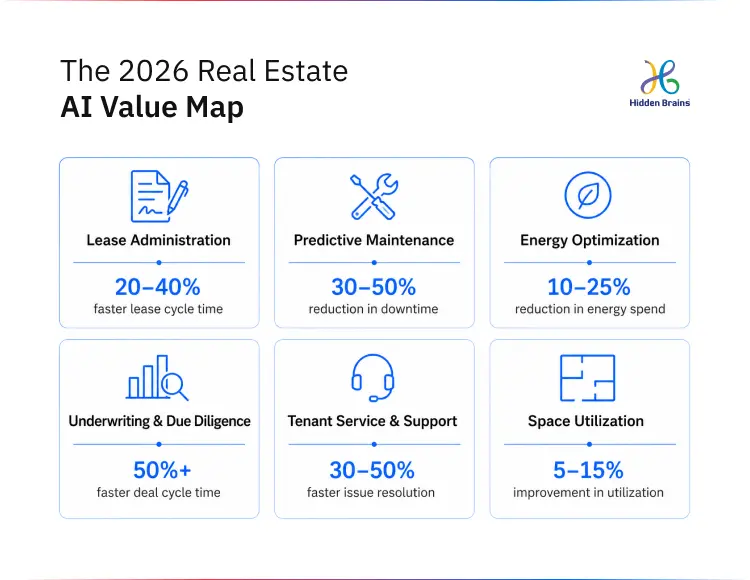
The most credible near-term gains are in use cases with a clear operating or transaction outcome, not “AI everywhere,” but AI where performance shows up in a number.
| Use case | What the AI actually does | Measurable outcome |
|---|---|---|
| Lease & document intelligence | Extracts clauses, dates, obligations, renewals, and risks from lease packs and due-diligence files | Fewer missed renewals, notices, and rent-escalation errors |
| Maintenance AI | Reads tenant requests, classifies urgency, checks asset history, predicts repeat failures, routes work orders | Less unplanned downtime; lower emergency repair costs |
| Energy AI | Forecasts consumption, flags abnormal equipment behavior, optimizes control systems | Lower utility spend and emissions; easier compliance |
| Underwriting copilots | Assembles comparable evidence, finds missing data, compares scenarios, drafts investment-committee memos | Faster deal screening; more disciplined memos |
| Tenant-service automation | Triages inquiries and requests, answers 24/7, generates listing/marketing content | Quicker response; fewer manual tickets; higher retention |
| Space optimization | Detects underused space, forecasts occupancy, evaluates consolidation | Lower workplace cost; better utilization |
The distinction that matters: don’t deploy a generic “property-management chatbot.” Deploy a maintenance-intelligence workflow that reads a tenant request, classifies urgency, checks the asset’s history, predicts repeat failures, routes the ticket, and hands the facilities team an approval checkpoint. One is a demo; the other moves response time, downtime, labor cost, and tenant satisfaction at once. This is how AI in real estate can do wonders and bring out a fully integrated solution that handles everything from management to analytics while slashing off the costs by 30%.
Build Real Estate Software that Pays Back
Start Your Project
Where Should Real Estate Businesses Place Their Bets in 2026?
Priority order matters more than ambition. For most owners, operators, and PropTech providers, this sequence de-risks spend:
- Operational AI first — Energy, maintenance, work orders, lease administration, and tenant service. Fastest, most measurable payback.
- Document and data foundation — Unify lease, finance, property, market, and building data before scaling sophisticated models. Sophistication on messy data fails.
- Investment intelligence — Use AI to support analysts and investment committees, with source traceability and human approval.
- Digital-infrastructure strategy — Assess exposure to data centers, power, cooling, and AI-driven tenant demand.
- Governance by design — Protect tenant and financial data, audit automated decisions, and prevent bias in pricing, screening, and recommendations.
What Does a Practical 2026 Roadmap Look Like?
Skip the ten-pilot scatter. This six-step path is how disciplined teams get from idea to measurable return.
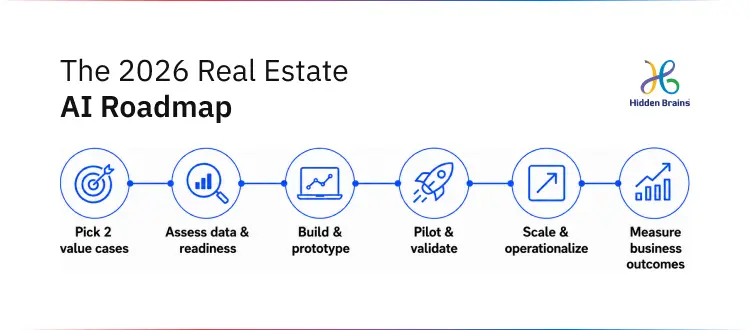
- Pick two value cases, not ten pilots. Pair one measurable operational case (energy optimization or lease abstraction) with one strategic case (portfolio scenario planning).
- Create a governed property-data foundation. Define common identifiers, ownership, quality controls, lineage, access policies, and integration standards across property, tenant, lease, financial, and building-telemetry data.
- Build AI into the workflow. Outputs should appear inside the systems people already use, underwriting platforms, property-management systems, CRM, maintenance tools, BI, not a separate AI tab.
- Keep humans accountable. Use AI to prepare, recommend, flag, and prioritize; retain defined human approval for pricing, investment, tenant-impacting, legal, and safety decisions.
- Measure business outcomes. Track cycle time, analyst hours saved, energy intensity, maintenance downtime, lead conversion, lease-compliance errors, vacancy duration, and net operating income — not model usage or prompt counts.
- Design for jurisdictional variation. Separate reusable core models from local policy modules for data residency, language, property law, energy codes, and fair-housing or consumer-protection rules.
Why is Governance the Make-or-Break Layer?
Because automated decisions in real estate touch people’s homes, money, and legal rights. A credible 2026 build treats governance as a design input, not an afterthought: protect tenant and financial data, keep an audit trail for every automated decision, and actively test for bias in pricing, tenant screening, and recommendation engines. Regulatory pressure is already here; carbon-reporting frameworks such as New York’s Local Law 97 and EU directives make auditable analytics a compliance requirement, not a nice-to-have. If your platform can’t show why it flagged a tenant or set a price, it’s a liability.
How Does This Vary Across Markets Globally?
A global platform needs a shared core and local policy modules; the differences aren’t cosmetic.
| Market | What shapes the build |
|---|---|
| USA | MLS/IDX integrations, state-level licensing, fair-housing screening rules, Local Law 97-style carbon reporting |
| UK | Rightmove/Zoopla feeds, MHCLG digital-planning direction, EPC and building-safety obligations |
| EU | CSRD sustainability disclosure, Energy Efficiency Act, GDPR data-residency constraints |
| UAE / GCC | DLD/RERA registration and Ejari-style lease workflows, Arabic-first UX, escrow and off-plan rules |
| Asia-Pacific | Mobile-first transactions, fast-growing digital ecosystems, varied land-record digitization |
Off-the-Shelf vs. Custom Real Estate Software: Which is Right?
Off-the-shelf wins on speed to a generic baseline; custom wins wherever your workflow, integrations, or compliance profile is specific, which, in real estate, is almost always.
| # | Off-the-shelf | Custom |
|---|---|---|
| Fit to your workflow | Average-user assumptions | Built to how your team actually works |
| Scaling cost | Per-user fees compound | Scales without per-seat penalty |
| Integrations (MLS, IDX, DocuSign, Stripe, BMS) | Limited to vendor’s roadmap | Native to your stack |
| Data ownership & governance | Vendor-controlled | Yours, auditable by design |
| Time to value | Fast, shallow | Deliberate, durable |
For teams that have outgrown packaged tools, custom software development services is the route to a platform that fits the exact operating model rather than forcing the operating model to fit the tool.

Invest in the Future of Real Estate
Start BuildingHow Do You Choose a Real Estate Software Development Company?
Choose on evidence, not adjectives. A capable real estate software development company should show:
- Domain workflows, not just code — Demonstrable understanding of leasing, property management, underwriting, and maintenance operations.
- Real delivery proof —Our PropTech experience is grounded in platforms already built and shipped. Affordable Living Solution is one example of how we have turned a real estate business need into a practical, scalable digital platform.
- Integration depth — MLS/IDX, CRM/ERP, payment, e-signature, and building-telemetry experience.
- Governance maturity — Auditable AI, data-residency handling, bias testing baked into the SDLC.
- Process credibility — CMMI Level 3 and ISO-certified engineering practices help maintain quality, security, and delivery discipline as platforms grow in complexity and scale.
- Global-with-local capability — A core-plus-policy-module architecture for multi-market operation.
Our services are built around exactly this model: operational AI first, a governed data foundation, and human-accountable decisioning.
Frequently Asked Questions
Where should we invest first to get ROI from real estate AI in 2026?
Start with operational workflows that pay back in money or time, energy optimization, lease abstraction, and maintenance intelligence, before strategic use cases like portfolio scenario planning. Pairing one operational and one strategic case keeps spend disciplined and returns measurable.
What business problems does custom real estate software actually solve?
It removes the cost of workarounds. Custom platforms fit how your team leases, underwrites, and manages assets, scale without per-user fees as your portfolio grows; and integrate natively with MLS/IDX, CRM, payments, and building systems, so the software supports the business instead of constraining it.
Should we buy off-the-shelf software or build custom?
Buy off-the-shelf for a fast, generic baseline; build custom wherever your workflow, integrations, or compliance profile is specific, which in real estate is almost always. The deciding factors are scaling cost, integration depth, and whether you need to own and audit your own data.
What does custom real estate software cost, and how do we budget for it?
Cost scales with scope, integrations, and compliance footprint, not a fixed price. [INSERT: real cost ranges by project tier, do not publish an invented figure.] The reliable way to budget is a value-case-first estimate tied to two prioritized workflows, so spend is anchored to a measurable outcome.
How do we reduce risk when choosing a real estate software development company?
Judge on evidence: property platforms actually shipped, domain fluency in leasing and asset operations, integration track record, governance maturity (auditable AI, data residency, bias testing), and engineering process credibility, not marketing superlatives. Ask for delivery proof and outcome metrics before scope.
How do we know our current real estate software is holding the business back?
Warning signs: manual workarounds for routine tasks, rising per-seat costs as you grow, missed lease renewals or compliance events, integrations your vendor won’t build, and no audit trail for automated decisions. Any of these signals it’s time to evaluate a custom build. Get a Free audit of your system and know whats holding you back in a 2-hour consultation.



Conclusion
The winners won’t be the teams that adopted the most AI; they’ll be the ones that adopted it in the right order and could prove the return. Start with operational workflows where the payback is measurable in money or time, build on a governed data foundation instead of scaling models on messy data, keep humans accountable for decisions that affect pricing, tenants, and legal exposure, and measure business outcomes rather than model usage.
That sequencing is also the real test of a build partner. A capable real estate software development company should push you toward two well-chosen value cases, not ten pilots, and should be as fluent in leasing, underwriting, and maintenance operations as it is in code. Get that combination right and real estate software stops being a cost line and becomes a source of net operating income. Hidden Brains’ real estate software development services are built around exactly that priority order.
Where Are Your Biggest Cost Leaks? Use a 2-hour free consultation to find where AI, automation, or better software can save the most time and money.
