


















































































































































Summary
- Full stack development cost in 2026 is shaped by project scope, technology stack, expertise, and engagement model.
- The right delivery approach impacts overall value more than choosing the lowest development rate.
- Regional talent availability, offshore models, and hybrid teams influence cost efficiency.
- Hidden expenses like rework, maintenance, onboarding, and technical debt affect total investment.
- AI capabilities, integrations, security, and scalability requirements are key cost drivers.
- Dedicated full stack teams offer continuity, flexibility, and long-term value for growing products.
If you’re trying to hire full stack developers in 2026, expect to pay anywhere from $20 to $160 per hour, or roughly $3,000 to $26,000 per developer, per month, depending almost entirely on where they sit, how you engage them, and what you’re actually building. The hourly rate is the number everyone quotes. It’s also the number that comes with different terms and conditions.
This guide breaks down full-stack development costs the way a buyer actually needs them: real 2026 rates by region, costs by engagement model, costs by project scope, and the hidden costs that turn a “cheap” $30/hour developer into an expensive one. The goal is a budget you can defend, not a rate range you have to guess around.
| Details | Information |
|---|---|
| Guide Focus | Help businesses understand full stack development costs in 2026, including key pricing factors, regional cost differences, engagement models, hidden costs, and strategies to optimise development investment. |
| Target Audience | CIOs, CTOs, founders, product leaders, technology managers, and businesses evaluating full stack development partners, outsourcing models, and scalable software delivery approaches. |
| TL;DR | Full stack development cost is influenced by more than developer rates. Project complexity, technology stack, expertise, engagement model, and long-term ownership costs determine the true investment. Choosing the right development approach helps businesses balance cost, quality, scalability, and delivery speed. |
| Main Takeaways | Understand what drives full stack development costs. Compare hiring models, identify hidden expenses, evaluate delivery approaches, and choose a model that supports long-term product growth. |
| Recommended For | Businesses planning new applications, modernising existing platforms, scaling digital products, or evaluating dedicated full stack development teams for ongoing software development. |
Worth to Look
- The cost benchmark: Full-stack developer rates in 2026 run ~$20–$160/hour or ~$3,000–$26,000/month, driven primarily by region, seniority, tech stack, and engagement model.
- Pricing Factors: North America is the most expensive market (US software developer median base pay is $133,080/year, per the U.S. Bureau of Labor Statistics); India and Southeast Asia sit at the value end of the range, typically 40–60% below US cost for comparable senior talent.
- The true cost driver is not the developer rate, but ownership. Recruitment, onboarding, management, rework, attrition, and security/compliance can add 30–50% on top of the headline number. A low hourly rate with high rework and turnover often costs more than a higher rate that ships clean the first time.
- How to decide: Match the engagement model to your project shape first (one-off task vs. evolving product), then optimize for region and stack. For most growing products, hire a dedicated development team gives the best balance of cost, speed, and continuity.
Why Full Stack Pricing is Different in 2026
Full stack development costs are no longer defined by coding hours alone. AI tools are making routine development faster, but skilled engineers who can design, build, and scale complete applications remain highly valuable.
The pricing gap is widening between developers who execute tasks and those who own complex product delivery. In 2026, rates depend less on an average market price and more on expertise, project complexity, and scalability requirements.
How Much Does it Cost to Hire Full Stack Developers in 2026?
Full stack developer cost depends first on region, then on seniority and engagement model. Contract hourly rates range from about $20/hour in Southeast Asia to $160/hour in North America. On a dedicated, full-time basis, the same talent runs roughly $2,800 to $26,000 per developer per month once you account for local pay plus overhead.
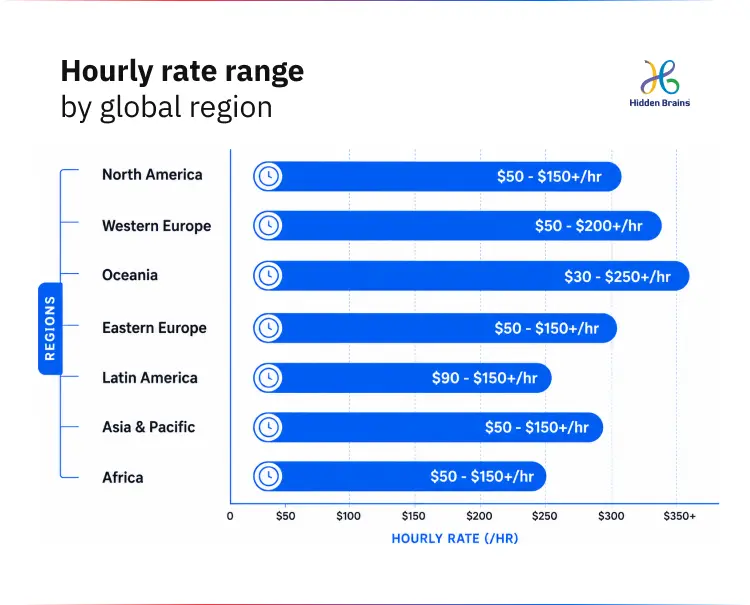
The one hard anchor in this market is US employee pay: the U.S. Bureau of Labor Statistics puts the median base salary for software developers at $133,080 as of May 2024, with a mean hourly wage of $69.50, and that’s base pay only, before benefits, overhead, equity, or agency margin, which is why contract and agency rates in North America run well above it.
Here are indicative 2026 ranges by region. Treat these as planning bands, not quotes; real numbers move with seniority, stack, and demand.
| Region | Hourly rate (contract) | Monthly (dedicated, full-time) | Notes |
|---|---|---|---|
| North America (US/Canada) | $90–$160 | $14,000–$26,000 | /Typical contract/agency planning range |
| Western Europe / UK | $65–$130 | $10,000–$20,000 | Deep senior bench; strong process maturity |
| Eastern Europe | $35–$70 | $6,000–$11,000 | Timezone overlap with EU; strong engineering culture |
| Latin America | $25–$65 | $4,500–$9,000 | Nearshore for US; good timezone overlap |
| India & South Asia | $25–$50 | $3,000–$7,000 | Large senior talent pool, strong English, mature delivery |
| Southeast Asia | $20–$45 | $2,800–$6,500 | Lowest entry cost; vetting depth varies |
**Ranges are indicative 2026 market bands synthesized from public wage data and anchored to BLS for the US. Confirm against a scoped quote before budgeting.
Global Talent Availability and Cost-Quality Dynamics
Cheaper regions are not lower quality by default; the variance is wider. A senior full stack engineer in India or Poland can match a US senior on architecture and code quality at a fraction of the cost; the risk in low-cost markets is that “full stack” is claimed more often than it’s earned, so vetting depth matters more than the rate.
The practical rule: Below a certain price point, you’re not buying a cheaper senior, you’re buying a junior with a senior title. Budget for vetting, not just hours.
What Determines Full Stack Development Cost?
Six factors move the price more than anything else. Understanding them lets you predict your quote before you receive it.
- Project Complexity. A brochure-plus-CMS site and a multi-role SaaS platform with real-time data are different orders of magnitude. Integrations, custom business logic, and concurrency drive cost far more than page count.
- Technology Stack. Stack composition is one of the biggest rate levers (see the table below).
- Developer Expertise. A senior who owns architecture prevents expensive mistakes; a junior at half the rate can cost more in rework. Blended teams (one senior, two mid-level) usually beat all-junior or all-senior on cost-efficiency.
- AI and automation requirements. Adding AI features (RAG, model integration, intelligent workflows), or building with AI-assisted engineering, changes both the skill set and the price. AI/ML specialization typically commands a 20–30% premium.
- Development timeline. Compressed timelines cost more; parallel work, larger teams, and overtime carry a premium. Realistic timelines are a cost-control tool.
- Security and compliance. Regulated industries (finance, healthcare) and standards like ISO 27001 or GDPR add secure-SDLC work, audits, and documentation. This is a cost you pay upfront or a risk you pay for later.
Stop Overpaying — Scope Your Build
Get a Free Estimate
Does the tech stack change the price?
Yes, the stack you choose can shift the rate by 30% or more. Broadly, JavaScript-only breadth sits in the middle of the market, while specialized backends and high-performance stacks command a premium.
| Tech Stack | Indicative Hourly Rate | Typical Use |
|---|---|---|
| Vue + Laravel | $25–$60/hour | Content platforms, admin panels, SMB web applications |
| MERN | $40–$80/hour | SaaS platforms, dashboards, MVPs, modern web applications |
| MEAN | $45–$90/hour | Enterprise web applications, business platforms |
| Django/Python + React | $40–$80/hour | Data-heavy applications, AI-integrated platforms, analytics solutions |
| .NET + React/Angular | $50–$90/hour | Enterprise systems, regulated industries, complex business applications |
| React + Go / Node Microservices | $50–$80/hour | High-scale platforms, distributed systems, performance-critical applications |
Full Stack Development Cost by Project Type
The most useful budget number isn’t a rate; it’s a total for your build. Here’s how full stack projects typically scope, using a dedicated offshore team as the cost basis. These are illustrative planning bands; a scoped estimate will tighten them considerably.
| Project Type | Scope | Indicative Total Budget | Typical Timeline |
|---|---|---|---|
| MVP / Prototype | Core features, single platform, standard authentication | Starts from $20,000 | 6–12 weeks |
| Mid-Size Web Application | Multiple modules, integrations, payments, user roles | $40,000–$200,000 | 3–6 months |
| Enterprise Platform | Complex workflows, high scalability, compliance, multi-role systems | $200,000+ | 6–12+ months |
Note: These figures are indicative estimates and can vary based on multiple factors, including project complexity, technology stack, design requirements, integrations, security needs, scalability, and development approach. Every application has unique requirements, so the final investment depends on the specific scope and business goals.
In our delivery experience, the projects that overrun budget are rarely the ones with the highest rate; they’re the ones scoped loosely, where “we’ll figure it out later” becomes three rounds of rework.
Choosing the Right Hiring Model for Your Business
The engagement model is the single biggest budget decision, often bigger than region. Each model has a different cost structure and a different risk profile.
Part-Time Hourly Dedicated Developer
- Pay only for the hours required from a dedicated developer working consistently on your product.
- Offers flexibility without the commitment of a full-time hire.
- Best suited for maintenance, feature enhancements, MVPs, and businesses with evolving requirements.
Full-time Dedicated Developers
- Developers work exclusively on your product through a monthly engagement model.
- Provides continuity, deeper product understanding, and faster iteration.
- Best for growing products, long-term development, and businesses needing scalable engineering support.
Agency / Project Outsourcing
- Works on a fixed scope or milestone-based pricing model.
- Provides a managed delivery approach with reduced internal coordination needs.
- Best for well-defined projects with clear requirements and timelines.
Staff Augmentation
- Our developers become an extension of your existing team and follow your processes.
- Helps increase engineering capacity without lengthy hiring cycles.
- Best for companies that need specific skills or faster team expansion while retaining project control.
Hiring Model Comparison Matrix
| Model | Cost Basis | Best For | Key Success Factor |
|---|---|---|---|
| Part-Time Hourly Dedicated Developer | Hourly engagement based on required development hours | Small enhancements, MVPs, maintenance, and flexible ongoing support | Clear priorities and efficient allocation of development hours |
| In-House Hire | Salary + benefits, taxes, equipment, and operational overhead | Long-term product ownership and building internal engineering capabilities | Strong talent retention and continuous team investment |
| Agency / Project Outsourcing | Fixed project cost or milestone-based pricing | Well-defined projects with clear requirements and timelines | Detailed scope definition and effective communication |
| Dedicated Full Stack Developer / Team | Monthly engagement per developer or team member | Product development, continuous improvements, and scaling applications | Clear product vision and long-term collaboration |
| Staff Augmentation | Monthly cost for embedded external developers | Expanding engineering capacity or adding specialised expertise quickly | Strong coordination between internal and external teams |
For some organisations, custom software development services can be the right approach to accelerate digital initiatives while maintaining flexibility and control. Partnering with experts in this can provide access to dedicated engineering teams that support end-to-end delivery, including architecture, development, quality assurance, compliance, and ongoing optimisation.
This approach enables organisations to extend their technology capabilities without the complexity of building large internal teams. Dedicated teams become aligned with business objectives, product roadmaps, and technical requirements, helping businesses improve delivery speed, maintain consistency, and scale development efforts as needs evolve.

Scale Your Product with Proven Engineering Expertise
Hire NowHidden Costs That Impact Your Development Budget
The hourly rate is typically 60–70% of what a developer actually costs you. The rest hides in places the rate card never shows.
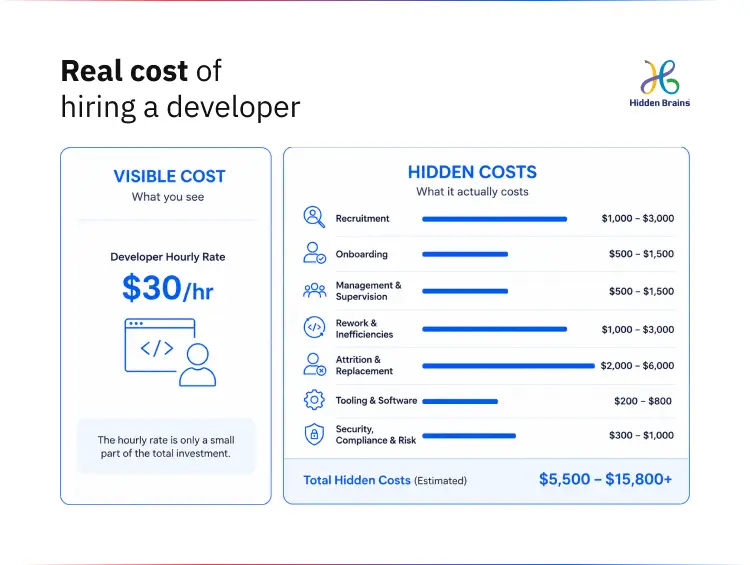
- Recruitment and onboarding. Sourcing, vetting, and ramp-up time before a developer is productive- weeks of paid, low-output time on every hire.
- Infrastructure and tools. Licenses, cloud, CI/CD, monitoring, security tooling. Small per-seat, meaningful across a team.
- Project management. Someone has to plan, coordinate, and unblock. Whether it’s your PM or theirs, it’s real cost.
- Maintenance and support. Most software cost lands after launch. Budget for it or inherit technical debt.
- Technical debt. Cheap, fast, unarchitected code is a loan against your future roadmap, paid back with interest in slower releases and more bugs.
- Attrition and knowledge loss. Turnover resets ramp-up and drains context. This is the quiet killer of “cheap” arrangements.
A CMMI Level 3 delivery process and ISO 27001 security practices exist precisely to compress these hidden costs: fewer defects reaching production, less rework, and security handled by design rather than bolted on after an audit.
How to Reduce Full Stack Development Cost Without Compromising Quality
You cut cost by removing waste, not by removing quality. Five factors do most of the work:
- Build an MVP first. Ship the core, validate with real users, then invest in the pilot-to-production phase. It’s the single biggest way to avoid building features nobody uses.
- Work in agile sprints. Short cycles with working software each sprint catch wrong turns early, when they’re cheap to fix.
- Use AI-assisted engineering. Applied well, AI code generation and automated testing cut hours on boilerplate and QA, savings that show up on well-scoped work.
- Reuse components and frameworks. Proven libraries, design systems, and prior modules beat rebuilding from scratch every time.
- Use offshore or hybrid teams. Moving delivery to a lower-cost region, or running a hybrid of onshore leads and offshore builders, cuts cost 40–60% without cutting quality, provided vetting and process are solid.
Why Dedicated Full Stack Developers Deliver Better Business Outcomes
A dedicated team lowers total cost by protecting the things that make software expensive: continuity, context, and consistency. The ROI case is practical, not promotional:
- Faster time-to-market — One team that owns the product end-to-end doesn’t lose days to handoffs and re-explaining context.
- Scalability — You add or reduce capacity as the roadmap changes, without the fixed cost and slow cycle of in-house hiring.
- Engineering consistency — The same people, standards, and architecture across the build means fewer defects and less rework.
- Long-term ROI — Retained product knowledge compounds; a team that knows your codebase ships faster in month six than any new hire can.
- Business continuity — A team (not a lone freelancer) means no single point of failure when someone is on leave or moves on.
How to Evaluate a Full Stack Development Partner
Evaluate on evidence, not on rate. Six checks separate a partner from a body shop:
- Technical expertise — Real depth across front end, back end, database, and cloud, demonstrated with code and architecture, not adjectives.
- Industry experience — Have they solved problems in your domain and at your scale?
- Development methodology — A defined process (agile, CI/CD, code review, QA). A CMMI-aligned process is a signal that quality is systematic, not accidental.
- Security practices — ISO 27001-grade information security, secure SDLC, and clear data handling. Non-negotiable if you’re regulated.
- Communication and collaboration — Timezone overlap, reporting cadence, and English fluency determine day-to-day friction.
- Scalability and support — can they grow the team and support the product after launch, not just build and disappear?
How Hidden Brains Is the Right Fit For Your Build
Hidden Brains is a CMMIDEV/3℠, ISO 27001:2022, and ISO 9001:2015-certified software development company serving clients across 107 countries since 2003. For full stack development, this delivery maturity matters in one critical way: it helps reduce the hidden costs associated with delays, rework, security gaps, and inconsistent engineering practices. A defined CMMIDEV/3℠ process helps improve delivery predictability and quality, while ISO 27001 practices ensure security is embedded into the development lifecycle from the start.
The model most relevant to this guide is the dedicated full stack development team, time-zone-aligned engineers who take ownership of product development end-to-end while providing the flexibility and cost advantages of offshore delivery. For organisations evaluating where to hire full stack developers while balancing cost, expertise, and continuity, this model offers a scalable approach.
Hidden Brains brings cross-industry experience to complex digital transformation initiatives, spanning automotive dealership transformation, equine digital marketplaces, oil and gas digital transformation, and AI-powered crop monitoring systems.
This breadth enables organisations to apply full-stack engineering, AI, cloud, and systems integration capabilities to address operational complexity, improve scalability, and support evolving business models.
Frequently Asked Questions
What’s the most cost-effective way to hire full stack developers for my business?
It depends on the shape of your work, not just the rate. For a defined, one-off task, a freelancer is cheapest. For an evolving product with ongoing releases, a dedicated team almost always costs less over time, because it protects continuity and avoids paying for ramp-up again and again. Match the engagement model to how much you’ll build and for how long before you compare hourly rates.
How do I avoid a low quote that balloons into a much bigger bill?
Overruns come from loose scope, not low rates. Insist on a written scope with clear deliverables and stated assumptions, ask what is explicitly out of scope, and treat any quote that skips a discovery step as a warning sign. A partner who invests in scoping upfront is quoting your real cost, not a headline number engineered to win the deal.
Is a dedicated offshore team actually cheaper than hiring in-house once everything is counted?
For most growing products, yes. A dedicated offshore developer typically runs 40–60% below a fully-loaded in-house hire after benefits, recruitment, overhead, and management. The larger saving is flexibility: you scale the team up or down with the roadmap instead of carrying fixed salary cost through slow periods.
How do I protect my source code, IP, and data when hiring offshore?
Put IP assignment and NDAs in the contract, confirm the partner holds recognized security certifications such as ISO 27001 for information security, and check their access controls and secure-development process. Certifications like CMMI and ISO aren’t decoration; they’re evidence that security and quality are handled by process, not left to chance.
How do I make sure I’m getting senior quality and not paying senior rates for juniors?
Interview the actual engineers, review real code or architecture they’ve shipped, and confirm who stays on your account long-term versus who only appears in the pitch. Below a certain rate you’re often buying a junior with a senior title, so vetting depth, not the rate card, is what protects you.
Fixed-price or a monthly dedicated team — which is safer for my budget?
Fixed-price suits a well-defined, unchanging scope: you trade flexibility for certainty. A monthly dedicated model suits products that will evolve, where locking scope too early costs more in change requests than it saves. If you can’t fully define the build yet, a dedicated team usually protects your budget better than a fixed price built on guesses.



Conclusion
Full-stack development cost in 2026 is not defined by a single rate; it depends on region, technology stack, developer expertise, and engagement model. Focusing only on the lowest hourly cost often leads to hidden expenses through rework, delays, and scalability challenges.
The smarter approach is to evaluate total cost of ownership and choose a development model that aligns with your product goals. A well-structured engagement model can improve delivery efficiency, maintain quality, and provide long-term value.
Looking to estimate your full stack development costs? Get a personalised consultation to identify the right team structure and engagement model for your project.