



















































![Sales & Distribution [Oil & Gas]](https://www.hiddenbrains.com/blog/wp-content/themes/blankslate/assets/images/sales_and_distribution-icon.74d08193.svg "Sales & Distribution [Oil & Gas]")

![Fluid Terminal Management [Oil & Gas]](https://www.hiddenbrains.com/blog/wp-content/themes/blankslate/assets/images/fluid_terminal_management-icon.4b3a27a4.svg "Fluid Terminal Management [Oil & Gas]")


![Sales & Distribution [Oil & Gas]](https://www.hiddenbrains.com/blog/wp-content/themes/blankslate/assets/images/sales_and_distribution-icon.74d08193.svg?1.0.0 "Sales & Distribution [Oil & Gas]")
![Fluid Terminal Management [Oil & Gas]](https://www.hiddenbrains.com/blog/wp-content/themes/blankslate/assets/images/fluid_terminal_management-icon.4b3a27a4.svg?1.0.0 "Fluid Terminal Management [Oil & Gas]")










































































Summary
- Learn what truly drives enterprise AI transformation costs beyond the initial development quote.
- Understand the hidden costs of ownership, from governance and integrations to maintenance and optimisation.
- Explore a phased AI roadmap that reduces risk, controls investment, and accelerates business value.
- Discover where enterprises overspend on AI—and the strategies that maximise ROI.
- Compare build, buy, and hire approaches, and understand how UAE-specific factors shape AI investment decisions.
- Learn how to evaluate an enterprise AI partner based on long-term transformation success, not just project cost.
Enterprise AI programmes in the UAE can range from tens of thousands of dirhams for focused use cases to AED 500,000+ for enterprise-wide deployments. But the initial build cost is only part of the equation. The real investment lies in the full lifecycle, scaling, integration, governance, adoption, and continuous improvement.
The UAE has already demonstrated the value of digital transformation, with government initiatives delivering AED 20 billion in direct savings and AED 368 billion in customer savings through digital services. For enterprises, the challenge is no longer proving AI’s potential, but ensuring investments translate into measurable business outcomes.
Before investing in AI, business leaders need clarity on where value is created, what drives costs, and how to scale beyond pilot projects. An Enterprise AI development company in the UAE can provide the strategic direction needed to align AI initiatives with business goals and deliver measurable outcomes. This guide outlines a practical framework for evaluating AI investments and building a roadmap for sustainable growth.
| Details | Information |
|---|---|
| Guide Focus | Helping UAE enterprises understand the true cost of AI transformation, from initial investment to long-term ownership, and how to maximise ROI. |
| Business Challenge | Organisations often underestimate AI costs by focusing on development alone while overlooking integrations, data readiness, governance, compliance, and ongoing operations. |
| Target Audience | UAE business leaders, CIOs, CTOs, digital transformation teams, IT managers, innovation leaders, and enterprises evaluating AI investments. |
| TL;DR | Enterprise AI success depends on planning beyond the build. A phased roadmap, strong data foundations, and the right implementation partner reduce risk, control costs, and improve long-term business outcomes. |
| What You’ll Learn | The key cost drivers of enterprise AI, hidden ownership costs, pilot-to-production planning, AI investment models, UAE-specific considerations, and partner selection best practices. |
| Key Decision Factors | Data readiness, system integrations, governance, compliance (PDPL), scalability, AI operating costs, deployment model, and business value. |
| Expected Outcome | A practical framework for budgeting, prioritising AI initiatives, reducing implementation risk, and selecting the right enterprise AI strategy and delivery partner. |
What Does Enterprise AI Development Actually Cost in the UAE?
Enterprise AI costs in the UAE are driven by scope, complexity, and scale. A single-use-case pilot sits at the lower end, while enterprise programmes involving custom AI solutions, integrations, governance, and ongoing optimisation require significantly higher investment. The key shift is moving from pilot to production, where AI development services, infrastructure, and operational support determine long-term value.
| Scope Tier | Typical UAE Planning Range (2026) | What It Usually Covers |
|---|---|---|
| Single use case (SME) | AED 30,000 – 120,000 | One chatbot, one automation, or one Copilot-style rollout. |
| Multi-workflow (mid-market) | AED 150,000 – 550,000 | Several connected use cases, system integration, workflow agents. |
| Full enterprise programme | AED 500,000+ | Custom models, multi-department rollout, governance, compliance. |
*Indicative planning ranges only. Actual investment will vary based on use case, solution complexity, integration requirements, and implementation scope.
SME vs. Enterprise AI Spend: Where the Difference Comes From
An SME is usually buying a capability: one problem, one system, a predictable build. An enterprise is buying a transformation: multiple workflows, integration with core systems, data governance, and change management across teams. That is why enterprise budgets don’t just scale up SME numbers; the integration and governance layers, not the AI model, account for most of the gap.
The Real Question Behind AI Investment
The cost of digital transformation is not the cost of an AI model; it is the cost of changing how the business runs. A quote for “an AI chatbot” tells you almost nothing, because the chatbot is rarely where the money goes.
Real transformation aligns five things:
Business processes
- People
- Data
- Systems
- Governance
When any one of those is missing, the AI works in a demo and fails in production, and you pay to rebuild it. So the right first question is not what does the tool cost but what does it cost to get our data, systems, and processes ready for the tool to be useful. Enterprises that skip that question fund the most expensive kind of AI: the pilot that impresses in a boardroom and never ships.
Get insights for your enterprise AI investment with a free 2-hour consultation.
Book a Call
Where AI Transformation Investment Actually Goes
Five factors move an AI budget far more than the choice of model or provider. Understanding them lets you predict a quote instead of being surprised by one.
| Cost Driver | Why it Matters |
|---|---|
| Integrations | Connecting AI to ERP, CRM, and core systems is often the largest single line item. |
| Data Readiness | Cleaning, structuring, and governing data is frequently the hidden bulk of the work. |
| Autonomy Level | A system that only answers costs far less than one that acts and triggers workflows. |
| Governance & Compliance | UAE data rules (PDPL) and audit requirements add scope, not just paperwork. |
| Customisation | Off-the-shelf configuration is cheap; a fine-tuned or custom-built model is not. |
The pattern we see repeatedly on enterprise engagements is that the AI model is rarely the cost driver; the integrations, data preparation, and governance around it are.
AI Total Cost of Ownership: What Comes After Development
The build cost is only part of the equation. Moving from pilot to production introduces ongoing expenses for maintenance, licensing, hosting, model API usage, monitoring, and optimisation. For high-volume AI applications, recurring API and token costs can quickly become a significant part of the total cost of ownership.
Plan for the full total cost of ownership before you approve the build:
- Maintenance and iteration — Models drift, requirements change, and prompts and pipelines need tuning.
- Licensing and hosting — Cloud infrastructure and any commercial model or platform tiers.
- API / token usage — Billed per use; scales with adoption, so success increases this cost.
- Governance and monitoring — The ongoing cost of keeping a live system accurate, secure and compliant.
An AI system is closer to a hire than a purchase: the cost of keeping it working is continuous, and a programme budgeted only for the build is under-budgeted from day one.

Identify High-Impact AI Opportunities and Create a Roadmap to Scale.
Talk to Our ExpertsThe AI Transformation Roadmap: Managing Investment and Risk
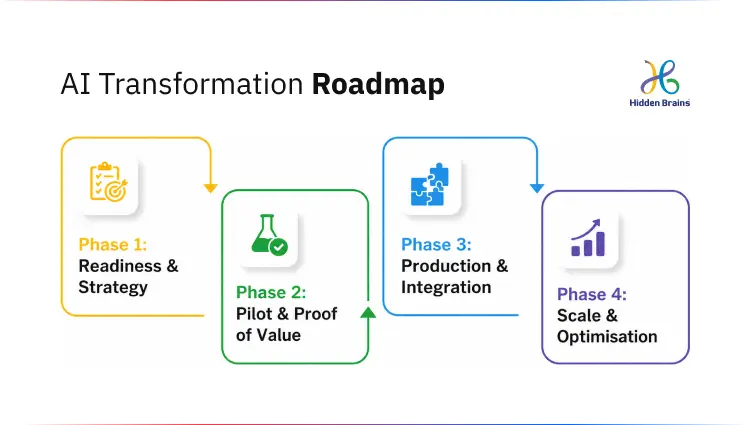
The single most effective way to control the cost of AI transformation is to phase it. A roadmap connects each stage of spend to a business outcome, so budget is released against proof rather than committed upfront to a broad vision. Sequencing is what turns a scattered set of pilots into a programme that compounds.
Phase 1 — Readiness and strategy
Before any code, score where you actually stand. A short readiness assessment, covering data quality, integration landscape, governance maturity, and a single highest-value use case, is the cheapest insurance in the whole programme. Our readiness lens weighs four things: is the data usable, will it integrate with core systems, is there a governance owner, and does the first use case have a measurable business result? This is the stage that prevents funding the wrong thing.
Phase 2 — Pilot/proof of value
Build one real use case that already shows stress under load, a growing review queue, a repetitive interpretation task, not a showcase. The goal is a working system that proves value against a number you agreed in Phase 1, at a contained cost.
Phase 3 — Production and integration
Move the proven pilot into daily operations: integrate it with core systems, harden it for security and compliance, and make it reliable under real volume. This is usually where the larger spend sits, and it should only be committed after Phase 2 has earned it.
Phase 4 — Scale and governance
Extend to further use cases on the same foundations, with governance and monitoring built in rather than retrofitted. Costs compound favourably here, because later use cases reuse the integration and governance work already paid for.
The AI Investment Decision: Build, Buy, or Hire?
The cheapest option is the one that matches the workflow, not the one with the lowest sticker price. The real “which is best” decision for a budget-holder is between three approaches:
| Approach | Cheapest When… | Trade-off |
|---|---|---|
| Buy (SaaS / API) | The workflow is generic and a mature product already exists. | Low upfront, fast — but limited to what the vendor built. |
| Configure / Integrate | A capable platform needs tailoring to your systems. | Balanced cost and control; integration effort applies. |
| Build Custom | The workflow is a differentiator or touches regulated/proprietary data. | Highest cost and control; justified by strategic value. |
On the talent side, the same logic applies. You can hire AI developers as a dedicated project team to build and own a system end-to-end, or hire AI developers in the UAE to augment an in-house team for specific skills, computer vision, generative AI, or data engineering, without the fixed cost of permanent hires. Buy when the capability is generic; build and staff when it is a competitive advantage.
How UAE Factors Influence Enterprise AI Costs
Budgeting for AI in the UAE differs from a generic global estimate in four concrete ways:
- PDPL and data governance. UAE data protection rules add real scope to any system handling personal or regulated data; this is design work, not a checkbox, and it belongs in the budget from Phase 1.
- National strategy tailwind. The UAE’s national AI ambitions and Dubai’s economic agenda are actively funding and accelerating adoption, which shapes both demand and available support for enterprise projects.
- Talent mix. Local delivery offers proximity and compliance alignment; offshore delivery offers cost efficiency. Most cost-effective enterprise programmes blend both.
- Grants and incentives. UAE innovation and technology incentives can offset parts of a qualifying project, worth checking before you finalise a budget.
Aligning an AI programme with the country’s broader digital transformation direction is both a compliance advantage and a commercial one.
Choosing an Enterprise AI Development Partner
The difference between a vendor and a partner is where the conversation starts. A vendor asks what you want built and quotes it. A partner starts with the bottleneck, scores your readiness, and tells you honestly which phase to fund first, including when not to build. Over a multi-year transformation, that judgement saves far more than a lower day rate.
This is where credentials stop being a footer and start mattering: a CMMI Level 3 process means fewer defects reach production, and ISO 27001 certification means governance is built into delivery rather than bolted on. As an enterprise AI development company in the UAE, Hidden Brains works from the business problem and the roadmap outward, with AI strategy consulting to phase the investment before a line of code is written. Twenty-three years and clients across 107 countries mean the cost patterns in this guide come from delivery, not theory.
Frequently Asked Questions
How do we know if our enterprise is ready for AI?
Readiness comes down to four things: is your data usable, will the AI integrate with core systems like your ERP or CRM, is there a clear owner for governance, and does your first use case have a measurable business result? A short readiness assessment scores these before any budget is committed; it is the cheapest way to avoid funding the wrong project.
How do we justify AI spend to the board or leadership?
Tie the investment to a single, quantified bottleneck rather than a broad vision: a review queue that keeps growing, a manual process that doesn’t scale, a decision that takes hours to inform. A phased roadmap helps here: you ask the board to fund one proof-of-value stage against an agreed number, not a multi-year figure upfront.
How long before an AI programme delivers value in the UAE?
A focused pilot can prove value in weeks rather than months when the use case is narrow, and the data is ready. Full production and integration take longer and depend heavily on how many core systems are involved. The phased approach exists precisely so you see a result early instead of waiting for a full rollout.
What happens if the pilot fails?
That is the point of phasing: a contained pilot is where failure is cheap and recoverable. A pilot that doesn’t hit its target usually reveals a data or process gap, not a dead end, and costs a fraction of discovering the same problem after a full build. Budget released by phase means a failed pilot stops there.
Is it cheaper to hire our own AI team or work with a development partner?
Building a permanent in-house AI team carries fixed salary, tooling and retention costs that only pay off with continuous AI work. For a defined transformation, engaging a partner or hiring dedicated developers for the build is usually more cost-effective, because you pay for the capability while you need it rather than carrying it permanently.
What’s the most common way UAE enterprises overspend on AI?
Funding several disconnected pilots at once instead of sequencing one proven use case into production. Ten half-built experiments cost more than one working system and deliver less; sequencing, not scale, is what controls the total number.
How do we prevent AI from exposing confidential business information?
For UAE enterprises, security and governance should be built into every stage of an AI initiative. Role-based access controls, encrypted data flows, secure integrations, and clear governance policies help ensure only authorized users and AI agents can access sensitive business information. This is especially important for organizations operating in regulated sectors such as banking, healthcare, government, and energy.
How do we future-proof a custom enterprise AI solution?
UAE businesses are investing in AI for long-term transformation, not one-off projects. Future-proofing starts with a modular architecture, open APIs, scalable cloud infrastructure, and flexible AI frameworks that can evolve alongside changing business needs and emerging AI technologies. This enables organizations to integrate new systems, adopt more advanced AI models, and expand use cases without rebuilding the entire solution.
We have legacy systems. Do we need to replace them before implementing AI?
Not necessarily. Many UAE enterprises operate a combination of legacy applications, ERP platforms, CRM systems, and industry-specific software. Enterprise AI can be integrated with these existing systems through secure APIs and middleware, allowing organizations to modernize at their own pace rather than undertake costly, high-risk system replacements. This approach preserves existing investments while accelerating AI adoption.


Conclusion
Enterprise AI transformation is not defined by the cost of building a model but by the value created across its entire lifecycle. The most successful organisations budget beyond development, accounting for data readiness, system integration, governance, ongoing optimisation, and user adoption from the outset.
Rather than committing to large-scale investments upfront, leading UAE enterprises reduce risk through a phased approach, validating business outcomes before expanding into enterprise-wide deployments. This ensures every stage of investment contributes measurable value while avoiding costly, disconnected AI initiatives.
Whether you’re evaluating your first AI use case or planning an enterprise-wide transformation, the right strategy, governance framework, and implementation partner will have a far greater impact on long-term ROI than the initial development quote alone.
Before you invest in AI, make sure you’re investing in the right direction. Book a strategy call today.