
































































![Sales & Distribution [Oil & Gas]](https://www.hiddenbrains.com/blog/wp-content/themes/blankslate/assets/images/sales_and_distribution-icon.74d08193.svg "Sales & Distribution [Oil & Gas]")

![Fluid Terminal Management [Oil & Gas]](https://www.hiddenbrains.com/blog/wp-content/themes/blankslate/assets/images/fluid_terminal_management-icon.4b3a27a4.svg "Fluid Terminal Management [Oil & Gas]")


![Sales & Distribution [Oil & Gas]](https://www.hiddenbrains.com/blog/wp-content/themes/blankslate/assets/images/sales_and_distribution-icon.74d08193.svg?1.0.0 "Sales & Distribution [Oil & Gas]")
![Fluid Terminal Management [Oil & Gas]](https://www.hiddenbrains.com/blog/wp-content/themes/blankslate/assets/images/fluid_terminal_management-icon.4b3a27a4.svg?1.0.0 "Fluid Terminal Management [Oil & Gas]")




























































































Blog Summary (Key Points)
- Enterprise AI success is about measurable business outcomes and ROI—not just demos.
- AI initiatives fail without clear goals, quality data, integration, and adoption plans.
- Real AI value comes from connecting models with workflows, ERP, CRM, and operational systems.
- A successful AI journey: Business Goal → Use Case → Data → Integration → Adoption → ROI.
- UAE enterprises should focus on high-value AI use cases with clear success metrics.
- Moving from pilot to production requires engineering, governance, security, and change management.
- The right AI partner enables compliance, knowledge transfer, and long-term optimisation.
- UAE AI adoption must address data privacy, responsible AI, and regulatory requirements.
Most enterprise AI budgets in the UAE are being spent, and most of them are not paying back. If you’re evaluating enterprise AI development services in the UAE, the harder question isn’t which vendor builds the model, it’s which delivery model actually converts a pilot into measurable return. The data on that is stark, and it should shape how you buy.
Most enterprise AI budgets in the UAE are being spent, and most of them are not paying back. If you’re evaluating enterprise AI development services in the UAE, the harder question isn’t which vendor builds the model, it’s which delivery model actually converts a pilot into measurable return. The data on that is stark, and it should shape how you buy.
The number that should worry any board approving AI spend
- 95% of enterprise GenAI pilots deliver little to no measurable P&L impact. (MIT Project NANDA, 2025)
- 80%+ of AI projects fail—around twice the failure rate of traditional IT projects. (RAND, 2024)
- Most AI initiatives struggle to move beyond the pilot stage. (McKinsey)
The gap between AI spending and AI proof is now the central risk in any enterprise AI programme. The good news: the failure pattern is well understood, and it’s fixable before you sign anything.
How Enterprises Win With AI: Where the Real Value Comes From
Enterprise AI development is the building, integration, and operation of AI inside your core business systems, not a standalone demo, but a capability wired into ERP, CRM, and daily workflows.
You gain from it in four measurable places:
- Faster decisions — Insights that once took days can now arrive in minutes.
- Lower cost-to-serve — Automating repetitive work reduces operational overhead.
- Better forecasting — Predict demand, risk, and maintenance needs earlier.
- Fewer costly errors — Built-in validation improves accuracy and reduces mistakes.
The value doesn’t come from the model. It comes from everything around it: data readiness, integration, governance, and measurement. That’s why two companies can buy the “same” AI and get opposite results.
💡 Insight: AI failures are usually organisational, not technical.The biggest blockers are unclear goals, weak data, poor integration, and limited executive ownership. Treat AI as a business transformation, not just a technology investment.
Where Enterprise AI Budgets Actually Leak in the UAE
If the failure rate is settled, the useful question is where the money goes. Four leak points account for most of it, and none is the model itself.
| Leak Point | Why the ROI Drains Here | The Fix |
|---|---|---|
| No monetised metric | The project never defined what a dirham of value looks like, so success can’t be proven or scaled. | Agree one measurable outcome before the build. |
| Weak data connectivity | Strong data integration is linked to 10.3x ROI vs 3.7x for poor connectivity (Integrate.io, 2024). | Fix data readiness before model choice. |
| Tool-first sequencing | Firms that redesign the workflow before picking the tool are 2x more likely to see returns (McKinsey, 2025). | Redesign the process, then select the tool. |
| Stopping at the pilot | 42% of firms abandoned most AI projects in 2025 (S&P Global) — “delivered” is not “adopted”. | Treat production adoption as the finish line. |
The pattern underneath all four: the spend goes on the model, but the return lives in the data, the workflow, and the measurement around it.
Turn AI spend into ROI
Talk to Our Team
A Practical ROI Playbook for Enterprise AI
AI ROI should be governed like any other business investment. The goal is to move beyond demos and measure whether AI creates measurable value, from pilot to production.
For every AI initiative, maintain a simple 1–2 page ROI document covering:
- Business problem & objective — What challenge is AI solving?
- Use case & workflow — Where does AI fit into the business process?
- Success metrics — Baseline performance vs. expected improvement.
- Business impact — Expected cost savings, revenue gains, or risk reduction.
- Total cost of ownership — Implementation, integration, and ongoing operations.
- ROI assessment — Expected return, payback period, and key risks.
- Decision point — Proceed, refine, or stop.
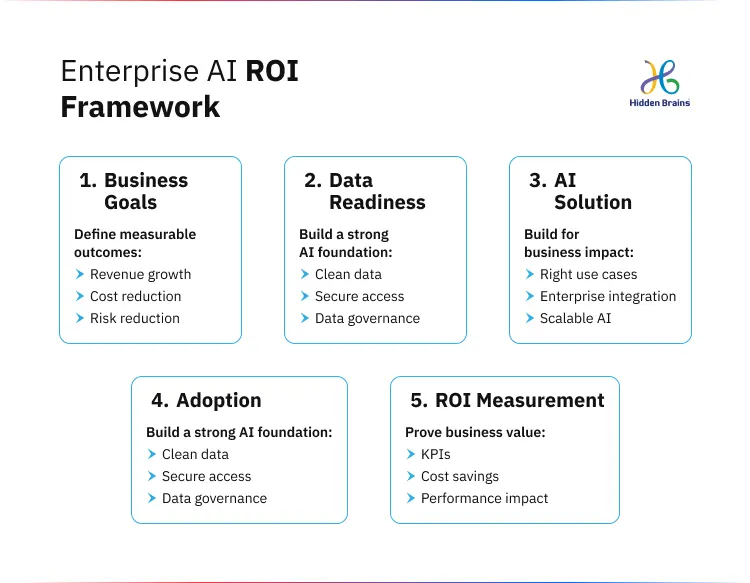
Enterprise AI ROI Framework
1. Business Goals
Define measurable outcomes:
- Revenue growth
- Cost reduction
- Risk reduction
2. Data Readiness
Build a strong AI foundation:
- Clean data
- Secure access
- Data governance
3. AI Solution
Build for business impact:
- Right use cases
- Enterprise integration
- Scalable AI
4. Adoption
Drive real usage:
- Workflow improvement
- User adoption
- Change management
5. ROI Measurement
Prove business value:
- KPIs
- Cost savings
- Performance impact
The principle is simple: Fund AI initiatives that can prove value, not just demonstrate capability.
The Pilot-to-Production Gap: Where UAE Enterprises Lose the ROI
The pilot-to-production gap is the distance between a demo that works and a system that runs daily and pays back, and it’s the single biggest leak. Roughly 70–80% of the effort to cross it is data engineering, integration, governance, and measurement, not modelling.
Four things close the gap:
- Data readiness — Ensure enterprise data is clean, accessible, governed, and permissioned so AI systems can deliver reliable outputs.
- Seamless integration — Embed AI into existing business systems and workflows rather than creating standalone tools that employees rarely adopt.
- Measurable success metrics — Define clear KPIs, track performance, and measure business impact from the beginning.
- Change management & adoption — Redesign workflows, support employees, and ensure teams actually use AI solutions in daily operations.
Miss any one and the pilot quietly dies. This is exactly where a delivery partner with real AI integration services earns its fee, the integration and monitoring layer is what production depends on.
When it comes to enterprise AI, the fastest route to ROI is not always building everything internally.
A specialised enterprise AI development company can often accelerate time-to-value by bringing proven expertise, delivery frameworks, and implementation experience. MIT Project NANDA found that vendor-built AI solutions achieved significantly higher success rates than many internal-only efforts.
If you want to expand internal capability without slowing delivery, you can also hire dedicated AI developers in the UAE to work as an extension of your team.
For many mid-market and growing UAE enterprises, a partner-led approach with knowledge transfer offers a lower-risk path: faster execution while building internal capability over time.

Develop AI Solutions That Meet Enterprise Compliance Standards
Get StartedAvoid the Consulting Dependency Trap
A common ROI blocker is separating strategy from execution. When consultants define the roadmap but leave before implementation maturity, organisations are left dependent on external teams.
Choose a partner that:
- Builds alongside your team
- Transfers knowledge and documentation
- Creates maintainable systems you can operate independently
A strong AI partner should not just deliver a solution; they should strengthen your internal capability.
Framework to Choose the Right AI Partner
| Criterion | What “Strong” Looks Like | Assessment |
|---|---|---|
| Industry experience & references | Has relevant UAE/GCC clients you can speak with. | Yes / No |
| Technical depth | Proven experience solving similar AI challenges. | Yes / No |
| Security & compliance | Meets enterprise security, governance, and data requirements. | Yes / No |
| Data & integration approach | Understands your systems, data readiness, and architecture. | Yes / No |
| Delivery model & communication | Clear ownership, timelines, and reporting cadence. | Yes / No |
| ROI focus & support | Defines success metrics and supports optimisation after launch. | Yes / No |
| Cultural fit & transparency | Realistic about risks and avoids overpromising. | Yes / No |
Certifications Matter When They Reduce Risk
Certifications should not be viewed as badges, they should demonstrate operational discipline.
Look for evidence of:
- Strong security practices
- Quality management processes
- Enterprise delivery experience
- Governance-ready implementation
The right certifications matter when they directly protect your data, reduce delivery risk, and improve long-term maintainability.
Pro Tip – A disciplined approach should look like:
Successful AI programmes follow checkpoints, not a big-bang rollout:
- Prioritise one high-value use case
- Prepare and validate the data
- Integrate into live workflows
- Measure business impact
- Scale only after proven results
No clear delivery sequence? That’s a red flag.
What UAE-Specific Factors Affect Enterprise AI ROI?
In the UAE, governance is becoming part of the ROI equation, not a separate compliance exercise.
The UAE’s National AI Strategy 2031 is accelerating enterprise adoption, while expectations around data governance, security, and responsible AI are becoming stronger. Standards such as ISO/IEC 42001 for AI management systems are increasingly relevant in enterprise procurement decisions.
The UAE Personal Data Protection Law (Federal Decree-Law No. 45 of 2021) shapes how organisations collect, process, and protect the data that powers AI systems. Businesses operating in financial centres such as DIFC and ADGM must also consider additional data protection requirements.
For organisations with global operations, the EU AI Act may also become relevant when AI systems are used in the EU market or connected to EU-based entities.
The practical takeaway: governance built into AI from day one protects both compliance and ROI. Retrofitting security, controls, and auditability after deployment often creates unnecessary cost and delays.
Across the GCC, sectors such as logistics, manufacturing, financial services, oil & gas, and utilities are seeing strong AI opportunities because they generate large volumes of operational data. The organisations that can connect, govern, and activate that data effectively are best positioned to capture AI value.
How Hidden Brains Helps UAE Enterprises Turn AI Into ROI
Hidden Brains helps enterprises move from AI experiments to measurable business outcomes through AI-powered solutions, engineering expertise, and governance-first delivery.
Hidden Brains provides end-to-end enterprise AI services that help organisations move from AI experimentation to scalable, measurable business impact.
- AI Consulting & Strategy — Align AI initiatives with business objectives through AI opportunity assessment, use-case prioritisation, ROI planning, and strategic roadmaps designed around measurable outcomes.
- Enterprise AI Development & Integration — Build secure, scalable AI solutions integrated with existing enterprise applications, workflows, and business systems to drive operational efficiency.
- Data Engineering & AI Enablement — Prepare, connect, and transform fragmented enterprise data into reliable intelligence through data engineering, modern architectures, and AI-ready data pipelines.
- Responsible AI & Compliance Services — Embed security, governance, privacy controls, and auditability into AI solutions to support enterprise requirements from day one.
- Dedicated Development Teams — Extend internal capabilities with experienced AI engineers, data specialists, and technology experts who work as part of your team.
- AI Maintenance & Optimisation Support — Move beyond pilots with deployment, monitoring, continuous improvement, and ongoing support to maximise long-term AI value.
- Enterprise Delivery Excellence — Leverage engineering experience since 2003, backed by CMMI Level 3, ISO 27001:2022, and ISO 9001:2015 certifications, to deliver reliable, enterprise-grade solutions.
Frequently Asked Questions
Which compliance requirements matter for enterprise AI development in the UAE?
The core ones are the UAE Personal Data Protection Law (Federal Decree-Law No. 45 of 2021), data-residency expectations, and ISO/IEC 42001 (AI management systems), which is increasingly appearing in procurement. Firms operating in free zones like DIFC or ADGM also fall under those zones’ own data-protection regimes. The EU AI Act doesn’t apply inside the UAE but reaches organisations whose AI outputs are used in the EU or that sit under an EU parent.
What are common enterprise AI use cases in the UAE?
The clearest early returns come from workflows with large volumes of operational data trapped in disconnected systems: demand and inventory forecasting in logistics and manufacturing, predictive maintenance in oil, gas and utilities, risk scoring and document processing in financial services, and internal knowledge assistants that cut the time staff spend searching for information. The common thread is a repetitive, data-heavy decision, not a flashy use case.
How do you start an enterprise AI project in the UAE?
Start with one high-value use case where the data exists and success can be monetised, agree the metric before any build, then run a small time-boxed pilot before committing to a full programme. This sequence, prioritise, define the metric, pilot, then scale, is what separates AI spend that pays back from spend that stalls.
How long does enterprise AI take to show ROI?
It depends on data readiness and integration complexity, but the biggest variable is scope discipline: a tightly scoped, well-measured first use case can show return far faster than a broad programme with no defined metric.
What does enterprise AI development cost in the UAE?
Cost is driven by data readiness, integration complexity, and scope rather than the model itself. The more useful figure is fully-loaded cost against measured value, which is why defining the ROI metric upfront matters more than the headline price.



Conclusion
Enterprise AI in the UAE is not failing because the technology does not work. It is failing because too many programmes stop at the pilot stage, lack measurable success criteria, and never become part of everyday business operations.The enterprises creating real AI value in 2026 have changed the question from “Can this work in a demo?” to “What does it take to deploy this in production and deliver measurable business impact?”
Define the success metric before development begins. Ensure data readiness and system integration. Select partners based on delivery capability, not just technical promises. Validate value through focused pilots before scaling enterprise-wide.
Want to explore how enterprise AI can deliver measurable ROI for your organisation? Connect with our on-ground AI experts in the UAE.