
























































































































































Summary
The real estate market has immense untapped potential, from enhancing customer experience to reducing investment costs and more. With tools like predictive analytics, IoT, and AI, there are several dimensions yet to be explored that can significantly improve the industry.
As a business, you can lead the way by closing these gaps, strategizing, and moving forward. From strategizing and training to implementation and post-development, Hidden Brains helps you build valuable solutions in real estate that enable you to outperform the competition.
The real estate industry holds immense potential. Negotiating from a square foot area, it has grown into a huge multi billion-dollar bagging industry. But still, many are not able to churn out the profit ratios and unlock more opportunities. Do you know why? They have failed to leverage and churn AI in real estate, leaving $1 trillion “blind spot” gaps in market efficiency, customer satisfaction, and closing deals better.
Now, what is this $1 trillion blind spot? What are the gaps that you can fill? What would be the investment cost and the resulting benefits?
Don’t worry, we have disclosed all this in this blog. We ensure to guide you on the right path and help you untap the goldmine with real estate solutions.
But here is the kicker – Most of the firms are still wrapped around outdated models that drain profits and compound the gaps. Meanwhile, AI in real estate is projected to hit $975.24 billion globally by 2029. It’s time to gear up and move ahead and be a leader in local and global markets.
What are Hidden Spots in Real Estate?
Real estate is often glamorized as prime locations, multi-million dollar properties, better constructed infrastructure, and large-scale developments. But some people often fail to dig down into the surface. It’s data, predictive trends, lurking opportunities, maintenance, and much more. From tenant feedback and maintenance reports to property listing and transaction histories, the journey is really long.
The missed opportunities extend beyond just right-time and physical properties. It goes for data, dynamic trends, maintenance, market shifts, potential customer patterns, and many things the real estate business often misses to look at. Fixing behind the scenes to automation and better results can turn into great profits.
It’s no surprise that Proptech and Contech are transforming the way businesses approach real estate development, but only those who adapt will thrive in this new era of efficiency.
Where Are the Gaps?
So, what are these hidden spots that we’ve been missing? Let’s take a look:
The Data You’re Sitting On
You probably already know that real estate is data-driven. But most businesses aren’t using that data effectively. This is where a real estate consultant can help identify insights hidden inside property values, tenant data, customer feedback, and market trends. There is tons of information about property values, tenants, customer feedback, market trends, and more, and it’s often underused.
- Missed opportunity: Without AI, you might be making decisions based on outdated or incomplete data, missing out on profitable opportunities.
- AI to the rescue: AI can analyze huge datasets in real-time to help you predict price changes, tenant behavior, and market trends. Imagine being able to predict the best time to sell or rent out a property before anyone else sees it coming.
Outdated Property Management Processes
Property management relies on paper and pen. From tenant complaints to maintenance requests, a lot of real estate companies still handle things manually, which leads to slow response times and higher costs.
- Missed opportunity: Without automation, tenants get frustrated with slow service, and maintenance issues aren’t addressed until it’s too late.
- AI to the rescue: Predictive maintenance powered by AI can help you stay ahead of issues by forecasting when a repair will be needed. Plus, automated systems can help with tenant communication, making sure no request slips through the cracks.
Missed Customer Engagement Opportunities
Customers are driven by experiences. But many real estate businesses aren’t doing enough to build relationships with clients after a deal closes. Once the transaction is done, they move on, but that’s a missed opportunity to build loyalty and referrals.
- Missed opportunity: If you’re not following up with tenants or buyers, you’re missing chances for repeat business or positive reviews.
- AI to the rescue: With AI, you can set up automated follow-ups after a sale or lease, send personalized recommendations to clients, and even send reminders for property maintenance, all without lifting a finger.
Inconsistent Marketing Efforts
Traditional marketing, like print ads or general online listings, isn’t always effective in today’s fast-paced world. Real estate businesses are still spending too much on broad, inefficient campaigns that don’t target the right customers at the right time.
- Missed opportunity: If your marketing isn’t optimized, you’re wasting money on channels that don’t convert.
- AI to the rescue: AI-powered marketing tools help you run hyper-targeted campaigns by analyzing customer data and behavior. These tools ensure that your marketing dollars are spent on the right audience, increasing your ROI and driving more sales.
Underutilizing Investment Opportunities
Real estate investors often focus only on established markets, ignoring the up-and-coming areas or emerging property types. This can result in missed opportunities for growth and higher returns.
- Missed opportunity: Focusing too much on traditional markets and missing out on hot spots that could yield higher profits.
- AI to the rescue: With predictive analytics, AI in real estate can help you identify high-potential markets before they explode. It analyzes factors like local economic growth, tenant demand, and even social media sentiment to give you an edge over competitors.
Why AI is the Key to Filling These Gaps
The real estate industry is fertile land for AI transformation, and businesses that adopt AI will be the ones that thrive. In fact, AI in real estate is expected to hit $975.24 billion globally by 2029. So if you are not using AI, you are giving someone else an advantage to capture your market share and grab more profits.
AI in Real Estate Can Help You:
- Make smarter investments: AI can analyze market trends and predict property values, helping you make smarter investments with less risk.
- Optimize property management: AI-powered tools help automate maintenance, tenant management, and operations, cutting down on costs and improving tenant satisfaction.
- Boost marketing ROI: By automating your marketing campaigns and targeting the right audience, AI can help you get more leads for less money.
AI in Real Estate: The Businesses Crushing It and What They’re Gaining
Here are the results of some of the leaders who have put their efforts and best practices of AI into action.
Zillow
Zillow embedded the ‘Zestimate’ feature, which turned out to be a great asset for evaluating property valuation. It can predict home value with a median error of just 2.4%, positioning Zillow as a leader in digital property estimates.
Redfin
Redfin used AI for automated property valuations and personalized recommendations. These tools improved the accuracy of property assessment and streamlined the buying and selling process. This solved the major challenge of customer experience.
Opendoor
Opendoor uses AI to make instant offers on homes by analyzing data-driven property valuations. This AI-backed approach significantly reduces time-to-close, improves pricing accuracy, making the buying and selling process quicker and more efficient.
CoreLogic
CoreLogic offers AI-powered property intelligence tools, such as automated valuation models and risk assessments. Widely used by lenders and appraisers, their tools deliver reliable property insights that help mitigate risk and make better decisions. This is another use case of AI for real estate leads.
Prologis
Prologis implements AI and IoT systems to optimize energy consumption and monitor real estate assets. With energy savings of around 20%, they demonstrate how sustainability can be integrated into operational processes while improving asset management.
Real Estate Marketplace
An idea driven by the client and powered by Hidden Brains resulted in an MLS real estate platform that provides comprehensive, convenient solutions, enabling buyers, sellers, and renters to transact in one place in real time.
Now you have a proven framework and results. Now, let’s talk numbers.

What is the Investment Cost?
AI sounds amazing. It can save a huge amount. But are these real? Yes! It is.
Calculate your no-shows and ghosted leads. Probably 20+ deals/year. AI costs 4 deals, recovers 16. This is the power of AI in real estate. It can grow every month and every year. The benefit is recurring.
Here we have broken down the investment cost. Though you might find a huge amount to invest, with AI-as-a-Service, you can solve and bring costs down, and be equally effective.
1. Software Setup & Integration
First things first: You’ll need to invest in AI platforms that fit your business needs. This involves purchasing licenses and integrating the software with your current systems.
- Costs:
- AI platform licenses: $10k – $100k
- Integration with your systems: $5k – $20k
- Customization to meet your needs: $15k – $30k
- AI platform licenses: $10k – $100k
- Total Estimate: $20k – $150k
2. Hiring Resources & Training
To get AI up and running, you’ll likely need a few new hires or some external consultants. Plus, training your team on how to use the new tools is key to success.
- Costs:
- Hiring AI/Data experts: $70k – $150k/year per expert
- Project managers/IT support: $60k – $120k/year
- Staff training: $5k – $15k (one-time)
- Hiring AI/Data experts: $70k – $150k/year per expert
- Total Estimate: $20k – $200k+
3. AI Integration & Feature Additions
Now, let’s talk about adding those cool AI features to your business, like property valuation models, predictive maintenance, chatbot development, and customer service automation.
- Costs:
- Adding AI features (e.g., predictive maintenance, automated pricing): $10k – $50k
- Custom AI integration: $15k – $60k
- AI algorithms/data feeds for valuation: $5k – $30k annually
- Adding AI features (e.g., predictive maintenance, automated pricing): $10k – $50k
- Total Estimate: $15k – $100k+
4. Ongoing Maintenance & Updates
Like any tech, AI requires ongoing updates, patches, and system maintenance to keep everything running smoothly.
- Costs:
- Maintenance contracts: $5k – $15k annually
- Cloud storage/servers: $3k – $20k per year
- System updates and feature improvements: $5k – $30k annually
- Maintenance contracts: $5k – $15k annually
- Total Estimate: $8k – $40k/year
5. Data Acquisition & Management
AI runs on data, so you’ll need to acquire high-quality, relevant data (think market trends, demographic data, property histories). Plus, you might need tools to clean and integrate it.
- Costs:
- Data acquisition (e.g., market data, property data): $5k – $50k annually
- Data cleaning and preparation: $10k – $25k annually
- Data acquisition (e.g., market data, property data): $5k – $50k annually
- Total Estimate: $15k – $75k/year
6. Testing & Quality Assurance
Before going full throttle, you’ll need to run some tests to ensure the AI is functioning as expected and delivering accurate results.
- Costs:
- Testing environments and tools: $5k – $15k
- QA labor (e.g., AI model validation): $10k – $30k
- Testing environments and tools: $5k – $15k
- Total Estimate: $15k – $45k

Total Investment Breakdown
Let’s pull it all together. For the real estate business, this may cost up to $200-$850k+. But at Hidden Brains, we solve all your strategy, consultation, implementation, and everything under one roof at just $150K.
To know more about it, get a 2-Hour Free Consultation. Where you can raise the queries in real-time, ask the questions one-to-one, and get the perfect, precise, experience-driven answers on the spot.
Quick Tips to save your cost:
- Opt for MVP (Minimum Viable Product) to start small and expand gradually
- Use pre-trained AI models and APIs to reduce training costs
- Outsource development to regions with lower costs but reliable expertise
- Focus on core features first, then add advanced functionality iteratively
How to Implement AI and Automation in Real Estate: Your Step-by-Step Roadmap
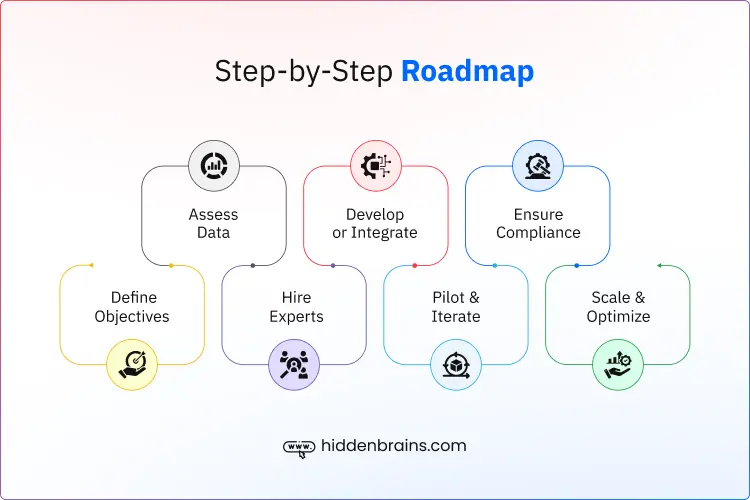
Define Clear Objectives: What’s Your End Goal?
Before you jump into the world of AI, figure out what you want to achieve. Are you looking to boost property valuations? Need help with tenant management or predictive maintenance? Maybe it’s marketing automation or improving the tenant experience. Whatever it is, be clear about your goals.
Assess Your Data Infrastructure: Clean Data = Smart AI
AI needs clean, organized data to work. That’s just a fact. So before you dive in, take stock of your current data. Is it tidy? Is it all in one place? The better the data, the better the insights.
Hire People to Build Your Software Development Team
Ready to take things to the next level? The question will be when and why to hire a dedicated development team.
Well, you basically have two options – Hire a dedicated team or go for end-to-end development. For both scenarios, choose one who is proficient with the domain and backed by industry knowledge.
Develop or Integrate AI Solutions: Build or Buy?
Now that you’ve got a solid team and clear objectives, it’s time to develop or integrate your AI solutions. You have two choices:
- Build: If you have specific needs and want complete control over your AI tools, custom development is the way to go.
- Buy: If time is of the essence, there are tons of off-the-shelf AI tools you can integrate into your current system, such as automated property valuation models or predictive maintenance systems.
Pilot and Iterate
Don’t go all-in right away! Start small with a pilot project. Test one aspect of your business, maybe it’s automated property valuation or tenant management. Get feedback, refine the process, and then scale. You don’t overdo everything at once.
Ensure Compliance and Ethics
AI is a powerful tool, but it’s also a sensitive one. You need to ensure that your AI system complies with data protection laws and ethical standards. This includes things like GDPR compliance and ensuring that AI decisions are fair and transparent.
Scale and Optimize
Once your AI system is running smoothly in the pilot phase, it’s time to scale. Take the successful elements and expand them across the rest of your operations. Whether it’s marketing, property management, or market forecasting, now is the time to take full advantage of what AI offers.
Frequently Asked Questions
Transforming AI dilemmas in real estate into clear, actionable insights for better decision-making. Get all your questions answered by our experts.
1. Why is AI important in real estate?
AI helps automate tasks, make data-driven decisions, and improve the customer experience, all of which lead to higher efficiency and profits.
2. Is AI expensive to implement?
While the initial investment can seem high, the long-term benefits far outweigh the costs. Automation leads to significant savings, and AI-driven decisions result in better returns.
3. How does AI help with property management?
AI helps predict maintenance issues, automate tenant communications, and optimize leasing processes, leading to better tenant retention and lower costs.
4. How can AI improve marketing in real estate?
AI helps you target the right audience, personalize your marketing messages, and optimize your campaigns for maximum return on investment.
5. Can you help me build an end-to-end solution for real estate?
Yes! At Hidden Brains, our 22+ years of experience and strong industry knowledge can bring untapped opportunities, potential, and possibilities for your business. Whether you’re looking to integrate AI-driven solutions, develop custom software, or create a complete end-to-end platform, we’ve got you covered.
From AI integration and property management tools to real-time analytics and tenant engagement systems, we help you build solutions that are both innovative and future-proof.



Wrapping Up
Well, seeing these patterns and evident use cases, it’s sure that AI is changing the game. Well, it’s not just this AI in Proptech and Contech that has different plans, too. What was past an unpredictable problem and a predictable bottleneck is solved with AI in real estate efficiently.
All you need is to be ready, set, and move with Hidden Brains and unlock massive $1 trillion hidden spots.