




















































































































Quick Summary:
AI-as-a-Service is changing the game for businesses of all sizes, making it easier than ever to tap into the power of artificial intelligence without the heavy lift of building infrastructure, hiring specialized talent, or managing in-house development. Whether you’re a startup, an SME, or a large enterprise, this guide acts as your go-to playbook to help you adopt AIaaS, streamline operations, make smarter decisions, and scale with confidence.
From predictive analytics in finance to computer vision in manufacturing, we break down real-world challenges and show how a Custom AI Development Company can leverage AIaaS to solve them.
AI is no longer on the horizon, it’s here, rewriting, restructuring and redefining every aspect of business. Statista forecasts this momentum to surge, with the AI market expanding at a 26.60% CAGR (2025–2031) and hitting a staggering US$1.01 trillion by 2031.
While the opportunity is huge, small-scale businesses are still lagging and are missing diving into it. AI being cost-prohibitive is still a matter of concern for the majority of businesses. But with ‘AI-as-a-Service’, things have simplified.
Artificial Intelligence as a service is not a new term. It works on the analogy of IaaS, PaaS, and SaaS. You don’t need to buy an entire heavy infrastructure. Building solutions is possible through a cloud-based delivery model. AIaaS is a way to build, maintain, and invest without investing in infrastructure or specialized expertise.
What does it translate to or for business? How does it help in building a business? What other possibilities are there with AIaaS? Let’s unfold many chapters, giving you complex insights into what works and what doesn’t, and what drives more value to the business.
What is AI-as-a-Service?
AI-as-a-Service (AIaaS) is like renting cutting-edge AI tools straight from the cloud. It offers ready to use capabilities for various business needs, including specialized solutions such as AI recruitment software. No need for vendor lock-ins, no monolithic equipment to be on your premises. All you need is to plug in, power, and connect, and create with endless possibilities.
Instead of getting resources and infrastructure, you use ready-made AI services through the internet. Also, you have to pay only for what you use, not extra for overheads.
AI-as-a-Service comes with pre-built, ready-to-use AI models like NLP, computer vision, speech processing, predictive analytics, and more.
AI-as-a-Service (AIaaS) is a startup’s secret weapon. It skips the huge upfront costs of AI infrastructure, hardware, or hiring PhDs, grabs ready-made AI tools from the cloud, and pays only for what you use. This levels the playing field, letting any business tap into AI to innovate, optimize processes, and scale without limits.
Good Read – Generative AI in healthcare is already driving a shift toward smarter treatment approaches. You too can be a part of revolution and make more with AI-as-a-Service.
Before we move ahead, let’s get a glimpse of what makes AIaaS special compared to traditional AI. Understanding these differences is essential when shaping a scalable go-to-market strategy framework that aligns AI capabilities with real customer needs.
AIaaS vs. Traditional In-House AI
Who Should Use AI-as-a-Service (AIaaS)? For which business is it a right fit?
AI-as-a-Service can fit businesses of all sizes. There are no biased restrictions. For anyone who wants to uplift with the power of AI without breaking the bank or building complex systems from scratch, you should take advantage of it.
Startups
Startups, you’ve got the vision, the energy, and the ambition to disrupt—but resources are tight, timelines are short, and every decision counts. Juggling product development, market fit, and scaling can feel overwhelming.
That’s where AI-as-a-Service comes in. It empowers you to innovate faster, make smarter decisions, and optimize operations, without the burden of heavy infrastructure or expensive talent.
AI-as-a-Service: Turning Business Roadblocks into Wins
Problem: No Strategic Roadmap & Limited Resources
Solution: NLP + Deep Learning enable scenario planning, decision-making, and risk assessment by analyzing trends, customer feedback, and competitors, helping craft adaptive, cost-effective strategies.
Problem: Unreliable Forecasting
Solution: Predictive Analytics leverages historical data for accurate demand, sales, and cash flow forecasts, transforming guesswork into data-driven decisions.
Problem: Inventory Chaos
Solution: Computer Vision + Predictive Analytics provides real-time stock monitoring and optimizes replenishment, ensuring balanced inventory and reduced profit leaks.
Problem: Slow Prototyping
Solution: Cloud-based AIaaS platforms accelerate prototyping and MVP development, offering AI features like AR try-ons and recommendation engines. Build faster, validate quicker, and launch impactful products on time.
Why AI-as-a-Service for Startups?
- Affordable Innovation: Enterprise-grade AI without upfront infrastructure costs.
- Faster to Market: Accelerate MVPs, prototyping, and product launches.
- Scalable by Design: Cloud-based models that grow as your user base expands.
- Smarter Decisions: Predictive analytics + NLP deliver insights for funding, growth, and competitive moves.
A startup’s journey is complex. We understand. From blueprints to execution, startup product development company is there for you.
SMEs
SMEs, you’ve grown fast, kept the momentum, and built your market presence. But behind the scenes, it’s a different story. Tight budgets, clunky workflows, and rising competition make the journey tough. Balancing it all? Easier said than done.
That’s where AI-as-a-Service steps in. It helps lighten the load, tackles your biggest pain points, meets critical needs, and drives real results. All this without blowing the budget.
AI-as-a-Service: Solving SMEs Challenges
Challenge – Overburdened Customer Support
Solution – AI-driven Chatbot Development with NLP automates inquiries, delivers personalized responses, and boosts service efficiency. Achieve 45% faster response times and 35% lower support costs.
Challenge – Inefficient Inventory Management
Solution – AIaaS + Computer Vision monitors stock in real time, while predictive analytics optimize replenishment. Gain better warehouse control, reduce 25% inventory waste, and streamline cash flow.
Challenge – Delayed Strategic Insights
Solution: Predictive analytics + Machine Learning uncover trends and opportunities fast. Get clear, actionable insights without the cost of a full in-house analytics team.
Challenge – Poor Employee Experience
Solution: Intelligent AI tools personalize workflows, optimize task allocation, and improve productivity, boosting both efficiency and morale.
Challenge – Slowed Innovation Curve
Solution: AIaaS accelerates R&D with predictive analytics and deep learning. Faster prototyping, sharper market insights, and more innovative products.
Challenge – Stagnant Customer Engagement
Solution – Generative AI, NLP, and Predictive Analytics create multilingual, personalized journeys. Redefine customer engagement across global markets.
Why AI-as-a-Service for SMEs?
- Enterprise-grade AI for SMEs through a pay-as-you-go model.
- No costly infrastructure or in-house expertise needed.
- From automating interactions to optimizing supply chains, AIaaS scales with your business.
Hire AI Developers to build custom, ROI-focused AI solutions tailored for your journey.
Enterprises
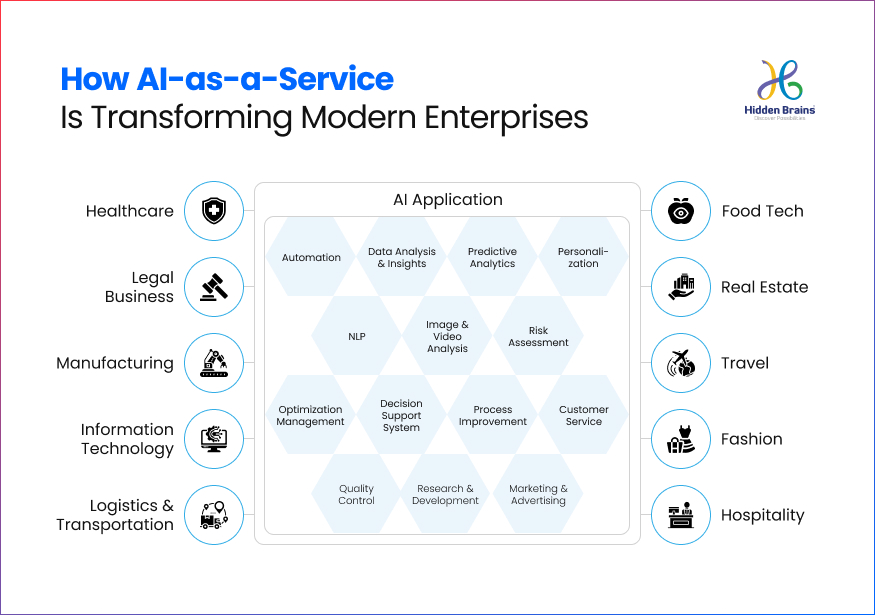
Enterprises today are complex ecosystems, undertaking multiple operations, processes, and teams. Only a selected few high-stakes players are strategically applying AI to drive broad organizational impact. For the rest, the challenge isn’t lack of ambition but lack of alignment.
By bringing together data, talent, and technology around high-value use cases, enterprises can move beyond scattered pilots and proofs of concept to truly deploy AI at scale, capturing measurable value from their investments and securing long-term advantage.
But the good news is enterprises don’t have to scale all at once or attempt a costly overhaul. With AI-as-a-Service, adoption can be modular and incremental. This approach lets organizations manage risk, control costs, and still move toward enterprise-wide transformation, one high-value use case at a time.
Challenge – Fragmented Operations
Solution – AIaaS integrates across multiple teams and processes, ensuring smoother workflows and connected decision-making across the enterprise.
Challenge – High Infrastructure & Talent Costs
Solution – With a pay-as-you-go model and access to hire dedicated developers, enterprises avoid heavy upfront investments and still access top-tier AI expertise.
Challenge – Slow Scaling of AI Initiatives
Solution – AI-as-a-Service enables modular adoption, start with a single use case, prove value, and scale across departments without disruption.
Challenge – Data Silos & Complex Decision-Making
Solution – Predictive analytics, NLP, and machine learning unify data sources and deliver actionable insights for strategic enterprise-wide impact.
Why AI-as-a-Service for Enterprises?
- Scale Without Disruption
- Unify siloed data, enabling faster, smarter decisions across
- Test, iterate, and expand without risks
- Access advanced AI capabilities through pay-as-you-go model
AI-as-a-Service Use Cases You Should Know About
AI as a Service is not a monolithic copy-paste version. There is something for every business.
Here are different models of AIaaS that can fit your business needs.
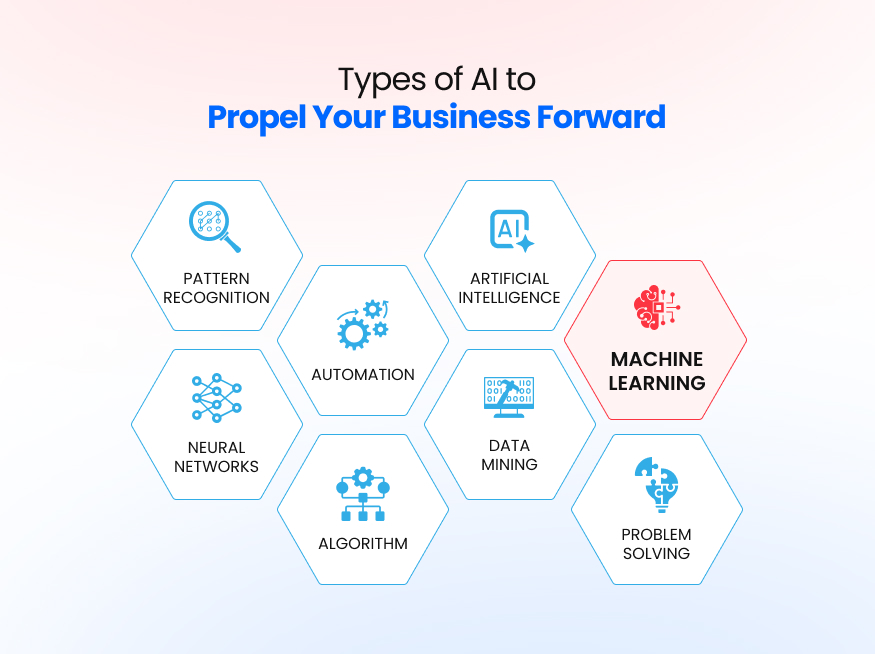
Machine Learning as a Service
Machine learning used to be a lot like building rule-based systems with limited outputs, complex tools, high costs, and models built entirely from scratch. But that’s no longer the case.
Today, Machine Learning as a Service (MLaaS) simplifies the process. Think of it as a ready-to-use toolbox, like Legos. Pre-built components let you piece together custom models without starting from zero. You get access to powerful AI tools that are already built in, and many platforms offer intuitive, drag-and-drop interfaces for experimentation and model building.
Sure, MLaaS has its limitations. But for many businesses, it opens the door to faster innovation without the overhead.
Key Features:
- Pre-built models
- Automated data processing
- Scalable computing power
- User-friendly interfaces
Benefits
- Reduced deployment time
- Lower costs
- Rapid prototyping and deployment
How can it be used in your industry?
AI is changing the game, but not in the same way for everyone. Its ability to automate, analyze, and assist is being used differently in every industry. Here’s how AI-as-a-Service is making an impact across the board.
Healthcare
✔️ Personalized Treatment and Diagnostics
✔️ Administrative Automation
Retail & E-commerce
✔️Personalized Recommendations
✔️Inventory Optimization
✔️Dynamic Pricing & Churn Prediction
Manufacturing
✔️Predictive Maintenance
✔️Quality Assurance
✔️Production Optimization
Finance & Banking
✔️Fraud Detection
✔️Credit Risk Assessment & Underwriting
✔️Compliance Monitoring
Challenges: Needs clean data and some expertise for fine-tuning. Ethical concerns like bias require regular audits.
Also Read – Role of AI and ML in Mobile App Development
Natural Language Processing as a Service
We build for humans. We work for humans. We need a solution that understands, interprets, and talks in human language in their language and their way. This is where NLP comes in.
As NLP capabilities extend into speech-based workflows, spoken language is increasingly processed alongside text. In multilingual environments, audio translator functionality supports the conversion of recorded or live speech across languages for use cases such as internal communication, training material, and archived media. Think of NLP as a best friend who understands, converses, and speaks every language. And it doesn’t get boring either!
Key Features:
- Pre-trained language models
- Sentiment and emotion analysis
- Language translation and localization
- Speech-to-text and text-to-speech
- Named entity recognition and intent detection
Benefits:
- Improved customer engagement
- Real-time multilingual communication
- Faster response times with conversational AI
- Automated support and reduced human workload
How can it be used in your industry?
Oil & Gas
✔️Intelligent Document Processing
✔️ Operational Safety & Incident Reporting
✔️ Exploration & Drilling Insights
✔️ Market Intelligence & Strategy
Logistics & Supply Chain
✔️ Risk Monitoring
✔️ Inventory Tracking
✔️ Route Optimization
Automotive
✔️ Autonomous Driving Development
✔️ Predictive Maintenance
✔️ Driver Behavior Analysis
Challenges – Models can sometimes perform exceptionally well, while others are bland. Need experts to train models and achieve real-time performance with complex NLP models.
Robotic Process Automation
Robotic Process Automation (RPA) cuts the repetitive, rule-based tasks that overly consume human time. This adds up to invoicing, data entry, form filing, system-to-system transfers, and more. RPA handles everything with speed and consistency.
RPA doesn’t work in isolation. Combined with AI, ML, NLP, OCR, IoT,and ERP Solutions, it powers up new levels of efficiency, agility, and intelligence. This combination helps in faster workflows, greater accuracy, and real productivity, all at scale.
RPA is not about physical robots. It’s smart software that mimics human actions with precision, handling high-volume tasks error-free. It can process unstructured data, learn from patterns, and make decisions based on logic and data.
Key Features
- Rule-based task
- Seamless System Integration
- AI and ML Integration
- NLP & OCR Capabilities
- Process Orchestration
- Audit Trails and Compliance Monitoring
Benefits
- Increase Productivity
- Improved Accuracy and Consistency
- Faster Turnaround Time
- Enhanced Customer Experience
- 24*7 Operations
- Data-driven Insights
Use Cases of AI-as-a-Service as Per Industry
Banking
✔️ Account Opening Automation
✔️ Loan Processing
✔️ Fraud Detection Alerts
Financial Services
✔️ Invoice Processing
✔️ Reconciliation of Transactions
✔️ Regulatory Reporting
Healthcare
✔️ Patient Record Management
✔️ Insurance Claims Processing
✔️ Appointment Scheduling
Challenges – Lack of intelligence. It can perform only rule-based tasks. Often requires a human step to add another layer of safety and clarity.
Also Read – Generative AI vs Agentic AI– Which One is the Best Approach in 2026?
AI Agents and Autonomous Systems
AI agents are like orchestra conductors. They coordinate multiple moving parts while keeping everything in sync. Traditional AI models have fixed rules or scripts, while AI agents combine machine learning, natural language processing, and planning algorithms to think, act, and adapt on their own.
They are capable of complex tasks independently. From analyzing data, making decisions to adjust new inputs, all in real time.
But there is more.
Autonomous systems have taken things a step further. They’re the brains behind self-driving cars, smart drones, and fully automated warehouses. These systems can run entire operations with little to no human intervention.
In the AI-as-a-Service world, these intelligent systems are delivered via the cloud. Platforms like AWS, Microsoft Azure, and Google Cloud offer these capabilities through APIs and dashboards, so there is no need to build from scratch. It’s like having a digital Swiss army knife for your business, ready to plug, play, and solve.
How Do AI Agents Work in AIaaS?
AI agents in AIaaS are powered by a blend of cutting-edge technologies:
- Machine Learning and Deep Learning: Enable agents to learn from data and improve over time, like perfecting a recipe.
- Natural Language Processing (NLP): Allows agents to understand and respond to human language, powering chatbots and virtual assistants.
- Planning and Reasoning Algorithms: Help agents break down complex tasks into actionable steps, like a GPS plotting the fastest route.
- Reinforcement Learning: Trains agents to make optimal decisions by rewarding successful outcomes, akin to teaching a pet new tricks.
- Computer Vision: Equips agents to interpret visual data, useful for tasks like quality control in manufacturing.
In AIaaS, these components are pre-built and accessible via platforms like Microsoft’s Copilot Studio or AWS’s SageMaker. Businesses integrate them through APIs, enabling seamless embedding into existing systems. For example, a retailer might use an AI agent to monitor inventory, predict demand, and reorder stock, all in one go.
Use Cases in Industry
Oil and Gas
- Autonomous Hazard Response Units
- Closed-loop Decision Systems
Logistics & Supply Chain
- Self-evolving Delivery Networks
- Preemptive Supply Chain Disruption Response
Healthcare
- Digital Cognitive Assistants in Diagnosis
- Autonomous Discharge Planning
Computer Vision
Seeing is believing, and computer vision grants machines that ability. By transforming raw video and image data into real-time, actionable insights, it powers a wide range of applications.
Autonomous vehicles and smart retail shelves, for example, are driven by computer vision. Just as human eyes feed data to the brain, computer vision systems rely on cameras and sensors as their “eyes” to capture and interpret the world with remarkable precision.
Using this analogy, the systems can detect product defects in manufacturing, manage warehouse inventory, monitor infrastructure, and help machines safely navigate their environment.
With the right strategy and tools, computer vision can turn observations into operations, combined with speed, accuracy, and scale. To get started, hire a Computer vision specialist to translate your use case into visual AI systems.
Key Features
- Object Detection & Recognition
- Image Classification
- Facial Recognition
- Optical Character Recognition (OCR)
- Pose Estimation
- Semantic & Instance Segmentation
- Video Analytics
- Anomaly Detection
Benefits
- Real-time Decision-Making
- Enhanced Operational Visibility
- Improved Accuracy & Safety
- Reduced Manual Inspection
- Cost-efficient Quality Control
- Fast Issue Resolution
Use Cases by Industry
Healthcare
✔️ Medical Image Analysis
✔️ Tumor & Anomaly Detection
✔️ Surgical Assistance
Manufacturing
✔️ Defect Detection
✔️ Assembly Line Monitoring
✔️ Predictive Maintenance
Retail & E-commerce
✔️ Shelf Inventory Monitoring
✔️ Customer Footfall Analysis
✔️ Visual Product Search
Now that you are aware of different models, use cases, and more for AI-as-a-Service, it’s time to choose the best platform. If you are still skeptical about a few things, it’s time to get AI strategy consulting services. Consulting solves specific problems, gives you better direction, and navigates in ever-changing seas.
Ready to move from exploration to execution? You’re almost there. Here are a few platforms we’ve highlighted to help you make a confident, well-informed choice.
AI-as-a-Service – Which Platform to Choose to Bring Innovation Alive?
Businesses are moving beyond Software-as-a-Service (SaaS), which helps people work faster, to Artificial Intelligence-as-a-Service (AIaaS), where the work gets done for you.
SaaS was built to digitize, while AIaaS is built to automate. It’s no longer just about having the right tools; it’s about achieving real outcomes. But before you dive in, make sure you choose the right platform to uplift your business to where it needs to go.
And when you’re ready to scale smart? Hire AI developers who build intelligent systems that deliver real results.
We have broken down the key AIaaS models and their technical foundations so you can make the most out of your investment.
Emerging Trends in AIaaS: What’s New in 2026?
- Advanced Language Models: Models like OpenAI’s o1 and o3 offer step-by-step reasoning, enhancing accuracy for complex tasks (MIT Technology Review).
- AI in Scientific Discovery: Tools like Meta’s datasets and Hugging Face’s LeMaterial accelerate breakthroughs in materials science and drug development (MIT Technology Review).
- AI Agents: Microsoft’s Copilot Studio enables no-code agent creation, transforming business processes (Microsoft AI Trends).
- Generative AI: Tools like Midjourney create immersive content for gaming and design (Grand View Research).
- National Security: AI powers drone surveillance and cybersecurity (Mordor Intelligence).
- Enhanced Chatbots: Improved NLP makes chatbots more conversational, boosting customer satisfaction (Thomson Reuters).
A Practical Framework for AI-as-a-Service Implementation
With a buffet of things and a new AI platform releasing every week, not clear which one to choose, and choosing the right one can feel overwhelming. DIY approaches often lead to confusion, delays, or missed opportunities. The right tech talent and strategic consultation can simplify the process.
Here are a few steps that help you kick off the journey with clarity and confidence.
- Start with Discovery
Before finalizing one, shell out where AI can actually help in your business. Or what are the gaps you want to fill?
- What are the challenges?
- What will be after the AIaaS implementation?
- What are the factors that need to be aware of?
This will help you cut through the chase of hype and understand the actual problems with clear goals.
- Focus on ROI and Simplicity
Not every AI is worth embracing. Prioritize the one that aligns with your goals, wants, needs, and future.
- Align if it can be implemented with the existing system. No major overhauling.
- Is it likely to save time or money? Is it for the better?
- Aligned with your business goals
- What about the future?
Think automation, customer services, or smarter decisions. A consultation will give clear directions, costs, value, and how to use them.
- Prioritize Tech That Scales and Stays Relevant
Your AI should be one that aligns with your business. It should not be a complicated puzzle that takes years to meet end goals.
- Easy integration with tools, those already in use
- Industry-specific starter kits
- You can tweak Workflows and the dashboard
- What are the future possibilities of rebuilding or revamping?
Of course, future proofing means a better return on investment and ahead.
- Pick the Right Model
It’s not one-size-fits-all. Some businesses demand efficiency and accuracy, while others demand an intelligent, resonant model. The right model equals a better return on investment.
How Hidden Brains Can Help?
Hidden Brains offers a suite of AI-powered development services that align with the AIaaS model, allowing businesses to access AI capabilities on demand.
With legacy-rooted experience across the industry, from basics to breakthroughs, we help deliver innovation through custom, outcome-driven solutions.
Every solution, AIaaS, SaaS, or custom AI, is designed with one thing in mind: enterprise-grade performance that scales.
The future of tech is immutable. Be ready to thrive in a far-reaching revolution. But before that, get a preliminary tech roadmap. Contact us TODAY!
Got more queries?
Let’s simplify for you with our FAQs.
Frequently Asked Questions
What is AI-as-a-Service?
AIaaS, or Artificial Intelligence as a platform, is a cloud-based service where you can rent tools like AI, machine learning, or language processing without setting up a monolithic AI.
Which AI services and tools do you offer?
We offer a suite of services and tools, including:
Natural Language Processing (NLP)
Computer Vision
Conversational AI
AI-driven Analytics
Custom Solutions as per industry-specific use case
How does AIaaS work?
AI-as-a-Service works on a plug-and-play model. Businesses can access AI capabilities via APIs, SDKs, or a tailored dashboard. You can go for an initial consultation and get insights on the suitable model that can be fit for your business workflow, either ready-made or custom-built.
All services are scalable, cloud-hosted, and maintained to ensure performance, security, and uptime.
Is AIaaS secure and compliant as per the industry standards?
Yes. All solutions are secure and compliant as per industry standards.
Can I integrate AIaaS in our existing legacy systems and infrastructure?
Yes. It’s possible to integrate into an existing legacy system without disturbing the present architecture or workflows. Whether you are working on legacy ERP systems, on-prem databases, or hybrid cloud environments, the platform supports all.
Can we customize AI models, or are we limited to “out of the box” solutions?
There are both options available. You can choose out-of-the-box and custom solutions.
What is the pricing structure of AIaaS implementation?
AIaaS pricing is flexible as per business needs. However, as per your usage level, customization, deployment type, type of AI services, model you choose, and more.

Conclusion
AI-as-a-Service has changed the game for business. The trending technology that was needed of the hour for small and SMEs to afford and bring more power within reach has become more affordable.
It’s no longer exclusive to privileged customers, but rather about promoting inclusivity and accessibility for all. With AI-as-a-Service, it’s time to recalibrate tech, costs, and efficiency for business.
The future of AI-as-a-Service is booming. There are more possibilities to be discovered. With the AI-as-a-Service toolbox, there are numerous possibilities. It comes in different shapes and models.
A mix-and-match combination of machine learning, natural language processing, robotic automation, AI agents, and computer vision can bring numerous possibilities. It’s not about monolithic, it’s about small solo segments or combinations that can work best.
A great approach to accelerating AI development and time-to-market starts with an expert AI software development service.