













































![Sales & Distribution [Oil & Gas]](https://www.hiddenbrains.com/blog/wp-content/themes/blankslate/assets/images/sales_and_distribution-icon.74d08193.svg "Sales & Distribution [Oil & Gas]")

![Fluid Terminal Management [Oil & Gas]](https://www.hiddenbrains.com/blog/wp-content/themes/blankslate/assets/images/fluid_terminal_management-icon.4b3a27a4.svg "Fluid Terminal Management [Oil & Gas]")


![Sales & Distribution [Oil & Gas]](https://www.hiddenbrains.com/blog/wp-content/themes/blankslate/assets/images/sales_and_distribution-icon.74d08193.svg?1.0.0 "Sales & Distribution [Oil & Gas]")
![Fluid Terminal Management [Oil & Gas]](https://www.hiddenbrains.com/blog/wp-content/themes/blankslate/assets/images/fluid_terminal_management-icon.4b3a27a4.svg?1.0.0 "Fluid Terminal Management [Oil & Gas]")



























































Summary
- Enterprises face scaling issues due to rigid, outdated architectures.
- Downtime, slow releases, and rising costs signal structural limitations.
- MERN stack architecture enables faster, flexible, and scalable systems.
- A unified JavaScript ecosystem reduces dependencies and complexity.
- Express.js simplifies API management and backend scalability.
- Modern MERN supports AI, serverless, and microservices architectures.
- MERN stack benefits for business include speed, efficiency, and growth.
When the System Becomes the Bottleneck!
Last quarter, we sat across from a CTO who had just completed another outage review. He wanted to understand why competitors were launching features faster while his team was still dealing with downtime.
We explained that high-performing organizations are not constantly fixing systems; they build on architectures designed for scalability, speed, and flexibility. MERN Stack Architecture has emerged as one such approach, enabling enterprises to build high-performance, scalable applications.
When asked if this was a performance issue, we clarified that performance is only a symptom. The real challenge lies in scalability and architectural design, which are essential for ensuring that applications can handle increased loads and user demands effectively.
This highlights a critical shift toward scalable systems. Why is MERN so effective? Let’s explore.
MERN: Not Just a Stack, But a Scalability Strategy
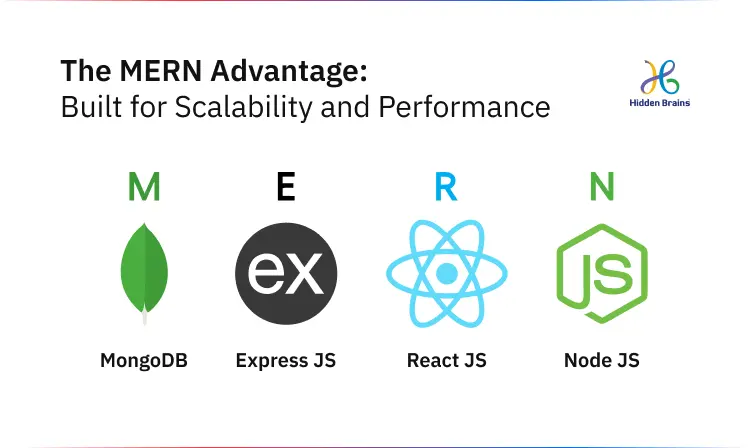
When we introduce the MERN stack: MongoDB, Express.js, React, and Node.js, we don’t position it as a trend. We position it as a response to the challenges enterprises are already facing.
- Growing data complexity
- Increasing user expectations
- The need for speed without instability
“What if your frontend, backend, and database spoke the same language?” we asked that CIO. He smiled. “Fewer dependencies. Faster releases.” This is precisely how the stack empowers enterprises to define a scalable digital strategy roadmap and consistently achieve business objectives. MERN simplifies complexity at scale.

Struggling to Scale Smoothly?
Connect NowThe MERN Advantage: Built for Scalability and Performance
MERN Stack Architecture combines MongoDB, Express.js, React, and Node.js into a unified ecosystem built for modern enterprise needs.
It eliminates fragmentation and enables scalable web application architecture that is flexible, high-performing, and efficient. Its true value lies in translating technical strengths into measurable business outcomes.
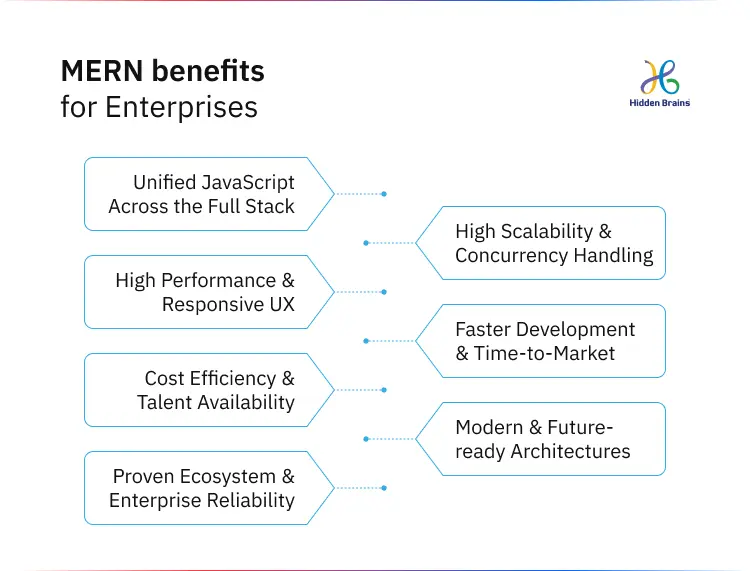
Key MERN Stack Benefits for Business
- Unified JavaScript Across the Full Stack: MERN uses a single language across frontend, backend, and database layers. This eliminates context switching, simplifies development, and enables code reuse across the application.
- Enterprise impact: Faster onboarding, fewer errors, and lower long-term maintenance costs with highly productive full-stack teams.
- High Scalability and Concurrency Handling: Node.js supports non-blocking, event-driven processing, while MongoDB enables horizontal scaling through sharding and replication. This allows systems to handle high volumes of concurrent users and transactions efficiently.
- Enterprise impact: Applications scale seamlessly from thousands to millions of users without major architectural changes.
- High Performance and Responsive User Experience: React’s Virtual DOM ensures efficient UI rendering, while Node.js handles backend operations with low latency. This combination delivers consistent performance even under heavy load.
- Enterprise impact: Faster response times, improved user experience, and stable performance during traffic spikes.
- Faster Development and Time-to-Market: With reusable components, extensive npm libraries, and flexible data modeling, MERN accelerates development cycles and enables rapid iteration.
- Enterprise impact: Quicker product launches, faster feature rollouts, and reduced development costs.
- Cost Efficiency and Strong Talent Availability: Being open-source, MERN eliminates licensing costs, and its widespread adoption ensures access to a large pool of skilled developers.
- Enterprise impact: Lower hiring costs, easier team scaling, and reduced dependency on specialized resources.
- Flexibility for Modern and Future-ready Architectures: MERN supports microservices, serverless deployments, PWAs, and seamless integration with AI, headless CMS, and cloud platforms.
- Enterprise impact: Systems remain adaptable and future-proof, evolving with business needs without major overhauls.
- Proven Ecosystem and Enterprise Reliability: With a strong open-source community and adoption by global platforms, MERN is a battle-tested stack for high-performance applications.
- Enterprise impact: Reduced risk, faster troubleshooting, and confidence in building mission-critical enterprise systems.
This unity offered by MERN is not just a technical improvement for businesses. It directly impacts how efficiently the business operates at scale.
How MERN Ensures Optimum Scalability
Scalability is not just about handling growth; it is about handling growth efficiently without increasing complexity or cost. MERN Stack Architecture is designed to support both vertical and horizontal scaling, making it a strong foundation for building scalable web applications.
MongoDB – Flexible Data Layer for Horizontal Scaling
MongoDB’s NoSQL structure allows applications to store data in flexible, JSON-like documents instead of rigid tables. It makes it easier to adapt to changing business requirements without major database restructuring.
It supports horizontal scaling through sharding, where data is distributed across multiple servers to handle large volumes efficiently.
Practical scenario: In a rapidly growing fintech platform, new transaction types and user data models can be introduced without disrupting existing structures, ensuring seamless scalability.
Express.js – Scalable API and Backend Structuring
Express.js acts as a lightweight backend framework that simplifies how APIs are built and managed. Its middleware architecture allows developers to handle authentication, request processing, and logging in a modular way.
It also supports microservices-based architecture, where different functionalities can be separated and scaled independently.
Practical scenario: In a SaaS platform, modules like billing, user management, and analytics can operate as independent services, scaling based on usage demand.
React – Scalable and High-Performance User Interfaces
React enables scalable frontend development through its component-based architecture. It ensures that only the necessary parts of the interface update, improving performance even in complex applications.
With modern capabilities like server-side rendering and concurrent rendering, React enhances speed and user experience at scale.
Practical scenario: In an e-commerce platform, product pages and recommendations can load faster and handle high user traffic without slowing down the interface.
Node.js – High Concurrency and Real-Time Scalability
Node.js uses a non-blocking, event-driven architecture that efficiently handles thousands of concurrent requests. It is particularly effective for real-time applications and high-traffic systems.
It also integrates well with WebSockets, enabling live interactions without overloading servers.
Practical scenario: In a real-time collaboration or streaming platform, users can interact simultaneously without performance degradation.
By combining these technologies, MERN Stack Architecture enables enterprises to scale both vertically by optimizing resources and horizontally by distributing workloads. It ensures that applications grow smoothly without requiring frequent architectural overhauls.
MERN Stack vs Other Tech Stacks: Why It Stands Out
Choosing the right technology stack is a strategic decision that directly impacts scalability, performance, and long-term costs. While several stacks offer enterprise capabilities, MERN stands out due to its simplicity, flexibility, and unified approach.
| Criteria | MERN Stack | Traditional / Other Stacks |
|---|---|---|
| Technology Ecosystem | Single language (JavaScript) across the full stack. | Multiple languages and frameworks across layers (e.g., PHP, Java, Python). |
| Scalability Approach | Built for horizontal scaling with Node.js and MongoDB. | Often requires additional effort and restructuring to scale effectively. |
| Development Speed | Faster development with reusable components and unified workflows. | Slower due to coordination between different tech layers. |
| Flexibility | Schema-less database (NoSQL) and modular architecture. | Rigid schemas (SQL) and often tightly coupled systems. |
| Performance | High concurrency and efficient UI rendering (Virtual DOM). | Performance may degrade as system complexity increases. |
| Cost Efficiency | Open-source with a massive, accessible talent pool. | Higher costs due to potential licensing and specialized skill requirements. |
MERN Stack Architecture simplifies how applications are built, scaled, and maintained by reducing fragmentation and enabling faster execution. For enterprises aiming to build scalable web applications without increasing complexity, it offers a practical and future-ready approach. This is why many organizations actively look to hire MERN developers from who can implement the stack effectively and align it with long-term business goals.
The Evolution of MERN in 2026
What makes MERN even more relevant today is how well it aligns with emerging enterprise trends. Modern MERN-based architectures are no longer just full-stack; they are future-ready systems.
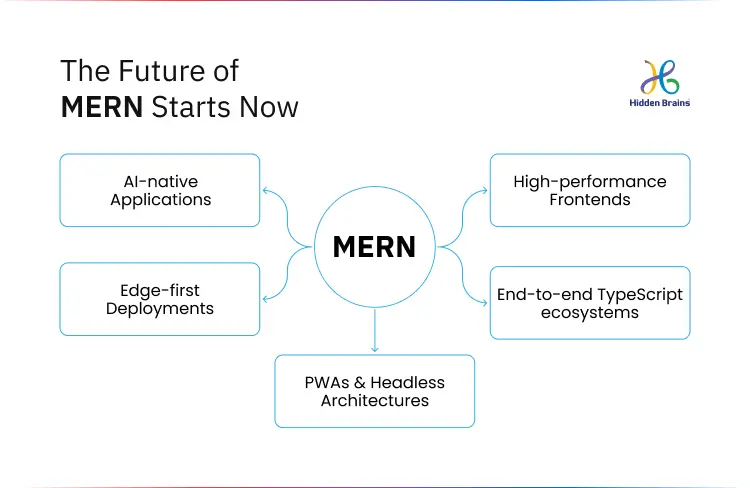
We are now seeing enterprises build:
AI-native Applications
MERN integrates seamlessly with generative AI workflows, enabling real-time intelligence without overloading systems. From recommendation engines to predictive analytics, the stack supports AI-driven experiences natively.
High-performance Frontends with React Server Components and Next.js
With server-side rendering, concurrent rendering, and optimized delivery, applications achieve faster load times and better performance at scale.
Serverless and Edge-first Deployments
MERN works naturally with modern deployment models, enabling auto-scaling and low-latency performance across geographies.
End-to-end TypeScript ecosystems
As applications grow more complex, type safety ensures stability, maintainability, and collaboration across large teams.
Microservices, PWAs, and Headless Architectures
Enterprises are breaking monoliths into modular systems and MERN supports this transition seamlessly.
This is no longer just a stack. It’s an ecosystem designed for modern enterprise demands.
Is Your Architecture Slowing Down Growth and Innovation?
Hire Our MERN Experts
Where Hidden Brains Comes In
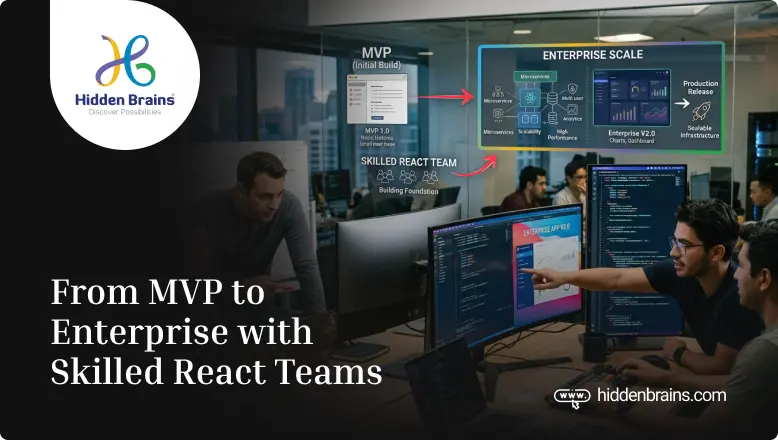
At Hidden Brains, we don’t see MERN or React as just technologies. We see them as the foundation for long-term scalability. With over 22 years in software development, we have seen frameworks rise and fade. React stood out early, and we invested in it as a core discipline. Today, with 700+ developers and experience across industries, we bring more than execution. We bring clarity on what actually works at scale.
Our focus always starts with architecture. Because the biggest decisions are made before development begins, not during sprints. We design systems for growth, not just launch. From MVPs to enterprise platforms, we ensure minimal rework and maximum efficiency. Whether it is real-time fintech systems, manufacturing operations, or high-traffic retail platforms, our approach aligns with real business needs.
What sets us apart is how we build. Compliance is built in from day one. We focus on strong foundations to avoid future rewrites. We actively reduce technical debt and design systems that scale smoothly over time. And when it comes to working together, you can either rely on a dedicated React team that owns your roadmap end-to-end or hire React developers to extend your existing team with the right expertise.
Frequently Asked Questions
How does MERN stack architecture support long-term scalability planning?
MERN enables modular development and flexible data management. It makes it easier to expand features, handle growing data, and scale systems without frequent redesigns or major disruptions.
Can MERN be integrated with existing enterprise systems and legacy platforms?
Yes, MERN is API-driven, which makes integration straightforward. It can connect with legacy systems without requiring a complete rebuild, allowing businesses to modernize gradually.
How does MERN handle high availability and fault tolerance?
MERN uses capabilities like Node.js clustering, distributed databases, and cloud deployments. These ensure systems remain available, stable, and resilient even during high traffic or failures.
Is MERN Stack Architecture suitable for AI-driven enterprise applications?
Yes, MERN works well with AI and machine learning services. It supports real-time data processing and integrates easily with AI tools, making it suitable for modern intelligent applications.
How secure is MERN for enterprise-grade applications?
MERN supports strong security practices such as authentication, encryption, and secure APIs. With proper implementation, it meets enterprise-level security standards effectively.
What role does MERN play in microservices-based architectures?
MERN fits well with microservices by supporting independent, API-based components. It allows teams to build, deploy, and scale services separately, improving flexibility and system efficiency.
Conclusion
As enterprises deal with growing scale, rising complexity, and constantly changing user expectations, architecture becomes a critical decision. MERN helps build systems that are scalable, high-performing, and flexible enough to adapt over time. It simplifies development, speeds up delivery, and reduces unnecessary complexity. More importantly, it creates a strong and reliable foundation that supports continuous innovation and long-term growth.