














































































































Summary
The single-cloud vs multi-cloud decision is no longer a technical debate; it’s a business strategy choice. This blog examines how enterprises should evaluate cloud models through the lenses of governance maturity, cost control, risk tolerance, and operational readiness. It explains single-cloud and multi-cloud architectures, highlights their benefits, and offers a practical decision framework to help CTOs and CFOs choose a model that can be scaled and sustained.
The multi-cloud vs single-cloud strategy debate no longer starts in IT meetings, it starts when growth begins to expose cracks in your operating model.
This is not a technical comparison. It is a leadership decision that shapes governance maturity, cost control, resilience, and execution speed. Most CTOs don’t confront this question during experimentation. They confront it when scale introduces friction.
Build a Cloud Strategy That Scales With Your Business.
Talk to Our Experts
Yet adoption does not guarantee advantage.
Single-cloud strategies offer clarity, standardized governance, and faster deployment cycles. Multi-cloud strategies promise flexibility, resilience, and reduced vendor dependency. But the real difference rarely appears in architecture diagrams.
It appears in operations.
Engineering velocity slows when visibility fragments. Monitoring tools fail to provide a unified view. Identity policies vary subtly across providers. Incident resolution takes longer, not because infrastructure fails, but because accountability blurs.
Multiple clouds do not create complexity on their own. Operational immaturity does. That is the real decision CTOs need to address.
What Is a Single-cloud Architecture?
A single-cloud architecture is built around one primary cloud provider that hosts the majority of all of an enterprise’s applications, data, and infrastructure. This model emphasizes standardization: one set of services, one security framework, and one operating model across teams. In the Multi-cloud vs Single-cloud discussion, single-cloud is often chosen for its operational clarity rather than its novelty.
Industry data shows that pure single public cloud adoption remains relatively low, typically around 10%, with single private cloud usage even lower. That tells an important story. Enterprises rarely arrive at a single cloud by default; they choose it deliberately when simplicity, control, and execution speed outweigh the need for platform diversity. For organizations with mature governance and predictable workloads, a single-cloud architecture can reduce overhead, accelerate delivery, and make accountability clearer, especially when teams are aligned around a shared operational standard.
Key Benefits of Single-cloud Architecture
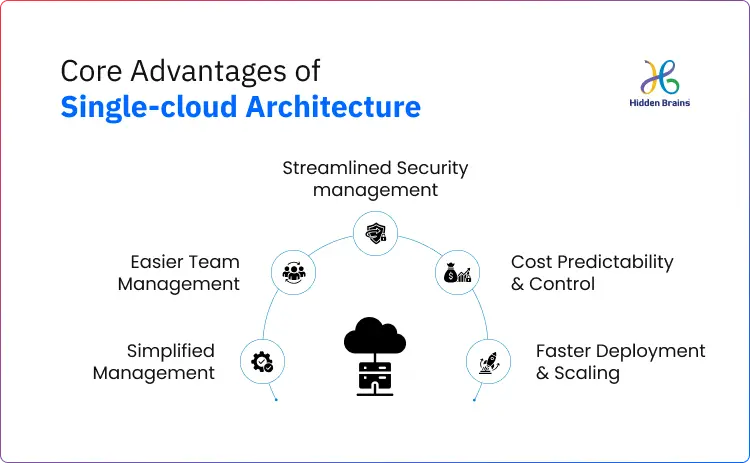
When enterprises commit to a single-cloud architecture, the decision is rarely about limitation; it is about control. For organizations prioritizing operational clarity, predictable costs, and execution speed, a single cloud creates an environment where teams spend less time managing complexity and more time delivering outcomes.
Simplified Management and Operations
Everything runs within one ecosystem: a unified dashboard, a single set of APIs, consolidated billing, and consistent security, identity, and governance policies. This reduces administrative overhead and minimizes errors that arise from switching between multiple tools and consoles. Teams focus on mastery rather than translation across providers. In practice, enterprises often see 15–30% lower management costs compared to more fragmented environments.
Deeper Expertise and Faster Innovation
When developers and operations teams work within one platform, knowledge compounds. Onboarding is faster, troubleshooting improves, and architectural decisions become more consistent. This depth of expertise shortens development cycles and enables quicker deployment and iteration without the friction of learning multiple cloud ecosystems.
Greater Cost Predictability
When everything stays on one cloud, enterprises can unlock better pricing benefits like committed-use discounts and long-term savings plans. Billing also becomes easier to manage because you deal with one invoice instead of multiple providers. It makes forecasting and cost governance much simpler. And since the ecosystem is unified, you avoid hidden expenses like duplicate tools, extra integrations, and additional management overhead.
Streamlined Security and Compliance
When all workloads follow one set of policies, it becomes easier to maintain consistency.
Security settings don’t vary across systems, and audits become simpler to manage.
This is especially helpful in regulated industries, where enforcing the same controls everywhere matters more than using multiple cloud providers.
Faster Deployment and Scaling
Native integrations allow applications to move from provisioning to production faster. Scaling is predictable, and teams avoid compatibility bottlenecks that slow releases.
Stronger Vendor Relationship
When your spending is concentrated with one provider, you often get better support in return. This can include faster issue resolution, dedicated account teams, and early access to new features that help you stay ahead.
What Is Multi-cloud Architecture?
Multi-cloud architecture refers to using services from more than one cloud provider, public, private, or a mix of both, to run enterprise workloads. In simple terms, what multi-cloud comes down to is choice and distribution: different applications, data sets, or regions are mapped to different cloud platforms based on specific business or technical needs.
This approach has become mainstream rather than exceptional. Nearly 80% of companies now incorporate multiple public clouds, and around 60% report using more than one private cloud. The shift reflects growing demands around resilience, regulatory alignment, and vendor risk management. Instead of relying on a single provider, enterprises use multi-cloud to avoid concentration risk and retain flexibility. However, while the model offers strategic options, it also requires stronger governance and operational discipline to ensure that flexibility does not translate into unnecessary complexity.
Key Benefits of Multi-cloud Architecture
Enterprises adopt multi-cloud architecture not to complicate their environments, but to retain strategic flexibility as scale, regulation, and market conditions evolve. When executed with intent, multi-cloud gives leadership more options technically, commercially, and operationally, especially in complex or fast-changing business landscapes.
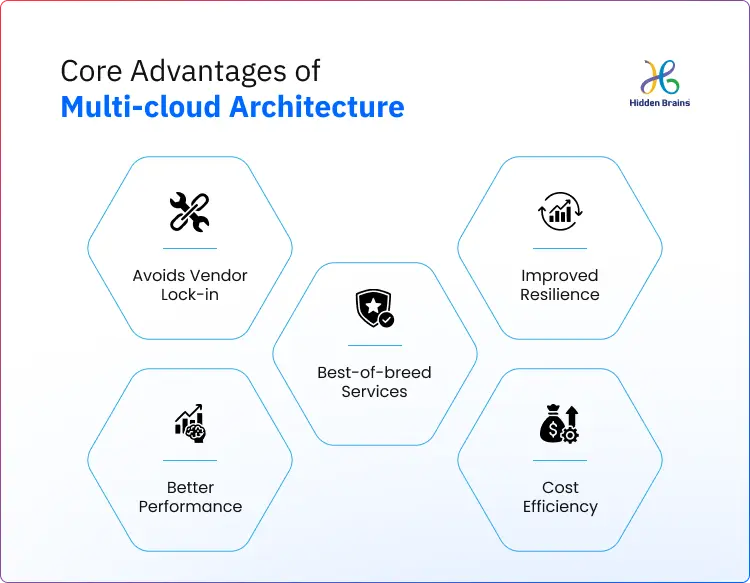
Avoids Vendor Lock-in
By distributing workloads across multiple providers, enterprises reduce dependency on any single vendor. This creates leverage during contract renewals, protects against abrupt pricing or policy changes, and allows teams to pilot or shift services without being constrained by one provider’s roadmap.
Access to Best-of-breed Services
Many organizations struggle to get full value from the cloud because no single platform excels at every need, leaving gaps in analytics, intelligent automation, or AI capabilities that slow decision-making and limit growth. Custom AI development services solve this by building tailored AI solutions that integrate seamlessly across multiple clouds, enabling predictive analytics, intelligent workflows, and specialized data models.
This approach ensures every workload performs optimally, giving enterprises agility, deeper insights, and a measurable competitive advantage without compromising on capabilities.
Improved Resilience & Disaster Recovery
Running workloads across multiple clouds removes a single point of failure. If one provider faces an outage or regional disruption, critical systems can fail over to another environment, reducing downtime and strengthening business continuity and ransomware recovery strategies.
Performance Optimization
Multi-cloud allows workloads to run where they perform best, closer to end users for lower latency, or in regions with specific performance advantages. This is particularly valuable for global platforms and latency-sensitive applications.
Strategic Cost Flexibility
Different providers offer different pricing models and incentives. Multi-cloud makes it possible to place workloads where costs are most favorable and adjust as pricing changes, provided governance is strong enough to prevent cost drift from unmanaged complexity.
Viewing Cloud Strategy Through the CFO’s Lens
Cloud decisions are fundamentally about cost predictability, risk exposure, and long-term financial control. At its core, a single cloud model means standardizing applications, data, and infrastructure on one provider, while a multi-cloud approach distributes workloads across two or more cloud platforms. While this is often framed as a cost discussion, the real impact is usually seen in how spending behaves over time, especially as complexity increases.
A single-cloud setup usually makes cost forecasting easier. Pricing is simpler to track, discounts are easier to negotiate, and it’s clearer which business unit is spending what. However, the downside is vendor dependency. Over time, relying on one provider can reduce your flexibility and negotiating power.
Multi-cloud strategies introduce flexibility and negotiation power, but they also carry hidden cost drivers like duplicate services, cross-cloud data transfer charges, and contracts that rarely align on renewal cycles. This is where the difference between single cloud and multi cloud shows up most clearly on the balance sheet.
The Real Questions Enterprises Should Be Asking in 2026
By the end of 2026, the cloud decision that matters most is no longer “single or multi-cloud.” That framing misses the real issue. The better question is whether your organization is ready to operate the model you choose. Do you have the governance maturity to manage complexity without slowing execution? Can you measure, forecast, and control cloud spend as scale increases? And are you optimizing for flexibility to absorb change or stability to deliver predictably quarter after quarter?
When enterprises answer these questions honestly, the right cloud model often becomes obvious. This shift in thinking moves the conversation from vendor selection to operational readiness, where long-term success is actually determined.
A simple decision framework to guide the choice:
| Factor | Aligns with Multi-Cloud | Aligns with Single-Cloud |
|---|---|---|
| Maturity Level | High DevOps maturity, global ops history | Limited resources, simpler application history |
| Primary Goal | Resilience and flexibility | Speed and predictability |
| Risk Tolerance | Higher tolerance for outages and vendor shifts | Low tolerance for operational risk |
| Automation Reliance | Essential, automation-first operations | Minimal automation dependency |
How Hidden Brains Can Help You?
With 22+ years of experience building enterprise IT solutions and cloud-native platforms, Hidden Brains brings proven expertise in cloud application development and DevOps engineering to complex digital transformation initiatives.
Whether you’re optimizing cloud architecture, modernizing workloads, or accelerating deployment speed, our team designs secure, scalable, and business-aligned cloud solutions that help enterprises reduce risk, control costs, and deliver measurable outcomes.

Talk to Our Experts to Finalize Your Cloud Strategy.
Schedule a CallFrequently Asked Questions
Need more clarity on single-cloud or multi-cloud setups? Check our detailed FAQs or contact our experts for answers.
1. What types of workloads are best suited for a multi-cloud setup?
Multi-cloud works well for workloads that need regional flexibility, specialized services (AI, analytics, databases), or high resilience. It is commonly used when enterprises run global applications, support multiple business units, or require workload portability across regions.
2. How do enterprises prevent cost leakage in multi-cloud environments?
The most effective approach is strong governance, standard tagging policies, centralized billing visibility, automated budget alerts, and workload-level cost accountability. Without this discipline, multi-cloud often results in duplicated tools and uncontrolled consumption.
3. Does multi-cloud improve business continuity automatically?
Not automatically. Multi-cloud only improves resilience if workloads are architected for failover, tested regularly, and supported by mature monitoring and incident response processes. Without that, multiple clouds can still fail operationally during disruption.
4. What is multi-tenancy in cloud computing?
Multi-tenancy is a cloud model where multiple customers share the same infrastructure while keeping data and workloads logically isolated. It enables scalability and cost efficiency but requires strong access controls, encryption, and governance to prevent security gaps.



Conclusion
Choosing between single cloud and multi-cloud depends on your business size and complexity.
If you’re a small business, a single-cloud strategy is usually the best fit. It’s cost-effective, easier to manage, and requires less technical overhead. Using one provider like Amazon Web Services, Microsoft Azure, or Google Cloud keeps operations simple and efficient.
If you’re a large enterprise, multi-cloud offers greater flexibility, redundancy, and protection against vendor lock-in.
If you’re unsure or scaling rapidly, get 2 hour FREE consultation with Hidden Brains experts to assess your needs and define the right cloud strategy for sustainable growth.