














































![Sales & Distribution [Oil & Gas]](https://www.hiddenbrains.com/blog/wp-content/themes/blankslate/assets/images/sales_and_distribution-icon.74d08193.svg "Sales & Distribution [Oil & Gas]")

![Fluid Terminal Management [Oil & Gas]](https://www.hiddenbrains.com/blog/wp-content/themes/blankslate/assets/images/fluid_terminal_management-icon.4b3a27a4.svg "Fluid Terminal Management [Oil & Gas]")


![Sales & Distribution [Oil & Gas]](https://www.hiddenbrains.com/blog/wp-content/themes/blankslate/assets/images/sales_and_distribution-icon.74d08193.svg?1.0.0 "Sales & Distribution [Oil & Gas]")
![Fluid Terminal Management [Oil & Gas]](https://www.hiddenbrains.com/blog/wp-content/themes/blankslate/assets/images/fluid_terminal_management-icon.4b3a27a4.svg?1.0.0 "Fluid Terminal Management [Oil & Gas]")








































































Summary
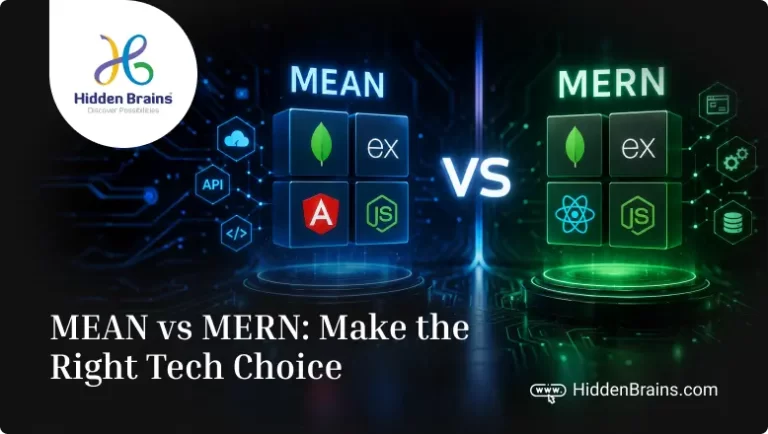
- The Core Architectural Difference: Both stacks utilize MongoDB, Express.js, and Node.js for backend infrastructure. The differentiator lies strictly in the frontend layer: MEAN uses Angular (a structured MVC framework by Google), while MERN uses React (a flexible component UI library by Meta).
- MEAN Stack (Angular) Best For: Enterprise-grade platforms, strictly governed architectures, and applications requiring out-of-the-box security, two-way data binding, and native TypeScript integration without heavy reliance on third-party libraries.
- MERN Stack (React) Best For: High-growth SaaS products, interactive web platforms, and mobile-first strategies leveraging React Native for high cross-platform code reuse and faster time-to-market.
- Performance & Developer Adoption: React leads global frontend adoption (~39.5%), offering rapid Virtual DOM rendering for dynamic UIs. Angular (~17.2% adoption) provides strong long-term maintainability for large engineering teams.
- Cloud & Modern AI Integration: Both stacks connect effortlessly with AI LLMs and vector databases via Node.js backends. MERN excels in real-time streaming UI responses (e.g., generative chat), while MEAN provides rigid data structures ideal for AI analytics and enterprise dashboards.
Selecting the right full-stack JavaScript ecosystem is one of the most critical architectural decisions for modern enterprise web application development services. While both MEAN and MERN stacks share a powerful backend foundation—MongoDB, Express.js, and Node.js—their front-end technologies (Angular vs. React) create fundamentally different development velocities, performance profiles, and scalability pathways.
According to the Stack Overflow Developer Survey, JavaScript remains the most commonly used programming language for the 12th consecutive year.
| Details | Information |
|---|---|
| Guide Focus | Compare MEAN stack (Angular) vs. MERN stack (React) for enterprise web application development, evaluating architectural governance, performance, security, and AI integration pathways in 2026. |
| Target Audience | CTOs, Chief Architects, Engineering Leads, Product Managers, CIOs, and Founders deciding on full-stack JavaScript technology models. |
| TL;DR | Both stacks share MongoDB, Express.js, and Node.js. MEAN (Angular) provides a structured, batteries-included framework ideal for complex enterprise workflows and strict typing. MERN (React) offers a flexible UI library built for speed, rapid component reusability, and seamless mobile extension with React Native. |
| Main Takeaways | Understand Angular vs. React architectural differences, evaluate out-of-the-box security features, assess generative AI & LLM integration capabilities, and align your stack selection with hiring availability and time-to-market targets. |
| Recommended For | Businesses deciding whether to hire MEAN or MERN development teams to build scalable, high-concurrency enterprise web apps, SaaS platforms, or cross-platform mobile solutions. |
However, developer preferences have shifted significantly: React leads front-end library adoption at 39.5%, while Angular maintains a dedicated 17.2% enterprise footprint, particularly in heavily regulated financial and healthcare systems.
Furthermore, Gartner Insights highlights that micro-frontend architectures and component reuse reduce time-to-market by up to 35% for enterprise engineering teams.
For a better understanding of these tech stacks, you can watch the following video.
Understanding the Core Difference: Angular vs. React
The fundamental difference between MEAN and MERN lies entirely in the View (V) layer of the architecture:
- MEAN Stack (Angular): A complete, opinionated MVC (Model-View-Controller) framework maintained by Google. Angular provides built-in tools for dependency injection, form validation, routing, and two-way data binding out of the box.
- MERN Stack (React): An unopinionated UI library created by Meta. React relies on a Virtual DOM, one-way data binding, and a vast ecosystem of third-party packages for routing and state management (e.g., Redux, Zustand).
Struggling to Select the Right Full-Stack Architecture?
Talk to Our Experts
Deep-Dive: The MEAN Stack Architecture
The MEAN stack is an end-to-end JavaScript framework designed for structured, enterprise-grade applications where strict coding standards and maintainability across large engineering teams are paramount.
Core Components of MEAN:
- MongoDB: NoSQL document database utilizing JSON-like BSON formats for flexible data schemas.
- Express.js: Lightweight server framework for Node.js handling HTTP routing and RESTful APIs.
- Angular: TypeScript-based front-end framework offering bi-directional data flow and modular design.
- Node.js: Event-driven, non-blocking asynchronous JavaScript runtime engine.
Key Advantages of MEAN Stack Development
- TypeScript by Default: Angular enforces strong typing, catching runtime errors during compilation and reducing enterprise bugs.
- Two-Way Data Binding: Synchronizes models and views automatically, simplifying real-time form handling and dashboard state updates.
- Out-of-the-Box Tooling: Reduces reliance on third-party npm packages, improving application security and long-term maintenance consistency.
Organized engineering teams seeking structured execution frequently standardize on MEAN stack development solutions to ensure uniform architecture across large-scale software products.
Deep-Dive: The MERN Stack Architecture
The MERN stack replaces Angular with React, delivering rapid rendering speeds, component modularity, and lightweight execution tailored for dynamic user interfaces and SPA (Single Page Applications).
Core Components of MERN:
- MongoDB: Document-oriented database built for horizontal scaling through sharding.
- Express.js: Minimalist web framework for building robust API endpoints.
- React: Declarative, component-based library utilizing a Virtual DOM for fast UI reconciliation.
- Node.js: High-concurrency backend runtime supporting simultaneous I/O connections.
Key Advantages of MERN Stack Development
- Virtual DOM Performance: Minimizes heavy DOM manipulation by updating only changed elements, driving exceptional UI responsiveness.
- Component Reusability: Developers can reuse UI components across web and native applications, accelerating cross-platform mobile app development services using React Native.
- Unrivaled Community & Talent Pool: Millions of pre-built React components lower build times and simplify resource acquisition.
When building fast-scaling SaaS products or interactive customer portals, leading brands choose to hire dedicated MERN stack developers to maximize release frequency and frontend flexibility.
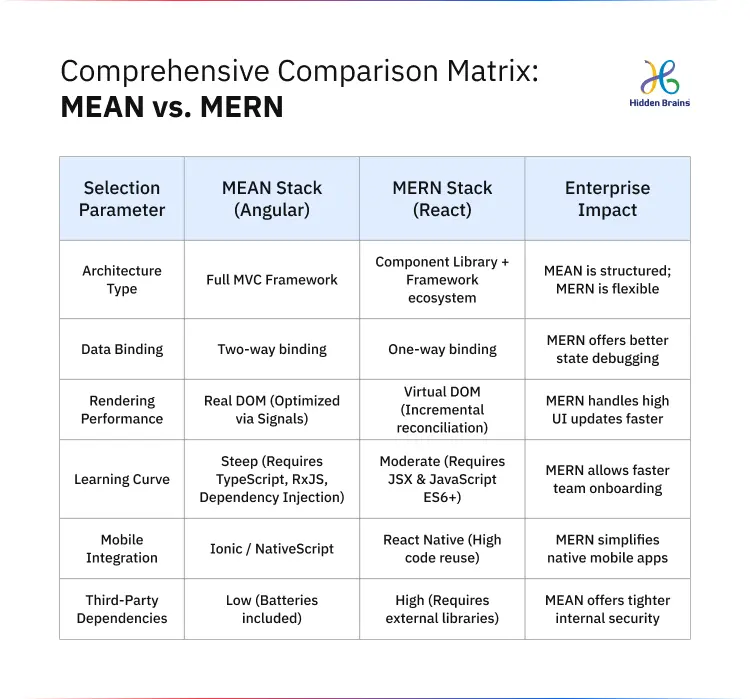
Comprehensive Comparison Matrix: MEAN vs. MERN
Modernizing Full-Stack Architectures: Cloud & AI Integration
In today’s software landscape, choosing between MEAN and MERN extends beyond basic UI rendering; it directly affects how your application handles cloud scalability and artificial intelligence capabilities.
Embedding AI Capabilities into Full-Stack Architectures
Modern web applications require smart automation, predictive search, and generative capabilities. Achieving seamless AI integration solutions into full-stack systems involves linking Node.js backends with vector databases (e.g., Pinecone, Milvus) and LLM APIs (OpenAI, Anthropic, Hugging Face).
- React (MERN) for Generative AI Interfaces: React’s streaming hook primitives (useActionState, streaming SSR) make it naturally suited for real-time generative AI responses and chat UI streams.
- Angular (MEAN) for Complex AI Dashboards: Angular’s strict typing and state management excel when processing complex analytics data feeds and enterprise AI model monitoring tools.
Collaborating with a specialized Custom AI development company ensures your underlying database architecture, API microservices, and front-end state management are built for high-throughput AI workloads.
Decision Framework: Which Tech Stack Should You Choose?
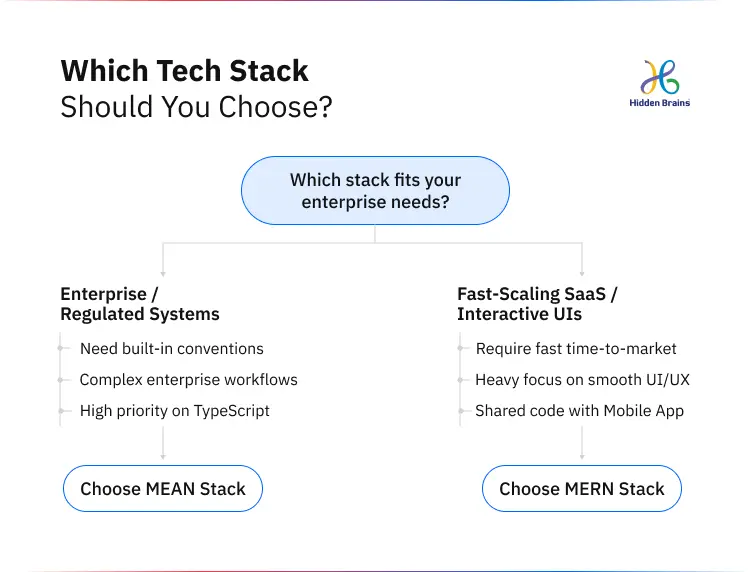
Choose the MEAN Stack if:
1. You are building large-scale, enterprise-level web applications with large distributed teams.
2. You require strict architectural guidelines, built-in dependency injection, and native TypeScript integration.
3. You prefer an all-in-one framework without relying on dozens of third-party npm packages.
4. Your application features complex forms, enterprise workflows, and dynamic data tables.
Choose the MERN Stack if:
1. Build an enterprise-grade SaaS for faster product development, scalability, security, and real-time performance.
2. Fast time-to-market and flexible, rapid prototyping are top business priorities.
3. You plan to extend your codebase into mobile applications using React Native.
4. You want to tap into the largest developer community and component library ecosystem available today.
How Hidden Brains Can Help
With 23+ years of software development expertise and over 6,000 successful projects delivered worldwide, Hidden Brains helps businesses make technology decisions that create lasting value.
Choosing between MEAN vs MERN isn’t just about frameworks; it’s about selecting the right foundation for your product, growth plans, and future scalability. We evaluate your business goals, technical requirements, team capabilities, and delivery timelines to recommend the stack that best fits your long-term vision.
Our experienced MEAN and MERN developers have built high-performing web applications across multiple industries, bringing both technical depth and practical business insight to every project. From technology consulting and architecture planning to full-scale development, we help you build secure, scalable, and future-ready applications so that you can move forward with clarity and confidence.
Struggling to Find Skilled, Pre-Vetted MEAN Engineers?
Hire MEAN Stack Developers
Frequently Asked Questions
Is the MERN stack better than the MEAN stack for enterprise web development?
Neither stack is universally superior; MERN is better for UI flexibility and rapid execution, while MEAN excels in standardized enterprise governance. MERN utilizes React’s Virtual DOM for high-performance rendering, making it ideal for fast-growing SaaS products. MEAN provides a structured MVC architecture with built-in TypeScript support, making it preferred for complex corporate software.
What is the main structural difference between MEAN and MERN?
The primary difference is the front-end layer: MEAN uses Angular (a complete MVC framework), whereas MERN uses React (a component-based UI library). Angular manages routing, forms, and state management natively, whereas React relies on third-party libraries like Redux or React Router.
How does AI integration work with Node.js backends in MEAN and MERN?
AI integration works identically on the backend for both stacks via Node.js and Express.js APIs connecting to vector databases and LLM endpoints. However, on the front end, MERN (React) offers superior streaming hooks for real-time generative AI text output, while MEAN (Angular) excels at displaying structured AI analytics dashboards.
Which tech stack offers faster time-to-market for startups?
The MERN stack typically offers a faster time-to-market due to React’s modular component library, gentle learning curve, and vast npm ecosystem. Development teams can build, test, and ship reusable UI elements significantly faster than setting up Angular’s full framework configuration.
Which stack provides better out-of-the-box security: MEAN or MERN?
The MEAN stack generally provides superior out-of-the-box security because Angular includes native built-in protection against common web vulnerabilities like Cross-Site Scripting (XSS) and Cross-Site Request Forgery (CSRF). Because Angular is an opinionated, batteries-included framework, it automatically sanitizes untrusted values before rendering HTML DOM elements. While MERN (React) can achieve identical enterprise-grade security, it relies on developers manually configuring third-party libraries and properly managing third-party npm dependencies to maintain an equivalent security posture.
Is it easier to hire MERN stack developers or MEAN stack developers?
Hiring MERN stack developers is generally faster due to React’s massive global developer adoption, though engineering teams choosing MEAN stack development often benefit from developers with stronger enterprise architectural discipline. Developer usage benchmarks show React leading at ~44.7% developer adoption compared to Angular’s ~18.2%. While this larger talent pool makes it quicker to hire dedicated MEAN stack developers for fast-scaling projects, MEAN developers are highly sought after by enterprise organizations for their deep expertise in TypeScript, strict design patterns, and large-scale code governance.


Conclusion
Both MEAN and MERN stacks offer battle-tested, highly scalable JavaScript foundations for modern software delivery. Your selection ultimately hinges on whether your priority lies in framework structure and TypeScript standardization (MEAN) or UI performance, flexibility, and mobile code sharing (MERN).
