


























































































































































Summary
- Discover how much businesses can save by hiring offshore developers.
- Compare US and offshore fully loaded development costs.
- Understand the impact of management, rework, hiring, and other hidden costs.
- Get insights on dedicated teams vs staff augmentation vs outsourcing.
- Learn how to measure true cost per delivered outcome.
If you are deciding whether to hire dedicated developers in the US or offshore, the honest answer is that offshore teams cost 40–70% less on a fully-loaded basis, but the hourly rate on the proposal is not the number that decides your budget. The savings are real, and they are large enough to fund a second team. They are also easy to overstate if you compare a quoted offshore rate against a fully-loaded US salary, which is the mistake most cost breakdowns quietly make.
This is a practical problem, not a theoretical one. A growing product team hits an engineering backlog, US senior hiring takes months and lands north of $200,000 per developer once everything is counted, and leadership needs velocity without doubling the payroll. So the question becomes concrete: what does the same capability actually cost offshore, and how much of the quoted saving survives contact with reality?
| Aspect | Details |
|---|---|
| What does this guide cover? | US vs offshore development costs in 2026, including hourly rates, fully loaded costs, regional comparisons, hidden costs, engagement models, and potential savings. |
| TL;DR | Offshore dedicated development teams can reduce fully loaded engineering costs by 40–70% compared with comparable US in-house teams, but the actual savings depend on team structure, management, scope, and delivery efficiency. |
| Who should read this guide? | CIOs, CTOs, founders, product leaders, engineering managers, and business decision-makers evaluating offshore development or looking to optimize software development costs. |
| What will you learn? | How US and offshore rates compare, what fully loaded costs include, which regions offer the best value, when offshore may not be cost-effective, and how to compare development models accurately. |
| Expected outcome | Build a realistic US vs offshore cost comparison, identify potential savings, understand hidden costs, and choose the right model—dedicated team, staff augmentation, nearshore, offshore, or in-house. |
| Key takeaway | Don’t compare hourly rates alone. Measure fully loaded cost, delivery efficiency, rework, oversight, and cost per business outcome to determine the true value of offshore development. |
Below are the 2026 numbers, the fully-loaded math both sides usually skip, a side-by-side you can adapt, and, because we run these teams rather than sell rate cards, an honest section on when offshore does not save you anything.
The short answer: how much can businesses save?
Hiring a dedicated development team offshore typically reduces fully-loaded engineering cost by 40–70% versus a comparable US in-house team. For a senior engineer, that is roughly the difference between a US fully-loaded cost of $200,000+ per year and an offshore dedicated-team cost in the $60,000–90,000 range. Across a five-person team, the gap is often more than $700,000 a year.
The exact figure depends on region, seniority, and critically, how the team is run. A well-governed dedicated team captures most of the savings; an under-managed offshore arrangement gives a chunk of it back in rework and coordination. The rest of this article shows where the number really lands.
US vs Offshore Developer Rates in 2026, By Region
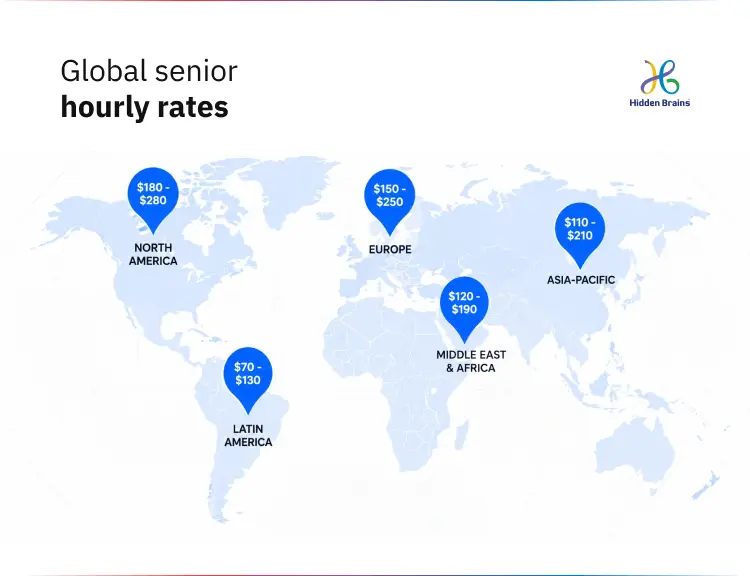
Here are the 2026 market ranges for a senior software developer, in USD per hour. These are blended agency and dedicated-team rates, not junior or freelance-marketplace floors.
Here are the 2026 market ranges for a senior software developer, in USD per hour. These are blended agency and dedicated-team rates, not junior or freelance-marketplace floors.
| Region | Senior Hourly Rate (2026) | Relative Cost vs US |
|---|---|---|
| United States (onshore) | $120 – $250 | Baseline |
| UK / Western Europe | $90 – $180 | ~25% lower |
| Latin America (nearshore for US) | $50 – $95 | ~50% lower |
| Eastern Europe | $45 – $90 | ~55% lower |
| India / South Asia | $30 – $65 | ~60–70% lower |
The pattern is consistent across every serious 2026 rate survey: US senior rates start near $120 and climb past $200, Eastern Europe and Latin America sit in the middle, and India / South Asia is the lowest-cost region for full, long-term teams. The US median software developer salary reached roughly $133,080 in 2026 per the Bureau of Labor Statistics, and that is base salary, before a cent of overhead.
Why rates vary so much between regions
Rates track local salaries, talent supply, and how mature the outsourcing ecosystem is, not skill. India stays the lowest-cost hub partly because it produces more than 2.5 million STEM graduates a year and has one of the largest English-speaking professional workforces in the world, which is why it remains the default for long-term product teams and offshore development centers. Eastern Europe commands a premium for deep senior engineering and EU time-zone overlap. Latin America charges more than Asia because it buys you real-time overlap with US working hours. You are not paying for better code as you move up the table; you are paying for proximity, time zone, and local wage floors.
What Is the Fully Loaded Cost of Hiring a Developer?
The “fully loaded” cost of a developer is base salary plus payroll taxes, benefits, recruiting, onboarding, equipment, software, and management overhead- everything it takes to keep that person productive, not just their paycheck. This is the number that makes an apples-to-apples comparison possible, and it is the number both sides of the offshore debate tend to hide.
For a US hire, employer overhead adds roughly 30–40% on top of base salary, and closer to 70% once recruiting, tooling, and the productivity lost while a seat sits vacant are counted. A fully loaded US employee generally costs 1.25–1.7× base.
For an offshore hire, there is a mirror-image trap: the quoted hourly rate is not the loaded cost either. Once you add management overhead, ramp-up time, and attrition, an ad-hoc offshore arrangement often runs 1.4–1.8× the quoted rate.
The important nuance most comparisons miss: that multiplier is highest for freelance or loosely-managed offshore work and lowest for a properly run dedicated team, where the vendor absorbs recruiting, HR, retention, infrastructure, and delivery management into a flat rate. That structural difference is exactly why the engagement model matters as much as the region.
Talk to Our Experts for a Real Cost Breakdown
Get Free Consultation
US In-house Senior Developer — Annualized
A US-based senior developer typically carries a significantly higher annual cost once salary, benefits, payroll taxes, infrastructure, and other employment overheads are included.
The fully loaded cost can be substantially higher than the headline salary alone.
| Cost component | Amount (USD/yr) |
|---|---|
| Base salary (senior) | ~$150,000 |
| Payroll tax, benefits, retirement | ~$45,000 |
| Recruiting, equipment, software, overhead | ~$20,000 |
| Fully loaded (before vacancy cost) | ~$215,000 |
Offshore Dedicated Senior Developer — Annualized
The headline rate doesn’t always reflect the actual annual cost of a dedicated senior developer. Here’s the typical cost breakdown:
| Cost Component | Amount (USD/yr) |
|---|---|
| Dedicated-team rate (India, senior) | ~$60,000 – $90,000 |
| Recruiting, HR, retention, infrastructure | Included in rate |
| Delivery management | Included/shared |
| Fully loaded | ~$60,000 – $90,000 |
US vs. Offshore Software Development: Annual Cost Breakdown of a 5-Person Team
Here is the comparison a CFO actually needs: a full senior dedicated development team, annualized and fully loaded. Figures are illustrative, built from 2026 public rate bands; replace with your own scope for an exact number.
| Model | Fully Loaded / Developer | 5-Developer Team/Year | Savings vs US |
|---|---|---|---|
| US in-house | ~$220,000 | ~$1,100,000 | — |
| UK / Western Europe | ~$180,000 | ~$900,000 | ~18% |
| Latin America (nearshore) | ~$130,000 | ~$650,000 | ~41% |
| Eastern Europe | ~$120,000 | ~$600,000 | ~45% |
| India dedicated team / ODC | ~$75,000 | ~$375,000 | ~66% |
On these numbers, an India-based dedicated team saves roughly $725,000 a year against a US in-house team of the same seniority, enough to fund a second squad, or a year of runway.
What Drives the Cost When You Hire Dedicated Developers
Four factors move the number more than geography alone: seniority, technology stack, team size, and engagement model. A senior engineer typically costs 25–40% more than a mid-level one in the same region.
Scarce skills- AI/ML, cloud architecture, specialised data engineering carry a premium everywhere, and the premium is widening as teams shift toward senior engineers who can validate AI-generated output. Larger, longer engagements unlock better blended rates than one-off tasks. And the engagement model changes both cost and control, which is worth spelling out.
Dedicated Team vs. Staff Augmentation vs. Project Outsourcing: Which Model Is Right for You?
Each model offers a different balance of control, flexibility, cost, and delivery ownership. Choosing the right approach depends on your project scope, internal capabilities, and how much control you need over the team and outcomes.
| Model | Best for | Cost Profile | Control |
|---|---|---|---|
| Staff augmentation | Filling specific skill gaps in an existing team | Pay per person; you manage them | High — you direct the work |
| Dedicated development team | A stable, long-term team owning a product or roadmap | Flat blended rate; vendor absorbs HR/retention/infra | Shared — you set priorities, vendor runs delivery |
| Project outsourcing | A defined, scoped deliverable | Fixed or milestone price | Low — vendor owns execution |
For long-term projects, a dedicated development team offers the best balance of cost and control. You retain ownership of your product and priorities, while your technology partner handles hiring, retention, and team management. Staff augmentation is ideal when you need a few skilled professionals quickly, while project outsourcing is best suited for projects with a clearly defined scope and timeline, especially when you need industry expertise, compliance support, and end-to-end project delivery.
Hidden Costs to Consider Beyond Hourly Rates
- Management Overhead – Time spent coordinating teams, reviewing work, and managing communication.
- Ramp-up Time – New developers need time to understand your product, codebase, and processes before reaching full productivity.
- Time Zone Differences – Limited overlap can lead to slower feedback, more revision cycles, and delayed decisions.
- Attrition & Knowledge Loss – Team turnover can impact project continuity and increase onboarding costs if knowledge isn’t retained.
- Communication & Collaboration – Clear processes, regular demos, and overlapping working hours help minimize delays.
- Vendor Stability – An experienced partner with strong retention practices reduces disruption and ensures consistent delivery.
Bottom line: The cheapest hourly rate doesn’t always result in the lowest total cost. A well-managed, experienced team often delivers better value through higher productivity, lower rework, and smoother collaboration.
The 2026 Tax Consideration That Changes the Cost Equation
For US companies, there is a tax dimension that changes the after-tax cost: domestic software development is now immediately deductible, while offshore development must be amortized over 15 years. Under Section 174A of the Internal Revenue Code, restored by the One Big Beautiful Bill Act signed in 2025, a US business can fully expense qualified domestic software development in the year it is incurred, but foreign research and development costs, including offshore software work, must still be spread over 15 years.
In plain terms: the pre-tax offshore saving is large, but the domestic-expensing benefit narrows the after-tax gap somewhat for US buyers. It rarely reverses the decision; a 40–70% cost advantage is hard to erase with timing alone, but it belongs in any serious US build-vs-offshore model, and it is missing from nearly every rate-card article online.

Scale Faster. Stay Compliant. Build Better.
Hire Our TeamWhen Offshore Development Doesn’t Save Money
Offshore stops paying off when the work is small, short, undefined, or dependent on constant real-time collaboration. Because we run offshore teams, we will say plainly what vendors selling rate cards usually will not:
- Tiny or one-off tasks. For a week of work, ramp-up and coordination eat the savings. Use a specialist or a local contractor.
- Undefined scope. If requirements change hourly and no one owns the spec, distance amplifies the confusion. Fix the process before you scale the team.
- Heavy real-time, high-context collaboration. Work needing constant live pairing with your onshore staff loses time to time-zone gaps; nearshore or a hybrid model fits better.
- Weak governance on your side. Adding developers does not remove an engineering bottleneck caused by poor architecture, unclear ownership, or slow decisions. Offshore inherits those problems; it does not fix them.
Get these wrong and a “cheaper” team becomes more expensive than the one you replaced. The saving is a function of fit and management, not just the rate.
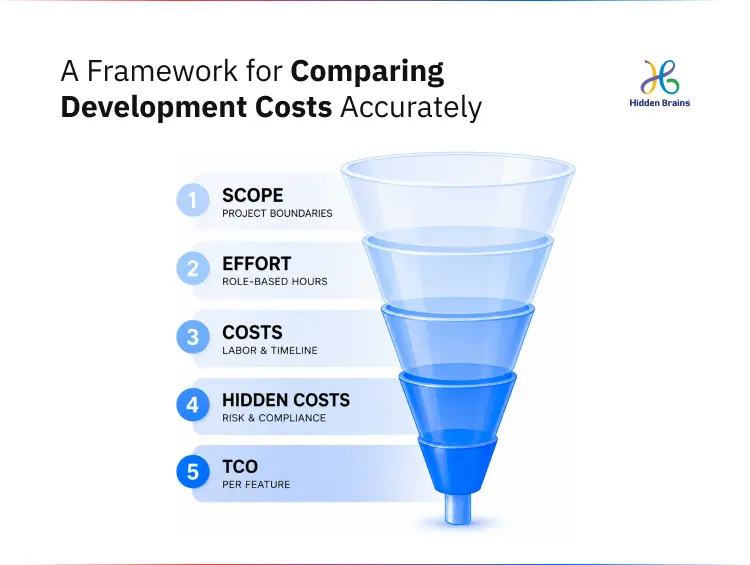
A Framework for Comparing Development Costs Accurately
A midsized company might pay $60,000 to build a project with an in-house team and get the same project delivered offshore for $40,000, a $20,000 saving on one build. So what is the difference? Just the time zone, or cheaper labour?
No. It goes far deeper than that. It is not about features, and it is not a currency conversion. It is that the two options carry completely different structures of cost, different role mixes, different rework rates, different oversight and compliance loads, and an hourly rate hides every one of them.
A fair comparison goes beyond hourly rates. Evaluate the total cost of ownership, including delivery efficiency, quality, scalability, and cost per business outcome. That means building the same estimate for each option (onshore, nearshore, offshore) from the same scope, then loading each with its own realistic assumptions.
Here is the structure to use.
1. Define scope in stories or use cases:
- Avoid comparing based only on “6 months of 3 developers”
- Align every option against the same deliverables, features, and expected outcomes
- Measure cost based on what gets delivered, not just the number of developers or hours invested
2. Estimate the effort by role:
- Base development hours
- PM / tech-lead hours (as a % of dev hours)
- BA/specification effort (which rises for models with more communication distance)
- QA / test effort, including automation
3. Apply realistic rates and friction to each option:
- Different hourly rates per role and per region
- A rework allowance by model, for example, ~8% onshore, ~15% nearshore, ~25–30% for loosely-managed offshore.
- An expected timeline extension by model (0, +1, or +2 months)
4. Add the costs that never appear on a rate card:
- Security/compliance retrofit buffer (typically higher for offshore)
- Internal oversight cost — the time your own people spend managing the arrangement (higher for offshore)
- Legal and IP-protection costs, where material
5. Calculate what actually matters:
- Total cost per option
- Effective hourly rate = total cost ÷ effective delivered feature-hours (not billed hours)
- Time-to-market impact — the revenue or strategic value at risk from each option’s timeline
The output is a total cost of ownership per feature, or per story point, a number that is far more meaningful than an hourly rate, because it captures role mix, rework, oversight, and speed in a single comparable figure. Run it across all three models and the genuinely cheapest option is often not the one with the lowest rate on the proposal. This is the same math we run for clients before recommending a model, and it is why the headline “$40 vs $90 an hour” almost never survives the exercise unchanged.
How to Choose the Right Development Model: A Cost Decision Framework
- Long-term product or roadmap, cost-sensitive, timezone-flexible → India-based dedicated development team / ODC. Largest saving.
- Need senior depth with EU overlap → Eastern Europe dedicated team.
- US company needing real-time overlap → Latin America nearshore.
- A specific skill gap for a few months → staff augmentation, any region.
- Small, bounded, or highly interactive build → nearshore or keep it in-house.
How Hidden Brains Structures Dedicated Development Teams
At Hidden Brains, our work with engineering teams starts before rates enter the conversation, with what is actually slowing delivery: architecture, ownership, skill fit, and governance. We assemble dedicated developers into accountable teams that integrate with your delivery structure, with the recruiting, retention, infrastructure, and delivery management absorbed into a flat model rather than left as your overhead. That structure is why our clients tend to land at the low end of the fully-loaded multiplier rather than the high end.
With two decades of experience and CMMI Level 3, ISO-certified delivery across 107 countries, our view is simple: a dedicated team should be measured as accountable capability—not additional headcount.
For your scope, we model the real economics against your current fully loaded cost, including the trade-offs, not just a rate card.
Learn more about our software development outsourcing approach.
Frequently Asked Questions
Who owns the code and IP when you hire dedicated offshore developers?
With a properly structured dedicated team, you own the source code, IP, and all deliverables; the vendor assigns full rights to you. Confirm this is written into the contract, ideally with a clean IP-transfer clause and NDAs for every team member.
How fast can a dedicated offshore team start delivering?
A vetted dedicated team can usually be assembled in 2–4 weeks and reach full productivity within the first 4–8 weeks, depending on domain complexity and how ready your requirements are. The single biggest accelerator is a clear spec and a named product owner on your side; the biggest delay is undefined scope.
How do you protect a fixed budget from hidden offshore cost overruns?
Use a flat dedicated-team rate rather than open-ended hourly billing, agree the team composition up front, and require monthly reporting on velocity and spend. A dedicated model is predictable precisely because recruiting, retention, and infrastructure are inside the rate instead of surfacing later as surprises.
Can you scale a dedicated development team up or down as the roadmap changes?
Yes, that flexibility is a core reason to choose the model. You can add or reduce specialists as priorities shift, without the recruiting lead time or severance exposure of in-house hiring. Agree the notice period and ramp terms in the contract so scaling is a planned lever, not a negotiation.
How do you keep code quality and standards consistent with an offshore team?
Quality comes from governance, not location: shared coding standards, code review, CI/CD, and clear definition-of-done, plus regular demos. A mature partner brings these as standard and reports against them. Ask any vendor how they measure quality before you sign, not after.
How soon can you tell whether the savings are real?
You should see the cost difference in the first invoice and the delivery difference within one or two sprints. Track fully-loaded cost per shipped feature, not hourly rate, over the first quarter; if velocity holds and the loaded cost is materially lower, the saving is real and durable.
What team size makes a dedicated model worth it versus staff augmentation?
As a rule of thumb, one or two people for a short gap suits staff augmentation, while three or more engineers on a sustained roadmap justify a dedicated team, where the flat model and absorbed overhead pay off. Below that threshold, the management setup can outweigh the savings.



Conclusion
Offshore dedicated teams can cut your fully-loaded engineering cost significantly, but only if you measure it right. Compare fully-loaded cost, not hourly rates. Model total cost of ownership per feature. And be honest about where offshore doesn’t pay off.
That’s where we come in. Hidden Brains builds hire dedicated development teams that deliver as accountable capability, recruiting, retention, and delivery management in one flat, predictable rate, backed by CMMI Level 3 and ISO-certified processes. We won’t hand you a rate card; we’ll model the real cost against your current spend and show you where the saving is genuine.
Weighing US vs offshore for your next build? Let us help you. Get a free consultation.