


































































































































Summary
- Most software partner comparisons focus on price and portfolios, but long-term outcomes depend on engineering maturity, governance, scalability, and ownership.
- UK businesses typically evaluate boutique agencies, enterprise consultancies, offshore vendors, and hybrid delivery partners when selecting a software development partner.
- Product thinking, architecture capability, AI readiness, and delivery discipline are as important as development rates when assessing vendors.
- Post-launch support, cost transparency, and long-term ownership often determine whether a software engagement succeeds or struggles.
- Different partner models suit different project sizes, complexity levels, timelines, and business objectives.
- A structured evaluation framework covering compliance, delivery track record, SDLC maturity, architecture, and governance helps reduce software delivery risks.
- Hidden Brains combines UK-facing governance with scalable engineering capabilities and 23+ years of software delivery experience.
- Asking the right questions before selecting a partner helps businesses avoid costly mismatches and delivery challenges.
- The right software development partner depends on project complexity, internal capabilities, growth plans, and long-term technology goals.
Every UK business shopping for a software partner eventually runs into the same shortlist: a boutique agency down the road, a household-name consultancy, an offshore vendor promising half the price, and, increasingly, a hybrid partner that doesn’t fit neatly into any of those boxes. Most comparisons treat this as a portfolio-and-price exercise. It isn’t.
The stakes are higher than ever. According to Deloitte’s 2026 UK Scale-Ups Confidence Survey, 61% of UK businesses are prioritising operational excellence, while 57% are using AI primarily to improve internal productivity, making the quality of engineering execution and technology partnerships a strategic business decision rather than simply a procurement exercise.
The partner you choose determines whether your product ships on time, whether it can absorb AI capabilities next year, and whether you’re still negotiating change requests eighteen months from now.
| Details | Information |
|---|---|
| Guide Focus | Compare Hidden Brains with boutique UK agencies, enterprise consultancies, and offshore development vendors. Evaluate each delivery model across critical decision factors including compliance readiness, engineering maturity, SDLC practices, architecture capability, AI readiness, governance, scalability, engagement models, and total cost of ownership. |
| Target Audience | CIOs, CTOs, enterprise technology leaders, procurement teams, product owners, and business decision-makers evaluating software development partners, outsourcing models, and technology delivery approaches in the UK. |
| TL;DR | The right software development partner is not selected based on hourly rates or portfolios alone. Businesses need to evaluate engineering capability, delivery maturity, compliance standards, communication models, scalability, and long-term ownership before making a decision. This guide compares UK agencies, enterprise consultancies, offshore vendors, and hybrid delivery partners to help organisations understand the trade-offs between cost, control, flexibility, governance, and execution quality. |
| Main Takeaways | Identify the right software delivery model for your business. Evaluate partners across engineering, compliance, and execution maturity. Balance cost, control, and scalability for sustainable outcomes. |
| Recommended For | UK businesses comparing software agencies, outsourcing partners, and hybrid development models to build secure, scalable, and business-aligned software solutions. |
What Should You Look for in a Software Development Partner?
Before comparing vendors, define what success looks like. A high-performing software development company in the UK should provide strategic guidance, disciplined delivery, engineering excellence, and long-term support, not just complete a list of development tasks.
A strong software development partner should offer:
- Business-first thinking—understanding the problem before recommending a technology stack.
- Predictable delivery with realistic timelines and a process that identifies risks early rather than at the end of a sprint.
- Scalable engineering that supports the product beyond launch, not just a team sized for the initial build.
- Clear post-launch ownership, ensuring the business isn’t left without support once the project goes live.
- Transparent and predictable pricing, avoiding unexpected change requests and hidden costs.
Every delivery model delivers these outcomes differently. Understanding the strengths and trade-offs of each approach is the first step toward choosing the right long-term software development partner.
Common Software Development Partner Models in the UK
Most UK businesses typically choose between four broad software development partner models:
- Boutique UK agencies — Small, senior-heavy teams that often excel in design, communication, and close client relationships. Their main limitation is usually scalability when projects require additional specialists or larger delivery teams.
- Large enterprise consultancies — Organisations with deep resources, established processes, and strong brand credibility. The trade-off is often higher costs, additional layers of account management, and processes designed for larger transformation programmes.
- Offshore development vendors — Teams that can provide cost efficiencies through lower development rates. However, businesses need to carefully evaluate governance, communication processes, time-zone overlap, and quality controls.
- Hybrid delivery partners (where Hidden Brains sits) — A model that combines UK-facing governance and accountability with a globally distributed engineering team, providing scalability without requiring a fully onshore delivery structure.
None of these models is universally “correct.” Each represents a different balance between cost, oversight, flexibility, and execution capability. The right choice depends on the complexity of the project, internal capabilities, compliance requirements, and long-term product goals.
Hidden Brains vs Boutique Agencies
Boutique agencies often win through strong relationships, design expertise, direct access to senior professionals, and a personalised approach that larger vendors may struggle to replicate.
Where they can face challenges is scalability. If a project requires additional specialists, parallel development streams, or rapid expansion of the delivery team, a smaller agency may have limited capacity to adapt quickly.
Hidden Brains’ hybrid model combines the relationship and accountability businesses value from boutique providers with access to a larger engineering team that can scale as project requirements evolve.
For a small, well-defined project with a fixed scope, a boutique agency can be an excellent choice. For businesses building products expected to grow, require ongoing enhancement, or need access to multiple engineering capabilities, delivery scalability becomes a critical consideration.

Choose a Partner That Grows with Your Business
Talk to an ExpertHidden Brains vs Enterprise Consultancies
Large consultancies bring brand credibility, broad service lines, specialised expertise, and the reassurance of scale, which can be valuable for enterprise procurement processes that require a recognised name.
The trade-off is usually cost structure, flexibility, and speed of execution. Layered account management, higher day rates, and processes designed for very large transformation programmes can sometimes feel heavier for mid-market businesses or projects that require faster iteration.
Hidden Brains competes here on delivery flexibility, cost predictability, and engineering scalability rather than brand size. With 23+ years of delivery experience and ISO/IEC 27001:2022 and ISO 9001:2015 certification, Hidden Brains provides the governance assurance procurement teams look for while maintaining a more flexible delivery structure than traditional tier-one consultancies.
For many UK SMEs and startups, understanding the true cost of custom software development isn’t simply about finding the cheapest quote. It’s about knowing where your investment goes, what influences pricing, and how to avoid expensive surprises later.
Hidden Brains vs Offshore Development Vendors
Pure offshore vendors are often the cost leaders, and for a well-scoped, low-ambiguity project, they can be an effective option. The challenges typically appear when requirements evolve: limited UK time-zone overlap, inconsistent governance processes, communication gaps, and, for businesses handling customer data, increased scrutiny around how information is managed under UK GDPR.
Hidden Brains’ hybrid structure keeps architecture oversight, governance, and stakeholder communication aligned with UK business expectations, while execution is delivered by a globally distributed engineering team. This approach helps businesses access global engineering efficiency while reducing common coordination challenges associated with purely offshore models.
This approach is reflected in Hidden Brains’ engagement with Tide Services, a UK-based client managing complex, multi-format document workflows across three business segments: legal contracts, insurance policies, and utility infrastructure reports.
Working through a monthly hire-developers engagement model, Hidden Brains built an automated PDF generation service on Microsoft Azure, covering XML validation, dynamic PDF output, secure authentication, and automated data retention for compliance.
The business impact was significant: document turnaround time was reduced from a manual, time-consuming process to minutes, while onboarding new document types improved from days to same-day delivery.
Get Expert Insights to Reduce Risk and Improve Delivery Outcomes.
Book a Consultation
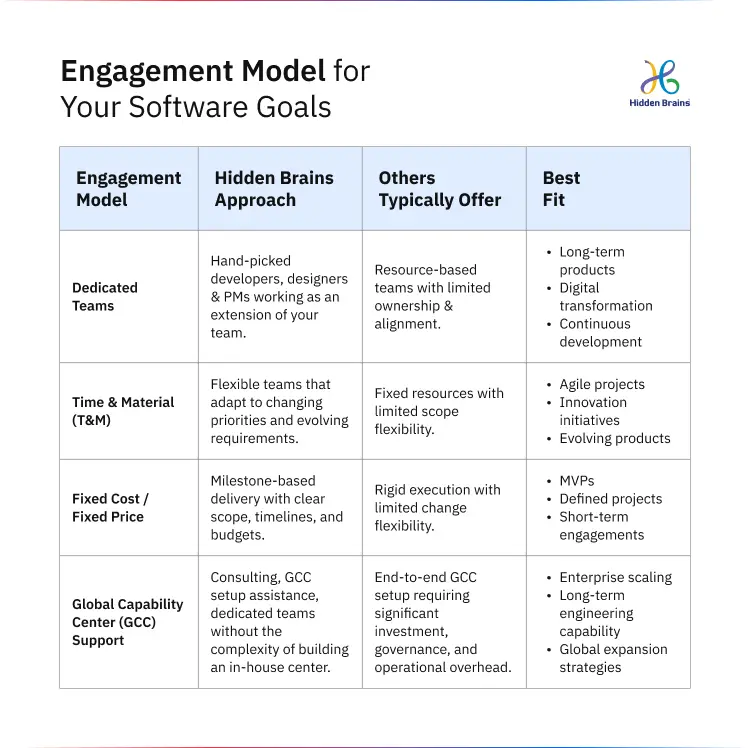
Choosing the Right Engagement Model for Your Software Goals
The right engagement model depends on your project scope, flexibility needs, and level of control required. Common models include:
Evaluating Software Development Partners
Most buyers evaluate a shortlist based on price and portfolio alone, only to discover delivery risks, governance gaps, compliance concerns, and scalability limitations after signing.
The framework below focuses on the factors that typically influence long-term software delivery success, regardless of which partner model you are evaluating.
| Evaluation Criterion | What to Check |
|---|---|
| Compliance and Security Readiness | UK GDPR readiness, data residency practices, ISO 27001 (information security), and ISO 9001 (quality management) certification. |
| Industry-Specific Track Record | Real delivered experience in your sector (fintech, healthcare, logistics, retail, etc.), not just generic case studies. |
| Strategic Alignment and Business Understanding | Whether the partner understands your business objectives before recommending technology solutions. |
| SDLC and Quality Maturity | Defined software development lifecycle, QA processes, code review practices, and engineering standards. |
| Architecture and Design Capability | Evidence of scalable, maintainable architecture decisions rather than simply delivering features. |
| Pilot-to-Production Capability | Proof that the partner can move from proof-of-concept to production and provide ongoing support. |
| Communication, Governance, and Transparency | Clear reporting processes, escalation paths, collaboration methods, and predictable pricing. |
These weightings are a starting framework, not a fixed formula. The importance of each factor depends on your business requirements. For example, a fintech platform may prioritise compliance and security, while an internal productivity tool may place greater emphasis on speed and cost efficiency.
Where Hidden Brains Is the Stronger Fit
Hidden Brains tends to be the stronger choice when a business needs:
- Strategic consulting – Upfront, not just execution; a partner that helps shape the roadmap before writing a line of code.
- AI integration – Handled with proper governance and security built in, not bolted on after the fact.
- Compliance assurance – ISO/IEC 27001:2022, ISO 9001:2015 for regulated or data-sensitive projects.
- End-to-end development — From discovery and architecture through build, launch, and ongoing support, under one accountable partner.
- Large-scale transformation – Programmes that need coordinated delivery across multiple workstreams, not a single-team engagement.
- Scalable engineering delivery — A team that can flex up or down without a lengthy hiring or offboarding cycle.
- Cloud consulting and DevOps – Support to keep infrastructure, deployment, and operations aligned as the product grows.
- AI-enabled enterprise software solutions – Built for production use, not just a proof-of-concept demo.
- UK-facing governance and accountability – Without paying full onshore rates for every hour of execution.
- Pilot to Production – A partner that can support a product from pilot through production and beyond, rather than handing it off after launch.
When Another Partner Model May Be More Suitable
A hybrid partner isn’t automatically the right answer for every project:
- A small, tightly scoped project with a fixed short timeline may be served well by a boutique agency’s direct, high-touch relationship.
- An enterprise procurement process that requires a recognised global brand for internal sign-off may favour a large consultancy, cost aside.
- A simple, well-defined build with no evolving requirements can be delivered efficiently and cheaply by a pure offshore vendor.
The right choice is not about selecting one model over another; it is about finding the partner structure that aligns with your business goals, risk profile, and future growth plans.
Questions to Ask Before Making the Final Decision
- What’s your SDLC and QA process, and how do you catch issues before they reach production?
- What compliance certifications do you hold, and how do you handle UK data residency?
- Can you show a project you took from pilot to live production and supported afterward, not just a demo?
- How do you handle change requests, and is your pricing transparent about what’s included?
- How quickly can your team scale up if the project’s scope grows mid-engagement?
- What does support look like the day after launch? Is there a defined ownership model, or does the relationship end at go-live?
Why UK Businesses Work With Hidden Brains
UK businesses choosing Hidden Brains are typically looking for a balance between UK-level accountability and global engineering scalability, combining structured communication and governance with flexible delivery capacity.
- Hybrid delivery model – UK-facing project management combined with global engineering teams for better value and seamless communication.
- Global expertise – Successfully delivered projects in 107+ countries across multiple industries.
- Certified quality and security – ISO/IEC 27001:2022 and ISO 9001:2015 certified, with mature engineering and information security practices.
- End-to-end software development – From discovery and UX to development, cloud deployment, and long-term support.
- Scalable engagement models – Dedicated teams, fixed-scope projects, and team augmentation tailored to business needs.
- AI-ready engineering – Experience integrating AI, automation, data engineering, and cloud-native architectures into modern software solutions.
- Transparent governance – Regular sprint reviews, clear reporting, defined SLAs, and predictable delivery processes.
- Long-term technology partner – Focused on evolving products through continuous improvement rather than delivering a one-off project.
Frequently Asked Questions
Is Hidden Brains better than a boutique agency for a small project?
Not necessarily. For a small, well-defined project with a fixed short timeline, a boutique agency’s direct, high-touch relationship can be a strong fit. Hidden Brains’ advantage shows up when a project is expected to grow or needs bench depth on short notice.
How does Hidden Brains compare to large consultancies on cost?
Enterprise consultancies typically carry layered account management and higher day rates across the board. Hidden Brains competes on cost predictability and delivery speed while still offering ISO/IEC 27001:2022 and ISO 9001:2015 certification for governance assurance.
Is offshore development riskier than working with Hidden Brains?
Pure offshore vendors can be cost-effective for simple, well-scoped projects, but typically involve limited UK time zone overlap and variable governance. Hidden Brains’ hybrid model keeps architecture and communication UK-facing while execution is delivered by a globally distributed team.
Does Hidden Brains support AI-driven projects?
Yes, AI readiness is built into Hidden Brains’ delivery approach rather than handled case-by-case, which is a common gap with boutique agencies and offshore vendors.
Does Hidden Brains work with IP and NDA?
Yes. Hidden Brains supports NDA agreements and works with clients to protect confidential information, intellectual property, and project-related assets throughout the engagement.
Ownership, confidentiality, and usage rights are defined as part of the contractual agreement, ensuring that businesses retain control over their software, data, and proprietary information.



Conclusion
At the end of the day, a software partner is judged on one thing: did the investment translate into a measurable business outcome? Faster time to market, lower total cost of ownership, fewer post-launch fires, and a product that can actually scale with demand- that’s the real scorecard, not the hourly rate on the proposal.
A boutique agency, a consultancy, or an offshore vendor can each deliver a working product. The gap shows up later, in support costs, in how fast the next feature ships, in whether the architecture holds up under real usage. That gap is where ROI is won or lost.
Hidden Brains is built to close that gap: UK-facing governance to keep the business accountable, compliance and security baked in from day one, and an engineering bench that scales without adding onshore overhead, so the investment keeps paying off well after launch, not just on delivery day.
If you’re ready to turn that into a real roadmap into strategy, our AI software development company is there for you. Let’s talk.