




































































Quick Summary
- Before hiring a software development partner in Europe, don’t just look at the portfolio; verify compliance, security, and delivery capabilities.
- Make sure the vendor understands GDPR requirements, DPAs, SCCs, and data protection responsibilities.
- If you’re building AI features, check whether the partner is prepared for EU AI Act requirements.
- Look beyond certifications and ask how security is built into the development process.
- Confirm who will actually work on your project, not just who appears during the sales process.
- Understand the full cost of development, including QA, onboarding, support, and long-term maintenance.
- Choose a partner that can support your product beyond launch with clear processes and scalable teams.
Choosing a software development partner in Europe in 2026 isn’t just about tech stack and day rate anymore. Between GDPR enforcement, the EU AI Act’s phased obligations, and a market flooded with vendors claiming “full-stack AI expertise,” the buyers who get burned are usually the ones who skip verification and rely on the pitch deck alone.
This is especially important as AI adoption accelerates. According to McKinsey’s State of AI research, 88% of respondents report that their organizations use AI in at least one business function, yet many companies are still working to move beyond experimentation and establish the governance needed to scale AI responsibly. For European IT buyers, this makes AI expertise, documentation practices, and regulatory readiness important criteria when selecting a software development partner.
| Section | Details |
|---|---|
| Guide Focus | Software development partner verification, GDPR compliance, EU AI Act readiness, security practices, delivery standards, and due diligence steps for European IT buyers. |
| Target Audience | CTOs, CIOs, Procurement Leaders, Engineering Managers, Product Owners, and businesses evaluating software development partners in Europe. |
| TL;DR | Hiring a software development partner in Europe requires more than comparing portfolios and pricing. Buyers should verify compliance, security, engineering quality, IP ownership, and long-term support capabilities before signing a contract. |
| Main Takeaways | Learn what to verify before selecting a vendor, identify potential risks, evaluate technical maturity, and choose a partner capable of delivering secure, scalable software. |
| Recommended For | Organizations planning custom software development, AI-enabled products, digital transformation initiatives, or long-term technology partnerships in Europe. |
Why Vendor Verification Matters More for European Buyers in 2026
European buyers carry more regulatory exposure than a US or APAC counterpart hiring the same type of vendor. If your software touches personal data, GDPR applies regardless of where your vendor’s engineers sit. If it includes AI features, the EU AI Act now adds a second layer of obligations, and vendors are not equally prepared for either.
Practical result: A leading software development partner in Europe should deliver secure, compliant, and high-quality software backed by transparent governance, enabling organizations to accelerate digital initiatives while confidently meeting commercial and regulatory requirements.
Need Help Vetting a Specific Vendor?
Get a 2-Hour Free Consultation
Verify the Legal Fundamentals First — GDPR, DPAs, and SCCs
Before evaluating anything else, confirm your vendor can operate as a compliant data processor under GDPR Article 28.
At a minimum, ask for:
- A signed Data Processing Agreement (DPA) — Not a generic NDA that spells out how personal data is handled, stored, and deleted.
- Confirmation of Standard Contractual Clauses (SCCs) – If any data or personnel sit outside the EEA. The European Commission’s modernised 2021 SCCs are the current baseline for these transfers.
- A clear answer on who their sub-processors are, and whether those sub-processors are also under DPAs.
A vendor that treats a DPA as optional paperwork is telling you, in advance, how seriously they’ll treat a data incident.
Ask About EU AI Act Readiness — Especially for AI-Enabled Builds
If any part of your build includes AI or ML features, recommendation engines, chatbots, predictive scoring, or generative AI, the EU AI Act adds obligations your vendor needs to already understand, not learn on your project.
Ask specifically:
- Can they classify the risk tier of the AI functionality you’re building (minimal, limited, high-risk, or prohibited under the Act)?
- Do they maintain documentation practices — training data provenance, model behaviour logs — that would support an audit?
- Have they already adapted their delivery process for AI Act obligations, or is this the first project where it comes up?
A vendor that hasn’t thought about this yet isn’t necessarily disqualified, but you need to know you’re the one absorbing that learning curve, not them.
Confirm Data Residency and Infrastructure Commitments
“GDPR compliant” is a claim. Data residency is a fact you can verify. Ask exactly where code repositories, CI/CD pipelines, and production environments are hosted, and get it in writing, not in a sales call.
Some European markets expect more than GDPR’s floor: buyers evaluating vendors for the DACH region, for instance, often need data protection commitments that exceed the regulation’s minimum requirements. Don’t assume “EU-based” answers this question by itself; confirm the specific hosting regions and any cross-border replication.
Check Security Certifications and DevSecOps Maturity
Certifications tell you what a vendor has proven to a third-party auditor, not just what they claim about themselves. ISO 27001 and SOC 2 are the two worth asking for directly.
Beyond the certificate, ask how security is built into the release pipeline itself; this is what “DevSecOps” actually means in practice:
- SAST/DAST scanning integrated into CI/CD, not run manually before a release
- Dependency and secrets scanning as a gated step, not an afterthought
- A documented incident response process, with a recent penetration test summary, they’re willing to share
| Framework | What It Covers | Request From Vendor |
|---|---|---|
| GDPR | Personal data protection | DPA, privacy policy, GDPR compliance evidence |
| EU AI Act | AI governance & risk | AI policy, risk assessment, technical documentation |
| ISO 27001 / SOC 2 | Information security | Valid certification, audit report, and security policies |

Create Virtual Experiences That Sell Homes Faster
Discuss Your ProjectVet the Actual Engineering Team and Standards
The most common unpleasant surprise in outsourced software development is that the engineers in the pitch aren’t the engineers on the project. Ask for:
- Named engineers and architects, with CVs or portfolio links for the lead roles
- Confirmation of who stays on the project post-contract-signing, not just post-sale
- Evidence of engineering standards, code review gates, architecture decision records, and documented coding conventions
Confirm Industry Experience — and Sector-Specific Compliance
Generic “we’ve built software before” experience isn’t the same as experience in your sector. A vendor that has shipped for fintech, healthcare, or logistics clients before will already understand the sector-specific rules layered on top of GDPR, PCI DSS for payment handling, sector data-retention rules for healthcare, or supply-chain data-sharing requirements for logistics.
Ask for reference clients in your specific industry, not just your general region, and ask what sector-specific compliance work they’ve had to do before, not just what they say they know.
Evaluate Delivery Process, Agile Maturity, and Communication
A mature delivery process should be visible before you sign, not something you discover mid-project. Ask to see how they run discovery, sprint planning, QA, and release management and how they report progress.
Agile delivery done well means faster, safer releases through short iterations and visible checkpoints, not just a Jira board and a stand-up meeting. Communication quality is worth testing directly: how they answer your due diligence questions during sales is a preview of how they’ll communicate during delivery.
Lock Down IP Ownership in the Contract
IP ownership disputes are avoidable, and they’re almost always a contract-drafting failure, not a vendor malice issue. Before signing, confirm in writing:
- Full IP transfer to you on payment, not licensed-back terms
- Source code and documentation handover rights, including mid-project if the relationship ends
- Warranty terms for defects discovered post-handover
- Clear termination and exit clauses, including source access during any transition period
Understand the True Cost of Software Development
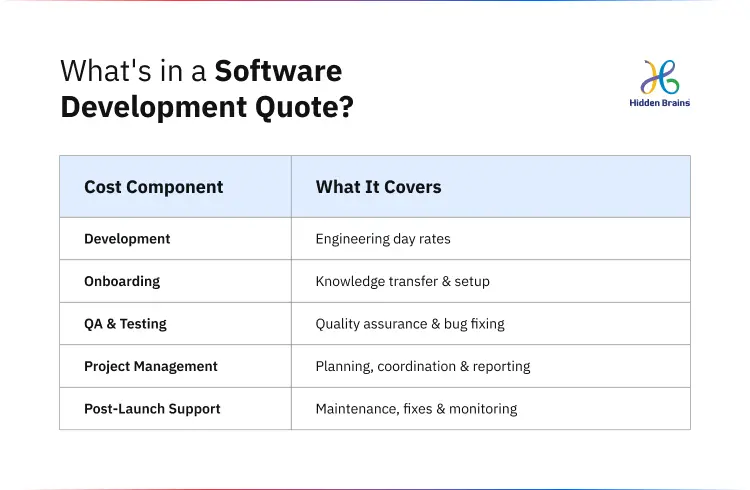
The quoted day rate is rarely the true cost. Total cost of ownership includes onboarding time, communication overhead across time zones, rework due to unclear requirements, and post-launch support, all of which vary significantly among a nearshore European team, an offshore team, and a local one.
As a rough frame: local European teams typically command the highest rates but the lowest coordination overhead; nearshore teams often offer strong cost-to-quality ratios with EU-adjacent time zones; offshore teams outside Europe can look cheaper on the quote but may add hidden costs in compliance adaptation, communication friction, and QA rework.
[INSERT: real comparative cost data or ranges, if available, to replace this general framing with original figures.]
Ask any vendor for a cost breakdown that separates day rate from onboarding, QA, project management overhead, and post-launch support, not just a single blended number.
Plan for Long-Term Support and Sustainable Growth
A launch is not the finish line. Ask how the vendor handles support after go-live:
Define post-launch support: Confirm response times, SLAs, and processes for resolving critical issues after go-live.
Plan for scalability: Ensure the vendor can expand the team and support growing product and user demands.
Ensure team continuity: Verify knowledge transfer, documentation, and backup resources if key engineers leave.
Look for a long-term partnership: Choose a vendor with a clear support and maintenance model beyond the initial delivery.
Red Flags That Signal an Unreliable Partner
Early warning signs are often visible if you know where to look. If a vendor exhibits several of these behaviors, consider them indicators of increased delivery, security, or compliance risk.
- No verifiable case studies, or “confidential client” used repeatedly with no detail
- Engineers shown in the sales process who aren’t available for your actual project
- Pricing significantly below market rate for the stated scope and seniority
- Reluctance to sign a DPA or discuss SCCs
- No clear answer on AI Act risk classification for AI-enabled features
- Vague answers on IP ownership or source code handover
Verification Checklist: What to Confirm Before You Sign
Before signing, verify that your software development partner can meet your technical, security, legal, and operational requirements. This checklist highlights the evidence to request and the capabilities that matter most.
| Area | What It Protects/Improves | What to Verify |
|---|---|---|
| GDPR Compliance | Protects customer data | Signed DPA, sub-processor list, SCCs if data leaves the EEA |
| EU AI Act Readiness | Reduces AI-specific legal and reputational risk | Risk-tier classification, documentation practices for AI features |
| Security Certifications | Demonstrates independently verified security maturity | ISO 27001 / SOC 2, recent penetration test summary |
| DevSecOps | Improves release quality and reduces vulnerabilities | SAST/DAST in CI/CD, dependency scanning, incident response process |
| Agile Delivery | Enables faster, safer releases | Visible sprint cadence, demo checkpoints, release management process |
| Industry Experience | Lowers project risk | Reference clients in your sector, sector-specific compliance history |
| IP Protection | Prevents ownership disputes | Full IP transfer on payment, source code handover rights, exit terms |
| Engineering Standards | Improves software quality | Named team, code review gates, architecture documentation |
| Communication | Improves collaboration and reduces delivery risk | Response quality during due diligence, reporting cadence proposed |
| Long-Term Support | Supports sustainable growth after launch | Post-launch SLAs, scaling plan, team continuity commitments |
For a deeper walkthrough of the GDPR-specific steps above, see our dedicated guide on GDPR compliance strategies.
Ready to Vet a Partner Against This Checklist?
If you’re evaluating vendors right now, we are here to help.
- Custom software development services: From discovery and architecture to delivery and post-launch support, with named engineers and DPAs in place before work begins.
- Hire Dedicated development teams: Scale quickly with experienced developers who provide the seniority, continuity, and transparency outlined in this checklist.
- AI integration expertise: Building AI-enabled products? Our team can assess EU AI Act risk classification and compliance requirements before development starts.
- AI strategy consultation: Planning your AI roadmap? Book a consultation with our AI experts to identify high-value use cases, define the right technology approach, and build a practical implementation strategy.
- Case Studies – Explore proven delivery, real-world solutions, and the results we have achieved for clients across industries.
Frequently Asked Questions
What should I ask before hiring a software development company in Europe?
Ask for a signed Data Processing Agreement, named engineers (not just sales contacts), IP ownership terms in writing, and a clear breakdown of total cost beyond the day rate.
How do I verify a software development company’s GDPR compliance?
Request their DPA, confirm Standard Contractual Clauses if data crosses outside the EEA, and ask who their sub-processors are and whether those sub-processors are also under contract.
Does the EU AI Act apply if my vendor is only building a chatbot or recommendation feature?
It can. The Act classifies AI systems by risk tier, and even limited-risk features like chatbots carry documentation obligations. Ask your vendor to classify the risk tier of any AI feature before development starts.
How early should I involve a software development partner in an AI project?
Involve them during the strategy and planning stage. A capable partner can help evaluate AI use cases, architecture choices, data requirements, and EU AI Act considerations before development begins.
How do I know if a vendor has experience in my industry?
Ask for relevant case studies, reference clients, and examples of handling industry-specific requirements such as healthcare data protection, financial regulations, or compliance standards.
What happens if the key developers leave during my project?
Ask about knowledge transfer processes, documentation standards, backup resources, and how the vendor ensures continuity throughout the engagement.



Conclusion
Make Verification Part of Your Vendor Selection Process
The vendors best positioned to win European IT budgets in 2026 aren’t necessarily the ones with the flashiest portfolio; they’re the ones who can answer every question in this checklist without hesitation. GDPR and the EU AI Act have raised the cost of getting vendor selection wrong, and “top company” rankings won’t tell you which partner actually has a signed DPA, a named engineering team, or a clear answer on IP ownership.
Treat this checklist as a working document: bring it to your next vendor call, ask the questions directly, and be wary of any partner who deflects rather than answers. The strongest partnerships start with a vendor that welcomes this level of scrutiny, not one that resists it.
Ready to build your next digital product? Partner with our AI-powered software development company for secure, scalable, and future-ready solutions tailored to your business goals.