
















































































































Summary
Looking to build powerful, real-time web apps without breaking the bank? Hiring a MEAN stack developer could be your smartest move. This guide unpacks everything you need to know—from what MEAN (MongoDB, Express.js, Angular, Node.js) developers bring to the table, to must-have skills, hiring costs, and where to find top talent. You’ll also get a quick MEAN vs. MERN comparison and discover why trusted tech partners like Hidden Brains make all the difference. Whether you’re scaling fast or building from scratch, this blog helps you hire with clarity and confidence.
If you’ve been exploring ways to build dynamic, high-performing web applications, you’ve encountered the term MEAN stack more than once. And there’s a good reason why. With tech companies of all sizes racing to build scalable, modern solutions, the demand for MEAN stack engineers has increased in recent years. prompting many to evaluate the cost to hire MEAN stack developers for their projects.
In the USA, the demand for MEAN stack experts rose by 150% in the past 3 years, indicating a higher rate of adoption. and naturally, many businesses are also evaluating the cost to hire MEAN stack developers for their upcoming projects.
It’s fast, flexible, and ideal for building everything from sleek single-page applications to robust enterprise platforms. In this blog, we break down exactly what a MEAN stack coders does, why hiring one can be a smart move, how much it typically costs, and what you should look for before bringing one on board.
The MEAN Stack Developer’s Role: What Employers Should Know
It will be useful to know what MEAN stack programmers do and why they’re important in today’s web.
What is MEAN Stack?
MEAN is an acronym for a powerful combination of JavaScript-based technologies:
- MongoDB – a flexible NoSQL database used to store app data
- Express.js – a lightweight backend framework that runs on Node.js
- Angular – a frontend framework developed by Google for building rich user interfaces
- Node.js – a server-side platform that runs JavaScript on the backend
With these tools, developers can build both the front end and the back end using only JavaScript. That is very significant when we talk about how fast, consistent, and effective the apps can be.
Who are MEAN Stack Developers?
MEAN stack developers’ mastery is in all four mentioned technologies. They can build, deploy, and maintain entire web applications from start to finish using one language.
No matter if you need to set up a database, create APIs, or design interactive UI parts, a MEAN stack developer can handle those tasks. Because of this, startups find it easy to move fast using just one person.

Where is MEAN Stack Used?
Startups and large enterprises alike widely adopt the MEAN stack. It’s a great fit for:
- Real-time applications (like messaging or collaboration tools)
- Single-page applications (like dashboards or admin panels)
- eCommerce platforms and portals
- Enterprise-grade content management systems
- On-demand service apps (like ride-sharing or food delivery)
In short, if your project demands flexibility, scalability, and a fast turnaround, MEAN stack is a smart choice.
Why Should You Hire a MEAN Stack Developer?
Now that you know what a MEAN stack developer does, why should you hire one?
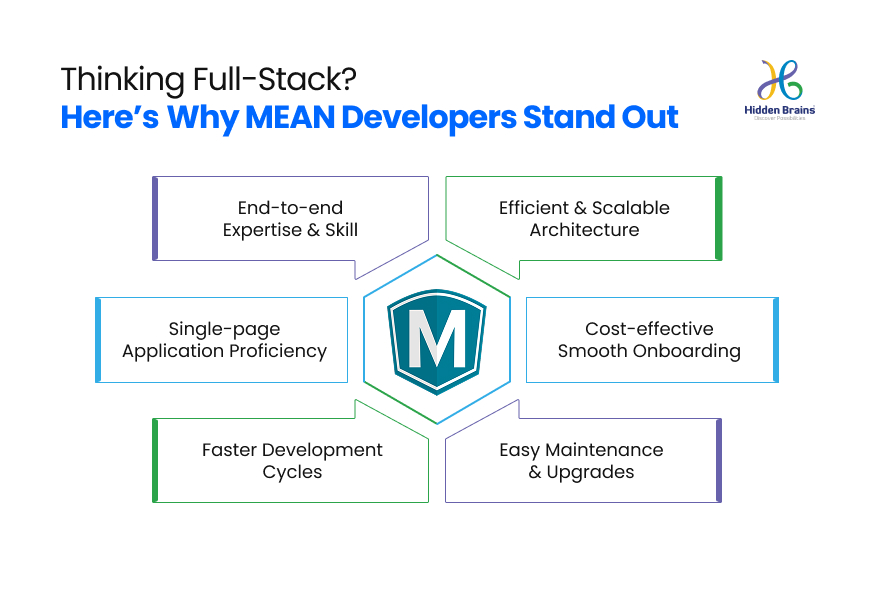
If you’re managing an emerging business or an MVP and want to build a web app quickly, efficiently, and without hiring multiple specialists, hiring a MEAN Stack developer is a great solution. Beyond technical capability, understanding the cost to hire MEAN stack developers helps you plan smarter while aligning budget and development goals effectively.
End-to-end Expertise in One Person
Using the MEAN stack, developers can work with every part of web development. Because they are skilled in frontend and backend development, they handle the user interface, server-side logic, and database work, all utilizing JavaScript. It makes it possible to work more organized and efficiently.
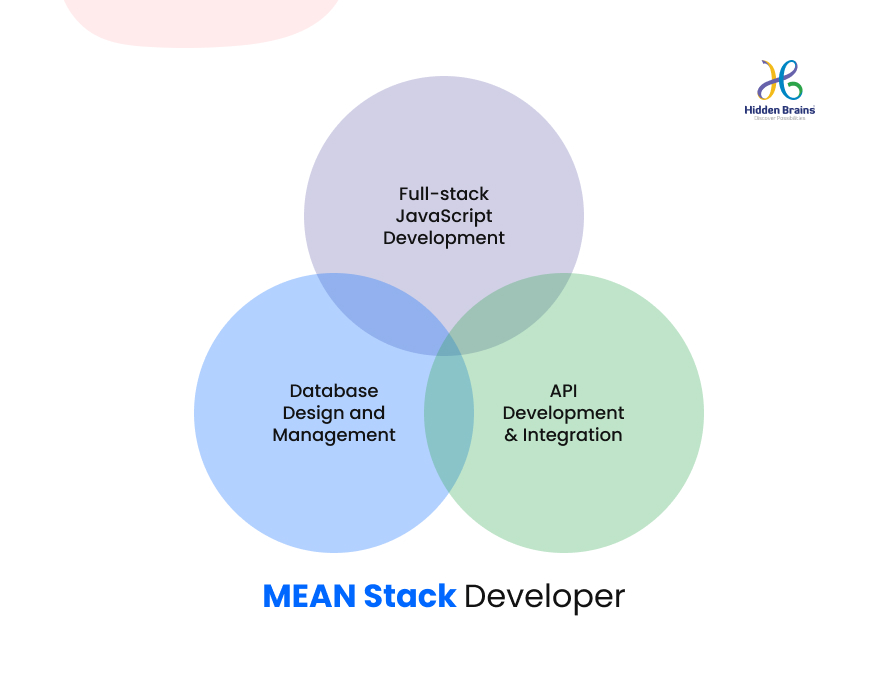
Just like in the image above, MEAN stack developers sit at the intersection of:
- Full-stack JavaScript Development
- Database Design and Management
- API Development and Integration
That’s a powerful combination for building robust, data-driven, and interactive web applications.
Faster Development Cycles
Every aspect of MEAN uses JavaScript, so developers don’t need to switch between different programming languages or frameworks. Because of this, coding takes less time, there are fewer errors, and deployment is faster, which is very helpful for both startups and product teams that aim for quick releases. When evaluating the cost to hire MEAN stack developers, this efficiency often translates into faster delivery and lower overall development costs.
Scalable Architecture for Growing Projects
MEAN stack is built for scalability. Whether you’re starting with a basic web app or planning something enterprise-grade, the architecture can grow with your product without requiring a complete rebuild later on. This long-term adaptability offers better ROI an important factor to consider when assessing the cost to hire MEAN stack developers for future-ready solutions.
Cost-effective Hiring
One MEAN stack expert can complete all the tasks of frontend, backend, and database developers at once. It is a great success when you are financially limited or have only a small team to rely on.
Ideal for Real-time Robust Applications
Planning to build a live chat app, real-time dashboard, or seamless single-page interface? MEAN stack is a natural fit. Node.js handles asynchronous operations like a champ, while Angular delivers smooth, interactive UI experiences.
Easy Maintenance and Upgrades
Since everything follows a common language and modular design, maintaining and upgrading a MEAN-based application becomes much simpler. Developers can easily debug, test, or extend features without breaking things across layers.
What Skills and Qualifications Should You look for in a MEAN Stack Developer?
You shouldn’t evaluate MEAN stack developers based on their technical skills. The key is getting individuals skilled enough to move effortlessly between the front-end, back-end, and everything else. These are the two parts to pay attention to.
What are the Qualifications of a MEAN Stack Developer in the USA?
In the U.S., these are the skills a MEAN stack developer should have:
- A Bachelor’s degree in Computer Science, Information Technology, or a related field (though some great developers are self-taught).
- 2–5 years of experience working with MEAN stack projects or full-stack JavaScript.
- Strong portfolio or GitHub with working project examples.
- Familiarity with agile workflows and version control (Git).
- Experience with CI/CD pipelines, Docker, and basic deployment strategies.
Bottom line? You want someone who not only knows the MEAN stack but understands how real-world web apps are built, deployed, and maintained.
What Skillsets Should MEAN Stack Developers Have?
Here’s a practical breakdown of what your ideal MEAN stack developer should bring to the table:
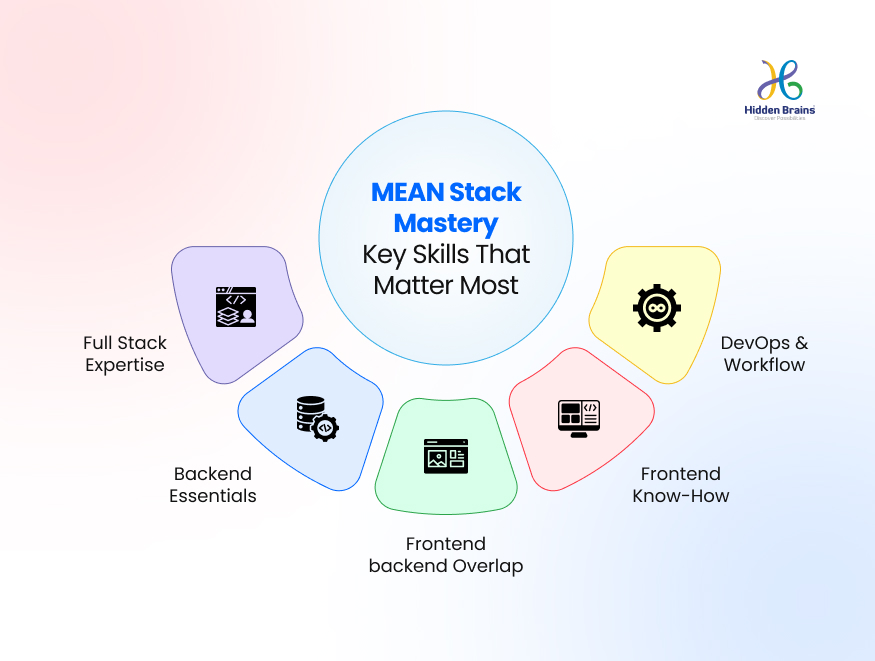
Full Stack Fundamentals
They should be comfortable working across the entire tech stack, even if they’re not experts in every piece. Think of it as having a well-rounded toolkit:
- Solid understanding of software design patterns (MVC, SOLID, event-based architecture).
- Good grasp of data structures and algorithms (arrays, trees, hashmaps, etc.).
- Familiarity with REST APIs and web security principles.
Back-end Proficiency
Your developer should know how to power the engine under the hood:
- Server-side language: Node.js (of course), but bonus points for knowing others like Python, Go, or Java.
- Databases: Strong command over MongoDB and understanding of relational DBs like MySQL/PostgreSQL.
- Web servers: Basics of Nginx or Apache.
- Protocols: Knowledge of HTTP, TCP/IP, and how communication flows between client and server.
- Performance strategies: Caching, using CDN, message queues (like Redis or RabbitMQ).
Front-end Know-How
This is where your users will interact so your developer needs to get it right:
- Strong in HTML (with semantic structure and accessibility in mind).
- CSS mastery, including box model, layout techniques, and responsive design.
- JavaScript fundamentals, DOM manipulation, event handling.
- Familiarity with Angular (MEAN-specific) and optionally React, Vue, or Svelte.
- Awareness of UX best practices, SEO fundamentals, performance optimization techniques, and WCAG accessibility standards.
DevOps & Day-to-day Workflow
It’s not just about writing code it’s about managing and deploying it efficiently:
- Proficient in Git for version control
- Knowledge of Docker or containerization tools
- Basic CI/CD pipelines (GitHub Actions, GitLab CI, etc.)
- Testing tools, liters, and automated deployment practices
Front-end–back-end Overlap
Certain tools (like WebSockets, JWT authentication, or GraphQL) blur the line between the front end and the back end. A strong MEAN stack developer understands how both sides work together and writes code that connects them seamlessly.
Understanding the Cost to Hire MEAN Stack Developers in the USA
When hiring a MEAN stack developer in the U.S., one of the main questions that arises is: what’s the actual cost to hire MEAN stack developers in today’s market?
Experience Level
The more experience a developer has, the higher the salary they enjoy. Unless your project is very simple, you should hire an MEAN developer with a few years’ worth of experience.
Location
Working with a developer in New York or San Francisco will have a bigger price tag than in other places across the USA.
Engagement Type
Full-time employees come with salary, benefits, and overhead.
Freelancers or contract developers can offer flexibility and often charge by the hour.
Agencies or managed teams may charge premium rates for end-to-end service.
Project Scope
Are you building an MVP, scaling an existing app, or starting from scratch with a massive system? The more responsibility and expertise required, the higher the compensation.
What Should Be Your Budget for Hiring a MEAN Stack Developer in the USA?
Budgeting $100K–$130K/year should ensure you get a skilled MEAN stack developer in the USA if they are hired full-time. Freelancers usually cost between $50 and $80 per hour based on how much experience and skills they have and what kind of project it is.
Should You Hire Onsite, Remote, or Offshore MEAN Stack Developers?
When hiring MEAN stack developers, the real question isn’t just who but where from. Your choice can affect your budget, speed, and how easily your team scales.
Onsite Developers (U.S.-based)
Great if you need someone deeply involved, sitting with your team daily. But this comes at a premium—higher salaries, benefits, and overhead. Best suited for long-term, high-stakes projects.
Remote Developers (Same region)
A middle ground. You get flexibility, cost savings, and still decent time zone overlap. They’re ideal if you want skilled talent without paying for office space.
Offshore Developers (Global talent)
Offshore developers are the go-to if you aim to build smart and stay lean. You’ll find experienced MEAN stack pros at much lower costs, especially in places like India or Eastern Europe. The key is choosing the right development partner to ensure quality and communication.
Is It Cheaper to Hire Offshore MEAN Stack Developers?
If you choose to hire in the U.S., you may expect to pay between $50 and $100 each hour, based on the programmer’s experience level.
Then, look at what offshore options have to offer:
If you look in India, Ukraine, or the Philippines, MEAN stack developers with experience usually charge between $25 to $49 per hour. With such a big difference in the cost to hire MEAN stack developers globally, it’s easy to see why many businesses outsource to talented professionals in regions like India or Eastern Europe.
Should I Hire Freelance or Full-time MEAN Stack Developers?
You should hire a freelancer if your project’s needs, time frame, and budget do not require a full-time worker. This illustration provides you with the main points to make your decision.
Freelance MEAN Stack Developer
Best For: Short-term projects, MVPs, quick fixes
Pros:
- More affordable (hourly or project-based)
- Flexible availability
- Easier to scale up or down
- Access to global talent
Cons:
- Limited availability (may juggle multiple clients)
- Less control over working hours
- Risk of communication gaps
Ideal If:
You want to create a simple app, check an idea, or want assistance with one task.
Full-time MEAN Stack Developer
Best for: Long-term projects, product development, team integration
Pros:
- More committed to your company/product
- Better collaboration with your internal team
- Consistent availability and support
- Easier knowledge retention
Cons:
- Higher cost (salary + benefits)
- Longer hiring and onboarding process
- Fixed working hours
Ideal If:
You require a complicated system, you want to grow and improve fast, or you always need expert help.
MEAN Stack vs MERN Stack — Which One Should You Hire For?
What should be your choice, MEAN stack development or MERN stack development? It is a question that many startup founders, product managers, and tech recruiters have in mind these days.
Both frameworks make it possible to create modern web applications by using full-stack JavaScript. Still, there are distinctions, and the one you settle on should fit your project, the team’s taste, and how you want the app to function for your users.
What’s the Key Difference?
- MEAN = MongoDB, Express.js, Angular, Node.js
- MERN = MongoDB, Express.js, React, Node.js
The only change? Angular vs React on the front end. But that swap changes a lot in how your app is built, updated, and scaled.
When to Choose MEAN Stack
- You prefer structured, opinionated frameworks (Google backs angular and enforces strong coding patterns)
- Your team already has experience with Angular
- You’re building enterprise-level apps that need strict architecture and long-term scalability
- You want two-way data binding for more dynamic interfaces
- Do you prefer built-in solutions over custom libraries
Good for:
CRM systems, dashboards, admin portals, enterprise SaaS apps
When to Choose MERN Stack
- You want a flexible, component-based approach (React is library-based and highly customizable)
- Your app needs high interactivity and speed, especially for dynamic content updates
- You value a large developer community and tons of third-party libraries
- You prefer JSX syntax for blending HTML with JavaScript
Good for:
Social platforms, single-page apps, marketplaces, and real-time web apps
Which One Should You Hire For?
- Go for MEAN Stack developers if your project is large-scale, needs strong architecture, and you want to stick with a full framework (Angular).
- Go for MERN Stack developers if flexibility, performance, and quick UI development are top priorities (React wins here).
How Hidden Brains Helps You Hire MEAN Stack Developers
Our team of expert MEAN Stack developers at Hidden Brains has comprehensive knowledge and experience in utilizing the entire potential of the latest and versatile tech stack of MongoDB, Express.js, React, and Node.js to develop future-ready, high-performance, and enterprise-scale software applications.
Our team will cover you whether you are releasing an elaborate enterprise web platform or releasing a custom CMS. We’re not coders; we add knowledge, foresight, and innovation to any project; we make sure the applications we develop are not only future-proof but also designed to change and grow with your business. If you want to build a next-gen app, hire dedicated MEAN stack developers from Hidden Brains right now!
Frequently Asked Questions
To find a qualified MEAN Stack developer, you do not need to feel overwhelmed, even if you do not have a technological background. We present you with our FAQ section to help you out with a few common questions.
How do you verify a developer’s real-world experience?
Ask for GitHub links, live project demos, or portfolio case studies. Let them walk you through a project they’ve built—what the challenge was, how they solved it, and their specific contributions. This gives you insight into both their technical depth and problem-solving approach.
How can you tell if a MEAN developer is actually skilled?
Don’t rely on resumes alone. Ask for project walk-throughs, check GitHub repos, or assign a short trial task. Clean code, good logic, and clear communication are great indicators.
What soft skills should I look for in a developer?
In addition to technical skills, a good candidate must be a team player, self-initiated, and feedback-friendly. Communication is important, particularly in remote or agile teams.
Where can you find experienced MEAN stack developers in the USA?
Prime MEAN Stack talent can be located in technology hot spots such as San Francisco, New York City, Austin, Seattle, Chicago, Los Angeles, Atlanta, and Boston. The developer communities in these cities are robust, and the full-stack professionals are continuously developing.
What are the main benefits of using the MEAN stack?
The MEAN stack offers a full JavaScript development environment from the front end to the back end. It enables faster development, real-time capabilities, easy scalability, and seamless data flow—all ideal for dynamic enterprise applications.
What kind of applications can be built with the MEAN stack?
Everything from enterprise dashboards and real-time analytics tools to eCommerce platforms, CMS systems, internal portals, and even social networking apps. MEAN is highly versatile.

Conclusion: Making the Right Choice When Hiring MEAN Stack Developers
Working with an expert MEAN Stack developer can make your app efficient and adaptable very quickly. Whether you’re building a simple prototype or a complex system, finding out what to watch for and where can save you time and money and make everything less confusing.
After gaining the proper knowledge, you are positioned to make a wise decision in your hiring process. Are you prepared to go to the next level? Start on a clear note and go on with confidence as your search progresses.
