















Quick summary
- FDEs are engineers embedded with a client to take AI from pilot to production.
- About 95% of enterprise GenAI pilots stall, mostly on integration (MIT).
- FDEs scope, integrate, deploy, secure, and hand over working AI systems.
- Biggest impact: AI agents, knowledge search, legacy systems, regulated industries.
- Not needed for standalone tools or projects with no internal owner.
Forward-deployed engineers are software engineers who work inside a client’s environment to take AI and software from a promising pilot to a system people use every day. Enterprises bring them in because most AI projects don’t fail on the model. They fail where the model meets real data, real systems, and real workflows.
That gap is now well documented. MIT’s NANDA initiative found that about 95% of enterprise generative AI pilots stall without measurable revenue impact, and traced the cause to a “learning gap” between AI tools and how organizations actually work (Computing, reporting MIT NANDA). Forward deployed engineering is one of the clearest answers the industry has found.
This guide covers what forward deployed engineers do, how they help enterprises, where they make the biggest difference, and when you don’t need one.
What Are Forward Deployed Engineers?
A forward deployed engineer (FDE) is a software engineer embedded with a specific customer to adapt, integrate, and deploy a technology platform until it solves that customer’s problem in production. Unlike a product engineer, an FDE is measured by the customer’s outcome, not by features shipped to the platform.
The role was popularized by Palantir, which splits its engineers into two groups. Product developers build the core platform for many customers. Forward deployed engineers, known internally as “Deltas,” take that platform into one customer’s environment and tailor it to the business problem (Palantir Engineering Blog).
Today, AI labs, enterprise software vendors and technology partners use the same model to make their products work inside large organizations. You will also see the role called forward deployed software engineers; the terms mean the same thing.
Why are Enterprises Hiring Forward Deployed Engineers?
Enterprises are adopting the FDE model because buying AI has become easy, and making it work inside the business has not. The bottleneck has moved from the model to integration, data, and adoption.
The data points in the same direction:
- Demand is rising fast. Lightcast counted about 200 US job postings for forward deployed engineers in 2024, about 1,200 in 2025, and more than 5,200 in just the first seven months of 2026 (Lightcast).
- Outside expertise improves the odds. The same MIT research reports that AI tools bought from specialist vendors succeed about two-thirds of the time, while internally built systems succeed about one-third of the time (Computing, reporting MIT NANDA).
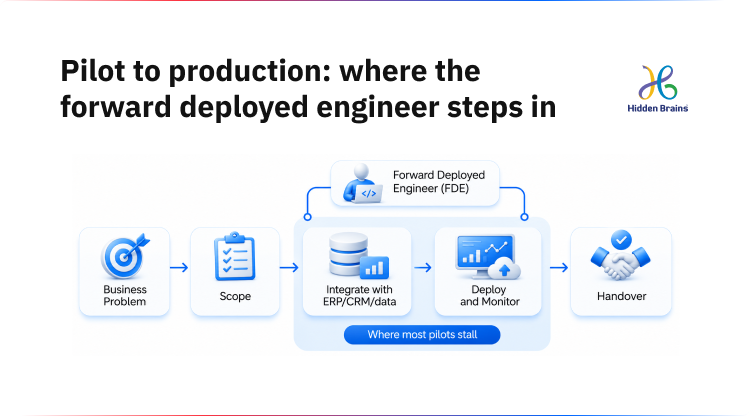
In practice, the pattern is predictable. A pilot usually runs on a clean data extract, a small user group, and relaxed security rules. Production runs on the live ERP or CRM, with its access controls, inconsistent master data, and multi-step approvals. That transition is where timelines slip, and it is exactly the work forward deployed engineers are hired to own. If you are weighing where AI agents fit in this picture, our guide to agentic AI for enterprise covers the business case.
How Do Forward Deployed Engineers Help Enterprises?
Forward-deployed engineers help enterprises by owning the hardest part of any AI program: the last mile between a working demo and a working business process. They do this in five ways.
1. They turn business problems into technical scope
An FDE starts with the process, not the model. They sit with the people who do the work — finance, operations, customer service — and map where time is lost, which decisions need data, and which exceptions break automation. The output is a scope engineers can build, and a business owner can sign off, rather than a vague brief to “use AI for operations.”
2. They connect AI to the systems you already run
Most enterprise value sits in existing systems: ERP, CRM, data warehouses, document stores and ticketing tools. FDEs build the integration layer — APIs, connectors, data mappings and single sign-on — so an AI agent or assistant can read and act on live data with the right permissions. This is the core of what an AI integration services engagement is built around.
3. They build for production, not for a sandbox
A demo needs to work once. A production system needs to work every day, under load, with users who phrase things unpredictably. FDEs set up evaluation sets drawn from real user questions, monitoring for accuracy and cost, fallback paths to a human, and logging that lets the team see why the system gave a particular answer.
4. They work within your security and governance rules
Because they work inside your environment, FDEs design around your access controls, data residency requirements, audit needs, and model-usage policies from day one. That avoids the common pattern where a pilot is approved by IT for testing and then blocked by security review before go-live.
5. They transfer knowledge and feed learnings back
A good FDE engagement ends with your team able to run, monitor, and extend the system: runbooks, documented integrations, and a named internal owner. Lessons from the field also flow back into the platform as fixes or features, which is what separates forward deployed engineering from one-off customization.
Where Do Forward Deployed Engineers Make the Biggest Difference?
Forward-deployed engineers add the most value where AI has to act inside several enterprise systems, and the cost of a wrong answer is high. The table below shows the most common cases.
| Use case | What usually blocks it | What an FDE does differently |
|---|---|---|
| AI agents for operations (approvals, order processing, procurement) | The agent can read data but can’t act in the ERP; exceptions have no owner | Maps the workflow, builds tool integrations with scoped permissions, adds human review for exceptions |
| Enterprise knowledge search (RAG) | Answers drift from source documents; users see files they shouldn’t | Indexes the right sources, enforces document-level permissions, tests against real employee questions |
| AI on top of ERP and legacy systems | No clean API; data only available in nightly batches | Builds an integration layer, maps master data, sets sync rules |
| Customer service automation | The assistant can’t see order or account data; escalation to agents breaks | Connects CRM and ticketing, designs the handoff to human agents |
| Regulated industries (finance, healthcare, public sector) | Compliance review stops go-live late in the project | Designs to audit, logging, and data-residency requirements from the start |
The common thread is integration. If the AI only needs to summarize text in a standalone tool, you rarely need an FDE. If it needs to work across systems and teams, you usually do. For a deeper look at how autonomous agents differ from content-generating AI, see generative AI vs. agentic AI.
Close the Gap Between AI Strategy and Execution.
Get Expert Guidance
How do Forward Deployed Engineers Compare With Consultants, Staff Augmentation, and In-House Teams?
Forward-deployed engineers differ from other delivery models in one way that matters most: they build and deploy the working system inside your environment and stay accountable until it runs in production. Palantir makes the same distinction, noting that FDEs deploy and build lasting solutions rather than hand over one-time recommendations (Palantir Engineering Blog).
| Model | What you get | Who owns the outcome | Best when |
|---|---|---|---|
| Forward deployed engineers | A working system in your environment, plus handover | Shared, tied to the system running in production | Integration is complex, and you need results in months, not years |
| Management or AI consultants | Strategy, roadmap, recommendations | You | You are still deciding what to build |
| Staff augmentation | Extra engineers directed by your team | You | You have clear technical leadership and a defined backlog |
| In-house AI team | Long-term capability you own fully | You | AI is core to your product, and you can hire and retain specialists |
These models are not mutually exclusive. Many enterprises use forward deployed engineers to get the first systems into production, then build an in-house team or a dedicated development team to run and extend them.
What Skills Make an Effective Forward Deployed Engineer?
An effective forward deployed engineer combines production-grade engineering with the ability to work directly with business stakeholders. Lightcast’s analysis of job postings shows employers ask FDEs for artificial intelligence, Python, and workflow management far more often than they ask general software engineers, alongside communication, problem-solving, and leadership (Lightcast).
| Skill area | What it looks like in practice | Why it matters to your project |
|---|---|---|
| Software engineering | Python, APIs, data pipelines, cloud deployment | You get production code, not slideware |
| Applied AI | Retrieval-augmented generation (RAG), tool and agent design, evaluation methods | The right approach is chosen, and its quality is measured |
| Systems integration | ERP and CRM integration, authentication, data mapping | AI can act on live business data safely |
| Delivery | Workflow mapping, scoping, prioritising | Pilots don’t drift without a finish line |
| Stakeholder skills | Explaining trade-offs, framing problems, managing expectations | Business and IT agree on what “done” means |
If you are assessing candidates or a partner, look for evidence of systems shipped into production environments, not only prototypes. Any AI developers you bring in should show that same combination of AI and integration experience.

Move Your AI Into Production With the Right Expertise
Talk to an AI EngineerWhen is a Forward Deployed Engineering Model Not the Right Fit?
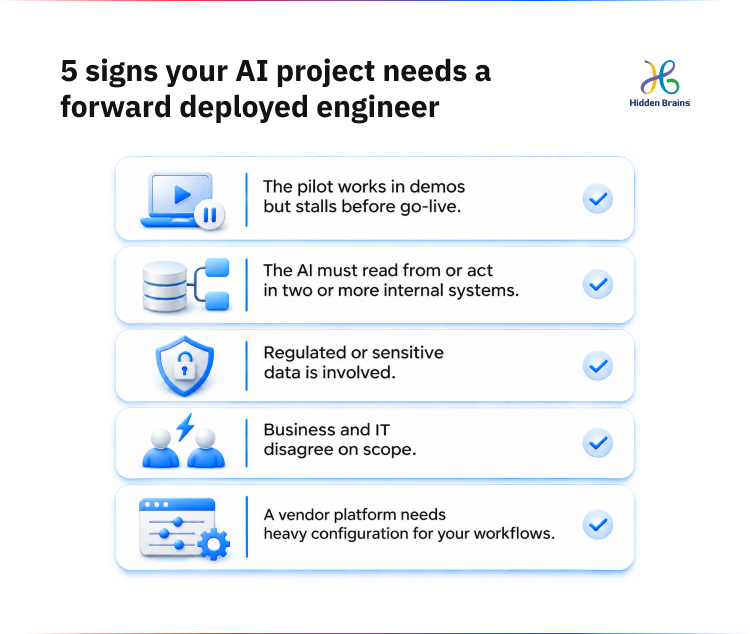
A forward-deployed model is not worth the investment for every AI project. It is usually the wrong choice when:
- The tool works out of the box. A standalone writing assistant or meeting summarizer rarely needs custom integration.
- Your data isn’t ready. If core records are incomplete or scattered, fix the data foundation first. An FDE will spend most of the engagement on cleanup.
- No one will own the system afterwards. Without an internal owner, even a well-built system decays after handover.
- The business problem isn’t defined. If there is no sponsor and no measurable target, start with a short discovery or consulting phase.
- The task is narrow and well specified. A single feature with clear requirements may suit a smaller development engagement better.
How Hidden Brains Approaches Forward Deployed Engineering
Hidden Brains places engineers who combine AI development with enterprise integration experience directly alongside client teams, so AI moves from pilot to production inside the client’s own systems.
Three things shape how we work:
- Enterprise integration depth. With 23+ years of enterprise software experience across 107 countries, we understand how to integrate AI with ERP, CRM, and legacy systems to enable production-ready solutions.
- Security and responsible AI governance. Our ISO/IEC 27001:2022 certification supports information security management, while ISO/IEC 42001:2023 establishes a structured approach to AI governance, risk assessment, accountability, and continuous improvement.
- Consistent engineering delivery. Our CMMI Level 3 maturity reflects defined development processes, helping embedded teams maintain consistency in project execution, testing, quality assurance, and delivery.
Whether you need a single engineer embedded with your team or a full custom AI development engagement, the goal is the same: AI that runs inside your business, not beside it. Once the first systems are live, many enterprises hire dedicated developers to run and extend them as a long-term extension of their team. If you are ready to hire forward-deployed engineers, start with a conversation about the workflow you want to change.
Frequently Asked Questions
What business problems do forward-deployed engineers solve?
Forward-deployed engineers solve the problem of AI investments that never reach daily use. They turn stalled pilots into working systems by connecting AI to the ERP, CRM, and data platforms your teams already rely on, so the investment shows up in a real business process rather than a demo.
What return should we expect from forward deployed engineers?
The return comes from getting one high-value workflow into production faster, not from the engineers themselves. Tie the engagement to a single measurable outcome agreed up front — such as approval cycle time, cost per transaction, or customer resolution time — and judge it against that number.
How much do forward-deployed engineers cost?
Cost depends on scope, seniority, and how long engineers are embedded. Weigh it against the cost of the alternative: a pilot that consumes budget for months without reaching users, or the time it takes to recruit specialist AI and integration talent in-house.
How do we measure whether an FDE engagement is working?
Measure it by production outcomes, not activity. Useful checkpoints are: the system is live with real users, it is connected to the agreed systems, the target business metric is moving, and your internal team can run it without the FDE.
What are the business risks of using forward deployed engineers?
The main risks are dependency on a few external engineers, custom code that is hard to maintain, and knowledge leaving when the engagement ends. Reduce them with documented integrations, a named internal owner from day one, and a planned handover.
Who owns the code and intellectual property?
Ownership is set by your contract, so agree on it before work starts. For systems built inside your environment on your data, enterprises typically expect to own the custom code and integrations.
How do forward deployed engineers work with our IT and security teams?
They work inside your rules, not around them. FDEs operate under your access controls, data policies, and change-management process, and involve IT and security early so the system passes review before go-live instead of being blocked at the end.
Should we build an in-house team or work with a partner?
Build in-house when AI is core to your product, and you can recruit and retain specialists. Work with a partner when you need production results quickly, lack integration experience, or want proven systems first and internal capability through structured handover.



Conclusion
Forward deployed engineers matter because the hard part of enterprise AI is no longer the model. It is making AI work inside real systems, data and workflows, and that is the gap FDEs are built to close.
The model pays off when AI must work across several systems, handle sensitive data or change how a team operates. For standalone tools, a lighter engagement is usually enough.
If your AI works in a demo but hasn’t reached the people who should use it every day, start with a free two-hour tech consultation. We’ll map the workflow you want to change and what it takes to get it into production.