















































































































































Overview
Agentic AI is about to redefine how enterprises operate. In 2026, autonomous agents will move beyond chatbots and manual workflows to plan, execute, and optimize business processes on their own. This blog explores why the shift is happening now, the capabilities that make agentic systems enterprise-ready, and the real-world use cases already delivering massive ROI. If you’re preparing for the next leap in enterprise AI, this is the roadmap you need to stay ahead.
2026 is the year Agentic AI for becomes unavoidable. Not because it’s new, but because it’s finally mature enough to deliver real autonomy. The market is already $7.55B. By 2026, it will reach $10.86B. And experts predict a jump to $199.05B by 2034.
Agentic AI is no longer an experiment; it’s the new growth engine for enterprise AI. Enterprises are hitting a tipping point. Data maturity is improving. Automation debt is overwhelming teams. APIs, workflows, and systems are finally ready for autonomous orchestration. Global AI policy is opening the doors for safe, compliant use.
Manual work can’t keep up with market pressure. Businesses need custom AI development company that understand goals, take actions, and self-correct. That’s why 2026 marks the true inflection point. Agentic AI brings autonomy. Autonomy brings the next leap in productivity.
Understanding Agentic AI: Beyond LLMs, Beyond Chatbots
Agentic AI is not “just another assistant.”It’s a system that thinks in goals, not prompts. It takes actions, not suggestions. And it improves itself as it works.
What Makes an Agentic System
- Agentic AI is goal-driven. You tell it the outcome, not the step-by-step instructions.
- It is tool-using. It triggers APIs, queries databases, updates systems, and performs tasks on its own.
- It is self-correcting. If something fails, the agent retries, adjusts the plan, or chooses a better path. This is far beyond traditional chatbots, which only answer questions.
And it’s beyond LLM development services, which wait for your next prompt. Agents execute. They move work forward.
How Agents Work Behind the Scenes
Agents read context. They break goals into subtasks. They plan, act, and verify. And they loop through this cycle until the job is done. This ability to operate independently is why enterprises are shifting fast.
In fact, there has been a 282% YoY surge in AI in the enterprise, driven directly by the Agentic boom. The momentum isn’t slowing: enterprise spending in this space is expected to reach $1.3 trillion by 2029.
Why Enterprises Need Autonomy
Modern operations are too complex, too fast, and too distributed for manual execution. Teams don’t need more chat. They need intelligent agents that handle full workflows without constant supervision. Agentic AI meets that need. It brings autonomy, precision, and speed. The core ingredients enterprises must adopt to stay ahead.

Ready to Build Your First Agentic Workflow?
Talk to ExpertsThe Automation Evolution: Why RPA + IA Hit a Ceiling
For more than a decade, RPA and Intelligent Automation have helped enterprises cut costs and eliminate repetitive tasks. They brought speed, accuracy, and predictability. But today’s operations are far more dynamic. Rules break. APIs change. Data shifts every hour. And that’s where traditional automation starts to fail and where Agentic AI steps in.
What RPA + IA Actually Solved
RPA handled structured, repetitive, rule-based tasks. It was perfect for copying data, moving files, and following predefined workflows.
IA added a layer of intelligence. It improved document processing and decision support. Together, they automated thousands of hours of manual work. But they were designed for stable, predictable environments. And enterprises no longer operate in those conditions.
The Structural Limitations of RPA
RPA breaks easily. One layout change, API update, or new exception and the bot stalls. It cannot adapt. It cannot reason. It cannot make judgment calls in nonlinear workflows. Moreover, maintenance drains teams. Scaling becomes expensive.
And automation pipelines slow down instead of speeding up. These limitations create a natural ceiling, and enterprises are hitting it fast.
Why This Sets the Stage for Agentic AI
Modern operations need systems that understand context and adjust on the fly. They need autonomy, not fixed rules. This is where autonomous reasoning becomes the missing piece. Agentic AI can see a change, replan, retry, and continue execution without human help.
How Agentic AI Merges the Best of All Worlds
Agentic AI combines the structure of RPA, the flow of orchestration tools, and the intelligence of cognitive automation. It doesn’t just follow rules. It creates plans. It uses tools. It handles exceptions. And it keeps working even when conditions change. This evolution is not an upgrade. It’s a new foundation, and it’s redefining automation for the next decade.
Core Capabilities That Define Enterprise-grade Autonomous Agents
Agentic AI is becoming the new backbone of enterprise software. By 2035, agentic-powered systems are expected to generate $450B in revenue, accounting for nearly 30% of all enterprise AI software. And the shift is coming fast. Experts predict that by 2026, 40% of enterprise apps will embed autonomous agents.
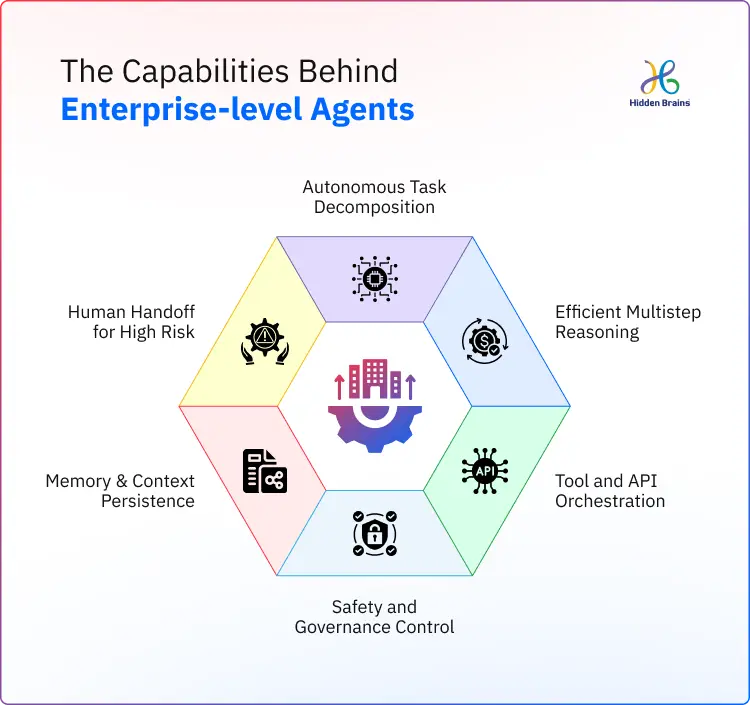
What makes these agents enterprise-ready? A set of core capabilities designed for real-world complexity, compliance, and scale.
1. Autonomous Task Decomposition
Agents don’t wait for step-by-step instructions. You provide a goal. The agent breaks it into subtasks, prioritizes them, and starts executing. This is how enterprises replace slow manual workflows with fully automated pipelines.
2. Multistep Reasoning: Plan → Execute → Verify
Agents think in loops, not single actions. They plan the path. Execute each step. Verify results before moving forward. It reduces errors and keeps workflows consistent even when conditions shift.
3. Tool Usage & API Orchestration
Enterprise work happens across dozens of systems. Agents connect them. They trigger APIs, run queries, post updates, and orchestrate multi-system actions end-to-end. No more swivel-chair operations. No more human glue between tools.
4. Memory & Context Persistence
Agentic AI Agents remember. They keep track of state, past actions, decisions, and outcomes. It lets them resume tasks, adapt to context, and improve over time. It’s not automation, it’s learning-driven execution.
5. Safety Protocols & Governance Controls
Enterprise autonomy must be safe. Agents operate within guardrails, permission tiers, and strict action logs. Every step is audited. Every action is governed. Nothing runs outside approved boundaries. This is what makes Agentic AI deployable in regulated industries.
6. Human Handoff for High-Risk Scenarios
Autonomy doesn’t mean isolation. When the stakes are high, such as financial approvals, compliance checks, and sensitive data, agents automatically escalate to humans. It keeps risk low and trust high. It also ensures enterprises stay compliant without slowing operations.
Inside the Agentic AI Architecture:
Agentic AI isn’t a single model. It’s an ecosystem of coordinated layers that allow the agent to think, perceive, plan, and act safely.
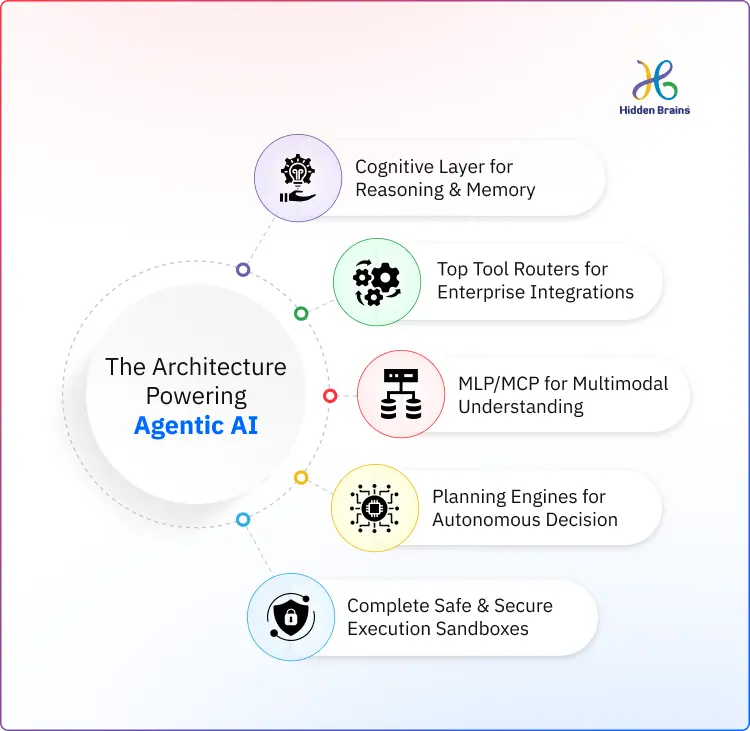
Here’s a simple breakdown of how the AI agent architecture works inside modern enterprise systems.
Cognitive Layer for Reasoning & Memory
This is the agent’s brain. It handles reasoning, long-term memory, context tracking, and decision-making. It understands goals, reviews past steps, and adapts when workflows change.
MLP/MCP for Multimodal Understanding
Agents must interpret more than text. MLP and MCP frameworks let them understand documents, screenshots, images, logs, and structured data. It makes them useful across every part of enterprise process automation.
Tool Routers for Enterprise Integrations
Tool routers function as the agent. They connect to APIs, databases, ERPs, CRMs, and legacy systems. The agent picks the right tool at the right time without human help.
Planning Engines for Autonomous Decision Loops
This layer allows the agent to break goals into steps, evaluate outcomes, and replan if something fails. It’s the core of autonomous execution and self-correction.
Secure Execution Sandboxes
Safety is built into the architecture. Agents operate inside controlled sandboxes where actions are logged, permissions are enforced, and risks are contained. It ensures autonomy without compromising security or compliance.
How Agentic Workflows Deliver More Value to Your Investment
Agentic AI isn’t just smarter automation; it’s a better return on every dollar you put into AI for enterprise. Generative AI development solutions laid the foundation with reasoning, language understanding, and multimodal comprehension.
Agentic AI builds on that foundation and turns intelligence into action, delivering measurable gains across operations.
Higher Throughput
Agents work continuously, across systems, without waiting for human prompts. The same principle is now applied in customer communication through conversational AI automation, where systems respond instantly, handle routine requests, and guide users through workflows without human intervention.
Cycle-time Reduction
Agents plan, act, and self-correct in real time. It eliminates idle gaps between steps and cuts delays caused by manual approvals or rework. Enterprises are seeing 20–30% (or more) reductions in cycle times, especially in finance, supply chain, and IT operations.
Cost Compression in Back-office Operations
With fewer manual touchpoints, lower maintenance needs, and higher reliability, agentic workflows compress operational costs. Studies comparing automation approaches show the difference clearly:
- RPA ROI: 1.5–2.2×
- Agentic Automation ROI: 4–5×
The value compounds quickly. Many deployments reach full payback in 6–12 months.
Error Reduction & Better Decision Accuracy
Agents verify their own actions. They validate data, compare outcomes, and retry steps when results look incorrect. It drastically reduces human error and strengthens compliance and decision accuracy across workflows.
Agentic AI: Enterprise Use Cases That Will Dominate 2026
Agentic AI is taking over fast. It powers smarter workflows. It accelerates decisions. And it transforms enterprise automation AI into real autonomy.
Finance
Banks use agents for reconciliation. They prep SOX documents. They escalate only real exceptions. Close cycles drop from days to hours.
Manufacturing
Steel mills run agent swarms. They forecast demand instantly. They optimize alloy mixes. Downtime drops by 25%. Raw materials stretch further.
Energy & Infrastructure
Oil majors use agentic pipelines. Agents balance depot stock. They route tankers automatically. Throughput rises 15–20%.
Technology & IT
ServiceNow agents fix issues. They solve 60% of L1 tickets. They patch configs. They verify results across clouds.
Retail & Logistics
Retailers like Walmart act faster. Agents set dynamic prices. They predict stock needs. They trigger supplier orders. Margins rise 5–10%.
This is the new business automation solution. This is the future of AI in the enterprise.
Enterprise AI Implementation Roadmap for CTOs & CIOs
AI adoption succeeds when it follows a clear, disciplined path. This roadmap helps leaders move from early exploration to full-scale enterprise workflow automation with speed, safety, and measurable impact.
1. Assess Readiness
Check data quality. Map workflows. Review compliance needs. Identify gaps before deploying agents.
2. Prioritize High-ROI Use Cases
Target bottlenecks. Pick feasible, high-volume processes. Focus on fast wins on that scale.
3. Follow a Phased Rollout
Start in a sandbox. Run a pilot. Move to production. Expand enterprise-wide.
4. Integrate Safely
Align IAM policies. Set guardrails and permissions. Enable audit logs and oversight.
5. Define KPIs Early
Measure cycle-time drops: track throughput and accuracy gains. Calculate cost savings clearly.
Why Choose Hidden Brains
Hidden Brains brings 22+ years of enterprise AI innovation as a Software Development Company in Saudi Arabia. Our cognitive engine, datumsAI, enables safe and reliable autonomy. Our MLP/MCP models understand documents, images, and structured data with high accuracy. We deploy fast across ERP, SCM, CRM, and even legacy systems. You get smarter workflows, safer automation, and faster time-to-value built for real enterprise scale.
Transform Your Enterprise with Autonomous AI & Maximize Efficiency.
Connect Now!
Frequently Asked Questions
Agentic AI is still new for many teams, but its impact is already reshaping AI for enterprises. These FAQs give quick, simple answers to help leaders understand the shift toward autonomous workflows in 2026.
What is Agentic AI, and how is it different from traditional AI/LLM chatbots?
Agentic AI is goal-driven and action-oriented. Unlike chatbots, it plans tasks, uses tools, executes actions, and self-corrects. It doesn’t just answer, it works.
Why is 2026 considered the breakthrough year for Agentic AI adoption in enterprises?
Tech maturity, new regulations, rising automation debt, and strong ROI are converging. Enterprises finally have the data, APIs, and infrastructure to support real autonomy.
How do autonomous AI agents work in enterprise workflows?
They interpret goals, break tasks into steps, use APIs and tools, verify results, and adjust when something fails. They operate continuously with human oversight only when needed.
What are the top enterprise use cases for Agentic AI in 2026?
Finance reconciliation, manufacturing optimization, depot automation, IT ticket resolution, inventory forecasting, and dynamic pricing are leading use cases.
How does Agentic AI outperform RPA and traditional automation tools?
It adapts to changes, handles exceptions, reasons through tasks, and avoids brittle rule-based failures. This boosts reliability, speed, and ROI.
What capabilities define an enterprise-grade autonomous AI agent?
Task decomposition, multistep reasoning, tool orchestration, memory, safety guardrails, and seamless human handoff. Together, these enable safe and scalable autonomy.


Conclusion
Agentic AI is no longer the future; it’s the new competitive edge to build enterprise AI software. Enterprises that embrace autonomy in 2026 will move faster, operate smarter, and outpace every traditional model. The next decade belongs to leaders who start now, experiment early, and scale boldly. The shift has begun. Winning starts with action.