











Summary
- AI-generated code can accelerate delivery but increase technical debt.
- Duplication, defects, architectural drift, and context gaps create hidden risks.
- Legacy systems amplify debt through undocumented rules and brittle integrations.
- Choose the right path: retain, wrap, refactor, replatform, or retire.
- Track duplication, rework, failures, and security vulnerabilities.
- Enforce code reviews, automated testing, and AI governance.
AI technical debt is the future cost of AI-generated code that ships faster than your team can understand, test, or maintain. It is real and measurable, but it is not a crisis everywhere. It becomes one where AI is added to weak engineering practices, or layered on top of legacy systems nobody fully understands.
The pattern usually looks like this. A team adopts an AI coding assistant and pull requests jump. The roadmap moves faster for a quarter. Then incidents start tracing back to code nobody wrote by hand, review queues grow, and a new API built over a 15-year-old core begins breaking business rules that were never written down.
By the end, you will know how to spot AI technical debt early, measure it against your own baseline, and decide which legacy applications to retain, refactor, or re-engineer before AI touches them.
What is AI Technical Debt?
AI technical debt is the accumulated cost of AI-assisted code that is harder to change, verify, or understand than it should be. Like any technical debt, you pay interest on it: slower changes, more defects, and more engineering hours spent working out what the code actually does.
Two Kinds of AI Technical Debt
The term is used in two ways, and it helps to separate them before deciding what to fix.
| # | Debt in AI-generated code | Debt in AI systems |
|---|---|---|
| What it is | Duplication, defects, and design drift in code written with assistants such as GitHub Copilot, Cursor, or Claude | Shortcuts in products that use AI: untested prompts, unmonitored models, ungoverned data pipelines |
| Who usually owns it | Software engineering teams | Machine learning (ML), data and platform teams |
| Typical symptom | Duplicated logic, rising change failure rate | Output quality drops without any error being raised |
The second kind is often called ML technical debt. This article focuses on the first: the code your teams generate and ship.
How is AI Technical Debt Different From Traditional Technical Debt?
Traditional technical debt is usually a choice. AI technical debt is often taken on without anyone noticing, because the code looks clean and passes the tests that exist.
| # | Traditional technical debt | AI technical debt |
|---|---|---|
| How it is taken on | A deliberate trade-off, often discussed and logged | Often unnoticed: a suggestion is accepted and merged |
| How fast it grows | With team size and deadlines | With generation volume, which can be many times higher |
| Who knows where it is | The developer who took the shortcut | Possibly no one |
| Typical form | Known workarounds, postponed refactors | Duplicated logic, unhandled edge cases, inconsistent patterns |
Is AI-generated Code Really Creating a Technical Debt Crisis?
The evidence points to a governance problem, not a universal crisis. Large studies show AI-generated code adding duplication, defects, and security flaws that persist. The same body of research shows teams with strong engineering practices getting real throughput gains.
| Source | Sample | Finding | What it means for leaders |
|---|---|---|---|
| Liu et al., “Debt Behind the AI Boom” (arXiv, April 2026) | About 302,600 AI-authored commits in 6,299 GitHub repositories, five assistants | More than 15% of commits from every assistant introduced at least one issue; 22.7% of tracked issues still existed at the latest revision | AI-introduced debt does not clean itself up |
| GitClear AI Copilot Code Quality 2025 | 211 million changed lines, 2020 to 2024 | Moved or refactored lines fell from 25% of changes in 2021 to under 10% in 2024; copy-pasted lines rose from 8.3% to 12.3% | Teams are adding code instead of reusing it |
| Veracode GenAI Code Security Report (July 2025) | More than 100 large language models (LLMs), 80 coding tasks | 45% of code samples contained an OWASP Top 10 vulnerability; Java failed more than 70% of the time | Models are getting better at coding, not at security |
| Google DORA 2024 report, via LeadDev | Global survey of technology professionals | A 25% increase in AI adoption was associated with a 7.2% decrease in delivery stability | Faster output did not mean steadier releases |
| METR randomized controlled trial (July 2025) | 16 experienced open-source developers, 246 tasks | Developers took 19% longer with AI tools, though they expected to be about 24% faster | Felt speed and real speed can diverge |
| Stack Overflow Developer Survey 2025 | More than 49,000 developers in 177 countries | 66% cite AI answers that are almost right as a top frustration; 45% say debugging AI code takes longer | The cost lands in review and debugging time |
What the Research Shows is Improving
The picture is not one-sided. The 2025 DORA report, based on nearly 5,000 technology professionals, found that AI adoption now has a positive relationship with delivery throughput, a reversal of the previous year. Instability, however, kept rising.
The arXiv study adds a second nuance. AI commits fixed slightly more code smells than they introduced. The net damage sat in correctness and security issues, where AI introduced more problems than it fixed, with security issues introduced at roughly 1.5 times the rate they were fixed.
Our View: AI Amplifies The Engineering System It Sits On
AI does not create a debt crisis on its own. It speeds up whatever engineering system it is placed in. DORA’s 2025 report describes AI’s primary role as an amplifier of an organization’s existing strengths and weaknesses. IBM makes the same point from the debt side: because AI sits on top of the tech stack, it can speed up how quickly existing debt does damage, while coding standards and review fall behind.
In practice, a team with strong tests, a clear architecture and disciplined review uses AI to move faster. A team without them gets more of what it already had, faster. That is why successful AI-assisted software development starts with the engineering system, not the tool.
What are the Business Risks of AI-generated Code Quality Issues?
The risks show up in five places, and most of them reach the business before they reach a dashboard.
- Delivery instability: more rollbacks, hotfixes, and failed releases- the pattern DORA has measured since 2024.
- Security exposure: insecure patterns and unvetted dependencies reaching production.
- Maintenance drag: every duplicated block is one more place a future change must be made.
- Key-person risk: when only one or two engineers can explain an AI-assisted module, attrition becomes a delivery risk.
- Audit gaps: in regulated sectors such as banking, healthcare, and the public sector, teams must show who wrote and approved code that handles sensitive data.
How does AI create technical debt?
AI creates technical debt through five mechanisms. It duplicates instead of reusing, writes plausible but wrong code, drifts from your architecture, generates faster than teams can verify, and fills knowledge gaps with assumptions.
1. Duplication instead of reuse
An assistant works from the context it can see. If the helper function that already solves the problem sits in a file outside that context, it writes a new one. GitClear’s data on falling refactoring and rising copy-paste is this mechanism at scale. Knowing when and how to refactor code matters more, not less, once AI is in the workflow.
2. Plausible but wrong code
AI-generated code often compiles, reads well, and passes happy-path tests, then fails on edge cases such as time zones, rounding, concurrency, or empty inputs. Dependencies are a quieter version of the same problem. A USENIX Security 2025 study of 16 code-generating models and 576,000 samples found hallucinated package rates averaging at least 5.2% for commercial models and 21.7% for open-source models. Attackers can register those invented package names.
3. Architectural drift
Ask an assistant the same question twice, and you can get two different patterns. Over months, a codebase collects three ways to call the same service, two error-handling styles, and mixed data-access approaches. No single pull request looks wrong, which is why drift is rarely caught in review.
4. Generation outpaces verification
Review and testing capacity do not scale with generation speed. Large AI-assisted pull requests get skimmed rather than read, and debt hides in the lines nobody examined.
5. Context debt
AI cannot see what is not in the code: why a rule exists, which customer a workaround protects, or what a regulator requires. It fills those gaps with plausible assumptions. We call this context debt, and it is most dangerous in legacy systems.
Identify Code Duplication and Technical Debt Before They Grow.
Request an Assessment
Why do AI and Legacy Systems Compound Technical Debt?
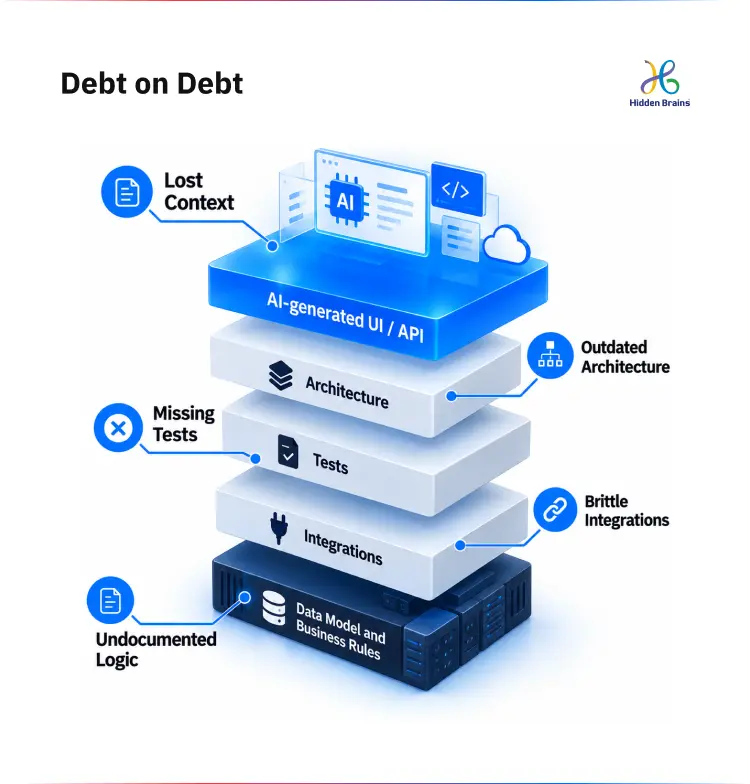
AI can produce modern-looking code in days. If that code is added on top of a legacy system before the team understands its business logic, dependencies, and constraints, it does not retire the old debt. It adds a new debt layer over an old one. This is why any legacy platform transformation has to start with the platform’s logic, not its interface.
| Layer | Existing risk in the legacy system | AI makes it worse when… |
|---|---|---|
| Undocumented logic | Critical rules live only in old code, configuration files, or employees’ memory | AI translates the syntax but misses compliance rules, edge cases, and institutional knowledge |
| Brittle integrations | Systems connect through fragile APIs, batch jobs, and point-to-point links | New AI-generated services add dependencies without simplifying the integration underneath |
| Poor test coverage | Current behavior is hard to verify safely | AI generates new functionality faster than teams can write regression tests |
| Outdated architecture | Monoliths, duplicated data, and tightly coupled modules slow every change | AI speeds up feature delivery inside the same flawed architecture |
| Context loss | Original developers and documentation are gone | AI makes plausible assumptions from incomplete context, producing context debt |
The integration layer is often where this shows first. Before generating new services, untangling brittle integrations usually removes more risk than any new feature adds.
The Shortcut Trap: A Modern Interface Over an Unstable Core
The most expensive pattern is using AI as a shortcut around modernization. A team generates a new web application front end or API layer in weeks, while the data model, business rules and integrations underneath stay unchanged. It demos well. Then every change needs edits in both the new layer and the old core, and the new layer has quietly encoded assumptions about the old one that nobody verified.
The alternative is slower at the start and far cheaper over time. Our legacy application modernization case study shows what that sequence looks like when the core is addressed before new layers are added.
How can AI reduce legacy technical debt when used correctly?
AI is not automatically the problem in legacy modernization. Used to understand a system before changing it, AI can shorten the slowest parts of a modernization program.
- Mapping dependencies across code, data, and interfaces, so the team sees what a change will touch before making it.
- Extracting business rules and generating documentation from code that has none, for business experts to confirm.
- Finding duplicate logic and refactoring candidates across large codebases.
- Converting legacy languages, such as COBOL or older .NET and Java versions, while dependencies are mapped and automated regression tests compare old and new behavior.
- Prioritizing the application portfolio by risk, cost, and business value, so each application gets the right treatment.
Two preconditions separate this from the shortcut trap. Someone who knows the business confirms extracted rules before anything is rebuilt, and regression tests capture current behavior before AI changes it. That understanding-first approach is the core of our legacy software modernization services.
For iMak, a premium backyard and pool services provider, we ran process workshops. We visited six pool sites before replacing a 10-year-old system with a web portal, an Android app, and Zoho integration. The new platform now processes 250 work orders and creates 30 Zoho invoices every day.

Modernize Legacy Systems Without Accumulating Technical Debt
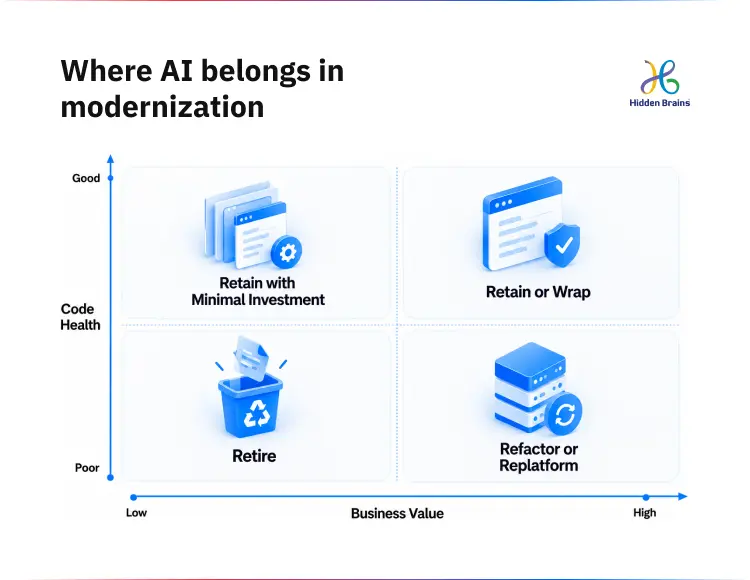
Talk to UsRetain, Wrap, Refactor, Replatform or Retire: Where Does AI Belong in Modernization?
Decide what to do with each legacy application first, then decide how much AI to use. The right role for AI, and the debt risk that comes with it, changes with each option.
| Option | When it fits | AI’s role | Debt risk if done carelessly |
|---|---|---|---|
| Retain | Stable, rarely changed, business-critical system | Documentation, dependency mapping, test generation | Low, unless AI-generated “quick fixes” skip review |
| Wrap | Core logic is sound but needs modern access, such as APIs or mobile | API and integration scaffolding | High: this is where the shortcut trap lives |
| Refactor | Logic is valuable, but the code is hard to change | Spotting duplication, proposing restructuring under test coverage | Medium: refactoring without tests can change behavior silently |
| Replatform | Move to cloud or a newer runtime with limited code change | Updating configuration and dependencies, flagging incompatibilities | Medium: hidden runtime differences |
| Retire | Low value or overlapping functionality | Mapping usage and data so nothing critical is lost | Low, if rules and data are migrated first |
When the honest answer is that the core itself must be rebuilt, professional software re-engineering services are usually cheaper over time than wrapping it again. When replatforming is the better path, cloud infrastructure and replatforming services move workloads to a modern platform without carrying old debt across.
For the wider decision, our application modernization strategy guide covers how to sequence the work.
How do you measure AI technical debt?
Track a few leading indicators in the codebase and a few lagging indicators in delivery. Leading indicators warn you early; lagging indicators confirm the cost. Compare each against your own baseline from before AI adoption, not against industry averages.
| Metric | What it reveals | Warning sign | Type |
|---|---|---|---|
| Share of duplicated code | Copying instead of reuse | Rising quarter over quarter after AI adoption | Leading |
| Refactored versus new lines | Whether existing code is being improved | Refactoring falls while new lines rise | Leading |
| Pull request size and review time | Whether reviewers can keep up | Larger pull requests reviewed faster than before | Leading |
| Rework within three weeks of merge | Code that was wrong on arrival | A growing share of recent code being rewritten | Leading |
| “Explain it” check | Comprehension debt | Owners cannot explain an AI-assisted module they are responsible for | Leading |
| Change failure rate | Delivery stability | Rising alongside deployment frequency | Lagging |
| Static analysis and security findings | Correctness and security debt | New findings outpacing fixes | Lagging |
How should engineering leaders manage technical debt in AI-assisted development?
Judge a partner by how it governs AI, not by whether it uses it. Almost every delivery team now uses AI assistants, so the real differences sit in six areas: transparency, quality gates, domain review, security, legacy discipline and ownership. The same standards apply whether you outsource a full project, hire AI developers for a specialist need, or hire dedicated developers to extend your own team.
- Transparency: AI-assisted work is disclosed upfront and flagged in pull requests, so its defects can be tracked separately.
- Quality gates: AI code passes the same test, static analysis and dependency checks as human code, enforced by the pipeline.
- Domain review: senior reviewers who know your business own sensitive areas such as payments, pricing and compliance.
- Security: every AI-assisted change is scanned, and new dependencies are verified before they reach production.
- Legacy discipline: business rules are documented and regression tests are in place before AI changes legacy code.
- Ownership: your team can explain and change every critical module at handover, backed by documented decisions and rules.
The real question for engineering leaders
Whether AI writes your code is no longer the question. The question is whether your engineering system can absorb code produced this fast. Teams that use AI to understand their systems first, and generate second, will pay down old debt while shipping faster. Teams that skip that step will find the bill arrives later, with interest, often in the legacy core they meant to escape. If you want a second opinion on where your own codebase stands, you can book a free two-hour technical consultation with our engineering team.
What Should You Ask a Development or Modernization Partner That Uses AI?
Ask how a partner governs AI use, not whether they use it. Almost every delivery team now does.
- Which parts of our codebase will be AI-assisted, and how will you disclose that?
- What test coverage and static analysis gates must AI-assisted code pass before merge?
- Who reviews AI-generated code, and what do they know about our domain?
- How do you scan for insecure patterns and unvetted or hallucinated dependencies?
- Before changing legacy code, how will you capture existing business rules and behavior?
- How will our team understand and own the code after handover?
- Which recognized standards govern your AI use and information security?
How Hidden Brains Can Help?
At Hidden Brains, our modernization and software product development work starts with understanding a system before changing it. Our delivery is governed by ISO/IEC 42001, the international standard for AI management systems, alongside ISO/IEC 27001 for information security, ISO 9001 for quality management, and CMMI Level 3 process maturity. For clients, that means AI use in delivery follows a documented risk process with clear accountability, rather than individual developer habit. Since 2003, across clients in 107 countries, the lesson has been consistent: the hard part of modernization is understanding, and AI only helps once that work is done.
Frequently Asked Questions
Is AI technical debt a business risk or just an engineering problem?
It is a business risk that starts in engineering. It reaches the business as delayed releases, outages, security incidents, and a growing share of the technology budget spent on rework instead of new features. Leaders who treat it as a developer issue usually notice it only when a roadmap slips.
How much does AI technical debt cost a business?
There is no single figure, because the cost depends on how much AI-generated code reaches production without tests and review. The broader cost of debt is well documented: IBM reports that ignoring technical debt is associated with an 18% to 29% decline in AI project ROI. Track the share of engineering time spent on rework to see your own number.
Should we slow down AI adoption to avoid technical debt?
No. Slowing adoption gives up real productivity gains, which the 2025 DORA research now links to higher delivery throughput. The better move is to govern adoption: decide where AI-written code is allowed, set quality gates before merge, and measure the results against your pre-AI baseline.
Is it safe to use AI to modernize our legacy systems?
Yes, if understanding comes before generation. AI is valuable for mapping dependencies, documenting business rules, and converting old code, but someone who knows the business must confirm the rules, and regression tests must prove behavior has not changed. Skipping those steps creates a new debt layer on top of the old one.
How do we know if our development partner’s AI-generated code is creating debt for us?
Ask for evidence, not assurances. A responsible partner can show which work was AI-assisted, the test coverage and static analysis results it passed, and the trend in defects and rework over time. If those numbers are not available, an independent code assessment is the quickest way to find out.
Who is accountable when AI-generated code causes a production issue?
The organization that ships it, never the AI tool. Inside your company, that means the engineer who accepted the code and the reviewer who approved it. With outsourced delivery, accountability should be written into the contract, including disclosure of AI use, quality gates, and remediation terms.
How long does it take to get AI technical debt under control?
The first improvements come quickly. Quality gates, AI usage rules, and visibility of AI-assisted work can be in place within weeks. Paying down debt already in the codebase takes longer and should be planned like any modernization effort, prioritized by business risk.


Conclusion
Whether AI writes your code is no longer the question. The question is whether your engineering system can absorb code produced this fast. Teams that use AI to understand their systems first, and generate second, will pay down old debt while shipping faster. Teams that skip that step will find the bill arrives later, with interest, often in the legacy core they meant to escape. If you want a second opinion on where your own codebase stands, you can book a free two-hour technical consultation with our engineering team.