


























































































































































Summary
AR/VR technologies have evolved far beyond virtual try-ons, transforming industries across the board. These immersive technologies are now redefining how businesses engage with customers, design products, and enhance user experiences. From healthcare and education to real estate and entertainment, AR/VR is driving innovation and providing solutions that were once unimaginable. Check how it matters for your industry, how you can leverage it, and make the most of it.
Over more than two decades of leading digital transformations across Fortune 500 organizations and high-growth startups, we have seen how each platform wave reshapes business models and how augmented reality is now delivering measurable, competitive advantages across industries.
The numbers don’t lie. The AR and VR market will bring an annual growth rate of 10.27% by 2030, reaching $75.9 billion.
AR and VR are changing how work gets done. They embed intelligence directly into workflows, enable experiential learning at scale, and allow teams to design, test, and iterate in immersive environments before committing real-world resources.
When combined with AI, these technologies move beyond visualization into adaptive, context-aware systems that continuously improve outcomes.
Before we dive ahead, understand strategy and ROI. Let’s decode what AR and VR are.
What are Augmented Reality and Virtual Reality?
Here’s a quick, 60-second explanation of AR and VR.
Virtual Reality – It’s complete digital immersion. Being in this world, you are transported to another world by just wearing headsets.
- Think: Employee wearing a headset, training for high-stakes scenarios in a simulated environment.
- Best for: Complex training, design collaboration, immersive simulations.
Augmented Reality (AR): The combination of digital information and the real world to enhance user interaction with the physical environment.
- Think: Technician seeing repair instructions projected onto live equipment.
- Best for: Field operations, guided workflows, real-time decision support.
Most companies don’t go for one. Instead, they choose AR/VR Development Services that give the best of both worlds.
Understanding the Advantages of Augmented Reality for Modern Businesses
Augmented Reality is no longer experimental; it delivers measurable business impact by reducing errors, accelerating execution, and scaling expertise across operations. From AR-guided manufacturing that cuts defects by over 30% and speeds assembly by nearly 25%, to immersive training and remote field support that dramatically reduces downtime and expert travel, AR embeds intelligence directly into the workflow.
With industrial AR projected to generate over $100 billion in value by 2030, and 75% of large-scale adopters reporting double-digit efficiency gains, the question for modern businesses is no longer whether AR creates value, but how quickly they can operationalize it to stay ahead of their competitors.
Advantages of AR/VR Across Industries
- Manufacturing: Cuts errors, speeds assembly, and embeds expert guidance directly into frontline workflows.
- Healthcare: Enables safer training, precise planning, and better patient understanding through immersive visualization.
- Retail: Improves purchase confidence, reduces returns, and delivers immersive, personalized shopping experiences.
- Education & Training: Boosts retention through experiential learning and enables safe, scalable skill development.
- AEC (Architecture & Construction): Prevents costly design errors by visualizing projects at full scale before execution.
- Automotive & Aerospace: Accelerates design, improves manufacturing accuracy, and simplifies complex maintenance tasks.
- Field Service & Utilities: Reduces downtime and travel by enabling real-time remote expert assistance.
- Marketing & CX: Creates high-impact brand engagement and data-driven customer insights.
Key Benefits of Virtual Reality in Enterprise Applications
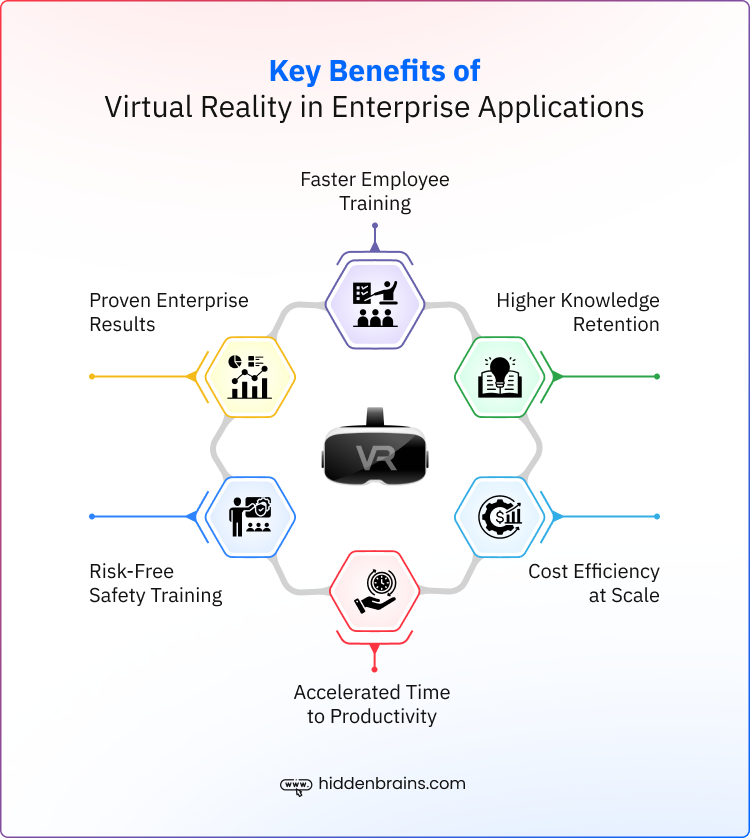
Virtual Reality has become a strategic advantage for enterprises focused on workforce readiness, safety, and operational excellence.
Faster, More Effective Training: VR improves learning effectiveness by up to 76% and enables employees to train up to four times faster than traditional methods.
Higher Knowledge Retention: Immersive learning significantly increases recall and long-term retention, with studies showing up to 80% improvement over classroom training.
Greater Employee Confidence: VR learners demonstrate higher emotional engagement and up to 275% more confidence in applying new skills on the job.
Risk-Free Safety Training: Employees can practice high-risk scenarios in safe virtual environments, reducing accidents, injuries, and operational disruptions.
Reduced Time to Productivity: Organizations like Walmart, UPS, Boeing, and Siemens report 50–75% reductions in training time, enabling faster workforce readiness.
Cost Efficiency at Scale: VR becomes more cost-effective than classroom training at scale, delivering ROI within 12–18 months for large enterprises.
Proven Enterprise Adoption: With over 22% of large enterprises already using VR and market growth exceeding 15% annually, VR is now a core enterprise capability, not an experiment.
How AR and VR Transform Industries?
Enterprises are more inclined towards how innovation can turn them into a powerful business outcome. AR and VR are delivering transformation, meeting innovation and efficiency along many touchpoints.
Check what’s happening on the ground.
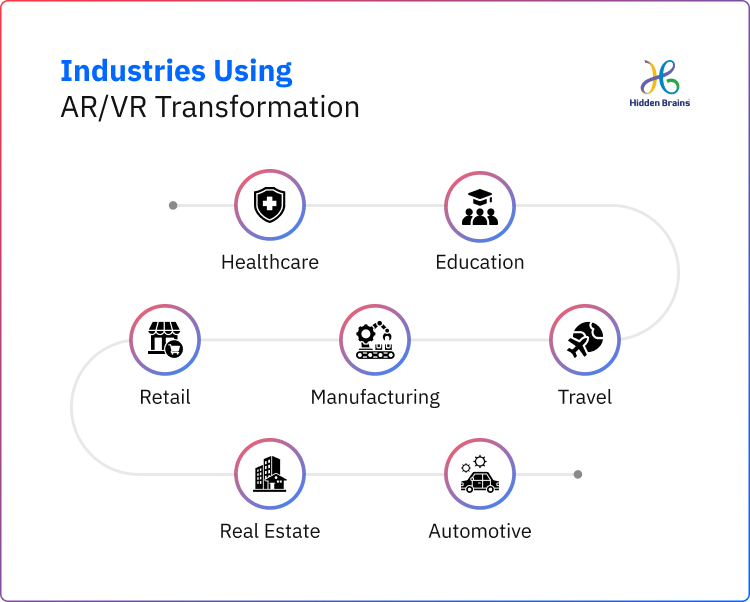
Healthcare: Precision and Training at Scale
- 40% of healthcare providers now use VR for patient treatment and staff training.
- AR-guided surgeries deliver improved accuracy, reduced radiation exposure, less blood loss, and fewer complications.
- VR surgical training is 34 times less expensive than traditional methods while producing 40% fewer errors.
- Stanford Medicine performed the world’s first AR-powered spine surgery in 2023, establishing new standards of care.
- VA deployed 1,200+ VR headsets across 160+ medical centers for training and patient care.
- Stroke rehabilitation with VR shows 20% faster gait-speed recovery.
Retail and E-Commerce: Conversion Revolution
- Products with AR content see 94% higher conversion rates (Shopify data).
- 40% reduction in returns when customers use AR visualization before purchase.
- 90% conversion lift among AR users versus non-AR users.
- 40% higher average order value with AR-enabled shopping experiences.
- 61% of consumers prefer brands offering AR/VR experiences.
Manufacturing: Efficiency and Error Reduction
AR is rewriting manufacturing economics with measurable precision improvements.
- 32% reduction in production errors with AR-guided assembly.
- 28% faster task completion rates across manufacturing operations.
- Boeing reported a 25% time reduction in wiring harness assembly with AR.
- 75% of industrial companies implementing AR/VR report 10% operational efficiency gains.
- AR remote support reduces expert travel by 75% while slashing equipment downtime.
- Economic value of AR IoT in manufacturing: $40-50 billion by 2025, expanding to $90-110 billion by 2030.
Education: Learning That Sticks
- 76% increase in learning effectiveness compared to traditional methods.
- Training time reduced from 30-40 hours to 3-6 hours (quick service restaurants).
- 70% better memory retention with AR versus traditional teaching methods.
- 275% higher confidence levels in VR-trained learners.
- 30% of universities worldwide offer VR-based courses; 40% of US K-12 schools use AR/VR.
- VR learners complete courses 4x faster than classroom cohorts.
Automotive: Design to Assembly Excellence
The automotive industry leverages AR/VR across the entire value chain.
- BMW assembly academy uses HoloLens AR for dashboard assembly training with enhanced effectiveness.
- Virtual prototyping reduces physical prototype costs by 60% and accelerates design cycles.
- AR maintenance guides reduce service time by 30-40% across dealership networks.
- Immersive showrooms increase customer engagement by 200% and boost configuration accuracy.
Real Estate: Immersive Experience, Faster Transactions, Higher Conversions
AR and VR are redefining real estate operations across PropTech, ConTech, and traditional real estate, shifting the industry from static listings to immersive, data-driven experiences. The advantage is no longer visual appeal; it is speed, scale, and conversion efficiency. Predictive analytics in real estate turns sales from reactive transactions into proactive, insight-driven decision-making.
- Virtual Property Tours – Reduce physical site visits by 60–70% while increasing qualified buyer intent.
- Virtual Staging and Furniture Replacement – Cut staging costs by up to 90% and drive 2–3× higher listing engagement.
- Architecture and Pre-Construction Visualization – Accelerate sales cycles by 20–35% and reduce late-stage design changes.
- Neighbourhood and Contextual Exploration – Improve buyer confidence and shorten evaluation time by 25–30% using AR overlays.
- Marketing, Sales, and Commerce Enablement – Deliver up to 2× higher lead conversion through immersive experiences.
- Tenant Onboarding and Digital Instructions – Reduce support queries by 40–50% and improve move-in satisfaction.
The pattern is clear: industries deploying AR/VR at scale are achieving double-digit improvements in productivity, training effectiveness, customer conversion, and error reduction. This isn’t emerging technology; this is competitive infrastructure.
The future of business is immersive,
spatial, and interactive.

Why Businesses Are Investing in AR and VR Technology
Investment in augmented reality (AR) and virtual reality (VR) has accelerated—not because it is “cool” to wear headsets or smart glasses, but because of the measurable results these technologies deliver. Businesses are no longer experimenting with AR and VR; they are adopting them to solve real problems and gain tangible competitive advantages.
The Competitive Imperative
Gartner predicts that the market will hit USD 370 billion by 2034. Retailers will use AR and VR as part of their customer strategy. When four out of five competitors are adopting the same capability, the question isn’t whether to invest; it’s whether you can afford to wait.
The Investment Side
Global AR/VR development exceeded $5.2 billion, with venture capital backing over 800+ startups focused on spatial computing and immersive technologies. The largest commercial investments are flowing into training and industrial maintenance, with $4.1 billion forecast across these two use cases alone.
Meta invested $19.9 billion in Reality Labs and is expecting to spend more in the future. These are not speculative bets; they are strategic responses to inevitable demand.
Measurable Business Outcomes
The ROI data is clear. 61% of organizations report 20% cost savings from AR/VR adoption, while 29% report productivity increases of 25% or more. Deloitte’s survey shows smart manufacturing initiatives delivering 10–20% output gains and up to 20% operational efficiency improvements. More tellingly, 92% of executives believe AR and VR will be primary drivers of competitiveness within the next three years.
When nine out of ten executives agree on what will shape competitiveness, that’s no longer opinion; it’s market consensus.
Industry-Specific Adoption
Adoption is already broad-based. 40% of healthcare providers now use VR for treatment and training. 30% of universities worldwide offer VR-based courses. According to IDC, global AR/VR spending is expected to reach $50.9 billion by 2026, with enterprise deployments leading the growth.
Challenges of Implementing AR/VR Solutions
AR and VR deliver transformational results, but success depends on realistic planning and execution. I’ve guided organizations through these challenges repeatedly.
Investment and Infrastructure
Upfront costs, hardware, software, content, and integration are real. But AR/VR should be evaluated as strategic infrastructure, not a line-item expense. In most cases, organizations see positive ROI within 12 to 18 months, as operational savings compound quickly.
The Talent Challenge
High-quality AR/VR requires specialized skills in 3D design, spatial computing, and immersive UX. The talent gap exists, but it’s narrowing. The organizations that win are those building internal capability early, even while working with external partners.
Integration Complexity
AR/VR must integrate with ERP systems, IoT data, and existing workflows. This complexity is comparable to any major enterprise deployment, but once solved, it becomes a durable competitive moat.
Device Management and Security
Managing AR/VR devices introduces new IT considerations, security, updates, and authentication, but these challenges are well understood and solvable with existing tools and best practices.
Discover Your AR/VR Payback
and Scale Strategy.

Choosing the Right AR/VR Technology
After years of investment with Fortune 500s and startups, the pattern is consistent: success starts with the right questions.
- Start with the business problem, not the technology.
- Pilot, measure, then scale with data-driven confidence.
- Select hardware based on the environment and use case.
- Choose software platforms that integrate, scale, and deliver analytics.
- Partner with teams that bring industry experience, not experiments.
Even when starting small, architect for scale. The organizations that succeed with AR and VR deploy pragmatically today, while building platforms designed for tomorrow.
Your Competitive Advantages are Now
AR/ VR adoption curve is moving faster, and it’s beyond just experimentation. Early adopters are already capturing measurable competitive advantages, while laggards are beginning to feel the gap.
We have seen this all with cloud infrastructure, mobile, and e-commerce. Organizations that moved early captured outsized, compounding advantages. Those who waited spent years catching up, and many never fully did. AR and VR now present that same narrowing window.
Today, organizations deploying immersive technologies are seeing:
- 76% improvement in learning effectiveness and up to 75% reduction in training time.
- 32% fewer production errors and 28% faster task execution.
- Up to 94% higher customer conversion rates with AR-enabled experiences.
- 20–25% gains in productivity and cost efficiency.
These are not incremental gains. They are step-function improvements that compound over time.
Your Action Plan
Whether you’re a C-suite leader shaping strategy or an IT executive planning execution, the path forward is clear:
- Start with one high-impact use case. Focus on where value will be immediate, visible, and measurable.
- Pilot fast and measure hard. Prove ROI, refine quickly, and build confidence through data.
- Work with experienced partners. The learning curve is real; avoid it by leveraging teams with proven deployments.
- Architect for scale from day one. Small starts should be designed to expand across teams, sites, and regions.
- Communicate results relentlessly. Adoption accelerates when success is visible and quantified.
The immersive era isn’t coming; it’s here. The technology is proven. The business case is clear. Capital is already flowing. The only question left is when you start.



Ready to Lead the Immersive Transformation?
We’ve helped hundreds of organizations successfully deploy AR and VR solutions that deliver measurable, bottom-line results. Our team brings deep expertise across industries, from manufacturing to retail to healthcare, and we’ve seen what works and what doesn’t.
Schedule Your Free 2-Hour Strategic Consultation
In our consultation session, we’ll:
- Conduct a detailed assessment of your specific business challenges and opportunities.
- Identify the highest-ROI AR/VR use cases for your organization.
- Provide a realistic implementation roadmap with clear milestones.
- Share relevant case studies and data from organizations like yours.
- Address your specific concerns about cost, integration, and change management.
Need Specialized AR/VR Resources?
We offer flexible engagement models designed to fit your needs:
- Full-time dedicated resources for long-term strategic projects.
- Development teams for custom AR/VR solution creation.