





















































































































































Summary
- Test whether AI can run safely on your real systems, data, and controls, not just in pilots.
- Move from scattered experiments to governed AI with clear owners, approvals, and audit evidence.
- Fix the three common blockers first: data quality, legacy architecture, and QA gaps.
- Modernize the core before adding more intelligence on top of inflexible systems.
- Build bias, drift, robustness, and human-override testing into the delivery pipeline.
- Align AI governance with CBUAE expectations around fairness, transparency, oversight, and accountability.
- Use the 20-question readiness assessment to identify gaps, prioritize risks, and build a four-phase roadmap.
There’s no shortage of AI Readiness manuals. Most of them cover the same ground: have a strategy, get your data in order, hire the right people, set some governance rules. For most industries, that’s a decent starting point.
Banking is different. In a bank, AI readiness is less about picking the right model and more about proving you can run AI safely, at scale, on top of your actual core banking systems, data, and controls. A recommendation engine at a retailer can get things wrong, and nobody gets hurt. A credit model that rejects the wrong customer, or a fraud engine that freezes a salary account on payday, is a very different story.
People are protective of their money and their financial data, and they should be. That’s why AI readiness in banking has to be provable, not assumed. And in our experience, the things that decide whether a bank can prove it are rarely the ones in the strategy deck. They are less glamorous and more critical foundations that could be built around through custom AI software development services in banking system.
This guide explains what AI readiness looks like in a bank, where the real opportunities are, why QA, legacy systems, and data matter more than most leaders expect, and how to assess where your bank stands today.
How Is AI Readiness in Banking Different?
AI readiness in banking is a bank’s proven ability to run AI safely, at scale, on its real core systems, data, and controls, with evidence a regulator would accept. Generic frameworks ask, “Can we adopt AI?” Banks have to answer a harder question: “Can we show that every model is owned, tested, explainable, and governed?“
What Does an AI-ready Bank Look Like?
An AI-ready bank has moved from scattered pilots to governed, measurable AI built into core processes. You can usually spot it by a few clear signs:
- AI runs in production, not just in the innovation lab. Credit, fraud, AML(Anti-Money Laundering), and customer service use it every day.
- Every model has a named business owner, not just a data scientist who built it.
- There’s a complete AI inventory, including AI inside vendor products.
- Each use case is risk-tiered by how much it affects customers, so controls match the stakes.
- Decisions can be explained to a customer or a regulator, in Arabic or English.
- Models are monitored after launch, with alerts for drift and a way to roll back.
- Human override is tested, not just written into a policy.
- Evidence is ready on request: data lineage, test results, sign-offs and incident logs.
- Success is measured in business outcomes, not in how many pilots were launched.
This is how a leading Middle East bank accelerated digital delivery with Hidden Brains.
What Does AI Readiness in Banking Include?
AI readiness in banking includes seven components. All seven matter, but as you’ll see, three of them are where most banks actually get stuck.
| Component | What it covers in a bank |
|---|---|
| 1. Strategy and value | A board-approved AI strategy, prioritized use cases with value estimates, a dedicated budget, business-line ownership |
| 2. Data foundations | End-to-end lineage, measured data quality (accuracy, completeness, timeliness), consistent data models |
| 3. Technology and engineering (including legacy) | Real-time access to core, risk and customer systems, APIs and event streams, MLOps with monitoring and rollback |
| 4. Governance, risk and compliance | Model inventory, risk tiering, a clear sign-off path, incident escalation, alignment with CBUAE guidance |
| 5. QA and assurance maturity | Bias, robustness, drift and adversarial testing, with QA built into delivery pipelines |
| 6. Organization, talent and culture | Business, risk and compliance co-owning AI, and AI literacy beyond the data science team |
| 7. Ethics, responsible AI and customer trust | Fair outcomes across customer groups, clear explanations, the right to a human review, consent under the UAE PDPL |
How is This Different From a Generic AI Readiness Framework?
Generic AI readiness frameworks on six pillars of strategy, infrastructure, data, governance, talent and culture are built to work for any industry. Banking raises the bar on almost every one of them.
| Dimension | Generic AI readiness | AI readiness in banking |
|---|---|---|
| Goal | Adopt AI | Prove AI runs safely at scale |
| Success measure | Pilots launched | Governed AI in core processes, with evidence |
| Data | Available and accessible | Traceable, consented and representative |
| Systems | A cloud-ready stack | Must work on top of a legacy core |
| Testing | Functional QA | Validation, fairness, drift and an audit trail |
| Governance | A policy document | Board accountability and regulator scrutiny |
| Tolerance for error | Fail fast and iterate | Close to zero |
Why Do UAE Banks Look AI-ready on Paper But Stall in Production?
UAE banks are ahead on ambition. They’re often held back by what sits underneath it.
The ambition is real. In the Cisco AI Readiness Index 2025, 64% of UAE organizations said they had a well-defined AI strategy. Finastra’s 2026 research found 53% of UAE financial institutions already use AI to improve accuracy and reduce errors. And in the first Evident AI Index for the Middle East and Africa, Emirates NBD ranked first in the region and FAB third.
The gap shows up in execution. Only 38% of UAE organizations in the same Cisco study believe they have strong in-house AI talent. And globally, validation is a known drag: Domino Data Lab reports that 59% of financial institutions expect less than half the AI return they forecast, with one bank taking 11 months to move a model from build to production.
The regulatory bar has also moved. The Central Bank of the UAE has issued guidance on the responsible use of AI and machine learning by licensed financial institutions, with a strong focus on consumer protection, transparency, human oversight, and data protection.
While the guidance is not legally binding, it signals a clear supervisory direction: banks remain accountable for how AI is used and cannot outsource that responsibility to a technology vendor.
AI Opportunities Within Intelligent Financial Engines
An intelligent financial engine is a decision system, for credit, fraud, pricing, or risk, that learns from live data and gets better with every decision. A traditional rules engine only does what it was configured to do. The difference is where most of AI’s value in banking comes from.
Traditional Use Cases and How AI Adds Value
Most of these use cases aren’t new. Banks have run them for years. What changes is how well they work, and what each one needs from the bank before it can go live.
That last column is the one most use-case lists leave out.
| Use case | The traditional way | What AI adds | What it needs to be ready |
|---|---|---|---|
| Credit decisioning | Static scorecards, manual review for thin-file applicants | More data signals, faster decisions, ongoing re-scoring | Data lineage, explainability, fairness testing |
| Fraud detection | Fixed rules, lots of false positives | Real-time pattern detection that adapts to new fraud | Real-time core access, drift monitoring |
| AML and transaction monitoring | Threshold alerts, large analyst backlogs | Smarter alert prioritization, network and link analysis | A clear sign-off path, a full audit trail |
| KYC and onboarding | Manual document checks | Document AI for Arabic and English, risk-based onboarding | Data quality, PDPL consent |
| Customer service | Scripted IVR and basic chatbots | AI agents with customer context, connected to core and CRM | API access, tested handoff to humans, Arabic testing |
| Collections | Bucket-based calling | Propensity-to-pay models, tailored outreach | Fairness checks, customer-trust controls |
| Trade finance | Manual document review | Automated document reading and discrepancy checks | Clean data foundations, strong QA |
| Treasury and liquidity | Spreadsheet forecasting | Machine learning forecasts and scenario modeling | Timely data, model validation |
| Regulatory reporting | Manual reconciliation | Automated data checks and report preparation | Data lineage, governance |
A broader overview of AI use cases across banking is available in our AI in banking guide.
Why the Opportunity Isn’t The Hard Part
Almost every row in that table works in a pilot. Give a good team a clean data extract and a few months, and the model will look impressive. The hard part is the last column. Whether a use case ever reaches production depends on the data feeding it, the core systems it has to connect to, and the testing that proves it’s safe. That’s where the next section goes. It’s also why so many AI pilot programs never make it past the demo.
Why QA, Legacy Systems and Data Matter More Than You Think
Data, legacy systems, and QA matter more than you think because they decide whether any AI use case can move from pilot to production. Strategy tells you where to go. These three decide whether you can actually get there, and most AI readiness manuals give them a paragraph each.
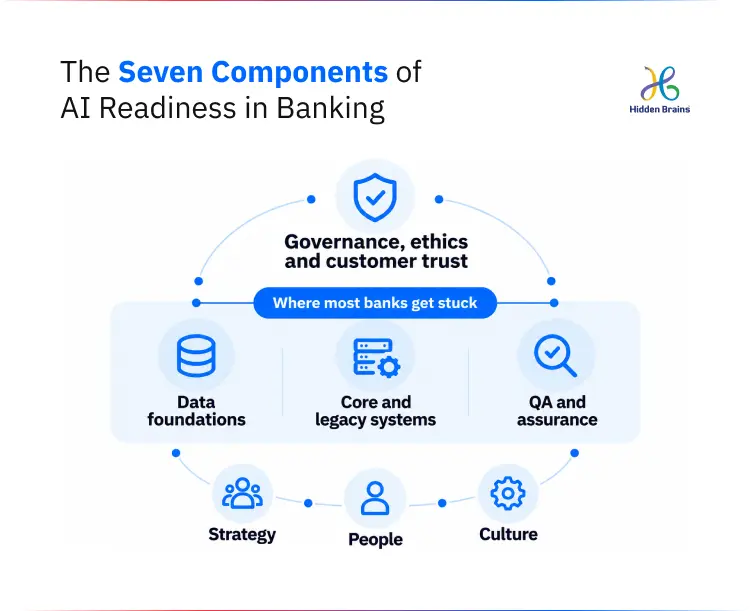
Data Foundations: Why Reporting-grade Data Isn’t Enough
Data that’s good enough for a monthly report usually isn’t good enough for AI. A report can live with a few gaps and a day’s delay. A credit or fraud model can’t, because it learns from every error and repeats it at scale.
Here’s what AI-ready data means in a bank:
- You can trace it. For every key field a model uses, you can show where it came from, what changed it, and when. That’s data lineage, and it’s the first thing a validator or regulator asks for.
- Its quality is measured, not assumed. Accuracy, completeness, and timeliness are tracked for the data that feeds AI, with thresholds that stop a model when the data falls below them.
- It means the same thing everywhere. “Customer,” “account,” and “transaction” are defined once and used consistently, through canonical data models or a feature store. When retail and corporate banking define “active customer” differently, the model quietly learns both.
- It represents your actual customers. The UAE has one of the most diverse customer bases in the world. Training data that under-represents some nationalities, income bands, or ages will produce a model that treats them unfairly.
- You’re allowed to use it. Customer data used for AI needs a clear purpose and consent under the UAE Personal Data Protection Law.
A quick test: if your data team needs weeks to answer “where did this number come from?”, your data isn’t ready yet. Five other warning signs to watch for:
- Models are trained on one-off extracts, not live, governed pipelines.
- Two teams report different figures for the same metric.
- Unstructured data, such as call notes, emails and scanned documents, is ignored or handled differently by each branch.
- Nobody owns data quality for AI as a named responsibility.
- Arabic and English records for the same customer don’t reliably match.
This is the foundational work our data engineering services typically address first, because every other pillar depends on it.
Legacy Systems: Why More Intelligence on an Inflexible Core Doesn’t Work
Banks don’t need more layers of intelligence on top of inflexible systems. They need cores designed to learn, adapt, and scale.
That sounds obvious, but it’s not how most AI projects start. The usual approach is to build a model and bolt it on top of whatever the core already does. It works in a demo. In production, the cracks show quickly:
- The model sees yesterday. Many cores still move data in overnight batch jobs. A fraud model scoring last night’s transactions isn’t real-time fraud detection.
- Workarounds become the architecture. Screen scraping, file drops and point-to-point connections hold everything together, until one of them breaks.
- Every change gets expensive. When the model is tightly coupled to the core, a small model update can trigger a full regression cycle across systems nobody wants to touch.
- Decisions can’t flow back. The model makes a recommendation, but there’s no clean way to push it back into the lending or payments workflow, so someone re-keys it.
An AI-ready core looks different. It streams events as transactions happen. It exposes clean, secure APIs so models can read data and write decisions back. It’s modular enough that one part can change without breaking the rest. And the data leaving it is already governed, so every model doesn’t have to clean it again.
The good news is that you don’t need a big-bang core replacement to get there. Most banks move in stages:
| Stage | What you do | What it unlocks |
|---|---|---|
| API and event layer | Wrap the existing core with APIs and stream key events out of it | Real-time data for priority use cases, quickly and with low risk |
| Data platform alongside the core | Build a governed data platform that models read from | Most AI use cases, without touching the core itself |
| Progressive core modernization | Replace or refactor core modules one at a time, starting where AI value is highest | A core that can genuinely learn, adapt and scale |
Stage 1 is a bridge, not the destination. Treat it as permanent, and you risk adding another layer of intelligence on top of an inflexible system.
The sequence should follow business priority, dependency, and risk rather than technology fashion. For teams working through that progression, our legacy modernization services and application modernization strategy provide additional context on how to approach the transition.
Get a Score Gap Report On Your Data, Core and QA
Start With Assessment.
QA and Assurance: The Pillar Most AI Readiness Frameworks Skip
QA is the pillar that proves AI is safe to run, yet it remains overlooked in many AI readiness frameworks. Most focus on data, infrastructure, governance, and talent while giving little attention to testing. In banking, that’s a serious gap because testing provides the evidence regulators need to assess AI reliability, safety, and compliance.
Testing AI vs. testing with AI. These get mixed up all the time. Testing with AI means using AI tools to speed up your normal software testing, for example by generating test cases. Testing AI means proving that the model itself behaves correctly, fairly, and safely. Both are useful. Only the second one makes a bank AI-ready.
A bank’s AI test strategy should cover:
- Data validation: checking the data going in, before it ever reaches the model.
- Robustness: how the model behaves with unusual, missing or extreme inputs.
- Bias and fairness: whether outcomes differ unfairly across customer groups.
- Drift: whether the model’s accuracy is slipping as customer behavior changes.
- Adversarial and prompt-injection testing: especially for generative AI that customers can talk to.
- Arabic-language quality: for any AI that reads or writes in Arabic.
- Integration and regression: making sure a model change doesn’t break the core systems around it.
- Fallback and human override: proving that when the model fails or a customer objects, a person can step in, and that the path actually works.
Build QA in, don’t bolt it on. The biggest mistake is treating validation as a final gate. When QA and model risk review only happen at the end, they become the bottleneck, which is how a model ends up taking 11 months to reach production.
AI-ready banks build testing and model risk checks into their CI/CD and MLOps pipelines, so evidence is produced as the model is built, not after.
| Dimension | Traditional banking QA | QA for AI |
|---|---|---|
| What’s tested | Does the software do what the spec says? | Does the model behave correctly, fairly, and safely? |
| Expected results | Fixed and predictable | Probabilistic, within agreed limits |
| When testing happens | Before release | Before release and continuously after it |
| Main risks | Bugs and outages | Bias, drift, hallucination, unexplainable decisions |
| Evidence produced | Test reports | Test reports plus fairness, drift and explainability records |
If your QA team hasn’t been involved in AI projects yet, bring them in early. The same principles used in software QA, validation, traceability, testing, and controlled release matter just as much when AI is involved.
Governance, Ethics and Customer Trust: Why Readiness Has to Be Proven
In banking, governance and trust are the reason data, systems, and QA have to be proven rather than assumed. They set the rules. The three foundations above produce the evidence that you’re following them.
Why Trust Raises the Bar
People guard their money and financial data closely. One biased credit decision, unexplained rejection, or vendor data leak can undo years of trust, and it quickly becomes a regulatory issue. So governance can’t wait until AI goes live. It belongs in readiness from day one.

Build Your Banking Solution With Compliance, Governance and QA Built In.
Get Started
The CBUAE’s guidance note on responsible AI sets five expectations. Each one needs evidence:
- Fair outcomes: no unfair gaps across customer groups. Proven through representative data and bias testing.
- Transparency: decisions customers and supervisors can understand. Proven through explainability records.
- Human oversight: a person can override high-impact decisions. Proven through tested fallback paths.
- Data protection: data is consented, secure and used for a stated purpose. Proven through PDPL consent and lineage.
- Accountability: vendor AI is governed like your own. Proven through an AI inventory and third-party testing.
Expectations scale with customer impact: a branch-timings chatbot needs far lighter controls than a loan-approval model. This is a summary, not legal advice.
What Working AI Governance Looks Like
Governance turns those expectations into routine. In an AI-ready bank, you’ll find:
- An AI inventory, including AI inside vendor products.
- Risk tiers that match controls to customer impact.
- A sign-off path that doesn’t add months to delivery.
- Clear incident escalation when a model misbehaves.
One honest warning: Governance without engineering evidence is just a policy document. If your policy says models are monitored for bias, someone has to be able to show the test results. That’s why governance and QA have to be planned together.
Ethics and Customer Trust: Fairness, Transparency, and Redress
Governance asks, “Who approved this, and is it logged?” Ethics asks, “Is this fair to the customer, and can they understand and challenge it?” A bank can pass a governance audit and still lose a customer’s trust, which is why both matter.
In practice, responsible AI in a UAE bank means:
- Testing outcomes across customer groups, such as nationality, gender and age, and acting on unfair differences.
- Telling customers when AI played a part in a decision that affects them.
- Giving plain explanations, not technical model outputs.
- Offering a real route to a human review when a customer disagrees.
A Note for Islamic Banks
For Islamic banks and Islamic windows, there’s one more layer. When AI recommends or personalizes financial products, those recommendations should pass through the bank’s Sharia governance before going live, in the same way new products do. It’s a small step in the design, but a big one for customer trust.
Use an AI-and-People-First Approach
AI readiness fails when it’s treated as a technology project. The banks that scale AI successfully redesign roles, decisions, and responsibilities around it, so people and AI each do what they’re best at.
AI supports judgment. It doesn’t replace accountability. A credit officer, relationship manager, or compliance analyst should end up with better information and less repetitive work, not with a black box they’re expected to sign off on. Set human-in-the-loop points by risk tier: low-impact decisions can run automatically, high-impact ones always get a human review.
Make AI a shared responsibility. When AI belongs only to the data science team, it stalls at the first risk review. Each use case works better with joint owners from the business, risk, compliance, and technology, agreed before the build starts, not after the model is ready.
Build AI literacy across the bank. Different people need to know different things:
- Board members need to understand where AI is used, what could go wrong, and how it’s controlled.
- Business and risk leaders need to know how to judge a model’s output and when to challenge it.
- Frontline teams need to know how to explain an AI-supported decision to a customer and when to escalate.
Bring people in early. Involve the teams who’ll use the AI in its design, and measure adoption, not just deployment. A fraud model nobody trusts is a fraud model nobody uses. This approach also fits the direction of the UAE National Strategy for Artificial Intelligence 2031, which puts building national AI capability alongside adopting the technology itself.
How to Assess AI Readiness in Your Bank: Checklist and Roadmap
The most useful way to assess AI readiness is to test it against one or two real use cases, not in the abstract. A bank-wide maturity score tells you very little. Tracing one credit or fraud use case from data to decision tells you exactly where you’re stuck.
Five steps to assess AI readiness
- Pick one or two high-value use cases. Choose ones that matter to the business and touch real customers, such as credit decisioning or fraud detection.
- Trace the data path end to end. Follow every field the model needs from source system to model input. Note every gap, manual step, and delay.
- Check whether your core can feed it in time. Does the data arrive when the decision has to be made, or the next morning?
- Test the path and map it to the CBUAE guidance. Can you show fairness, explainability, human oversight, and data protection for this use case today?
- Score the results and sequence the fixes. Use the checklist below, then plan the work in the order that unblocks the most value.
How long this takes depends on the number of use cases and how accessible your systems are.
AI readiness checklist for banks: 20 questions for leaders
An AI-ready bank can answer “yes” to most of these questions. A “no” in governance, QA, or ethics matters more than the rest, because those are the areas that stop a model from going live.
| Pillar | What Banks Must Prove |
|---|---|
| Strategy | AI delivers measurable business value |
| Data | Information is reliable, traceable, and compliant |
| Technology | Infrastructure supports secure, scalable AI |
| Governance | Every AI decision is explainable and auditable |
| QA & Assurance | AI is continuously tested, validated, and safe to deploy |
| People | Business, technology, and risk share accountability |
| Customer Trust | AI outcomes are fair, transparent, and reviewable |
How to Read Your Score:
- Mostly “yes” and no red flags in governance, QA or ethics: you’re ready to scale AI across more use cases.
- Gaps in data or technology: you’re pilot-ready, not production-ready. Fix the foundations before adding more pilots.
- Any “no” in governance, QA, or ethics: pause before putting AI in front of customers, and close those gaps first.
AI Readiness Roadmap for Banks
Most banks move through four phases. The timeframes below are indicative and depend heavily on where you start.
| Phase | Indicative timeframe | Focus | You’re ready to move on when |
|---|---|---|---|
| Assess and govern | 0 to 3 months | Readiness score, AI inventory, governance model, one or two priority use cases | Scope is board-approved, and the sign-off path is agreed |
| Build foundations | 3 to 9 months | Data lineage and quality, API and event layer, AI test harness, MLOps | The first use case passes validation |
| Scale in production | 9 to 18 months | Production deployments, monitoring, fairness testing, team enablement | Business outcomes are measured and the audit is clean |
| Modernize and optimize | 18 months onward | Progressive core modernization, more intelligent financial engines | AI is part of how core processes run |
Where to Start, Based on What’s Blocking You
Your checklist results usually point to one main blocker. Start there:
- Governance-blocked (risk won’t sign off on any AI): begin with Phase 1. Agree the inventory, risk tiers and sign-off path first.
- Data-blocked (models can’t get fit-for-purpose data): focus Phase 2 on lineage, quality and consistent data models.
- Core-blocked (systems can’t feed models in time): start with an API and event layer before commissioning another model.
- Assurance-blocked (no test plan risk will accept): build the AI test strategy and pipeline before the next release.
- Trust-blocked (strong controls but no fairness testing or customer review route): add fairness monitoring and redress before scaling customer-facing AI.
How Hidden Brains Helps Banks Become AI-Ready
Hidden Brains works with banks and financial institutions to connect AI strategy with the engineering it depends on. Our work usually starts before any technology is chosen, by finding where data, systems, and controls are breaking down.
We help with:
- AI readiness assessment: scoring your bank across the seven components and building a sequenced roadmap through our AI strategy consulting services.
- Data foundations: lineage, data quality and consistent data models through data engineering.
- Core and legacy modernization: API and event layers today, progressive core modernization over time, through our legacy software modernization services.
- AI development with QA built in: models delivered with fairness, drift, and robustness testing as part of the pipeline for our fintech and banking services.
- Governance evidence: documentation, monitoring and evidence packs aligned with CBUAE expectations.
We’re a CMMI Level 3,ISO/IEC 27001:2022, and ISO 9001:2015 certified company with more than two decades of delivery experience. For banks, that means documented processes, information security controls, and delivery consistency that stand up to risk and audit review.
Our Dubai Business Bay team adds the local layer that matters in regulated banking programs: closer stakeholder access, faster decision-making, and delivery aligned with UAE compliance, governance, and data expectations. That local context is built into our AI software development services in the UAE.
Frequently Asked Questions
What is AI readiness in banking?
AI readiness in banking is a bank’s proven ability to run AI safely and at scale on its real core systems, data and controls. It covers seven areas: strategy, data, technology, governance, QA, people and customer trust. The difference from other industries is that a bank must be able to show regulators the evidence, not just say it’s ready.
How long does it take for a bank to become AI-ready?
It depends on where you start. Most banks can assess readiness and get governance in place within a few months, then spend longer on data and core foundations. The smart move is to get one or two use cases into production early, rather than waiting for the whole bank to be “ready.”
What do we get from an AI readiness assessment?
You get a clear picture of what’s blocking AI in your bank and what to fix first. A good assessment scores you against real use cases, maps gaps to CBUAE expectations, and gives you a sequenced roadmap with priorities and owners.
When should we expect ROI from AI investments?
ROI usually comes from the first use cases that reach production, not from the readiness work itself. Banks that fix data, systems and testing first tend to see later use cases go live faster and cheaper, because the foundations are reused. Pick early use cases with measurable outcomes, such as fewer false fraud alerts or faster onboarding, so value is visible.
Do we need to replace our core banking system before adopting AI?
No, not before you start. Most banks begin with an API and event layer over the existing core, then add a governed data platform, then modernize core modules over time. A full replacement is a long-term decision, and it should be driven by business priorities, not by AI alone.
Should we build AI capability in-house or work with a partner?
Most banks do both. Keep ownership of strategy, governance and key decisions in-house, because the CBUAE expects accountability to stay with the bank. Use a partner to move faster on specialist work such as data engineering, core integration, AI development and testing, and to transfer those skills to your teams.
Which AI use case should a bank start with?
Start with a use case that has clear business value, measurable outcomes and manageable risk. Fraud detection, AML alert prioritization and document processing for onboarding are common first choices. Avoid starting with the highest-impact customer decisions until your governance and QA are proven.
What does the CBUAE expect from banks using AI?
The CBUAE’s February 2026 guidance note expects fair outcomes, transparency, human oversight, data protection and clear accountability. Expectations scale with how much each AI use affects customers. The note is guidance rather than law, but it shows where supervision is heading, so it’s wise to align now.
Will AI replace jobs in our bank?
AI is more likely to change roles than remove them. It takes over repetitive work like document checks and alert sorting, while people focus on judgment, customer relationships and oversight. Banks that plan reskilling and involve teams early get much better adoption.
Who is accountable if a vendor’s AI model makes a wrong decision?
The bank is. The CBUAE guidance makes clear that using a third-party model doesn’t transfer responsibility. That’s why vendor AI belongs in your model inventory, with the same testing, monitoring and controls as models you build yourself.
How do banks make sure AI decisions are fair to customers?
By testing outcomes across customer groups before launch and monitoring them continuously after. Fair AI also needs representative training data, plain-language explanations for customers, and a real route to a human review when someone disagrees with a decision.
How do we measure whether our AI readiness is improving?
Re-score your bank against the readiness checklist every quarter or two. Then track practical signals: time from model build to production, number of models in production, audit findings, and how often models need emergency fixes.

Conclusion
AI readiness in banking isn’t something you achieve once and file away. It’s an operating capability: the ability to keep putting new AI into production safely, prove it works, and fix it quickly when it doesn’t.
Most banks won’t fall behind because they picked the wrong model. They’ll fall behind because their data, core systems, and testing couldn’t keep up with their ambition. The banks that invest in those foundations now will scale each new use case faster than the last. The ones still stacking pilots on an inflexible core will keep running the same demo. If you’re not sure which side you’re on, getting a quick insightsful 2 hour consultation with experts is the quickest way to find out.