






























































































































































Summary
- UK financial firms spend heavily on compliance, with costs continuing to rise.
- ECCTA and FCA resilience rules demand evidenced controls, not policy alone.
- Automation is growing across onboarding, AML, reporting, fraud, resilience, and reconciliation.
- Custom software works best when workflows span systems, standard RegTech falls short, or legacy platforms must stay.
- Strong compliance platforms connect existing systems through APIs rather than replacing everything.
- AI can accelerate analysis and preparation, but human accountability remains essential.
- A practical roadmap: Map → Prioritise → Integrate → Automate → Add Intelligence → Measure.
Compliance is no longer the cost line UK finance leaders can quietly absorb. Financial services automation has moved from an efficiency project to a board-level response to rising regulatory costs and rising regulatory expectations.
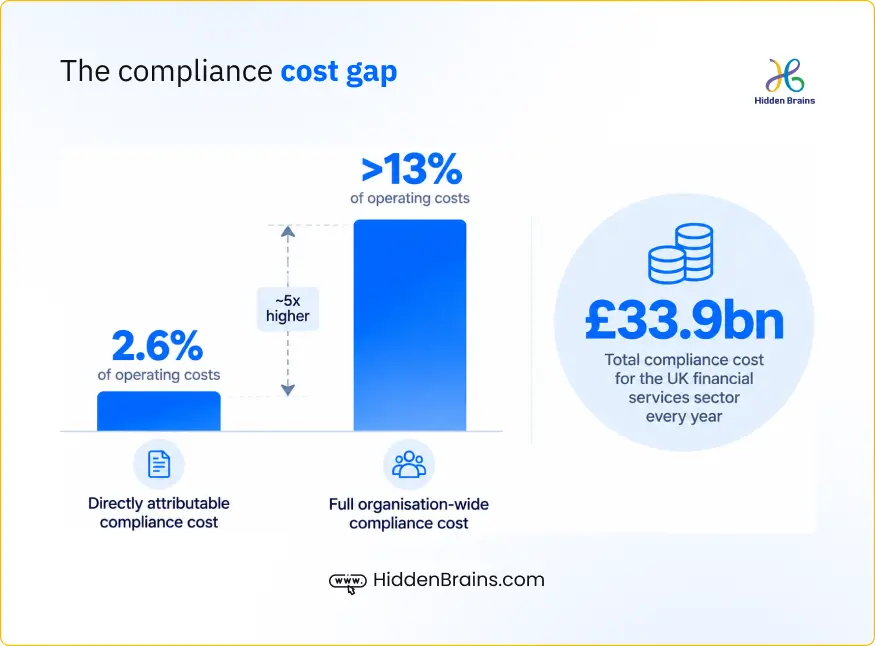
New research from TheCityUK and PwC UK estimates that regulatory compliance now costs UK financial services firms more than £33.9 billion a year, over 13% of a firm’s average operating costs, and 84% of firms surveyed said that cost had increased over the past five years.
The instinct is to buy another compliance tool. Often the better question is different: which processes are actually slow, why are they slow, and where does connecting your existing systems remove more risk and cost than adding one more platform.
The instinct is often to buy another compliance tool. But the better question is: which processes are actually slowing you down, why are they slow, and where can a finance software development company connect your existing systems to close those gaps? By integrating the systems you already rely on, you can reduce manual work, compliance risks, and operational costs, without adding yet another platform to manage.
This article looks at what enterprises across UK banking, lending, wealth, and fintech are genuinely automating, where custom software earns its place over off-the-shelf RegTech, what a sound architecture looks like, and how to sequence the work.
What is Financial Services Automation?
Financial services automation is the use of software to carry out compliance and operational tasks that people currently do by hand, such as collecting and validating data, running checks, routing approvals, generating regulatory reports, and capturing audit evidence, so that specialist staff spend their time on judgement rather than assembly.
It is not one product, and it is not only compliance. In most firms it spans two connected problems. The first is regulatory: proving to the FCA, the PRA, and now the courts that controls exist and work. The second is operational: onboarding clients, reconciling transactions, investigating exceptions, and reporting, all of which get slower and more error-prone as a firm grows and as systems multiply, a challenge we explore further in our guide to software development for fintech.
Automation done well addresses both, because the same fragmented data usually sits behind both problems.
Why Has UK Finance Hit an Automation Tipping Point?
Three forces have converged, and together they have changed automation from optional to structural.
Cost has become strategic, not operational. The £33.9 billion figure is the headline, but the more useful detail from TheCityUK and PwC research is the gap between measured and real cost. Directly attributable compliance costs sit at around 2.6% of operating costs, yet the full, organisation-wide cost is more than four times higher, at over 13%.
Firms that budget only for the compliance function are planning against a fraction of their true exposure. Automation targets the hidden portion: the hours that operations, technology, and front-line teams spend feeding the compliance machine.
Regulation now expects evidence, not intent. Under the Economic Crime and Corporate Transparency Act 2023, the failure-to-prevent-fraud offence came into force on 1 September 2025. It is a strict-liability corporate offence for large organisations, and the only defence is having had reasonable fraud-prevention procedures in place at the time. That word, reasonable, is doing a lot of work.
In practice, a firm has to be able to show what its controls were, when they ran, who approved exceptions, and what evidence exists. Policies in a document are no longer enough. Controls have to live in systems that record what happened.
Operational resilience is now a hard requirement. Since 31 March 2025, firms in scope of the FCA and PRA operational resilience rules (PS21/3 and SS1/21) must be able to remain within defined impact tolerances for their important business services during severe but plausible disruption, and must evidence this through mapping, scenario testing, and self-assessment.
Incident capture and impact tracking stop being an IT nicety and become a supervised obligation, with further operational-incident and critical-third-party reporting rules on the way.
Add the FCA’s Consumer Duty expectations on customer journeys and the steady tempo of regulatory reporting through RegData, and the pattern is clear. The regulator is not only asking finance firms to comply. It is asking them to demonstrate compliance continuously, and that is a data and systems problem before it is a policy problem.
What UK Finance Enterprises are Actually Automating
The most productive automation programmes in UK finance are not chasing a single flagship use case. They target a handful of high-effort, high-risk processes where the work is repetitive but the stakes are real. Six areas come up again and again, and in each one the value of custom software development services is less about the task itself and more about connecting it to everything around it.
| Area | What can be automated | Where custom software adds value |
|---|---|---|
| Customer onboarding | KYC checks, document collection, verification, approvals | Connecting KYC, CRM, risk, and onboarding workflows into one journey |
| AML and financial crime | Screening, alerts, investigation routing | Firm-specific risk scoring, escalation, and investigation workflows |
| Regulatory reporting | Data collection, validation, report preparation | Consolidating data from fragmented internal systems into one submission |
| Fraud prevention | Monitoring, controls, evidence collection | Mapping controls and evidence to your organisation’s specific fraud risks |
| Operational resilience | Incident capture, escalation, impact tracking | Linking services, dependencies, incidents, and regulatory reporting |
| Reconciliation and operations | Matching, exception identification, approvals | Automating rules unique to your products, counterparties, and legacy systems |
A few of these deserve a closer look, because each maps to a live UK obligation rather than a generic efficiency claim.
Customer onboarding is where cost of acquisition and regulatory risk meet. Automating KYC document capture and verification is standard. The harder, more valuable work is joining that verified data to your CRM, your risk engine, and your approval chain so that a client is onboarded once, cleanly, against your obligations under the Money Laundering Regulations 2017 and the FCA’s expectations on fair customer journeys. Off-the-shelf KYC tools do the check. Connecting the check to the rest of the business is usually custom.
Regulatory reporting is the clearest example of hidden cost. In many firms, every submission through RegData becomes a fresh data-collection exercise, with analysts pulling figures from systems that do not agree with each other. Automating the report template is the easy part. The value is in consolidating and validating data from fragmented sources so the submission is right the first time and defensible afterwards.
Fraud prevention now sits directly under the ECCTA failure-to-prevent-fraud offence. Monitoring and controls can be automated, but the point that matters for the reasonable-procedures defence is evidence collection. A firm needs to show that controls were mapped to its actual fraud risks and that the evidence was captured as the work happened, not reconstructed later. That mapping is organisation-specific by definition, which is exactly where a standard product struggles and a tailored system fits.
Operational resilience ties incident capture to your important business services, their dependencies, and your regulatory reporting obligations. This is connective work across systems that a single tool rarely owns end-to-end.
Custom Software vs Off-the-Shelf RegTech: How to Decide
Neither option is universally right. Off-the-shelf RegTech is faster to deploy, cheaper up front, and maintained by a vendor. Custom software fits your processes exactly, connects to your systems, and puts you in control of your own business rules. The decision comes down to how much of your compliance and operational reality a standard product can actually absorb.
| Consideration | Off-the-shelf RegTech | Custom software |
|---|---|---|
| Time to first value | Faster | Slower initially |
| Upfront cost | Lower | Higher |
| Fit to your workflows | Good for standard processes | Built to your exact processes |
| Integration with legacy core systems | Limited or add-on | Designed in from the start |
| Control over business rules | Vendor roadmap | Yours |
| Total cost of ownership at scale | Rises with seats, add-ons, and workarounds | Higher build, lower ongoing friction |
| Audit evidence and data residency | Vendor-defined | Owned and configurable |
The honest summary: if your processes are standard, your data is reasonably clean, and you are happy to adapt to a product, off-the-shelf RegTech is often the right call, and forcing a custom build would be a waste. Custom software earns its place when the workarounds start to outnumber the wins. The next section is the practical test for that.
When Should You Build Custom Financial Software?
Custom development probably makes sense if you recognise your firm in several of these signals. One on its own rarely justifies a build. Three or four together usually do.
- Compliance spans multiple systems. Teams continually move information between platforms to complete a single check or report.
- Your workflows do not fit standard RegTech. You are building spreadsheets and workarounds around the tool you already bought.
- Reporting consumes significant manual effort. Every submission becomes a data-collection exercise rather than a press of a button.
- Exceptions dominate operations. The happy path is automated, but the complex cases, which are where the risk lives, remain manual.
- Audit evidence is reconstructed later. Evidence is assembled after the fact instead of captured within the workflow as it runs.
- Legacy systems cannot simply be replaced. Core banking or policy-administration systems have to keep running, but they need to participate in modern digital workflows.
- You need control over business rules. You want to change a rule when the regulation or the product changes, rather than wait for a SaaS provider’s roadmap.
If several of these are true, the question stops being whether to build and becomes how to build it well. That decision also involves choosing a delivery model- whether an in-house team, a partner, or a mix- a trade-off we cover in our guide to fintech development outsourcing, ideally with a partner that has delivered regulated software in the UK before.
Turn UK Compliance Into Connected Workflows.
Talk to Our Experts
The Technology Architecture of a Custom Compliance Platform
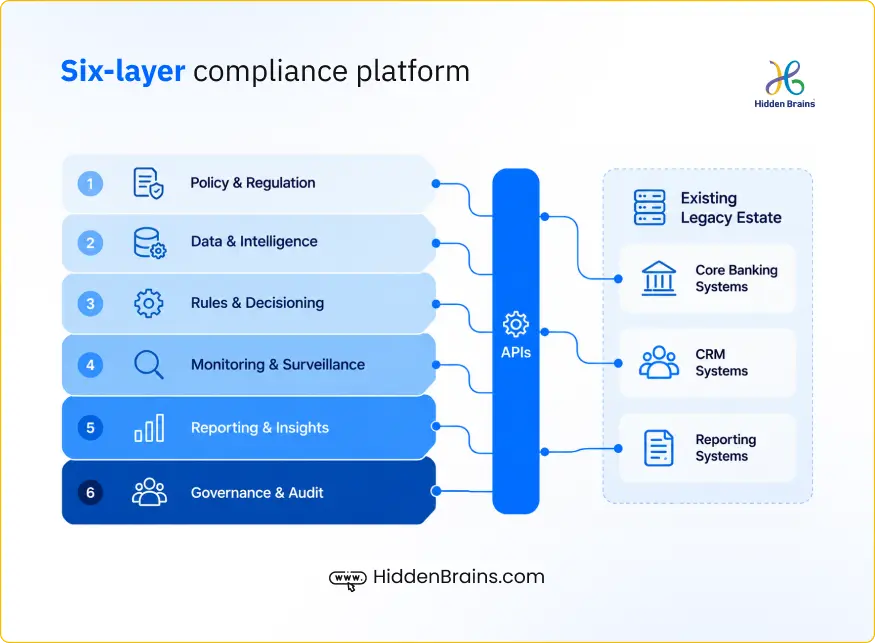
A robust custom compliance platform generally includes six layers. Understanding them helps a buyer ask better questions of any partner, and it explains why integration, not a single application, is the real deliverable.
| Layer | Purpose |
|---|---|
| Data integration | Connects core banking, CRM, payments, ERP, identity, and reporting systems |
| Data normalisation | Standardises customer, transaction, account, and reference data |
| Rules engine | Applies AML, KYC, sanctions, risk, and internal policy rules |
| AI and analytics | Supports document extraction, anomaly detection, classification, and prioritisation |
| Workflow orchestration | Routes tasks, approvals, alerts, exceptions, and escalations |
| Governance and audit | Records access, model decisions, evidence, changes, approvals, and retention |
The governance and audit layer is not the least glamorous layer. It is the one that makes the whole system defensible. It is precisely what the ECCTA reasonable-procedures defence, and the FCA operational resilience self-assessment require you to produce on demand: who did what, when, under which rule, with what evidence, retained for how long. Design it in from the start, and it is an asset. Bolt it on afterwards, and it becomes the reason an audit takes weeks.
APIs are central to this architecture. They let the compliance platform exchange data with your existing systems without forcing the enterprise to replace every legacy application at once. This is the practical answer to the most common objection in UK finance, which is that core banking cannot simply be switched off.
A well-designed platform uses software integration so that legacy systems participate in modern workflows, and it allows legacy software modernisation to happen incrementally, layer by layer, rather than as a single high-risk replacement.
How AI Improves Compliance Workflows
AI improves compliance workflows mainly by reducing the manual effort of gathering, reading, and sorting information, so specialists spend their time on judgement rather than assembly. It is best understood as the analytics layer inside the architecture above, added after deterministic automation is working and always with governance around it, not as a replacement for the controls themselves.
| Where AI helps | What it actually does | The human still owns |
|---|---|---|
| Document extraction | Reads KYC documents, contracts, and statements; pulls structured data | Confirming identity and accepting the customer |
| Anomaly and pattern detection | Flags unusual transactions or behaviour for review | Deciding whether activity is genuinely suspicious |
| Alert prioritisation | Ranks alerts by risk so teams work the highest first | Investigating and clearing or escalating each case |
| Classification and routing | Sorts cases, queries, and reports to the right team | Handling the case and the regulatory response |
| Summarisation | Drafts case summaries and pulls related evidence together | Reviewing, signing off, and reporting |
| Investigation assistance | Assembles related transactions, entities, and history | Reaching and defending the conclusion |
The value of AI here is well illustrated by predictive analytics in fintech, where models surface risk earlier than manual review can. In UK finance, though, unexplained AI inside a compliance decision is itself a compliance problem.
Any use of AI needs model transparency, explainability, logging of AI outputs, and a human in the loop, all recorded in the governance and audit layer so that an AI-assisted decision can be defended to the FCA.
It also needs an honest view of the risks AI introduces: false confidence in a wrong answer, model drift as conditions change, and opacity that makes a decision hard to explain. Used with those guardrails, AI integration removes drudgery and surfaces risk. Used without them, it creates a new one.

Turn Manual Compliance into Automated, Controlled Workflows.
Talk to UsA Practical Financial Services Automation Roadmap
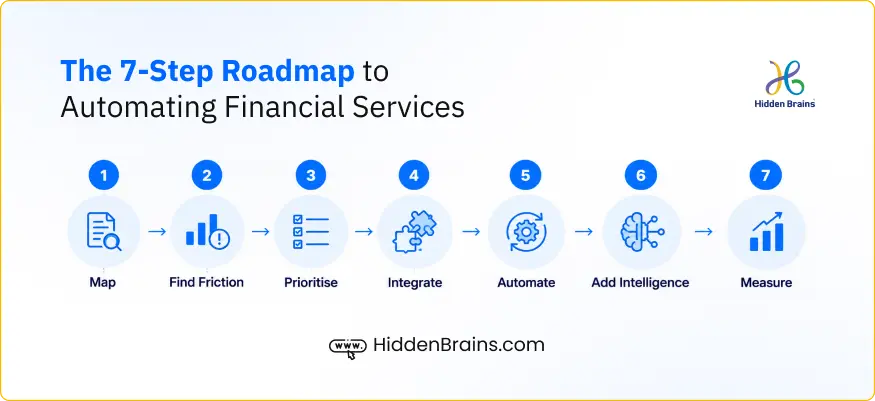
Rather than buying technology and looking for a use, sequence the work. This seven-phase roadmap keeps a programme disciplined and, importantly, produces evidence at each step.
- Phase 1: Map. Map each process across six dimensions: process, system, data, control, owner, evidence. This mirrors what ECCTA and the operational resilience rules already ask you to be able to show, so the mapping is useful twice.
- Phase 2: Find friction. Look for duplicate data entry, spreadsheets doing critical work, repetitive reconciliation, manual reporting preparation, approval chasing, disconnected audit evidence, and high exception volumes. These are the symptoms worth automating.
- Phase 3: Prioritise. Start where three things intersect: high manual effort, regulatory importance, and measurable business impact. Anything with all three is a strong first candidate. Anything with only one can usually wait.
- Phase 4: Integrate. Connect existing systems before replacing them. Most early value comes from making current systems talk to each other, not from ripping them out.
- Phase 5: Automate. The best starting point is often the simplest: automate processes with stable rules and predictable outcomes before moving to more complex workflows.
- Phase 6: Add intelligence. Introduce AI where classification, anomaly detection, summarisation, or investigation assistance creates value, with governance surrounding it, and only once the deterministic layer is solid.
- Phase 7: Measure. Track processing time, exception rate, manual touches, compliance preparation hours, reconciliation effort, reporting errors, time to investigate, and cost per transaction or case. Without measurement, you cannot prove the programme worked or defend the next investment.
How Hidden Brains Helps
At Hidden Brains, work on financial services technology usually begins before any tool is chosen. The first step is understanding where processes, systems, data, and evidence are breaking down, and which of the six areas above carry the most regulatory and operational risk for your firm. From there, the work is connecting systems, building the rules and workflows that fit your business, and designing the governance and audit layer that makes the whole thing defensible.
This is not abstract for our team. Over a five-year engagement, including more than two years with a 15-person team working onsite, Hidden Brains built and elevated the credit-scoring and risk-management platform for a leading national credit bureau. The building blocks that a UK compliance programme depends on, namely data integration, entity resolution, risk scoring, and governed workflows, sit at the centre of that work. At national scale, the platform covers:
- 40 million+ credit scores
- Legal Entity Identifier (LEI) coverage across 17 countries
- Benchmarking across 700 financial institutions
- 17 mortgage benchmarks
As a CMMI Level 3, ISO/IEC 27001:2022 and ISO 9001:2015 certified engineering partner, Hidden Brains treats data security, auditability, and delivery governance as design requirements in regulated software, not as afterthoughts. For UK firms weighing a build, the most useful next step is a short review of where automation would remove the most cost and risk first.
Frequently Asked Questions
Will automation actually reduce our compliance costs, or just move them into IT?
It reduces them if you target the right work. The largest saving is not the compliance team’s line item; it is the hidden effort across operations, front office, and technology that feeds compliance, which TheCityUK and PwC research puts at over four times the directly attributable cost. Automating data collection, reconciliation, and reporting preparation removes that hidden load. It does add a build and maintenance cost, so the honest measure is total cost of ownership over three to five years, not the first invoice.
How do we decide between buying RegTech and building custom without over-spending?
Buy off-the-shelf when your processes are standard, your data is reasonably clean, and you can adapt to the product. Build custom when compliance spans several systems, your workflows do not fit a standard tool, reporting still takes heavy manual effort, or legacy core banking has to participate rather than be replaced. If you count three or more of those, a build usually pays back. If you count one, forcing a custom project is a waste.
What is the real cost of doing nothing while regulation tightens?
It is rising on two fronts. Compliance cost is climbing for 84% of UK firms, and the regulatory downside has changed shape: since 1 September 2025, the ECCTA failure-to-prevent-fraud offence carries strict liability and unlimited fines, with the only defence being reasonable procedures you can evidence. Manual, spreadsheet-based controls make that defence harder to prove, so inaction is now a measurable risk, not a neutral choice.
How long before we see a return, and how do we prove it to the board?
Sequence the work so value arrives early: connect existing systems and automate one high-effort, high-risk process first, rather than attempting everything at once. Then track a small set of before-and-after measures the board understands, such as compliance preparation hours, reporting errors, exception rates, time to investigate, and cost per case. Those numbers are also what justify the next phase of investment.
We cannot replace our core banking system. Can we still automate?
Yes, and this is the most common starting point. A well-designed platform connects to core banking, CRM, and reporting systems through APIs, so legacy applications keep running while modern workflows sit on top. Modernisation then happens incrementally, layer by layer, rather than as a single high-risk replacement that most boards would never approve.
Who is accountable if an automated control or an AI model gets it wrong?
The named individual under the Senior Managers and Certification Regime, not the software. Automation and AI can prepare, prioritise, and evidence decisions, but accountability for material compliance judgements stays human. That is why the governance and audit layer matters commercially as well as technically: it records who decided what, when, and on what evidence, which is exactly what protects the firm and the individual under scrutiny.
What is the biggest reason these projects fail, and how do we avoid it?
Automating a broken or poorly understood process, which just makes the problem run faster. Avoid it by mapping each process end to end (process, system, data, control, owner, evidence) before writing any code, automating deterministic steps first, and adding AI only once that foundation is stable. Skipping the mapping phase is the most expensive shortcut in this kind of programme.
How do we choose an implementation partner for regulated financial software?
Look for evidence of three things: delivery at regulatory scale, security and quality governance built in rather than bolted on, and a build-first-understand approach rather than a rush to sell a platform. Ask for named accountability, certifications that matter for data handling such as ISO 27001, and a track record in regulated environments, not just general software delivery.



Conclusion
The goal is not to automate more. It is to automate the right processes in the right order. As UK regulation places greater emphasis on evidencing controls, ownership, and decisions, financial services automation is becoming as much about operational defensibility as efficiency.
Off-the-shelf RegTech will remain the right choice for many standard workflows. But when compliance spans multiple systems, legacy platforms must stay, and evidence is still assembled manually, custom software can provide greater control, integration, and auditability.
Start with the process creating the most operational cost and regulatory risk. Connect what already works, automate deterministic tasks first, and add AI only where the foundation and governance are ready. Not sure where to start? Get a free 2-hour consultation with our financial software experts to identify the right automation opportunities for your business.
